

Iconic furniture design describes chairs, tables, and objects that survived not because they were beautiful but because they solved a problem nobody else had named — the slum of legs, the cost of plywood, the argument against ornament. This hub examines what those arguments were, and what they still mean for the furniture you choose today.
If you want the chair histories, reproductions, reviews, and buying guides that branch out from this argument, use the Iconic Furniture Design hub.
What makes a chair a position rather than just a seat
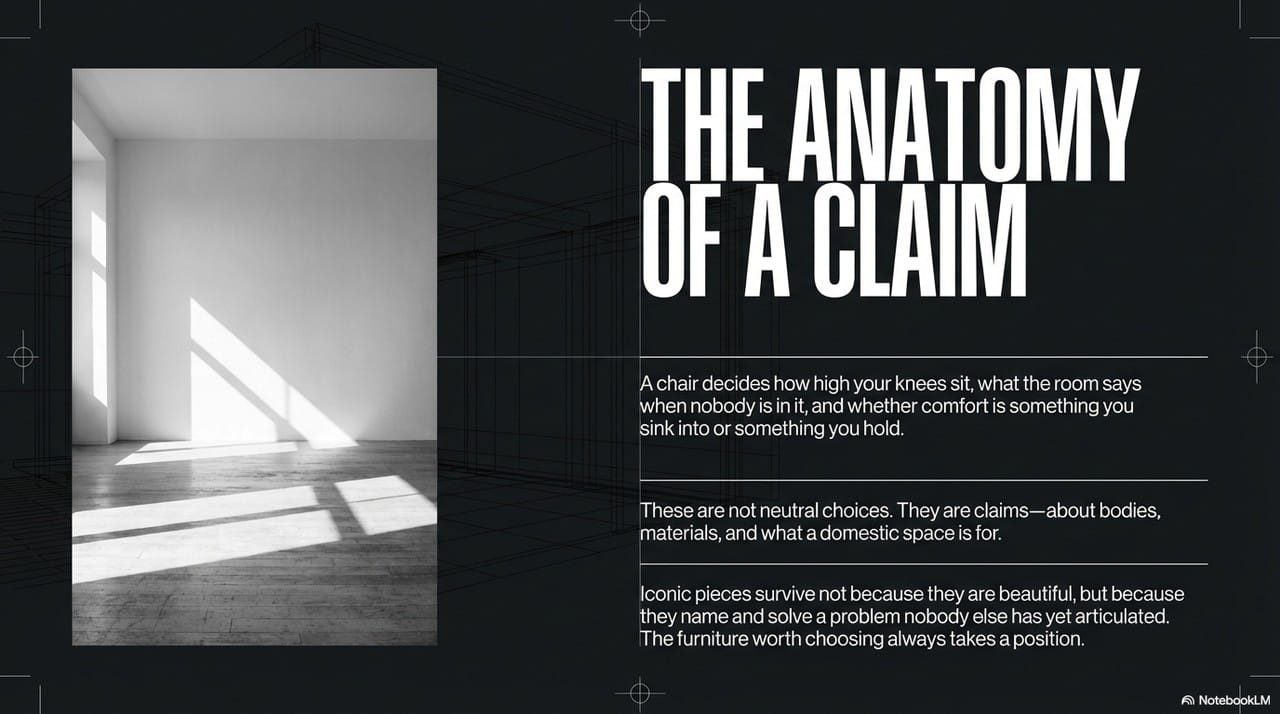
Every piece of furniture takes a position. A chair decides how high your knees sit, what the room says when nobody is in it, and whether comfort is something you sink into or something you hold. These are not neutral choices. They are claims — about bodies, materials, and what a domestic space is for.
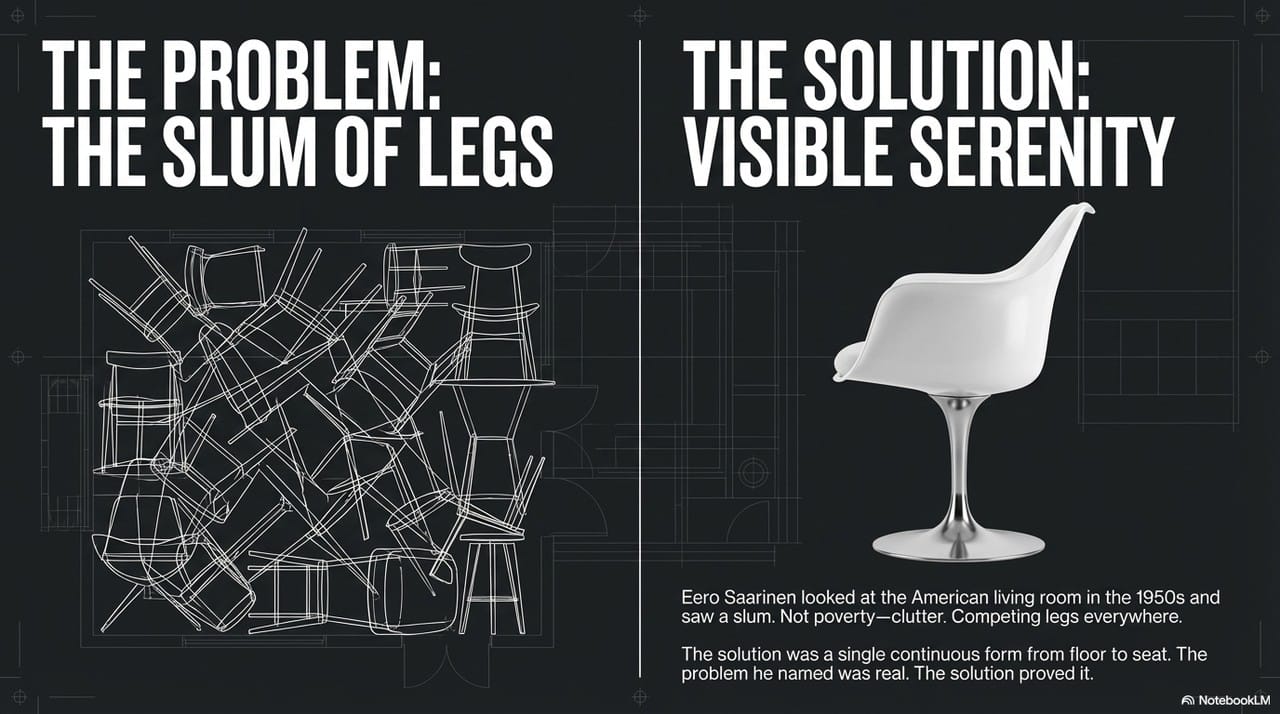
The furniture that has lasted — still in production seventy years later, copied so often the copies have copies — lasted because it named a problem nobody else had articulated. Eero Saarinen looked at the American living room in the 1950s and saw a slum. Not poverty. Clutter. Competing legs everywhere: chair legs, table legs, sofa legs, all fighting for the same floor. His solution was the Pedestal Collection (1956, Knoll): a single continuous form from floor to seat, one aluminum base where four wooden legs would have been. He wanted to achieve, in his own words, “visible serenity of clear plastic”, though the base ended up aluminum because plastic couldn’t carry the structural load. The problem he named was real. The solution proved it.
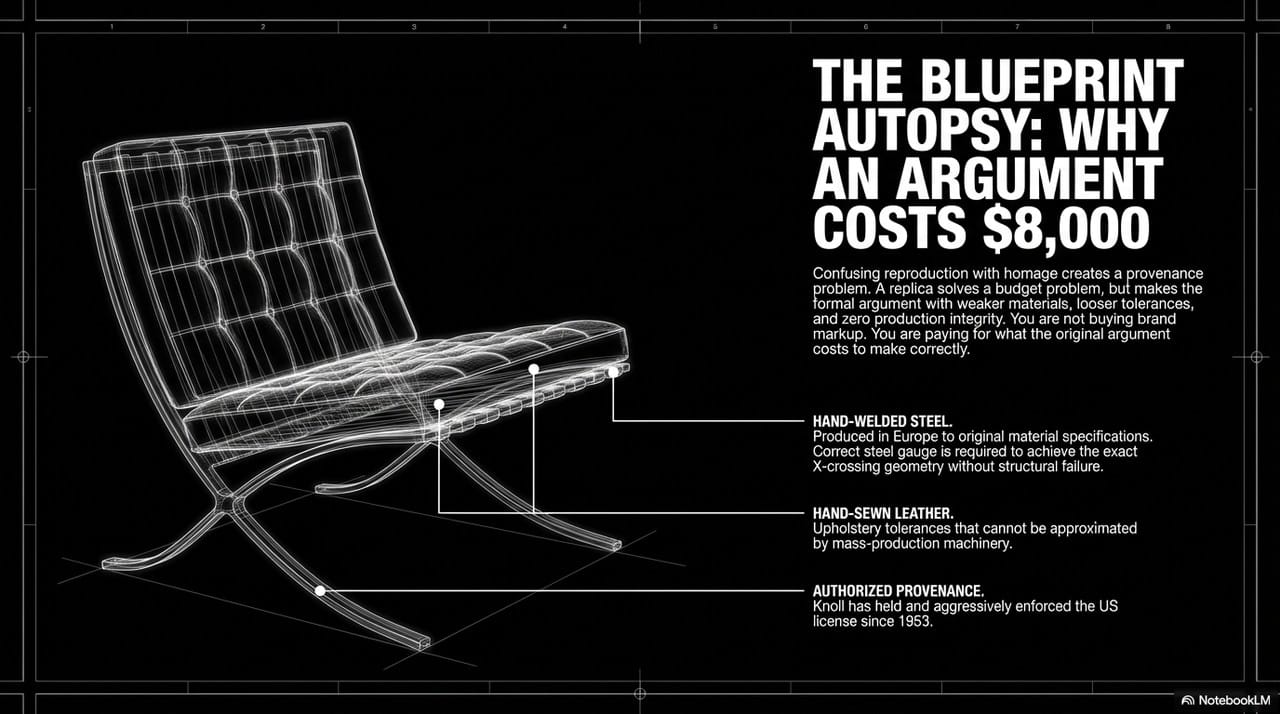
That is what the furniture worth choosing actually does. Ludwig Mies van der Rohe and Lilly Reich designed the Barcelona Chair in 1929 for a room with no functional purpose. The German Pavilion at the International Exposition in Barcelona was a national architectural statement, not a space for sitting. The chair was added because the king of Spain needed somewhere to sit at the opening ceremony. But the chair’s argument outlasted the pavilion by nearly a century: two X-crossing bands of chromed flat steel, loose leather cushions, no structural necessity that the form didn’t earn. It is still in production. It gets copied constantly. The argument was that right.
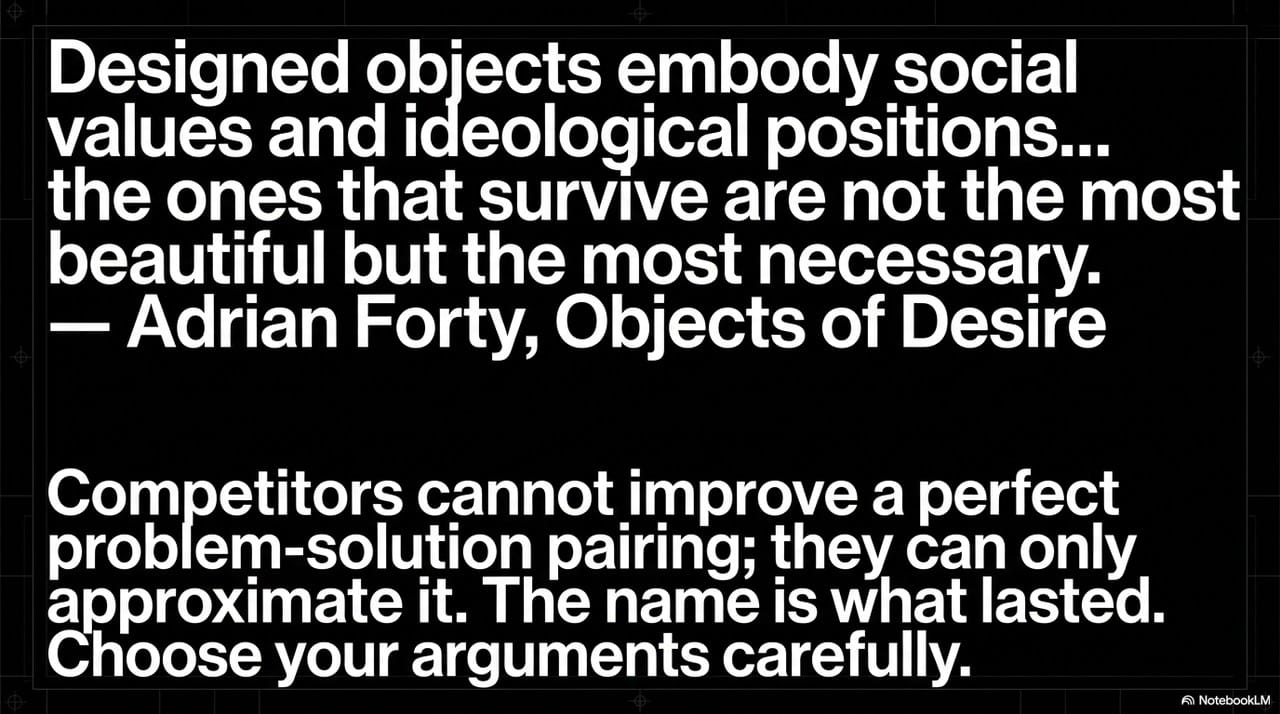
Adrian Forty’s Objects of Desire: Design and Society Since 1750 (Thames & Hudson, 1986) is the clearest account of why this happens: how designed objects embody social values and ideological positions, and why the ones that survive are not the most beautiful but the most necessary. It belongs on the shelf of anyone who wants to understand what they are actually buying when they buy a designed piece. Find it here: Adrian Forty, Objects of Desire. For the visual survey that pairs with it — specific pieces, dates, and production histories from Art Nouveau through postmodern — see Sembach, Leuthäuser, and Gössel, Twentieth-Century Furniture Design (Taschen).
The broader design argument — the one that runs from these chairs through the design legends who created them and the design brands that carried their ideas into the market — starts here. Iconic furniture is where the argument becomes an object you can sit in.
The specific arguments behind the furniture that survived, room by room
The argument a piece of furniture makes is always specific to the room it’s in. A chair that solves the dining room problem fails in the office. A stool that works in a 400-square-foot apartment makes no claim at all in a loft. Here is what each surviving piece was actually arguing, room by room, and what that means for the choices you’re making now.
The sitting room: where the lounge chair became a design argument
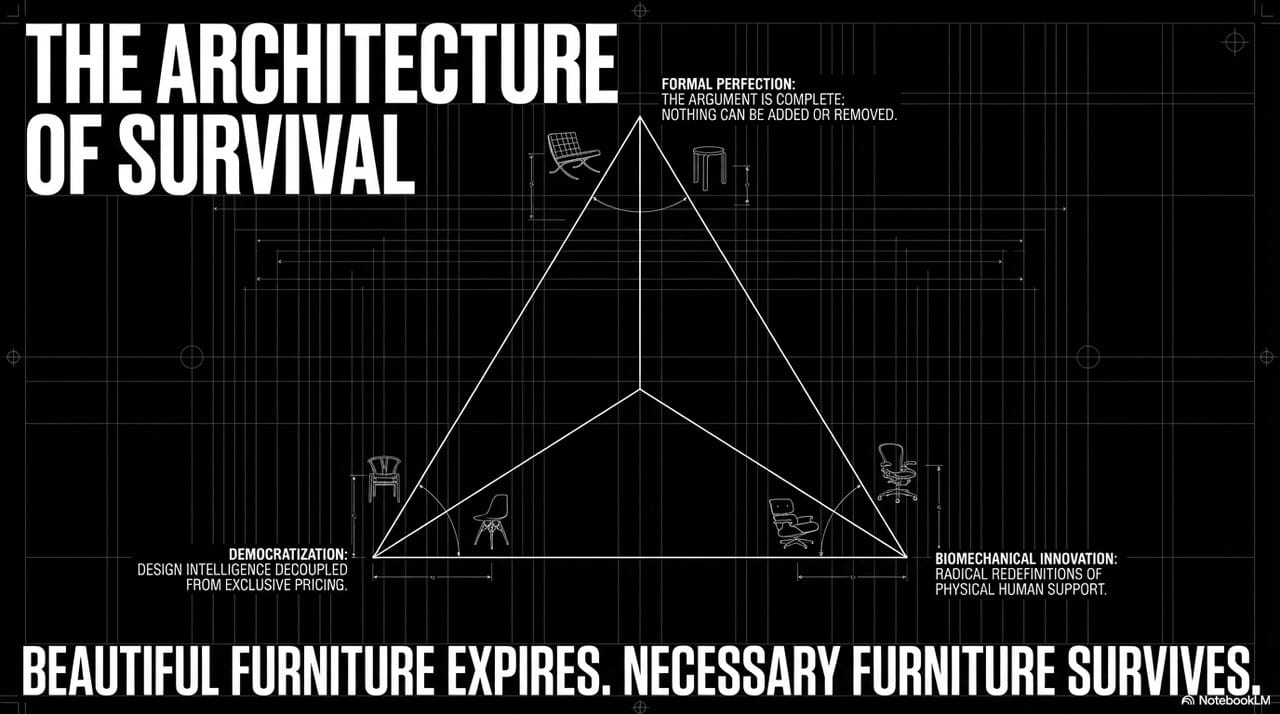
The lounge chair is the most theorized furniture type in the design canon because it forces a single condensed question: what does rest look like? The Eames Lounge Chair (model 670, 1956, Charles and Ray Eames for Herman Miller) answered it with a phrase before it answered it with a form. Charles Eames described the design goal as “a warm receptive shell of a well-used first baseman’s mitt” — a brief that named a feeling that did not yet exist in mass-produced furniture. Molded plywood shells, leather upholstery, down-filled cushions: the form followed the feeling he had already described.
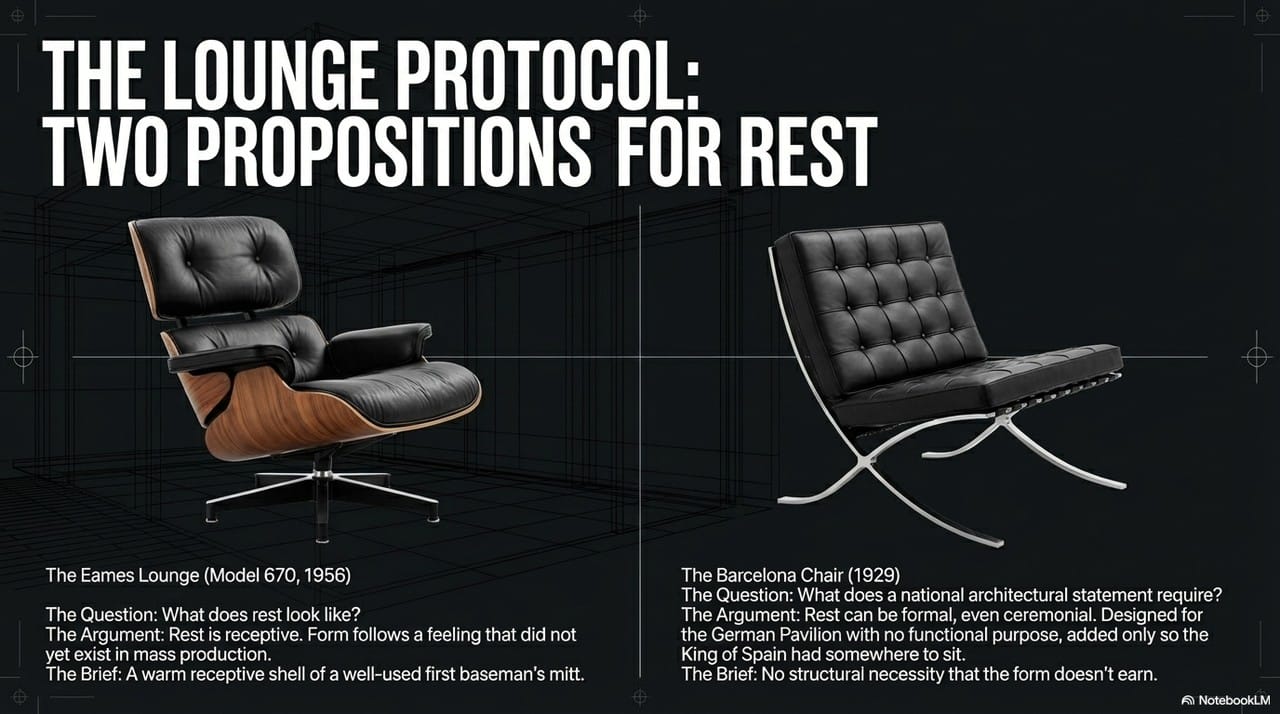
The Barcelona Chair, see our full ADI profile, made a different claim in the same room: that rest could be formal, even ceremonial. Two positions on the same question. The chair you choose takes one of them. For the full Eames design philosophy — the arguments behind both the LCW and the Lounge Chair — see our profile on Charles and Ray Eames.
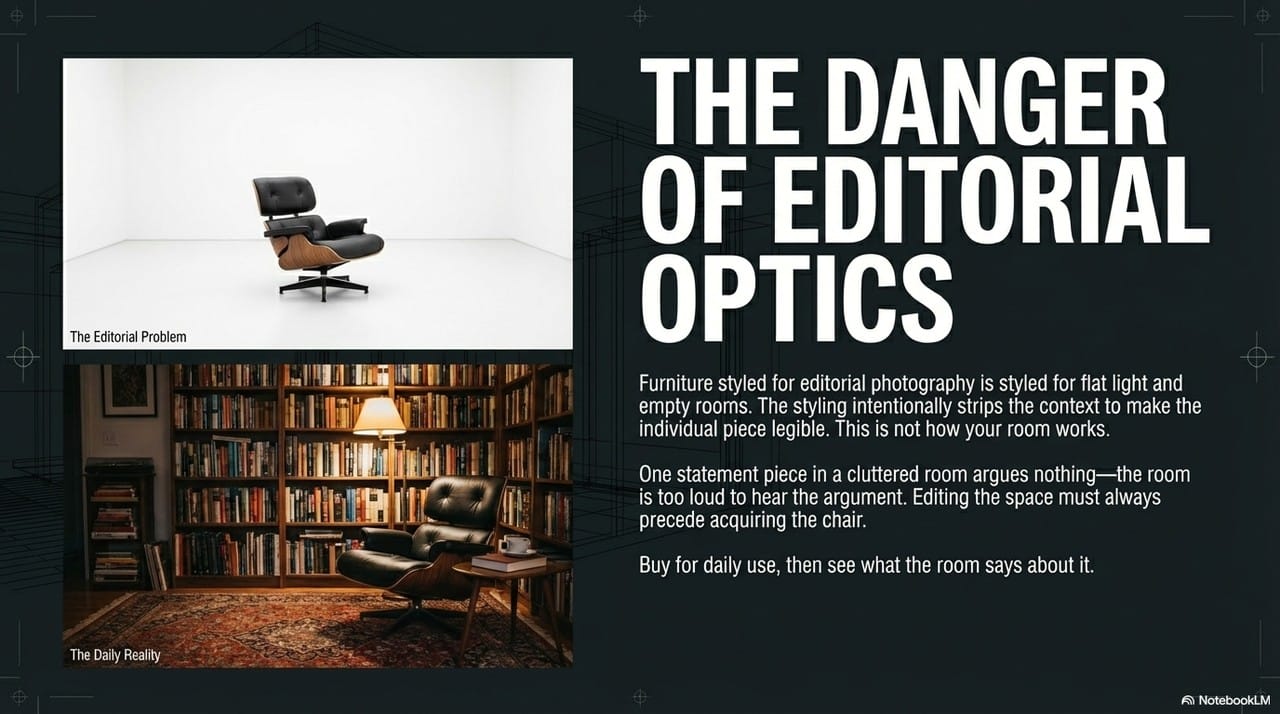
If you are choosing a lounge chair now, you are working within this tradition whether you know it or not. The relevant category — mid-century lounge chairs across price points from manufacturer originals to well-made alternatives — starts here: mid-century modern lounge chairs. See also our guide to the best designer lounge chairs for a ranked breakdown.
The dining room: where the chair multiplied and had to work unoccupied
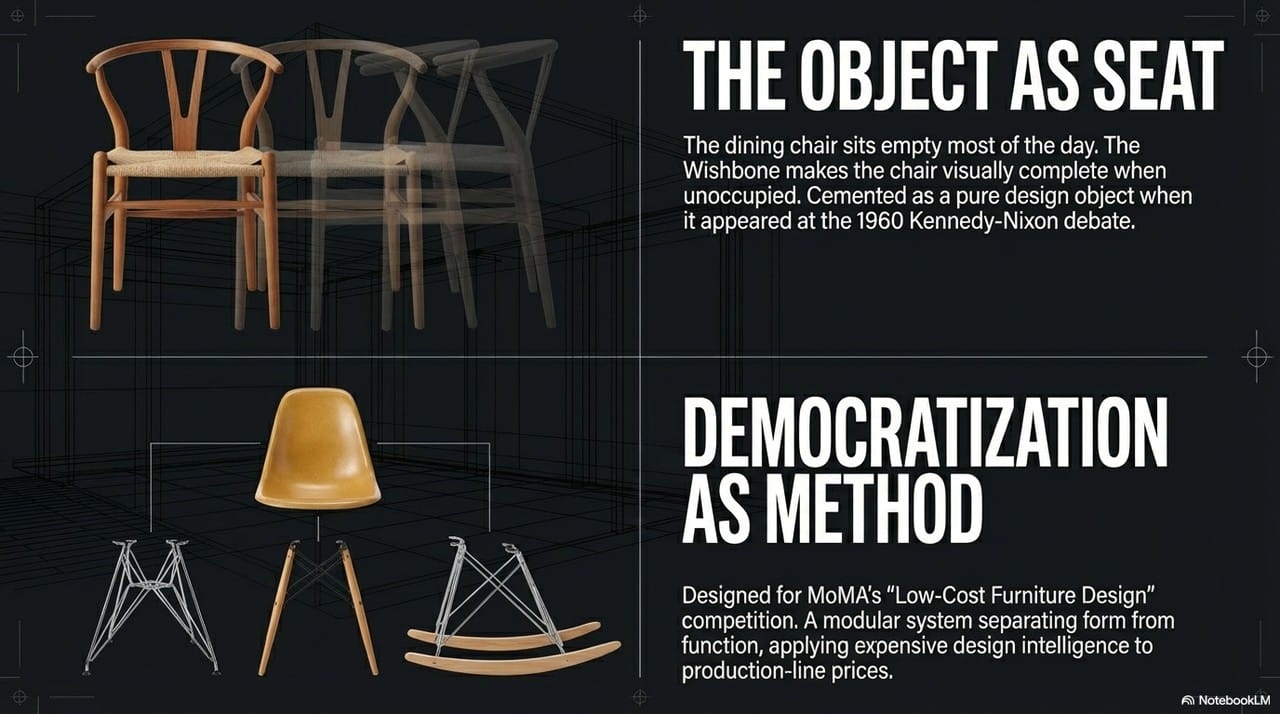
The dining chair is the most democratic furniture problem. You need several. They must cohere — either matching, or arguing productively against each other. And they sit empty most of the day, which means they must be as much object as seat.
Hans Wegner’s Wishbone Chair (CH24, 1949, Carl Hansen & Søn) solved this by making the chair visually complete when unoccupied: steam-bent beech frame, paper cord woven seat, a silhouette that reads as furniture even across a room. The chair acquired the nickname “The Chair” after appearing at the 1960 Kennedy-Nixon presidential debate — the American press fixated on it as a design object, not a prop. Wegner designed approximately 500 chairs in his lifetime. This one is still in production. Hans Wegner’s work sits at the center of this canon — with over 500 chair designs and continuous production of the Wishbone and Shell chairs, his output spans nearly every register of the seating question.
The DSW chair (Charles and Ray Eames, 1950, Herman Miller/Vitra) made a different argument: that the same design intelligence as expensive furniture could arrive at production-line price. It entered MoMA’s “Low-Cost Furniture Design” competition with a single fiberglass shell mountable on multiple bases: Eiffel tower wire, wood legs, rocker. A modular system that separated form from function. Democratization as design method. For the Bauhaus tradition that preceded this kind of democratic production thinking, see our guide to Bauhaus design ideas — the movement that established the premise Eames was extending.
For the dining chair category today — from Saarinen-influenced pedestal forms to modern interpretations of the Wegner problem — this search covers the range: tulip-style pedestal dining chairs. Our guide to the best modern dining chairs ranks them by use case. Alongside Eames, Jacobsen, and Saarinen, Vico Magistretti’s Italian rationalism gives the canon its Milanese voice — the argument that mass production is a domestic ethics, not just a manufacturing method.
Knoll’s postwar catalogue carried more of this canon than any other manufacturer, including Saarinen’s Womb chair and Pedestal collection.
The workspace: where ergonomics finally became a design problem
The office chair was the last furniture type to develop a real design canon. Most chairs before Herman Miller’s Aeron (1994, Bill Stumpf and Don Chadwick) were either ergonomic without being designed, or designed without being ergonomic. The Aeron named the actual problem: sitting for eight hours is not the same biomechanical problem as sitting for an hour. Different load, different support requirements, different argument. It broke with upholstered convention by using an 8Z Pellicle mesh suspension fabric — differential support across the sitting surface rather than uniform padding. Time magazine named it design of the decade.
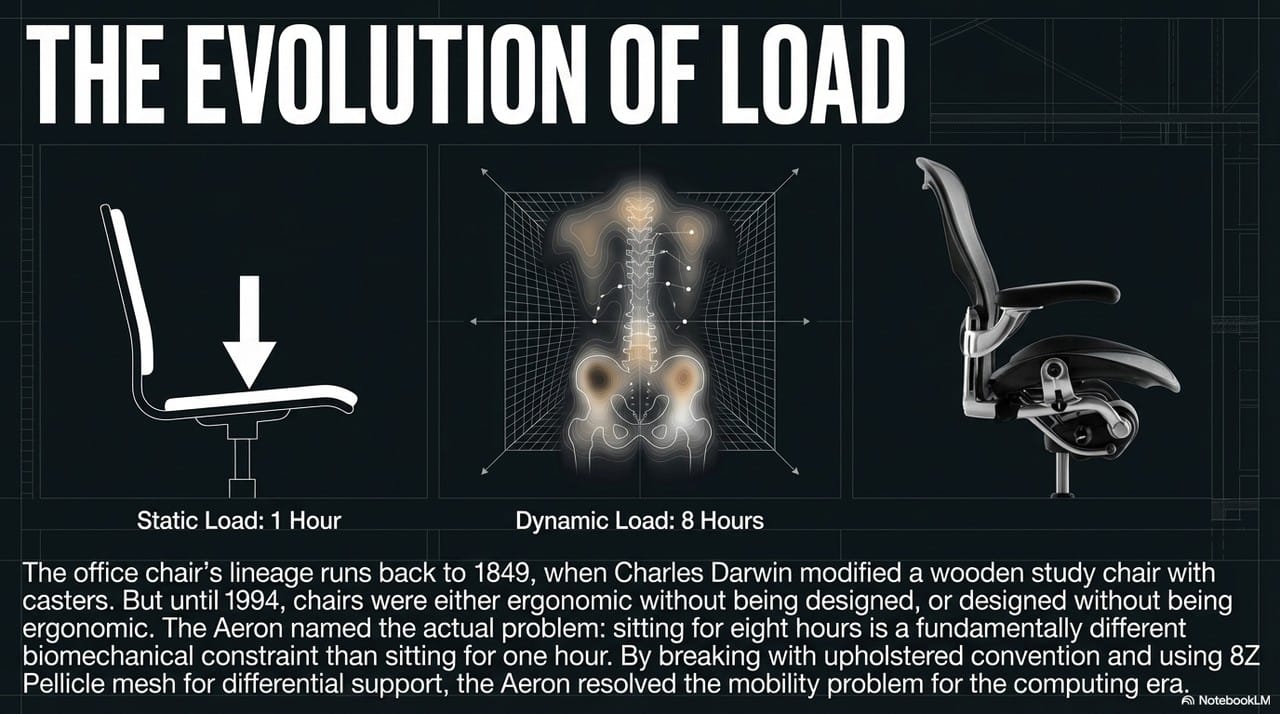
Before the Aeron, the office chair’s lineage ran back to the swivel chair, attributed (with some dispute in the record) to modifications Charles Darwin made to a wooden chair with casters for his study around 1849. The problem of mobility within a workspace has always been a chair problem. The Aeron resolved it for the computing era.
For the distinction between a lounge chair and an office chair as design objects, see our comparison: lounge chair vs. office chair. For ranked picks in the office category: the best modern office chairs.
The small space: where constraints produced the clearest design thinking
Furniture for small spaces does not mean small furniture. It means furniture that makes an unambiguous argument about what a room is for. The problem is editing, not scaling.
Alvar Aalto’s Stool 60 (1933, Artek) demonstrated this without making a case study of it. Three bent birch legs, circular birch seat, stackable. It works as a seat, a side table, or a plant stand. One form, multiple arguments, nothing sacrificed. The L-leg joint Aalto patented bent solid birch without metal hardware — a manufacturing problem nobody had solved before him. The stool is still in production. It has been copied more widely than almost any other stool in furniture history. For the broader Scandinavian tradition Aalto helped define, see our guide to Scandinavian design history. For how Philippe Starck extended this kind of democratic material thinking into polycarbonate and mass production, see our profile of Philippe Starck.
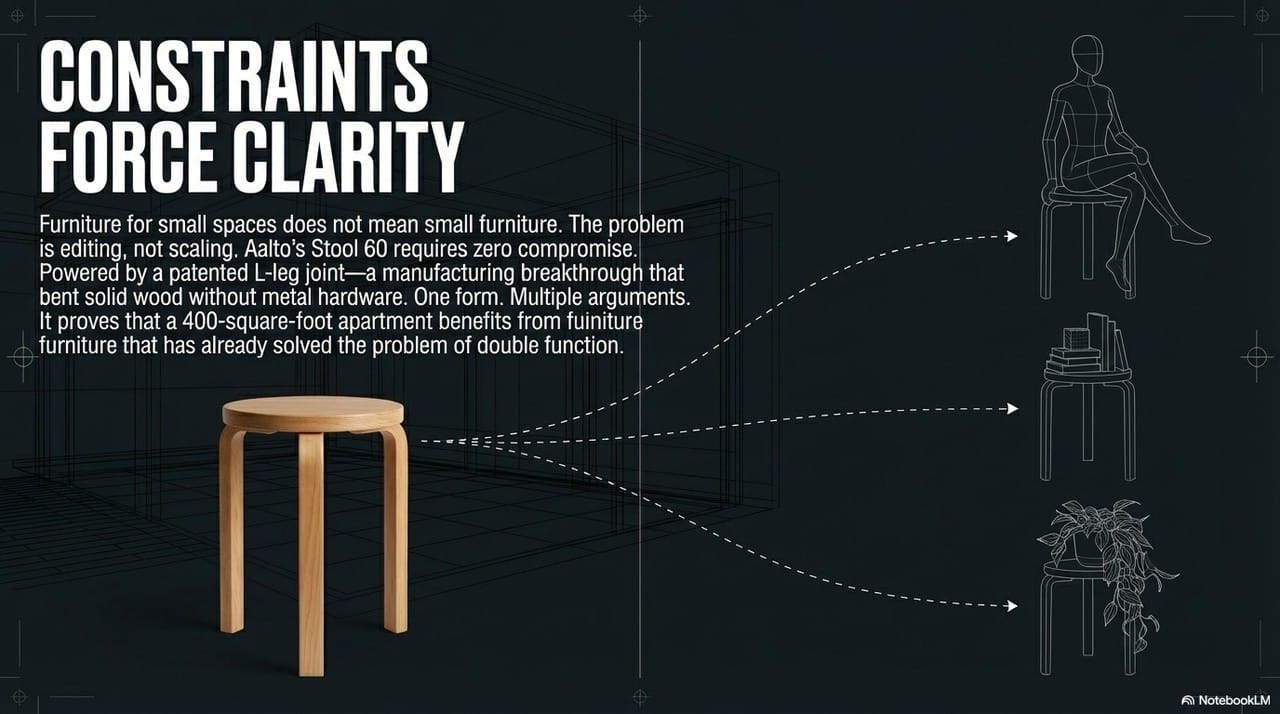
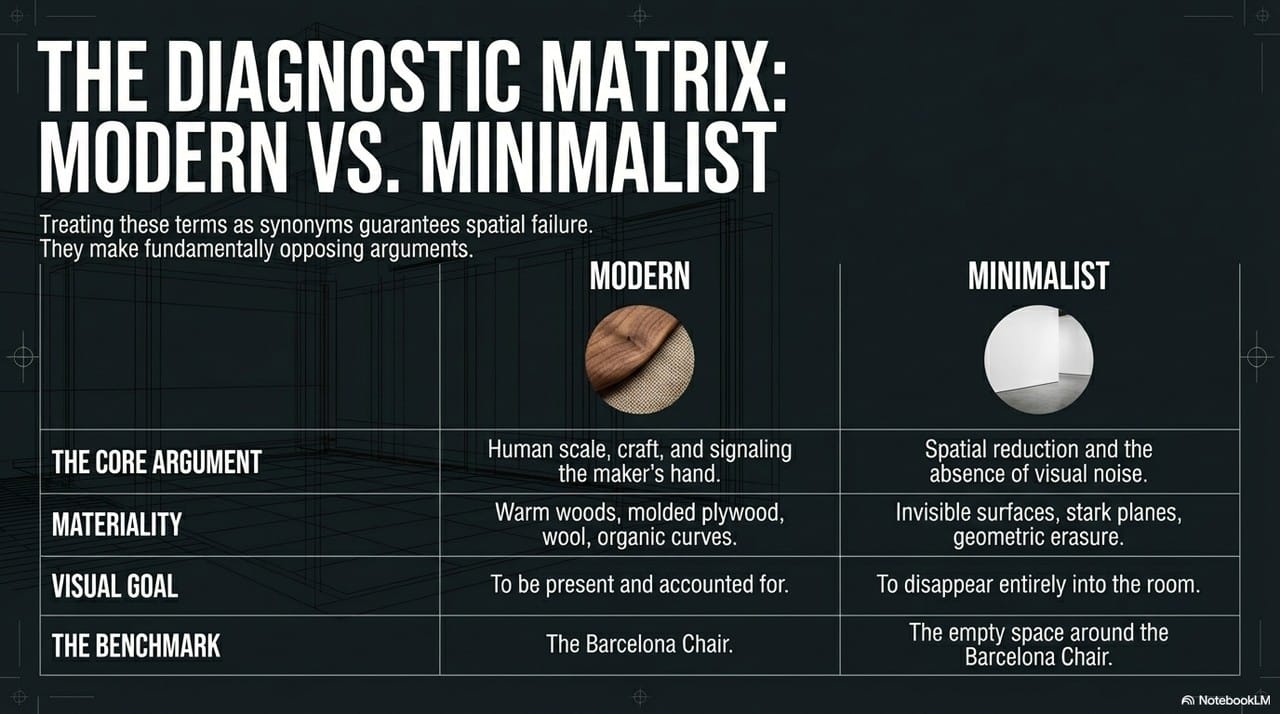
This is not minimalism as aesthetic. It is minimalism as structural argument: a 400-square-foot apartment doesn’t benefit from fewer things because fewer things look better. It benefits from furniture that has already solved the problem of double function. The argument for restraint in small spaces is practical, not stylistic. For a guide to what this looks like in practice: the best minimalist furniture for small spaces. And for the distinction between modern and minimalist as design positions: modern vs. minimalist interior design.
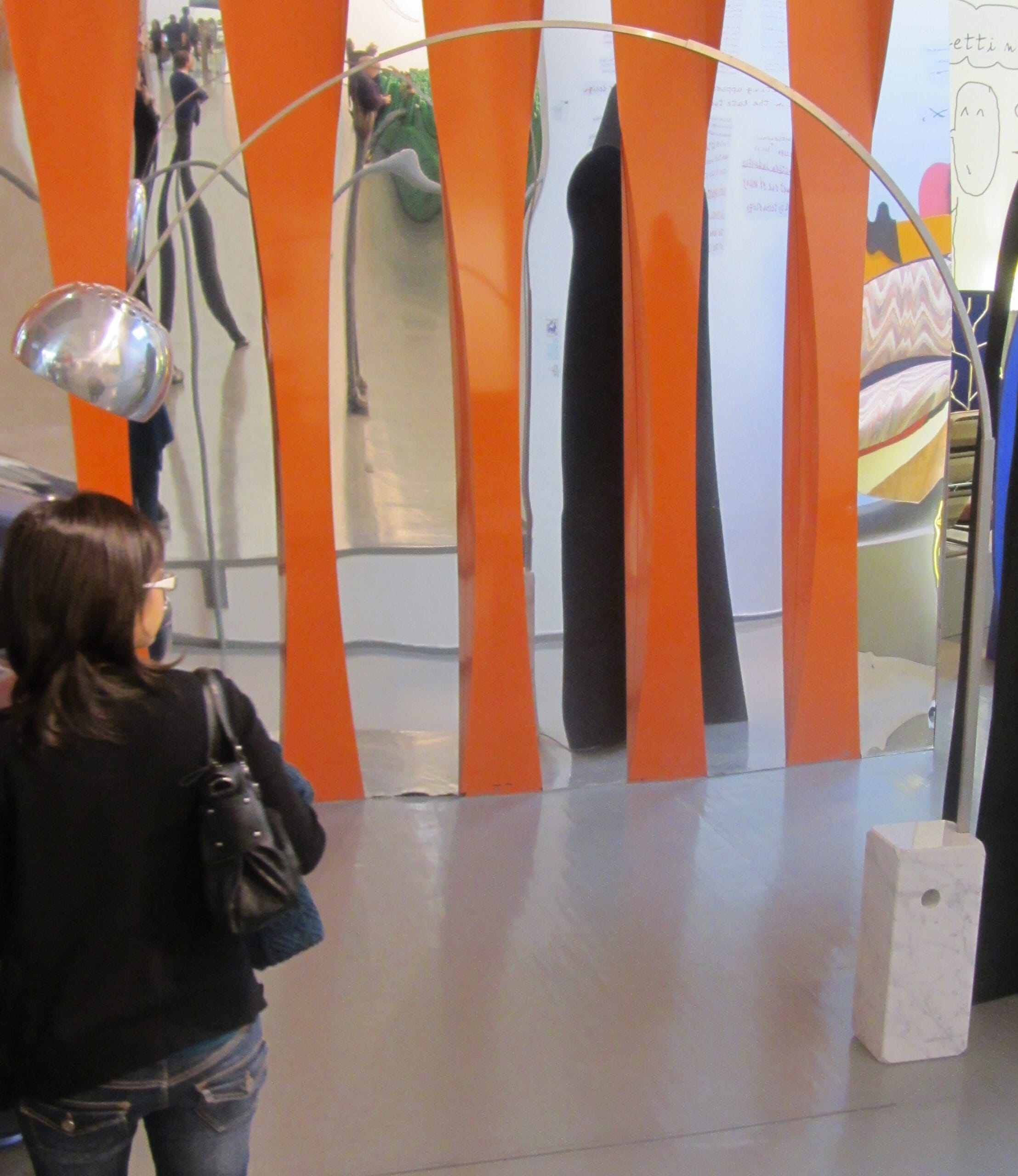
For specific sub-categories: best Eames office chairs covers the full Aluminum Group and Soft Pad families; modern desk lamps covers the task-lighting tradition from Anglepoise through contemporary LED design; how to identify an authentic Eames Lounge Chair covers the full range of unlicensed versions of the 1956 design. Lighting belongs in the canon too — the Castiglioni Arco lamp has been in production since 1962 and sits in the collection of the Museum of Modern Art.
Every Iconic Furniture profile and guide on ADI
- The Barcelona Chair
- The Wassily Chair
- The Eames Lounge Chair
- How to identify an authentic Eames Lounge Chair
- The Saarinen Tulip Chair
- The Noguchi table
- Designer lounge chairs
- Modern dining chairs
- Modern office chairs
- Lounge chair vs office chair

About Joe Post
Joe Post holds an MFA in Art from California Institute of the Arts (CalArts) and has done additional graduate work at the School of the Art Institute of Chicago. He founded Art Design Ideas to write about design as cultural argument — the decisions, contradictions, and assumptions built into the objects we live with.