

Bauhaus and Scandinavian design are both modernist, but they start from opposite places. The Bauhaus was a German art school (Weimar 1919, Dessau from 1925, closed under Nazi pressure in 1933) that treated design as a program for rebuilding society through industry: tubular steel, glass, geometry, no ornament. Scandinavian design grew out of Nordic craft and the welfare state between the 1930s and 1960s: bent birch, teak, organic curves and comfort for ordinary homes.
Two movements, two completely different arguments
The Bauhaus was not a design style. Walter Gropius founded it in Weimar in 1919 as a school built on a specific claim: that art, craft, and industrial production were the same problem, and that solving it correctly would rebuild European society after World War I. His founding manifesto opened with “The ultimate aim of all creative activity is building!” The Bauhaus was an ideological project before it was anything else. Geometry, tubular steel, and the elimination of ornament were not aesthetic preferences. They were political positions. The school’s three directors (Gropius 1919–1928, Hannes Meyer 1928–1930, Ludwig Mies van der Rohe 1930–1933) each understood this, even as they disagreed about what the ideology required. The Nazis closed it in 1933, characterizing it as degenerate, cosmopolitan, and leftist. They were not wrong about what it was.
Scandinavian design arrived at a different question. The movement that produced Alvar Aalto, Arne Jacobsen, Hans Wegner, Poul Henningsen, and Bruno Mathsson had no single founding moment, no manifesto, and no central institutional home. It emerged from Nordic craft traditions and the social welfare state. The Swedish concept of folkhemmet (the “people’s home”) expressed a policy conviction that good design improved the daily lives of all citizens regardless of income. Where the Bauhaus asked whether the right object could change society, Scandinavian design asked a more modest and perhaps more useful question: could this chair be made to actually fit a human body?
The critical distinction holds across everything that follows. Bauhaus was a school with a program. Scandinavian design was a regional tradition. One had a theory of society; the other had a theory of sitting.
| Bauhaus | Scandinavian design | |
|---|---|---|
| Origin | German art school, Weimar 1919, Dessau 1925, closed 1933 | Nordic craft tradition, no founding date, peak 1930s to 1960s |
| Key figures | Walter Gropius, Marcel Breuer, Mies van der Rohe, Josef Albers | Alvar Aalto, Arne Jacobsen, Hans Wegner, Poul Henningsen |
| Materials | Tubular steel, chrome, glass | Bent birch, teak, oak, cane, wool |
| Politics | Design as a program to remake society | Design as welfare-state policy for everyday homes |
| Form | Geometric, rectilinear, primary colors | Organic curves, natural tones, human scale |
| Defining objects | Wassily Chair (1925) | Paimio Chair (1930 to 1931), Round Chair (1949), Egg Chair (1958) |
Bauhaus vs Scandinavian design: five categories where the movements part ways
Materials as argument
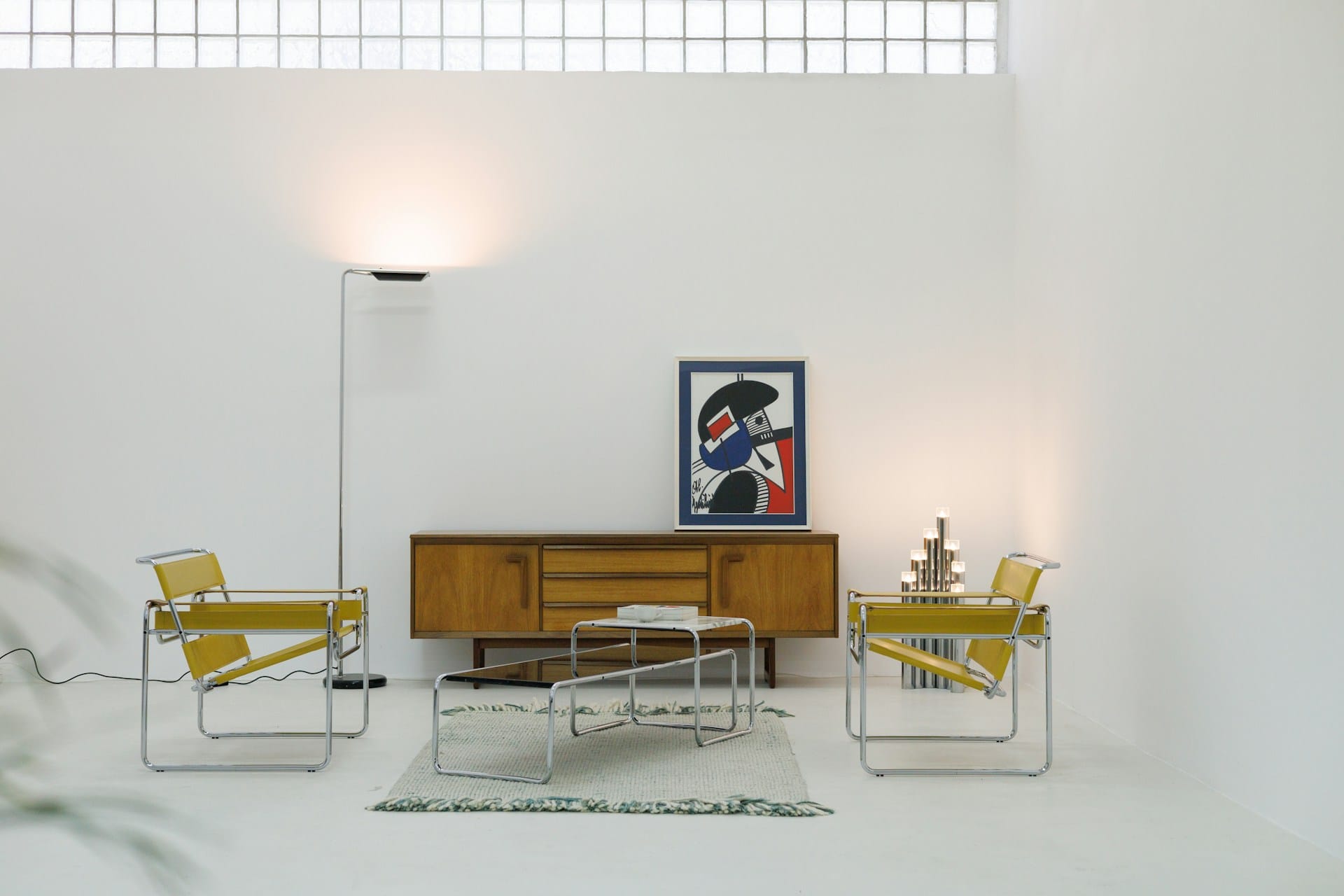
The Bauhaus chose industrial materials on principle. Marcel Breuer’s Wassily Chair (1925) was the first bent tubular steel chair, later named for Kandinsky after being placed in his Dessau studio. It was a provocation: furniture should look like the industrial age it came from. Steel and chrome were not neutral choices. They declared that the factory floor and the living room were part of the same world.
Scandinavian design made the opposite declaration with equal deliberateness. Alvar Aalto designed the Paimio Chair (1930–31) for tuberculosis patients recovering at the Paimio Sanatorium. He chose laminated bent birch over tubular steel because metal was too cold against the skin of sick people resting in it. That single material decision is the Scandinavian argument against the Bauhaus argument, compressed into a choice about what a chair should be made of. Wegner’s Round Chair (1949) used teak and hand-woven cane. The materials were selected for warmth, tactility, and the way they age. Patina was a feature, not a defect.
Steel ages as an idea. Wood ages as an object.
Social philosophy
Both movements claimed democratic goals. The Bauhaus curriculum was built on the conviction that correctly designed objects would produce a better society: design as ideology, the object changing the human. Scandinavian design operated from the welfare-state premise that good design should not be reserved for people with money: design as social policy, the object serving the human.
The difference shows up in outcomes. Bauhaus achieved democratic design theoretically. Scandinavian design achieved it commercially. IKEA, founded by Ingvar Kamprad in Sweden in 1943 and later explicit about “democratic design” (Function, Form, Quality, Sustainability, Low price) as its governing principle, is what Scandinavian design’s social philosophy looks like when you follow it to its conclusion. No Bauhaus-equivalent institution exists in the commercial furniture market.
Aesthetics
Bauhaus design is geometric and rectilinear; every surface reduced to what the school considered honest form. Gropius absorbed Adolf Loos’s “Ornament and Crime” (lecture 1910, published 1913) as received truth: ornament was dishonest, a form of cultural degeneration. Kandinsky’s color theory gave the school its palette: black, white, primary colors deployed as visual argument rather than decoration.
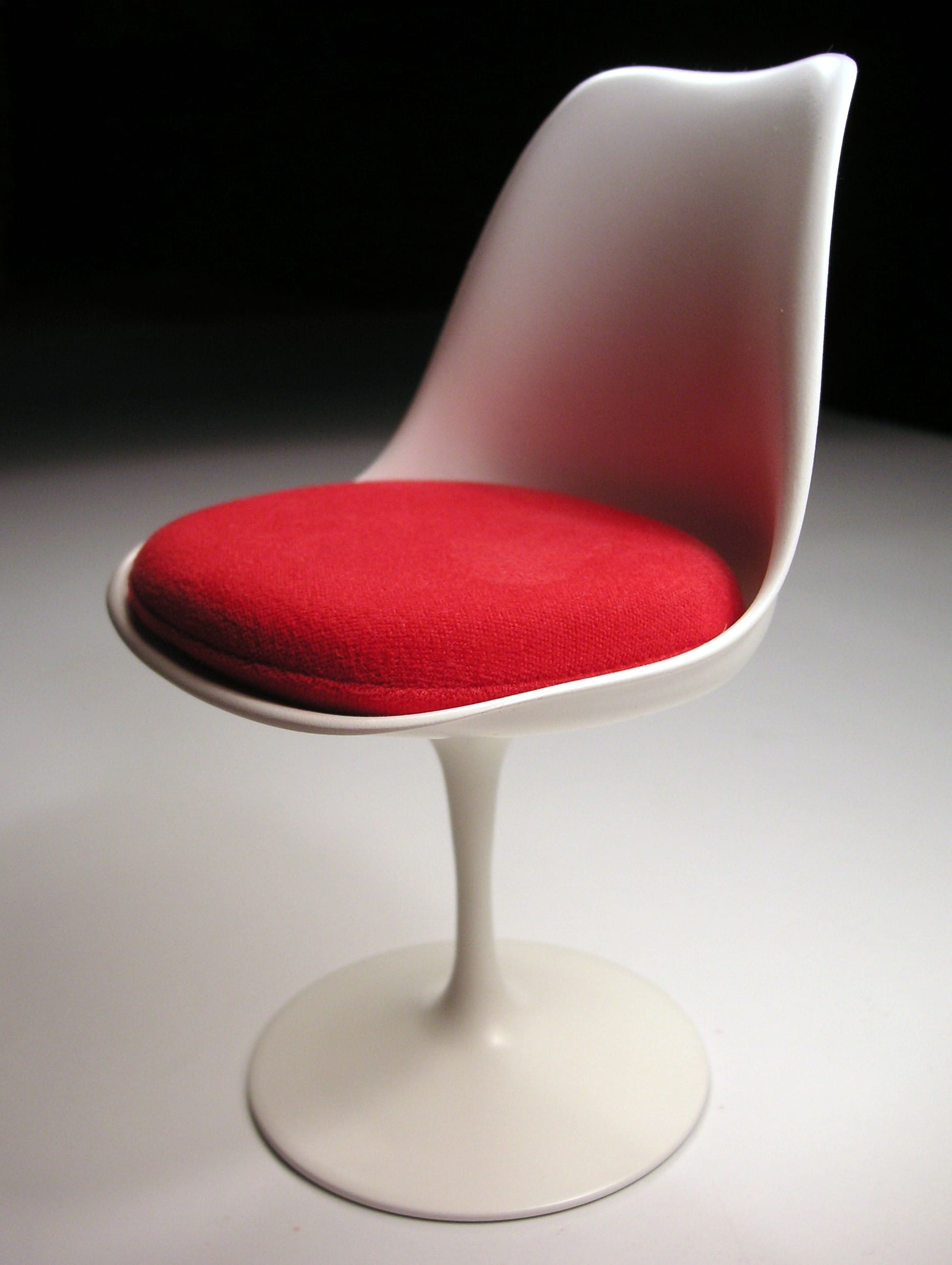
Scandinavian design is organic, curved, and human-scaled. Jacobsen’s Egg Chair (1958), designed for the SAS Royal Hotel in Copenhagen and still produced by Fritz Hansen, is not a geometric exercise. It wraps the human body in a shell designed to create enclosure and warmth. Aalto’s undulating forms responded to the Finnish landscape and to what he understood about how the nervous system responds to softness versus rigidity.
The practical consequence: rooms furnished in the Bauhaus tradition feel rational. Rooms furnished in the Scandinavian tradition feel inhabited.
Relationship to industry
The Bauhaus aspired to mass production and largely failed to achieve it during the school’s lifetime. The Wassily Chair was not manufactured at scale while Gropius was running the school. Most Bauhaus work was produced in small workshop runs. The gap between the school’s industrial rhetoric and its actual industrial output was considerable.
Scandinavian design achieved mass production through direct industry partnerships. Jacobsen’s Ant Chair (1952) was designed for Fritz Hansen as a stacking chair for institutional use: molded plywood formed into a single piece, first with three legs, then four for stability. It became among the most commercially successful Scandinavian furniture designs of the postwar era. IKEA’s entire model is the logical extension of this: Scandinavian design principles, manufactured at global volume.
Legacy in contemporary design
The Bauhaus lives in design education. The vorkurs (preliminary course), developed by Johannes Itten and later reformed by Moholy-Nagy to orient toward industry rather than spirituality, became the template for foundation courses at design schools worldwide. It survives in the structure of almost every design program today. Josef Albers, who taught the preliminary course from 1923, carried it to Black Mountain College and Yale, and his color exercises became Interaction of Color (1963). You can trace the Bauhaus education lineage through minimalist German industrial design, from Braun under Dieter Rams (who cited Gropius openly) to the International Style of architecture. For the objects that carry that lineage into living spaces today, see the guide to best Dieter Rams inspired products.
Scandinavian design lives in the furniture market. Every IKEA store is the evidence. HAY, Muuto, and the broader “Scandi aesthetic” that dominates interior design media trace directly back to the postwar work of Jacobsen, Wegner, and Henningsen. The irony is total: Bauhaus had the bigger theoretical ambition; Scandinavian design won the furniture market.
What each movement gets right — and what it gets wrong
Bauhaus Pros:
- Solved design education: the vorkurs model became the global standard for how you teach design at all
- Proved that industrial materials could carry genuine cultural weight: Breuer’s steel, Marianne Brandt’s metalwork, Herbert Bayer’s Universal typeface
- Built a coherent visual language that is still immediately legible a century later
- Maintained political courage under sustained external pressure until the school could no longer survive
Bauhaus Cons:
- Produced few objects manufactured commercially at scale during its actual existence; the gap between theory and production was real
- The utopian program has been thoroughly co-opted: “Bauhaus style” is now a luxury aesthetic, which inverts the original intention with some precision
- The school’s gender hierarchy: women were directed toward the weaving workshop; Anni Albers (admitted 1922) became one of the great textile artists of the century partly because the school’s own contradictions contained her ambitions in other directions
- The ideological frame makes the objects easy to fetishize and difficult to actually live with
Scandinavian Design Pros:
- Actually achieved democratic access: the Round Chair exists at the Fritz Hansen price point; the same principle exists at the IKEA price point; both are real objects you can own
- Organic forms age well domestically; they are livable across decades without requiring the room to conform to them
- Natural materials improve with use: patinated teak, worn leather, linen that softens
- Produced designers who understood the body (Jacobsen, Wegner) and light (Poul Henningsen’s PH lamp series, which eliminates glare by sizing each shade to a specific arc of the light source). For Jacobsen and Wegner-influenced seating available today, see the guide to best designer lounge chairs
Scandinavian Design Cons:
- The “Scandi aesthetic” has been flattened into a trend (white rooms, blond wood, throw blankets) that strips the movement of its social content entirely
- Lacks the intellectual framework that makes Bauhaus legible as argument; Scandinavian design is harder to write about because it resists the kind of theoretical framing that produces manifestos
- Hygge as a concept has been commodified into a lifestyle category with no critical content
- The high-end version (Fritz Hansen, Carl Hansen & Son) is as expensive as anything from the Bauhaus tradition: democratic design at the top of the price range is a contradiction that goes largely unremarked
Which Should You Choose?
Choose Bauhaus-influenced design if you want furniture that argues with you, pieces that make a position legible from across the room. If you value design as cultural object first and functional object second. If you want a chair that carries the weight of a particular moment in European intellectual history, and you find that weight interesting rather than exhausting. A licensed Breuer tubular steel chair or a Bauhaus poster print is not just decoration. It is a statement that you know what modernism was trying to do.
Choose Scandinavian design if you want to actually live in the room. If you want pieces that improve with use rather than dating as ideas. If warmth, texture, and human scale matter more to you than the object’s theoretical genealogy. The Egg Chair does not ask you to think about it. Wegner’s Round Chair, used by both Kennedy and Nixon in the September 26, 1960 television debate (the first American presidential debate broadcast on television), was chosen because it fit human bodies well. That is the Scandinavian premise in a single fact. For the modern dining and seating options that carry that tradition into everyday rooms, see the guide to best modern dining chairs.
The real answer for most rooms: use both. A Louis Poulsen PH pendant over one of Breuer’s tubular steel side tables, which Thonet still makes, is not a contradiction. It is a room that knows its own influences. For licensed Bauhaus-era furniture and Bauhaus-influenced objects available now, see the guide to best Bauhaus design products.
Two objects hold the whole argument between them. Breuer’s Wassily (1925) was the provocation: furniture as bent tubular steel, the frame doing the work a carved leg used to do, sold as an industrial product rather than a piece of cabinetmaking. Knoll has produced it under licence since 1968 and still does. Set it against any well-made Scandinavian lounge chair in wood and wool, and the two positions are legible in the room without a word of explanation — the machine argument and the craft argument, both from the same decade.
Shop the Collection
Both movements produced objects worth owning. The selections below cover the Bauhaus argument and the Scandinavian response, plus one object that bridges them.
- Arne Jacobsen Egg Chair (Fritz Hansen, 1958; buy from Fritz Hansen or an authorised dealer): The Egg’s shell geometry is not comfort-as-accident; it is the argument that organic form and protective enclosure are the same problem, which is precisely what Scandinavian design solved that Bauhaus never did.
- Bauhaus Kandinsky Wall Art Print: Bauhaus typography and geometric art prints are the most accessible way to bring the school’s visual argument into a room; they carry the full language without the furniture budget.
- Poul Henningsen PH 5 Pendant (Louis Poulsen, 1958; still in production): The PH lamp design, with concentric shades sized to eliminate glare, is the distillation of Scandinavian design’s premise: that human comfort, not abstraction, drives form.
Further Reading
Three books worth the shelf space: two on Bauhaus, one on the Scandinavian tradition. The Bauhaus has produced considerably more serious scholarship; that asymmetry in the literature is itself a fact about the two movements.
- Magdalena Droste, Bauhaus (Taschen, 2015): The standard single-volume reference. Droste was curator at the Bauhaus-Archiv Berlin, and this is institutional knowledge, not a design-press summary. If you read one Bauhaus book, this is the one to read.
- Frank Whitford, Bauhaus (Thames & Hudson, 1984): Where Droste gives you the institution, Whitford gives you the argument: why it mattered philosophically, what it was doing culturally, and why it failed on the terms it set for itself. Older but still the best English-language critical account.
- Charlotte Fiell, Scandinavian Design (Taschen, 2002): Covers the full arc from craft origins through IKEA democratization with the visual density Taschen does well. The Fiells are not theorists, but their survey work is thorough, and the images let you form your own argument about what the tradition was actually doing.
Frequently Asked Questions
What is the difference between Bauhaus and Scandinavian design?
Bauhaus was a German design school (1919–1933) founded on the belief that design could rebuild society: an ideological program expressed through industrial materials, geometric forms, and the elimination of ornament. Scandinavian design was a regional tradition from Nordic countries (peak influence 1930s–1960s) focused on making well-crafted, comfortable, human-scaled objects accessible to ordinary people. Bauhaus argued with the human; Scandinavian design tried to serve the human.
Is Bauhaus design the same as minimalist design?
No, though they overlap. Bauhaus design eliminated ornament as a philosophical position. Gropius absorbed Adolf Loos’s argument that ornament was cultural dishonesty. Contemporary minimalism borrows that anti-ornament stance but strips the political content. A Bauhaus-influenced room makes a specific historical argument; a minimalist room is often just clean. The Bauhaus was never neutral; minimalism often is.
How can you tell if a piece of furniture is Bauhaus-influenced or Scandinavian?
Materials are the quickest indicator. Tubular steel, chrome, and glass with geometric forms point toward Bauhaus influence. Bent plywood, teak, birch, oak, or beech with organic curves point toward Scandinavian design. The Bauhaus palette runs to black, white, and primary colors deployed as visual statements. Scandinavian interiors favor natural tones, warm neutrals, and textile textures. The deeper test: does the object feel like it’s making an argument, or does it feel like it’s trying to make you comfortable?
Why did Bauhaus design use so much steel and glass?
Because steel and glass were industrial materials (they came from factories, not from craft workshops) and the Bauhaus position was that design should declare its industrial moment rather than disguise it behind traditional craft finishes. Marcel Breuer’s tubular steel came from observing bicycle handlebars; the material was chosen for what it represented, not just what it could do. It was a declaration that the twentieth century had arrived and furniture should look like it knew that.
Are IKEA products considered Scandinavian design?
IKEA is the commercial consequence of Scandinavian design’s core principle: democratic design, meaning good design accessible at any income level. Ingvar Kamprad founded the company in Sweden in 1943, and IKEA now states “democratic design” as its explicit mission: Form, Function, Quality, Sustainability, and Low price must all be present. Whether individual IKEA products qualify as design objects is a separate question from whether the company is the heir to Scandinavian design philosophy. It is the heir.
Is IKEA considered Bauhaus?
No. IKEA is Swedish and belongs to the Scandinavian tradition, not the Bauhaus. The overlap is real but indirect: both wanted well-designed objects made in volume at prices ordinary people could afford, and IKEA’s flat-pack, factory-made furniture pursues that industrial goal more literally than the Bauhaus ever managed. Its forms and materials, mostly light wood and soft shapes, are Scandinavian.
What are the 7 principles of Scandinavian design?
There is no official list of seven. The principles most often cited are functionality, simplicity, natural materials (wood, wool, leather), light-filled rooms, a muted natural palette, good craftsmanship, and accessibility: the idea that good design should be affordable to ordinary households. Treat them as a summary of the postwar work of Aalto, Jacobsen and Wegner, not a manifesto. The movement never wrote one.
Is Scandinavian design good quality?
It depends on who makes it. The classics made by their licensed manufacturers, such as Fritz Hansen (Jacobsen), Carl Hansen & Son and PP Møbler (Wegner) and Artek (Aalto), are built from solid wood and good upholstery to last decades, and are priced accordingly. The Scandinavian look sold cheaply in particleboard and veneer is a style, not the same standard of construction.
Is Bauhaus the same as brutalism?
No. Brutalism is a postwar architectural style of the 1950s to 1970s, named after béton brut, the raw concrete Le Corbusier used on the Unité d’Habitation in Marseille (1952); the critic Reyner Banham popularized “The New Brutalism” in 1955. The Bauhaus (1919 to 1933) came first and favored light steel frames, glass walls and smooth white render. Both reject ornament, which is where people confuse them. For another contrast with the school, see Memphis vs Bauhaus.
Which design movement is better for a home interior — Bauhaus or Scandinavian?
Scandinavian design is more livable for most homes. The organic forms, natural materials, and human-scale proportions work across a wider range of rooms and age better over time. Bauhaus-influenced pieces work best as deliberate statements in rooms designed around them. The most successful interiors often use both: Bauhaus-influenced lighting or graphic art for argument, Scandinavian furniture for living. The PH-style pendant over a tubular steel table is not a contradiction; it is a room that has read both manifestos.
For the broader context of this work, see the Design Legends hub — profiles of the designers and movements that shaped modern design. To bring the Bauhaus into a home, see Bauhaus design for the home. The Bauhaus-Archiv Berlin maintains the primary public record of the school’s output, including the original workshop products and educational materials.

About Joe Post
Joe Post holds an MFA in Art from California Institute of the Arts (CalArts) and has done additional graduate work at the School of the Art Institute of Chicago. He founded Art Design Ideas to write about design as cultural argument — the decisions, contradictions, and assumptions built into the objects we live with.