
Disclosure: As an Amazon Associate, Art Design Ideas earns from qualifying purchases. This article contains affiliate links. Full disclosure policy.

Bauhaus design products distill the school’s founding argument into objects you can live with daily: form follows function and craft must meet industry. This guide covers the best Bauhaus design products available now: tubular steel chairs, geometric chess sets, the Wagenfeld lamp, art prints, and the books that explain why any of it matters.

Our top picks

The four picks below were selected on a single criterion: does this object make the Bauhaus argument legible? Not nostalgia, not brand recognition. Each one either preserves the structural logic of a specific 1919–1933 workshop design or delivers the movement’s visual vocabulary at a price that doesn’t require an inheritance.

Kardiel Wassily Chair in black saddle leather with chrome tubular steel frame

Kardiel Wassily Chair, Black Saddle Leather

Premium · Statement seating

Marcel Breuer’s 1925–26 tubular steel chair for Kandinsky’s studio, the first armchair built from metal and still the clearest statement of what Bauhaus furniture was trying to do.

Wagenfeld MT8 WG24 table lamp Bauhaus 1924

Wilhelm Wagenfeld Style MT8 Table Lamp

Mid-Range · Desk or ambient lighting

The 1924 Weimar workshop lamp designed by Wagenfeld and Carl Jakob Jucker: circular base, cylindrical stem, spherical glass globe, no hidden construction, no ornament that isn’t also structure.

Josef Hartwig Bauhaus chess set in ebonised boxwood with geometric pieces encoding each move

Josef Hartwig Bauhaus Chess Set, Ebonised Boxwood

Mid-Range · Gift or shelf object

Hartwig’s 1923 design, held in MoMA’s permanent collection, in which each piece’s shape encodes its legal move. The most disciplined application of form-follows-function logic to any object in this guide.

BigWig Prints Bauhaus Wall Art set of 9 prints showing geometric and primary color Bauhaus designs

BigWig Prints Bauhaus Wall Art Set of 9

Budget · Wall display

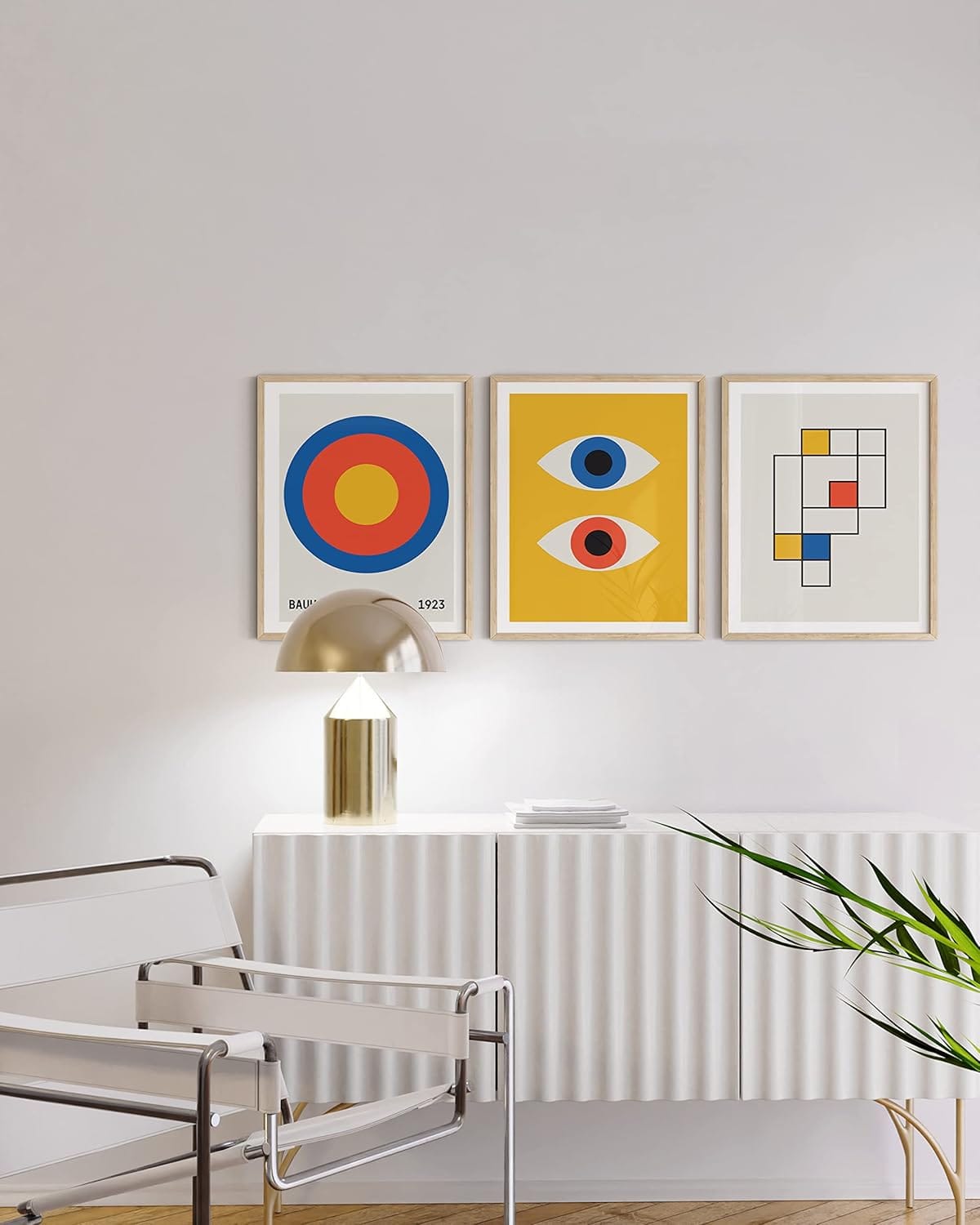
Nine 8×10 prints in the movement’s geometric, primary-color vocabulary, a way to live with the Bauhaus visual argument before committing to a chair or lamp.

Quick decision guide

  • Best overall Bauhaus investment: Kardiel Wassily Chair: if you’re going to own one object that argues for the Bauhaus position on furniture and form, this is it.
  • Best budget entry point: BigWig Prints Bauhaus Wall Art Set: nine prints for the cost of a dinner out; the visual vocabulary of Klee, Kandinsky, and Schlemmer at the scale of a wall.
  • Best gift for a design enthusiast: Hartwig Bauhaus Chess Set: this isn’t a novelty; it’s a proof of concept, and anyone who understands design will see that immediately.
  • Best for a Bauhaus-inspired work desk: Wagenfeld MT8 Table Lamp: compact, functional, and the internal structure is part of the point; the glass globe doesn’t hide anything.
  • Best if you want to understand the movement before buying anything: Magdalena Droste, Bauhaus Updated Edition (Taschen, 2019): Droste was the archivist at the Bauhaus-Archiv Berlin; this is the reference that doesn’t oversimplify.
  • Best single-volume critical history of the school: Frank Whitford, Bauhaus (Thames & Hudson, 2020): the most readable account of why three directors ran the same school so differently.

Full comparison

ProductBest ForPrice RangeKey FeatureLink
Kardiel Wassily ChairStatement seatingPremium1925–26 tubular steel, exposed structureAmazon
Wagenfeld MT8 Table LampDesk or ambient lightingMid-Range1924 glass globe, no ornamentAmazon
Hartwig Chess Set (Ebonised)Gift or shelf objectMid-RangePiece shape = movement logicAmazon
BigWig Prints Bauhaus Set (9)Wall displayBudget9 prints, geometric vocabularyAmazon
Droste, Bauhaus Updated Ed.Reference or giftMid-RangeTaschen standard, 500+ images, archival sourcingAmazon

What makes the best Bauhaus design products worth owning

The Kardiel Wassily Chair

Marcel Breuer designed this chair in 1925–26 for Wassily Kandinsky’s studio at the Weimar Bauhaus. Breuer had noticed that his bicycle handlebars were made from seamless tubular steel: lightweight, strong, manufacturable. He applied the same material to a chair frame, replacing the upholstered box of traditional seating with a structure you could see through. The exposed frame is the design.

Pros:

  • Structurally faithful to Breuer’s original geometry: the tubular steel frame at 1-inch diameter with UV-cured chrome finish holds the proportional logic of the 1925–26 design
  • Saddle leather straps aged from horsehide traditions; available in black, white, and red
  • The exposed-structure argument is preserved: you can see exactly how this chair holds a person

Cons:

  • This is a replica, not an authorized reproduction. Knoll holds the licensed Breuer design and produces the “official” version at $2,000–$2,500
  • At this price point, seam finishing and leather weight can vary between production runs; the Kardiel is generally well-reviewed but is not the Knoll. Check current reviews before ordering: look specifically for comments on leather weight and frame finish, since these vary more than the geometry does

Who it’s for: Anyone who wants the structural and visual argument of the original without paying for the manufacturer’s license fee.

Why it stands out: A well-made replica preserves the logic of the original. What Knoll’s authorized version adds is provenance and tighter production tolerance, not a different design. The Wassily is either a tubular steel frame supporting leather slings, or it isn’t. Among Amazon Wassily replicas, the Kardiel is one of the few that specifies the 1-inch seamless tube diameter matching Breuer’s original spec; most budget replicas use thinner or welded tube.

The Wagenfeld MT8 Table Lamp

Wilhelm Wagenfeld and Carl Jakob Jucker designed this lamp in 1924 at the Bauhaus metal workshop in Weimar. The design is a demonstration: circular base, cylindrical stem, opal glass diffuser, spherical globe. Every part is visible. The internal mechanism (the stem carrying the wire up through the shaft) is readable from the outside. Nothing is hidden because, in Bauhaus terms, there was no reason to hide anything.

Pros:

  • Translucent glass globe makes the lamp’s own structure part of the aesthetic: the opal diffuser, the visible stem, the base weight
  • No ornament that isn’t also structure: what you see is what the lamp is
  • Compact desk footprint; works as task lighting and as a statement about what task lighting could look like

Cons:

  • Replica glass quality varies; the original WG24 spec used a specific opal glass weight that cheaper reproductions approximate unevenly
  • Base weight in some listings differs from the original’s proportions

Who it’s for: People furnishing a home office or reading space who want a functional object that also makes a statement about function.

Why it stands out: The original Tecnolumen-licensed version is still manufactured in Germany and costs considerably more. This replica makes the same argument in the same materials at a fraction of the price. Whether that matters to you depends on whether you’re buying an object or a certificate.

The Hartwig Bauhaus Chess Set

Josef Hartwig designed this set in 1923 at the Bauhaus wood workshop. The design is almost confrontationally logical: each piece’s shape encodes how it moves. The rook is a cube: it moves in straight lines, so its form is a rectangular prism. The bishop moves diagonally, so its form is two diagonal pyramids joined at their bases. The knight moves in an L, so the piece is an L. The king combines a cross (straight lines) with a sphere (all directions). MoMA acquired the original in 1924.

Pros:

  • Ebonised and natural boxwood; the color contrast between the two sides is clean and readable
  • Each piece is formally consistent with the design logic: this is not a decorative approximation, it is the design
  • King height 2.0 inches, base 1.1 inches; proportions are correct for the original spec

Cons:

  • Many listings are pieces only: no board included; you’ll need a separate board suited to 40–45mm squares
  • The small scale means these pieces reward attention; they’re not imposing at distance

Who it’s for: Designers, architects, and chess players who want the board to carry an argument as well as a game.

Why it stands out: MoMA holds the original. That’s not a marketing claim. It’s a record of what the design community decided this object was, a century ago. Hartwig solved a problem that every chess set designer before him had avoided: he made the rules of the game visible in the pieces themselves. Not all chess sets marketed as “Bauhaus” on Amazon are based on the Hartwig design. The Hartwig original has each piece’s shape encoding its movement; if the pieces are purely geometric decoration with no movement logic, it isn’t the Hartwig design.

The BigWig Prints Bauhaus Wall Art Set

The Bauhaus produced significant work in two-dimensional form. Klee, Kandinsky, László Moholy-Nagy, Oskar Schlemmer, and Herbert Bayer were all teachers there, and the school’s graphic output was as consequential as its furniture. These nine 8×10 prints draw from that geometric, primary-color vocabulary.

Pros:

  • Nine prints spanning the movement’s visual range: geometric abstraction, flat-plane composition, primary-color palette
  • 8×10 unframed means you can frame them as you see fit; the standard size makes framing straightforward
  • The Bauhaus print tradition is the affordable entry point into a movement whose furniture costs hundreds to thousands

Cons:

  • Reproduction quality at this price point is adequate, not archival: paper weight is not museum-grade
  • These are commercial reproductions, not licensed prints from the Bauhaus-Archiv or MoMA’s collection

Who it’s for: People who want the visual language of the Bauhaus on a wall before they can justify a chair or lamp, or find room for one.

Why it stands out: The Bauhaus was not only furniture. Klee and Kandinsky taught there for years. Schlemmer’s figure studies and Bayer’s typography are as central to the movement as any chair. BigWig’s set of 9 specifically includes prints from Klee, Kandinsky, Moholy-Nagy, and Schlemmer, the four teachers whose graphic work is most central to the movement. Lower-priced sets often repeat one or two designs across multiple prints.

The Bauhaus was making a specific argument. These products make it too.

The phrase “form follows function” predates the Bauhaus. Louis Sullivan coined it in 1896, and Walter Gropius made it the organizing principle of the school’s workshop method when he founded the Bauhaus in Weimar in 1919 with a stated goal: end the split between art and craft in an industrialized world. By 1923, he was saying plainly that the school wanted “an architecture adapted to our world of machines, radios and fast cars.” The school moved from Weimar to Dessau in 1925 and from Dessau to Berlin in 1932, where the Nazis shut it down in April 1933. Its masters, among them Gropius, Mies van der Rohe, Breuer, Moholy-Nagy, and Albers, emigrated primarily to the United States and continued the argument from there.

The products above are not nostalgic objects. Each one applies a still-coherent position: that an object should work, look like it works, and cost what honest materials and process cost. That’s what makes a Wassily Chair replica defensible and what makes the Hartwig chess set worth more than a glance.

For a broader account of what the Bauhaus was doing and why it still matters, see our Bauhaus Design Ideas post. If you want to understand the school’s internal debates before committing to any object in this guide, start with Frank Whitford’s Bauhaus (Thames & Hudson, 2020), the most readable account of why three directors ran the same school so differently.

Frequently asked questions

What is the most famous Bauhaus furniture design?

The Wassily Chair, designed by Marcel Breuer in 1925–26, is the most frequently cited Bauhaus furniture design. It was the first armchair built from tubular steel. Breuer adapted the material from bicycle handlebars, and its exposed-frame structure made the construction logic visible as a design choice. The Barcelona chair by Mies van der Rohe (1929, for the German Pavilion at the Barcelona International Exposition) is a close second, though Mies was at the Bauhaus only as its final director.

Are Wassily Chair replicas worth buying?

A well-made replica preserves the structural logic of the original: the tubular steel frame, the leather sling proportions, the exposed construction. What an authorized reproduction (Knoll’s licensed version, at $2,000–$2,500) adds is provenance and tighter manufacturing tolerance, not a different design. If the argument of the object matters more to you than the manufacturer’s certificate, a quality replica like the Kardiel is a reasonable choice. If the certificate matters, for resale or for a catalogued collection, pay for the Knoll.

What did Josef Hartwig design?

Josef Hartwig designed the Bauhaus chess set in 1923, in which each piece’s shape directly encodes its legal move: cubes for rooks, diagonal forms for bishops, L-shapes for knights, a cross-and-sphere for the king. He was a sculptor and craftsman at the Bauhaus wood and sculpture workshops. MoMA acquired the original in 1924. It remains one of the clearest applications of Bauhaus design logic to a non-utilitarian object.

Is the Wagenfeld lamp still made?

Yes. The original authorized manufacturer, Tecnolumen in Germany, still produces the Wagenfeld WG24 table lamp under license, using materials and proportions close to the 1924 original. Tecnolumen’s version is available in the US and Europe at a premium price. The replica versions on Amazon approximate the same design at lower cost with variable glass quality.

Where can I buy authentic Bauhaus-licensed products?

For furniture: Knoll holds the principal licensed Bauhaus tubular steel designs (Wassily Chair, Cesca chair, Breuer series). For the Wagenfeld lamp: Tecnolumen. For the Hartwig chess set: the Bauhaus-Archiv in Berlin sells authorized versions. Amazon stocks replicas across all categories, and the price difference between replica and licensed is typically a factor of five to ten.

How do I know if a Bauhaus-style product follows the original design principles?

Ask two questions: does the form follow from the function, or is it decorative geometry applied to a conventional object? And are the materials honest, meaning do they show what they are rather than hiding their construction? A Bauhaus-principle object doesn’t have ornament that doesn’t also do structural work. If a product calls itself Bauhaus-inspired but adds decorative flourishes that serve no structural purpose, it’s using the word as a style label, not a design position.

For the broader context of this work, see the Iconic Furniture Design hub — a survey of the chairs and objects that defined twentieth-century design.

Joe Post

About Joe Post

Joe Post holds an MFA in Art from California Institute of the Arts (CalArts) and has done additional graduate work at the School of the Art Institute of Chicago. He founded Art Design Ideas to write about design as cultural argument — the decisions, contradictions, and assumptions built into the objects we live with.

Large modernist building with glass curtain walls and steel structure
Mies van der Rohe

Mies van der Rohe

Joe PostJoe PostMay 18, 2026
Art Deco Design History

Art Deco Design History

Joe PostJoe PostApril 15, 2026
Best Scandinavian design products — HAY, Marimekko, and Muji objects
Best Scandinavian Design Products

Best Scandinavian Design Products

Zoe PostZoe PostApril 14, 2026