
New genre public art is a term coined by artist Suzanne Lacy in 1991 to describe socially engaged practice that treats community process as its primary medium. Unlike sculpture placed in public space, it positioned the audience as participant, not viewer, and argued that art’s proper subject was social change itself.
What Suzanne Lacy was arguing against
The dominant model of public art in the 1970s and 1980s was monumental sculpture commissioned for civic plazas: federal buildings, corporate forecourts, transit hubs. The assumption behind it was straightforward: art improves public space by being present in it. The commissioning institution selects the artist. The artist makes the work. The public arrives to find it already there.
Richard Serra’s Tilted Arc is the perfect emblem of what that model produced and what it could not survive. Serra designed a 120-foot arc of Cor-Ten steel for Foley Federal Plaza in Manhattan, installed in 1981 at the request of the General Services Administration. The arc bisected the plaza. It blocked sightlines. Office workers who used the plaza daily signed petitions almost immediately. After years of public hearings and sustained opposition, the federal government removed it in 1989. The work is documented in full at Wikipedia, and the removal hearing transcripts remain one of the most unsparing records of what happens when public art is answerable only to its commissioning institution.
Lacy watched all of this. So did the milieu she came from.
She had trained at CalArts in the late 1970s under Allan Kaprow. Kaprow’s Happenings in the late 1950s and early 1960s had already argued that the boundary between artwork and social event was a fiction worth dissolving. Within this context, Lacy also studied in Judy Chicago’s feminist art program, which held that art had an obligation to address social conditions directly, not metaphorically. That double formation gave Lacy both the conceptual tools (Kaprow’s dissolution of the art object) and the political frame (Chicago’s insistence that art’s subject matter had to include women’s lives, not just abstract form). It was a direct reaction against the solitary-genius model of postwar American art, in which the artist worked in isolation and the public arrived to receive the finished result.
In 1991, Lacy organized a series of closed discussions at the San Francisco Museum of Modern Art (SFMOMA) titled “Mapping the Terrain.” These conversations brought together artists, curators, theorists, and writers attempting to formulate a shared vocabulary for a kind of practice that didn’t have one yet. That event generated the term. The anthology Mapping the Terrain: New Genre Public Art (Bay Press, 1995), which she edited, gathered the theoretical framework with essays by Lucy Lippard, Suzi Gablik, Allan Kaprow, Guillermo Gomez-Pena, Mary Jane Jacob, and others. It remains the founding document of the movement.
Community engagement as medium, not message
The central claim of new genre public art was not that art should depict social issues. That claim was older and less interesting. What NGPA argued was that social process itself — the organizing, the gathering, the conversation — was the artistic medium. The distinction matters because it relocates the artwork entirely.
In the monumental public art tradition, the work is the object. In NGPA, the work is the event. The gathering of 430 older women in a church in Minneapolis is the artwork. The two-year series of workshops between Oakland youth and police officers is the artwork. The object, if one exists at all, is documentation. Architecture made a comparable turn later in the decade, when Stan Allen’s field conditions theory in Points + Lines (1999) moved attention from single buildings to the systems that connect them.
This repositioning also redefines the artist’s role. The NGPA artist is not the maker of the thing people look at. She is the convener of the thing people do. Lacy’s own formulation, from her introduction to the anthology, put it directly: “visual art that uses both traditional and nontraditional media to communicate and interact with a broad and diversified audience about issues directly relevant to their lives” (Suzanne Lacy, Mapping the Terrain, Bay Press, 1995).
The movement sat in explicit and sometimes uncomfortable dialogue with relational aesthetics, the European tendency that Nicolas Bourriaud theorized in his 1998 book Esthétique relationnelle (Presses du réel). NGPA preceded it by seven years and was more explicitly political. Bourriaud was describing gallery-based practices that created social situations as aesthetic form, without the activist demand that those situations produce change. The difference is not trivial. NGPA insisted on accountability to a specific community with specific needs. Relational aesthetics was agnostic about outcomes. The deeper question — what art owes its audience, and who that audience is — connects NGPA directly to earlier arguments about art’s relationship to mass culture and the public sphere.
The harder challenge came from Claire Bishop. In MoMA’s documentation of participatory and socially engaged practices from the 1990s through 2010s, the contested status of this work is apparent. Bishop’s Artificial Hells: Participatory Art and the Politics of Spectatorship (Verso, 2012) made the critique explicit: the field’s ethical framework displaces aesthetic judgment entirely. Social good as the measure of artistic value means that if the process was meaningful to participants, who is to say the work failed? Bishop’s answer is that this logic evacuates art criticism of any purchase.
Grant Kester, whose Conversation Pieces: Community and Communication in Modern Art (University of California Press, 2004) theorizes “dialogical aesthetics,” offers the opposing position. Kester argues that meaning is generated through conversation rather than in the object. These two accounts are not reconcilable, and anyone who tells you they are is simplifying. NGPA’s most interesting problem is that it leaves itself without standard criteria for aesthetic quality. That is either its freedom or its weakness, depending on which day you read it.
The CalArts genealogy mattered in another way. Kaprow’s Happenings had dissolved the artwork into the activity of daily life, but they were still addressed to an art audience. Judy Chicago’s feminist art program pushed past this. It was addressed to women who might never set foot in a gallery. NGPA synthesized both moves: the dissolution of the art object (Kaprow) and the expansion of the audience beyond art’s traditional address (Chicago). That synthesis gave the movement its political weight and its theoretical instability simultaneously.
The works that defined new genre public art
The risk with any movement built on process is that the theory outlives the work. With NGPA the opposite problem is more common. The works are specific and consequential enough that the theory barely does them justice.
In Mourning and in Rage (1977, with Leslie Labowitz)
Before the term existed, there were performances that would become its examples. In Mourning and in Rage was staged outside Los Angeles City Hall in response to the Hillside Strangler murders. Nine performers in black robes, each representing a statistic about violence against women, spoke directly to city council members and to press cameras that Lacy and Labowitz had organized in advance. The work was designed to generate media coverage. The press event was the medium. The goal was a specific policy response from the city government.
This is worth dwelling on. The work was not a documentation of activism. It was designed as a press event that would reach people who would never see a gallery. The gallery, if it existed at all, was the evening news.
The Crystal Quilt (1987, Minneapolis)
430 older women seated at tables in a quilted formation at Hennepin Avenue United Methodist Church. The seating arrangement made the quilt pattern visible from above through the architecture of the gathering itself. This was the formal decision. Filmed conversations about aging, memory, and purpose were recorded throughout the afternoon. The work was broadcast on public television.
The gathering itself was the aesthetic form. There is no object from The Crystal Quilt that you could acquire, install in a museum, and call the work. What you have is footage and the fact of what happened. The formal choice — 430 women, a quilt pattern, a church, a camera above — was as deliberate as any sculptor’s material decisions.
Code 33: Emergency, Clear the Air! (1998–1999, Oakland)
A two-year project with youth, police officers, and Oakland community residents, culminating in a performance on the roof of a downtown parking garage on October 7, 1999. The project was collaborative, created with Julio César Morales and Unique Holland. The two years of preparatory workshops, in which youth and police officers were placed in structured dialogues under conditions neither group controlled, was the work. The rooftop performance was the documentation event.
This is NGPA’s formal claim at its most demanding: the long-duration organizing process is not preparation for the artwork. It is the artwork. The preparatory work is the thing. If you missed the two years, you missed the piece.
Between the Door and the Street (2013, Brooklyn, commissioned by Creative Time)
On a single afternoon in October 2013, 400 women and men from activist organizations held simultaneous conversations on 60 Brooklyn stoops about different social-justice topics. Approximately 2,500 people attended and moved between conversations. Sound installation by Bruno Louchouarn moved through the street.
The city block became the stage. The conversation became the aesthetic unit. Five months of preparation with participants across organizations preceded the single afternoon. The afternoon was not the work becoming visible. It was the work reaching its necessary scale.
Three Weeks in January (2012, Los Angeles)
A reworking of her 1977 Three Weeks in May, addressing rape in Los Angeles over three weeks of presentations, conversations, performances, and community events. The durational project is the form. The work lives in accumulated time and testimony. No single event is the piece. The three weeks are the piece.
Shop the collection
There is exactly one book you need before reading anything else about this movement, and then there are two more books that define the debate that followed. All three are worth owning.
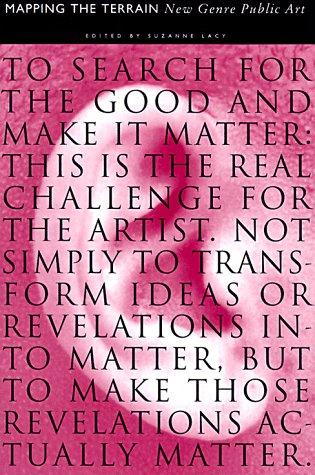
Mapping the Terrain: New Genre Public Art, edited by Suzanne Lacy (Bay Press, 1995): The founding document. The anthology gave NGPA its theoretical vocabulary. You cannot understand the movement without it. Essays by Lucy Lippard, Suzi Gablik, Allan Kaprow, and others appear here. The original 1991 closed-discussion transcripts appear nowhere else.
Public art and social practice: For readers who want a broader view of the range of approaches to socially engaged practice. This search surfaces academic and popular treatments that situate NGPA in the larger history of art’s engagement with the public sphere.
Further reading
Bishop and Kester are the prosecution and the defense. Reading one without the other leaves you with half an argument.
Claire Bishop, Artificial Hells: Participatory Art and the Politics of Spectatorship (Verso, 2012): The most rigorous critique of NGPA’s theoretical framework. Bishop argues that the field’s ethical logic crowds out aesthetic judgment. She is not wrong that this is a problem. Reading her alongside Lacy is the only way to understand the movement’s actual contested status in art theory. Agreeing with either one without knowing the other is incomplete.
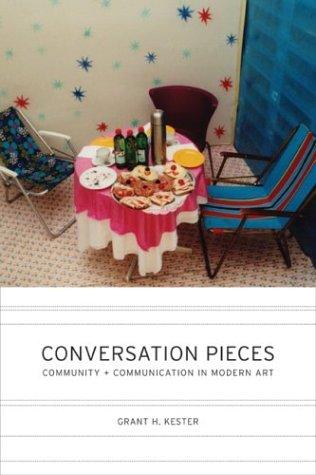
Grant H. Kester, Conversation Pieces: Community and Communication in Modern Art (University of California Press, 2004): Kester’s “dialogical aesthetics” is the most developed theoretical framework that extends NGPA’s claims. It directly engages Lacy’s work. If Bishop is the prosecution, Kester is the defense. Together they define the field’s live fault lines.
For broader reading on the theory behind socially engaged practice, see our curated list of essential art books.
Frequently asked questions
What is new genre public art?
New genre public art is a term coined by Suzanne Lacy in 1991 to describe socially engaged art practice that treats community process — organizing, gathering, conversation — as its primary artistic medium. Unlike sculpture installed in public space, it positions the audience as participant rather than viewer and argues that the social event itself, not the resulting object, is the artwork.
Who coined the term new genre public art?
Suzanne Lacy coined the term in 1991 at a series of organized discussions at the San Francisco Museum of Modern Art (SFMOMA) titled “Mapping the Terrain.” She formalized the framework in the 1995 anthology of the same name, which she edited. The anthology gathered essays by Lucy Lippard, Suzi Gablik, Allan Kaprow, and others who had been working in related practices without shared vocabulary.
How is new genre public art different from traditional public art?
Traditional public art — the monumental sculpture commissioned for a plaza or civic building — positions the artist as maker and the public as recipient. The work is the object. The audience arrives to find it already there. New genre public art inverts this. The artist is the convener, not the maker. The audience is a co-author. The artwork is the social event that the artist organizes — the gathering, the conversation, the structured encounter — not a physical object that results from it.
What are the most important examples of new genre public art?
Lacy’s own works are the central examples: The Crystal Quilt (1987, Minneapolis, 430 older women in a quilted seating formation engaged in filmed conversations about aging), Code 33: Emergency, Clear the Air! (1998–1999, Oakland, a two-year project with youth and police), and Between the Door and the Street (2013, Brooklyn, 60 stoops hosting simultaneous social-justice conversations). Mary Jane Jacob’s 1993 exhibition Culture in Action in Chicago is the most frequently cited institutional example of NGPA principles at scale. It featured Mark Dion, Iñigo Manglano-Ovalle, and others working with community organizations on long-duration projects.
Why is new genre public art considered controversial?
The controversy runs in two directions. In the 1990s, NGPA was a direct challenge to the commissioning model. It argued that the Tilted Arc controversy was not an aberration but a structural problem with how public art was funded, authorized, and sited. The institutional art world was not enthusiastic about an argument that proposed dissolving the art object and redefining the artist’s role as facilitator. The deeper controversy came later, from art theory itself. Claire Bishop’s Artificial Hells (Verso, 2012) argued that NGPA’s ethical framework — social good as the measure of artistic value — makes the work immune to aesthetic criticism. If the participants found it meaningful, on what grounds do you say it failed? Bishop is right that this is a genuine problem. NGPA has not resolved it.
Is new genre public art still practiced today?
Yes, and the field has expanded considerably since the 1990s. The institutional apparatus for socially engaged practice — residencies, commissions, grants, graduate programs in “social practice” — is now well established in the United States and internationally. Organizations like Creative Time in New York continue commissioning work on NGPA’s terms. Whether the institutionalization of social practice compromises its claims is a live debate. NGPA’s original framework, which was in part a challenge to institutional authority, is not well positioned to answer it. For a sense of how contemporary artists engage those boundary questions from within the gallery world, see our profile of Karen Kilimnik.
See also: West Coast Conceptual Art, Connie Hatch and the CalArts Lineage, Video Installation Art Explained

About Joe Post
Joe Post holds an MFA in Art from California Institute of the Arts (CalArts) and has done additional graduate work at the School of the Art Institute of Chicago. He founded Art Design Ideas to write about design as cultural argument — the decisions, contradictions, and assumptions built into the objects we live with.