
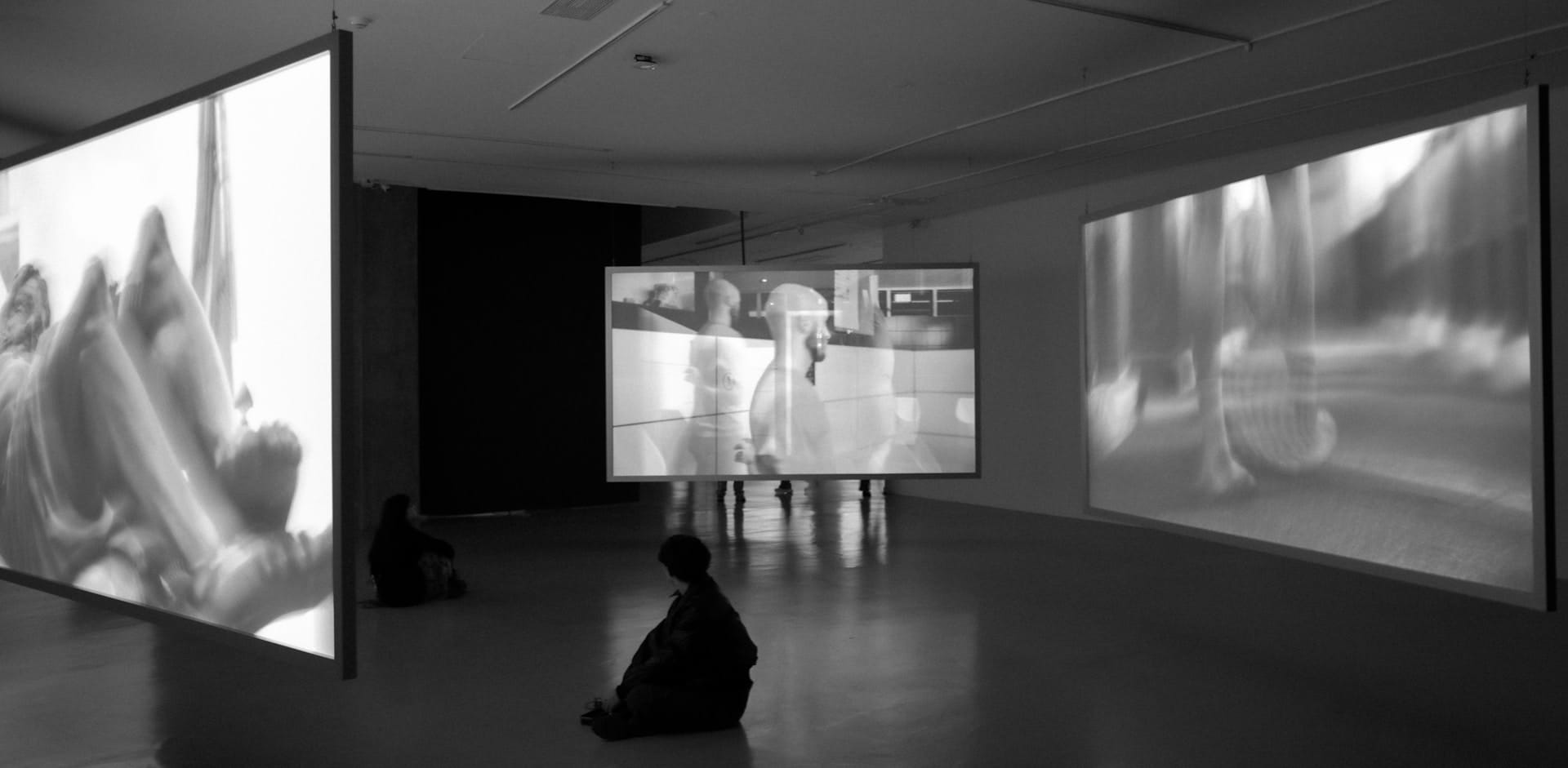
Video installation art places the moving image inside an architectural environment rather than in front of a screen. Unlike video shown in a gallery, installation gives the viewer a spatial relationship with image and time — the work surrounds rather than addresses. Nam June Paik and Bill Viola developed the form from the 1960s onward, followed by Gary Hill.
What Happens to the Moving Image When You Give It a Room?
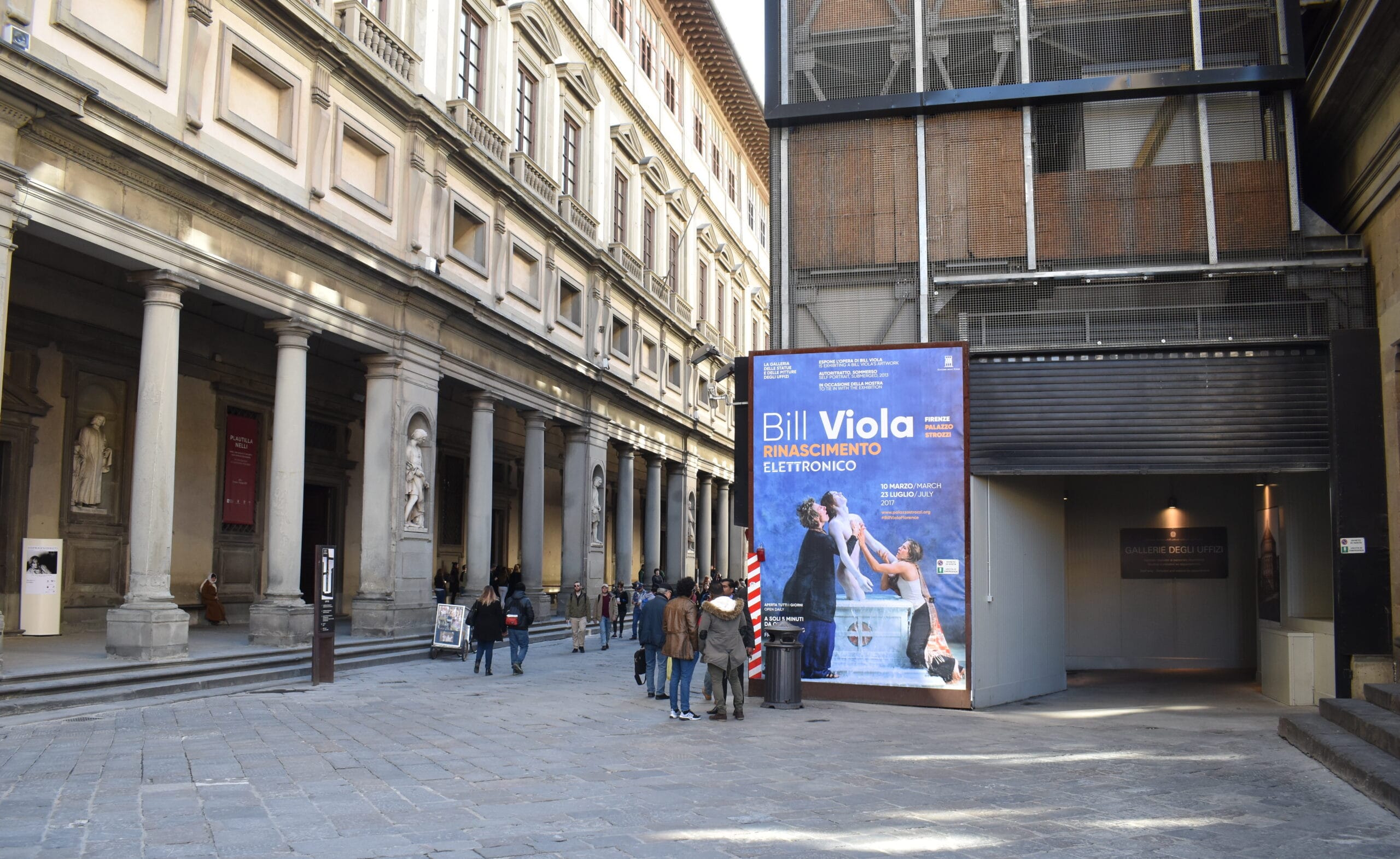
In March 1963, Nam June Paik opened “Exposition of Music — Electronic Television” at Galerie Parnass in Wuppertal, Germany. Thirteen manipulated television sets arranged through the gallery space. The cathode-ray tubes had been tampered with. Magnets warped the scan lines; the images pulsed and deformed. Nobody had done this before. What Paik had recognized, before anyone had a name for it, was that the television was a sculptural object as much as a broadcast medium. The screen was not the work. The room was.
That distinction — between the screen as window and the screen as condition — is what separates video installation from video art more broadly. A video work shown on a monitor in a gallery is still a picture on a wall. The viewer stands in front of it at the same distance they would stand from a painting. The frame is respected. Installation refuses this arrangement. It makes the frame the problem.
Bruce Nauman’s Live-Taped Video Corridor (1970) is the clearest early demonstration of what this refusal can do. The work is a 20-inch-wide corridor. Two monitors sit at the far end. A ceiling-mounted camera feeds live footage to the top monitor; the bottom monitor shows pre-taped footage of the empty corridor. As the viewer walks toward the monitors to see themselves, their image on the live feed grows smaller rather than larger. The architecture and the image conspire together against the body’s expectation. You walk toward yourself and recede. That is not something cinema can do. Cinema presupposes a fixed viewer in a fixed seat facing a fixed frame. Installation disperses the viewer, refuses the single correct vantage point, and makes spatial position the medium.
The contrast with cinema is worth holding. Film theorists from Christian Metz onward have described the cinema spectator as sutured into the image, immobilized, darkened-out, absorbed. Video installation breaks that suture deliberately. The lights may be low, but the viewer can walk. Their body casts a shadow on the projection. Their presence is part of the work’s physics. This connects installation’s spatial logic to questions that postwar American artists were also rethinking what presence meant in a gallery. Those artists asked whether art could be an event rather than an object, a relationship rather than a thing to look at.
Paik’s position within this history also runs through his relationship to mass media. He purchased a second-hand video camera in 1965 on the same day Pope Paul VI visited New York and shot footage from a taxi. He screened that footage that evening at Café au Go Go as art. The gesture argued that the artist’s relationship to the broadcast image was adversarial and appropriative. This was closer to Pop art’s willingness to use commercial media against itself than to the contemplative tradition of painting. Television was not a neutral delivery mechanism. It was a cultural apparatus, and an artist could seize it.
The Screen Is Not a Window
Paik’s TV Buddha (1974) purchased an 18th-century bronze Buddha statue on Canal Street, New York. He placed it facing a closed-circuit monitor that showed its own reflection in real time. The Buddha contemplates the Buddha. The work does not depict self-regard. It enacts a closed loop of self-regard that is also a very precise critique of television as mirror. The medium is used to comment on the medium. What makes it installation rather than video art is the sculptural presence of the statue: the weight of the bronze, the historical resonance of the object, the physical distance between the statue and its electronic double. Remove the distance and you have a different work.
Bill Viola trained as an assistant to Peter Campus and Nam June Paik in his early career. The spatial logic he learned from both runs through everything he made afterward. His The Crossing (1996) is a two-channel color video installation with four channels of sound. Each projection is approximately 14 feet tall, runs 10 minutes and 57 seconds. One screen shows a man consumed by fire. The other shows the same man consumed by water. Both projections run simultaneously. There is no correct place to stand. You are always between two conditions, never resolved into one. The binary is not symbolic decoration. It is a structural argument about the viewer’s position in the work: always between, never arriving.
Gary Hill’s Inasmuch As It Is Always Already Taking Place (1990), first exhibited at the Museum of Modern Art from October 1990 through January 1991, installs 16 monitors of varying sizes in a horizontal niche carved into a wall. Each monitor shows a fragment of a naked body in slow motion: a hand, a ribcage, the curve of a shoulder. The body is never assembled. The monitors disaggregate rather than aggregate. Hill’s work at MoMA demonstrates how installation uses the monitor itself as sculptural mass. The physical variation in screen sizes carries meaning that a single large projection could not.
The spatial argument these works share is this: installation doesn’t simply put video in a room. It uses architecture as syntax. Darkness matters. Distance matters. Ceiling height determines whether a projected figure is life-size or monumental. Speaker placement determines whether sound surrounds or directs. You cannot reproduce a video installation by watching a recording of it, for the same reason you cannot reproduce a building by looking at a photograph. The experience is volumetric, and volume cannot be flattened without loss.
That unreproducibility is not a bug. It is the medium’s most radical claim. Against the digital reproduction and infinite circulation of the still image, installation insists on presence. Sound and performance installation share this insistence: both traditions use time-based, site-specific work to refuse the reproducibility of conventional art objects. For that thread, see Sound, Performance, and Installation Art. Jessica Bronson represents a contemporary continuation of what Paik, Viola, and Hill established. Her practice extends this argument into mediated landscape and video environments. The moving image, given space, becomes something fundamentally different from film or photography. The internal link to Bronson’s work will be added once her ADI post is live.
This ambition also connects to a longer question in art history: whether painting could be an environment rather than an object. Rothko’s chapel paintings want to surround the viewer. Video installation does surround the viewer. The spatial aspiration is continuous; the medium that can fulfill it changed.
Five Works That Changed What the Moving Image Could Be
Nam June Paik, TV Garden (1974–1977, revised 2002): Forty-nine television monitors placed among live tropical plants, all playing Global Groove (1973). The tape mixes Beethoven’s Moonlight Sonata with Allen Ginsberg chants, Japanese television commercials, and Nigerian dance performance. The garden format puts television back into biological time, among things that grow and die. The monitors flicker with human-made images; the plants are indifferent to them. Paik found the juxtaposition funny and serious simultaneously, which was his characteristic register.
Bruce Nauman, Live-Taped Video Corridor (1970): A corridor twenty inches wide. Two monitors at the far end. As documented at the Solomon R. Guggenheim Museum, the top monitor shows a live feed from a ceiling-mounted camera; the bottom shows pre-taped footage of the empty corridor. The viewer who walks toward the monitors sees their own image shrink rather than grow. Architecture produces a specific kind of self-alienation. Nauman was not interested in beautiful images. He was interested in what happens to the body in designed space. Anyone who has ever wondered whether buildings make you feel a certain way on purpose knows this question is real.
Bill Viola, The Crossing (1996): Two-channel projection, each screen approximately 14 feet tall, running 10:57, with four channels of surround sound. One screen: fire consumes a man from his feet upward. Other screen: water pours from above and consumes the same man downward. Both projections play simultaneously. There is no narrative sequence, no resolution, no instruction about which screen to watch first. The elemental opposition of fire and water operates less as symbol than as structural argument about simultaneity and the viewer’s impossible position between two irreconcilable conditions.
Gary Hill, Tall Ships (1992): Commissioned by curator Jan Hoet for Documenta 9 in Kassel, Germany. A dark corridor; 16 figures projected at life-size scale on the walls. As the viewer walks through, each figure approaches in response to the viewer’s proximity, pauses, then retreats. The interaction is not programmed to be spectacular. The figures are quiet, unhurried, slightly uncanny. The work belongs in the same conversation as artists working in installation who bring accumulation and atmosphere rather than narrative. The effect builds through duration and repetition rather than through a single dramatic gesture.
Bill Viola, Ocean Without a Shore (2007): Three high-definition video channels installed within an existing 15th-century chapel — the Church of San Gallo in Venice — for the 52nd Venice Biennale, as documented by the Pennsylvania Academy of the Fine Arts (pafa.org/museum/exhibitions/bill-viola-ocean-without-shore). Figures emerge from blackness through a luminous threshold, moving as if crossing between states of being. Viola did not adapt the work to the chapel. He read the chapel’s proportions and age into the work’s logic, so that the 15th-century stonework became part of the argument about time and passage. The building was not a neutral container. It was a collaborator.
Shop the Collection
These two books address the same question this article does — what video installation art is and why it matters — from complementary positions. London’s book is the historical record; Mondloch’s is the theoretical framework. Together they cover the ground.
Barbara London, Video/Art: The First Fifty Years (Phaidon, 2020): London spent decades at MoMA acquiring and exhibiting the artists discussed here — Paik, Viola, Hill — and the book reads like a firsthand account because in many cases it is one; 304 pages, generously illustrated, with the production quality Phaidon brings to all their survey volumes.
Kate Mondloch, Screens: Viewing Media Installation Art (University of Minnesota Press, 2010): Mondloch wrote the theoretical framework that most clearly articulates what distinguishes screen-reliant installation from both cinema and gallery video — this is the book that answers the question this article raises, from the academic who worked hardest to answer it.
Further Reading
If you want to go deeper into video art’s first fifty years, there are two books worth owning. Not three.
Michael Rush, Video Art (Thames & Hudson, revised 2007): The most complete single-volume survey of the medium — 224 pages, covers early practitioners through large-scale installation, and Thames & Hudson’s production quality means the frame grabs and installation shots are worth the page count alone; if you are buying one overview, this is it.
Doug Hall and Sally Jo Fifer, eds., Illuminating Video: An Essential Guide to Video Art (Aperture, 1990): The primary-source anthology for the medium’s first generation — essays by artists and critics who were in the room; if Rush gives you the survey, Illuminating Video gives you the argument from inside, in the voices of the people who were making it.
For broader context on the books ADI recommends for serious looking across art and design, see a library for serious looking.
Frequently Asked Questions
What is the difference between video art and video installation art?
Video art is the broader category: any artwork that uses video as its medium, including single-channel works shown on a monitor in a gallery or online. Video installation art is a specific practice within that category — one that uses architectural space as a formal element. In a video installation, the viewer’s physical position in the room, the scale of projection, the relationship between multiple screens, and the spatial properties of darkness and sound are all part of the work’s meaning, not incidental to it. A video installation cannot be fully experienced through a recording.
What is TV installation art?
TV installation art uses the television set itself, the physical box, as sculptural material rather than as a delivery screen. Nam June Paik defined the form: his 1963 Wuppertal exhibition presented 13 manipulated TV sets as objects, and works like TV Garden (1974) planted dozens of monitors in a bed of live plants. The distinction from projection-based video installation matters, since the TV set carries its own domestic and broadcast associations into the room, and the artist is working with those meanings as much as with the image on screen.
Who invented video installation art?
No single inventor, but Nam June Paik is the figure whose early work established the core argument. His 1963 exhibition at Galerie Parnass in Wuppertal — 13 manipulated television sets, objects as much as screens — was the first time an artist had used television itself as a sculptural medium rather than as a broadcast delivery mechanism. Bruce Nauman, Vito Acconci, and Dan Graham developed the body-in-space dimension of the form through the late 1960s and 1970s. Bill Viola brought a new scale and physical intensity to installation from the 1980s onward.
How do you experience video installation art — is there a right way to watch it?
There is no single correct viewing position, and that is deliberate. Most video installations are designed to be experienced through movement — walking through, standing in different positions, staying long enough for the temporal dimension of the work to become visible. The temptation to watch an installation the way you would watch a film (from a fixed position, through a single duration) usually misses the work. The right question is not ‘what does this show?’ but ‘what does my position in this room do to what I’m seeing?’
Why can’t video installation art be reproduced on a screen at home?
Because the spatial and architectural properties of the work are part of the work’s meaning, not its packaging. The Crossing projected 14 feet tall in a darkened space with four-channel surround sound is a physically different experience from the same footage on a laptop screen. The scale determines whether the figures are monumental or intimate. The sound determines whether you are inside the event or observing it. The darkness determines whether you can see the edges of the projection or whether the image seems to extend beyond its frame. None of those properties survive compression into a domestic viewing context.
What are the most important video installations in art history?
Any short list is a position, not a survey. Nauman’s Live-Taped Video Corridor (1970) established the body-in-space problem that most subsequent installation addressed. Paik’s TV Garden (1974) made the most generous and funny argument for television as biological medium. Viola’s The Crossing (1996) is the work that most completely realized the immersive ambition of the multi-channel form. Gary Hill’s Tall Ships (1992) remains the clearest demonstration of what interaction can do when it is formally rigorous rather than merely responsive. Viola’s Ocean Without a Shore (2007) showed how installation could absorb an existing architectural context without subordinating itself to it.
How do museums preserve and maintain video installation artworks?
Video installation conservation is one of the more technically demanding areas in contemporary art preservation. The challenges include hardware obsolescence (early works used equipment that is no longer manufactured), format migration (from 1/2-inch open-reel tape through Betamax through DVD through digital file formats), and the question of whether a work migrated to new hardware is still the same work. Most major institutions with significant video collections — MoMA, the Guggenheim, the San Francisco Museum of Modern Art — have developed protocols for variable media conservation that involve extensive documentation of the artist’s intent and regular consultation with living artists or their estates.
See also: Systems Art Explained, New Genre Public Art, Conceptual Art After Minimalism

About Joe Post
Joe Post holds an MFA in Art from California Institute of the Arts (CalArts) and has done additional graduate work at the School of the Art Institute of Chicago. He founded Art Design Ideas to write about design as cultural argument — the decisions, contradictions, and assumptions built into the objects we live with.