
Sound art is a practice in which sound is the primary artistic medium — not background, not accompaniment, but argument. From Luigi Russolo’s noise machines in 1913 to Janet Cardiff’s spatial audio walks today, it encompasses installation, performance, and sculpture, insisting that experience requires time, presence, and a body in space.
Why sound art has always made the visual art world uncomfortable
The problem is structural. The commercial art world runs on objects: things that can be catalogued, insured, shipped, and auctioned. Sound performance and installation art refuses all of this. A drone emerging from a steam grate in Times Square cannot be consigned to Christie’s. A four-minute-and-thirty-three-second silence cannot hang above a collector’s fireplace. The discomfort that has always accompanied sound art in museum and gallery contexts is not a matter of taste — it is a matter of the market’s inability to process an art form that dissolves on contact with the object economy.
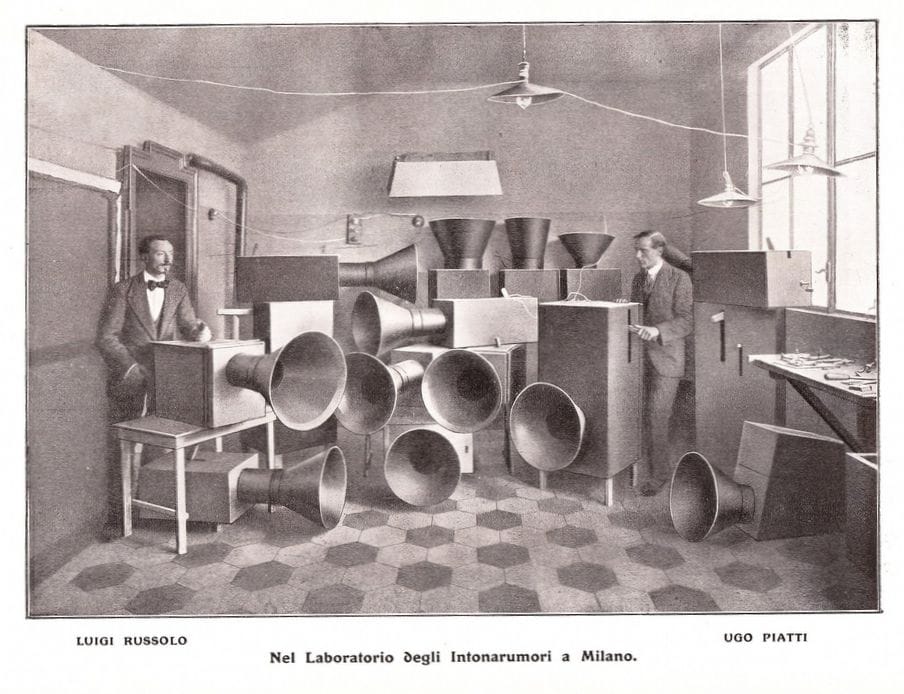
The origin story is Futurist and deliberately confrontational. In 1913, Luigi Russolo — a painter, not a musician — published “The Art of Noises,” a manifesto arguing that the acoustic materials of modern life were more alive than anything the concert hall’s inherited repertoire could produce. He then built the Intonarumori: mechanical noise instruments designed to replicate the sounds of industry, warfare, and crowd. The machines were destroyed in World War II. What survives is the manifesto and later reconstructions. Their importance is not documentary. Instead, they established the premise the entire field would work within for the next hundred years: the acoustic materials of contemporary life are a legitimate artistic medium, and the institutions that organize what counts as music are the obstacle, not the gateway.
The conceptual pivot came in 1952. John Cage’s 4’33”, first performed August 29 at the Maverick Concert in Woodstock, New York by pianist David Tudor, consists of four minutes and thirty-three seconds of silence — a three-movement composition in which the performer sits at the instrument and does nothing. The “content” is whatever ambient sound the room contains: shuffling seats, wind through the hall, the audience’s own discomfort. Cage was direct about the influence that produced it: “Actually what pushed me into it was not guts but the example of Robert Rauschenberg.” Rauschenberg’s 1951 White Paintings — monochrome canvases that turned the gallery wall into a screen for ambient light and shadow — gave Cage the permission to reattribute authorship of sonic content from composer to environment. A 1951 visit to Harvard’s anechoic chamber, where Cage heard his own nervous system and blood circulation, confirmed that silence doesn’t exist. There is only sound we have or haven’t decided to notice.
The Fluxus movement of the late 1950s and 1960s took Cage’s permission and turned it into institutional critique. Event scores, sound happenings, and performance works positioned artistic practice against the museum system and the inherited European concert tradition simultaneously. By 1974, the term “sound art” had entered print: Bernhard Gál’s research identifies its first documented use in the Something Else Press 1974 Yearbook. By 1979, MoMA mounted the first major museum exhibition under the title “Sound Art,” featuring Maggi Payne, Connie Beckley, and Julia Heyward — the institutional acknowledgment arriving, as it usually does, approximately sixty years after the field had already done its most consequential work. The practices that were grounded in the broader context of the postwar avant-garde’s refusal to explain itself had been producing sound art for decades before the art world had a name for it.
What separates sound art from music — and why the distinction matters
The distinction is not about instruments or genre. Barbara London, curator at MoMA, formulated it clearly: sound art is “more closely allied to art than to music, and usually presented in the museum, gallery, or alternative space,” as cited at Tate Art Terms. But the more exact difference is about control over time. Music is organized from the outside — the composer or performer controls duration, tempo, sequence. Sound art is organized by space experienced from the inside: the viewer moves, stops, returns, and the work continues regardless. The artwork does not perform for you. You inhabit it.
This is what separates sound art from the art world’s hunger for the optical and the sellable. A painting asks you to stand in front of it. A sound installation asks you to stand inside it — and to notice what changes as you move. The terms of attention are entirely different, and the commercial infrastructure that processes visual art has never found a way to accommodate them.
Meredith Monk — born November 20, 1942 in New York City — is the clearest demonstration of what this means as a sustained artistic practice. She studied at Sarah Lawrence College, graduating in 1964, and founded The House in 1968, an explicitly interdisciplinary performance company that refused to sort its work into existing categories. Her extended vocal technique — using the voice across a four-octave range plus non-standard sounds including whining, hiccupping, and animal-like vocalizations — is not a stylistic choice. It is the argument: the voice is an instrument that precedes language and carries information no text or image can carry. The MacArthur Foundation Fellowship followed in 1995. The National Medal of Arts, presented by Obama, came in September 2015. Among artists working in immersive space, Monk is the practitioner who most consistently grounds the immersive experience in the human body’s own sonic capacity rather than in visual spectacle.
Max Neuhaus’s Times Square (1977, maintained by Dia Art Foundation, removed 1992 and reinstalled 2002) is the field’s most precise demonstration of what sound art proposes about attention in public space. A deep, slightly pulsating drone emerges from a steam grate on the pedestrian island at Broadway between 45th and 46th Streets. No signage. Neuhaus intended the sound to register as “unusual machinery sound from below ground,” as documented by the Dia Art Foundation. The work is experienced daily by thousands of people, identified by almost none of them as art. That ratio is not a failure. It is the point.
Susan Philipsz’s Lowlands (2008) brought sound installation into the most contested institutional arena in British contemporary art when it won the Turner Prize in 2010 — the first sound installation to win, the first sound artist to win. She sang three unaccompanied a cappella versions of the 16th-century Scottish lament “Lowlands Away” under three bridges over the River Clyde in Glasgow: George V Bridge, Caledonian Railway Bridge, and Glasgow Bridge. There was no visual component. There was no score to display. The Tate’s decision to award it registered, within that world, as a commitment to the terms the field had been arguing for since 1913.
Connie Hatch, faculty at CalArts School of Art, represents a practice rooted in presence and performance working at the intersection of Cage-influenced institutional critique with contemporary gallery and museum work. Her installations have been exhibited at the Whitney Museum and The New Museum, among others.
Five works that prove sound can be an argument
Not every work in the field earns the description. These five do.
Luigi Russolo, Intonarumori (1913–1930)
Russolo built the Intonarumori — mechanical noise instruments producing the sounds of industry, warfare, and crowd — to mount a direct attack on the concert hall’s inherited acoustic repertoire. The machines were destroyed in World War II. What survives is the manifesto and later reconstructions. Their importance is not documentary. Instead, they established the premise the entire field would work within for the next hundred years: the acoustic materials of contemporary life are a legitimate artistic medium, and the institutions that organize what counts as music are the obstacle, not the gateway. Video installation art shares this condition — the destruction of the originals and the survival only of reconstructions prefigures a recurring theme in time-based and installation art.
John Cage, 4’33” (1952)
A three-movement composition in which the performer — David Tudor, at the first performance — sits at the piano and does not play. Four minutes and thirty-three seconds. The work is not silence. It is a demonstration that silence doesn’t exist. The frame — concert hall, piano, performer — is what makes the ambient sound audible as content rather than noise. Cage reattributed authorship from composer to environment. The work is documented at the Museum of Modern Art, which holds it in its collection. Whatever one thinks of the piece, the claim is precise: the frame makes the art.
Max Neuhaus, Times Square (1977/2002, permanent, Dia Art Foundation)
A subterranean harmonic drone emerging from a steam grate on the pedestrian island at Broadway and 45th–46th Streets, New York City. No label. No signage. Neuhaus wanted the work to be plausible as environmental sound — and it is. The Dia Art Foundation has maintained it since Neuhaus’s death in 2009. Thousands encounter it daily. The work is not visible. It has no object to stand in front of. The proposition it makes — that attention is a choice, and that the city contains structures of aesthetic experience that go unnoticed because we haven’t agreed to notice them — is the cleanest statement of sound art’s core argument in any medium.
Janet Cardiff, The Forty Part Motet (2001)
Forty speakers arranged in an oval, each carrying one of forty individual vocal recordings of Thomas Tallis’s Spem in alium (1570). Standing at the center, you hear the full polyphony of a Tudor choral work in three-dimensional space. Moving toward a speaker, you hear a single voice — a tenor, a countertenor, breathing between phrases — close enough to feel the human presence the recording indexes. The work is in the permanent collections of the National Gallery of Canada, the Museum of Modern Art, and Inhotim, Brazil. Cardiff was born in 1957 in Brussels, Ontario. She completed her MVA at the University of Alberta in 1983. The Forty Part Motet is the essay’s hinge: it demonstrates, more clearly than almost any work in the field, that the listener’s body in space determines what they hear. The work changes as you move through it. That is not a feature. It is the argument.
Janet Cardiff, Audio Walks (1991–ongoing)
Cardiff’s first audio walk was created during a residency at Banff Centre in 1991. The premise: participants carry a device that layers Cardiff’s pre-recorded voice over real-time ambient sound, producing a double temporality — the walk is both now and recorded. The recorded Cardiff narrates events, describes what she saw, speaks to the listener. The live environment contradicts or confirms or ignores her. Notable works include Her Long Black Hair (2004, Central Park) and Words Drawn in Water (2005, Hirshhorn Museum). The walks make the body’s location their subject: you are always in two places at once, and the dissonance between them is the content.
Shop the collection
The two records below are not background listening. They are works — complete arguments about what a human voice can carry when it refuses the conventions organizing what a voice is allowed to do.
- Meredith Monk, Dolmen Music (ECM Records, vinyl LP): The record that established Monk’s extended vocal practice as a full compositional language — not a sample or a preview, but the whole argument held in one’s hands and played at home.
- Meredith Monk, Book of Days (ECM Records, CD): Companion to a 1988 film, Book of Days moves between Monk’s voice and ensemble, between medieval and modern temporal registers. It functions as a sound installation in miniature and represents one of the more coherent arguments for what extended vocal technique is actually for.
Further reading
These three books are worth owning together. None of them duplicates what the others do.
- Alan Licht, Sound Art Revisited (Bloomsbury Academic, 2019): The most thorough account of the field’s history written from inside the practice — Licht covers dozens of artists and works not found elsewhere, without the philosophical abstraction that makes some sound art writing unreadable. Start here.
- Douglas Kahn, Noise, Water, Meat: A History of Sound in the Arts (MIT Press, 1999): The serious scholarly history — an interdisciplinary account from Russolo through postwar America that grounds the field in material and institutional specifics rather than aesthetic claims. Kahn names his sources and argues his positions. That discipline is part of its value.
- Brandon LaBelle, Background Noise: Perspectives on Sound Art (Second Edition, Bloomsbury, 2015): Where Kahn gives you the history and Licht gives you the roster, LaBelle gives you the theory — spatial thinking, architecture, environments, the body’s role in reception. Read it after the other two.
Frequently asked questions
What is sound art?
Sound art is an artistic practice in which sound is the primary medium — not background, not accompaniment, but the substance of the work itself. It encompasses installation, performance, and sculpture. Unlike music, it is typically presented in gallery, museum, or public space contexts rather than concert halls, and it is often structured around the listener’s movement through space rather than a fixed duration imposed by a performer. The term was first documented in print in the Something Else Press 1974 Yearbook.
How is sound art different from music?
The organizing difference is control over time. Music is structured from the outside: the composer or performer determines duration, sequence, and tempo. Sound art is structured from the inside: the viewer moves through space and determines their own duration and path, while the work continues regardless. Barbara London’s formulation at Tate Art Terms places sound art as ‘more closely allied to art than to music.’ The difference is not about instruments — it is about what the work asks the audience to do and whether the audience controls their own experience of it.
Who are the most important sound artists?
The most documented figures in the field’s development include Luigi Russolo (whose 1913 Intonarumori machines and manifesto established the premise), John Cage (whose 4’33” in 1952 reattributed authorship of sonic content from composer to environment), Max Neuhaus (whose Times Square installation has operated continuously, with interruption, since 1977), Meredith Monk (whose extended vocal technique redefined what the voice can carry as artistic medium), Janet Cardiff (whose spatial audio works and the Forty Part Motet demonstrate the body’s role in determining what is heard), and Susan Philipsz (whose Lowlands won the Turner Prize in 2010, the first sound installation to do so).
Where can you experience sound art?
Permanent and recurring installations exist in several accessible locations. Max Neuhaus’s Times Square drone can be experienced at the pedestrian island at Broadway between 45th and 46th Streets, New York City, at any hour. Janet Cardiff’s The Forty Part Motet (2001) is in the permanent collections of the Museum of Modern Art, the National Gallery of Canada, and Inhotim in Brazil. MoMA periodically reinstalls it. Major sound art programs exist at Dia Art Foundation, the Tate (London), and the Hamburger Bahnhof (Berlin).
Is sound art a visual art form or a musical one?
Neither category fits, and that is the point. Sound art developed precisely because it could not be accommodated within existing institutional categories: it is not performance music (it lacks the concert hall’s conditions), not visual art in the object sense (it cannot be hung or shipped), and not theater (it does not require a script or a stage). The Tate, MoMA, and Dia Art Foundation all collect and present sound art within their visual art programs, which reflects the practical reality that gallery and museum infrastructure is the closest available accommodation — not that sound art is fundamentally visual.
What was the first major sound art exhibition?
The first major museum exhibition under the title ‘Sound Art’ was held at MoMA, New York in 1979, featuring Maggi Payne, Connie Beckley, and Julia Heyward. The term itself had appeared in print five years earlier, in the Something Else Press 1974 Yearbook, as documented by researcher Bernhard Gál. Earlier exhibitions had presented works we now classify as sound art without using the term.

About Joe Post
Joe Post holds an MFA in Art from California Institute of the Arts (CalArts) and has done additional graduate work at the School of the Art Institute of Chicago. He founded Art Design Ideas to write about design as cultural argument — the decisions, contradictions, and assumptions built into the objects we live with.