Yayoi Kusama is a Japanese artist born in 1929 who has spent six decades building a visual system out of personal pathology. Her polka dots originated as hallucinations. The Yayoi Kusama design language (dots, nets, infinity mirrors) is the most commercially successful case in contemporary art of psychiatric experience converted into repeatable visual form.
Where the Dots Came From
Kusama’s dots originated as childhood hallucinations. This is not metaphor and it is not a retrospective reframing. Born March 22, 1929, in Matsumoto, Nagano, Japan, on her family’s plant nursery and seed farm, Kusama began experiencing vivid hallucinations from around age 10: flowers that appeared to speak, patterns that multiplied endlessly across her visual field, fields of dots that covered everything she saw. Her earliest documented dot work dates to 1939. She began drawing to contain the hallucinations, to get them out of her body and onto paper so she could function. This is the origin of the visual system. It was coping before it was art.
She left Japan in 1957, encouraged partly by correspondence with Georgia O’Keeffe, whom she had written asking for advice on entering the American art world. O’Keeffe replied and encouraged the move. Kusama arrived in New York in 1958 and spent the next 15 years there. During that period she was central to the New York avant-garde: large canvas paintings of obsessively repeated arcing marks (the Infinity Nets series), soft sculptures covered in stuffed fabric forms, Infinity Mirror rooms, and large-scale happenings that included nude anti-Vietnam War protests. The Infinity Nets paintings drew comparisons from critics to Pollock, Rothko, and Newman. The formal resemblance was real even if the sources were entirely different.
When she left New York in 1973, she was largely forgotten outside Japan. The retrospectives of the late 1980s and 1990s restored international attention. By 2012 she had become, by auction revenue and ticket sales, the most commercially successful living artist in the world.
I fight pain, anxiety, and fear every day, and the only method I have found that relieved my illness is to keep creating art.
Since 1977, Kusama has voluntarily lived in a psychiatric facility in Tokyo. She walks from the facility to her studio each morning and returns each evening. The institution is not confinement; it is the stable condition under which she can work. She has said: “I fight pain, anxiety, and fear every day, and the only method I have found that relieved my illness is to keep creating art.” The psychiatric context is part of the work’s public meaning. Kusama has never hidden it, and the work cannot be understood without it. Her 2003 autobiography, Infinity Net (trans. Ralph McCarthy, University of Chicago Press / Tate Publishing), documents the hallucinations from childhood through the New York years in her own words.
How Obsession Becomes a Repeatable System
The Infinity Mirror Rooms, first created in 1963 and continuously developed since, are the mechanism by which Kusama transfers her interior experience to other people. The mirror room is a hallucination you can enter voluntarily and leave at will. Inside, reflections multiply to apparent infinity; the viewer’s sense of self-boundary dissolves momentarily. This is not a simulation of psychosis. It is a controlled delivery of a specific perceptual effect. The distinction matters.
Kusama has produced more than 20 distinct Infinity Mirror Rooms across her career. They vary significantly: some are intimate chambers lit by suspended LED lights, others are large installations with reflecting pools. What they share is the mechanism of multiplication, mirrors producing infinity from a finite space, and the timed exit. Most museums allow 45 seconds to two minutes per viewer. The brevity is not a logistical concession. It is part of the formal structure: the room is most powerful at the threshold, before the eye adjusts.
The 2017 Hirshhorn Museum exhibition Infinity Mirrors generated 34,000 Instagram shares and sold out for months in advance. The rooms became the most broadly attended contemporary art exhibition of that year. This created a split in critical reception: the rooms were described as Instagram bait, as tourist attractions, as content rather than art. They were also the most direct delivery of Kusama’s original project to the widest audience in the history of contemporary art. The accusation and the achievement cannot be separated. Kusama’s visual system was always about multiplication, always about distributing the experience outward. Instagram is continuous with the polka-dot dress, the pumpkin sculptures, the collaboration with Louis Vuitton.
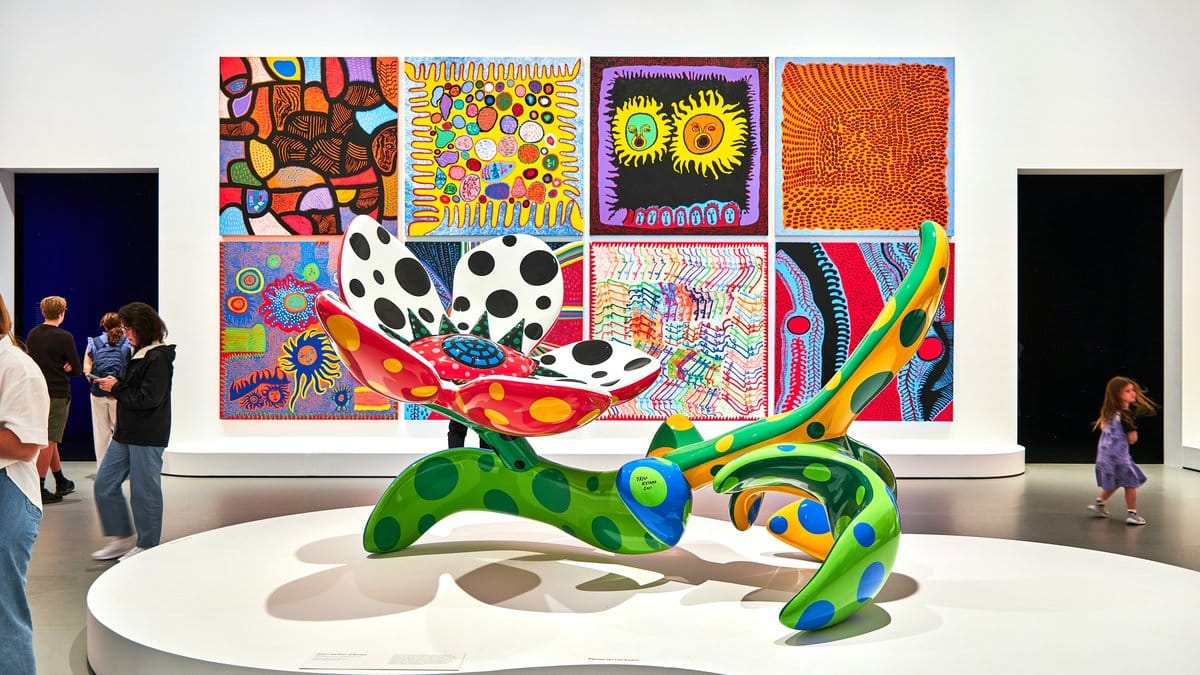
The Louis Vuitton collaboration ran from 2011 to 2012, under Creative Director Marc Jacobs. Kusama’s dots appeared on handbags, scarves, and jewelry. Pop-up installations with Kusama mannequins opened in store windows worldwide. A second collaboration was announced in 2023. These collaborations attracted sharp critical reaction: fine art absorbed into luxury commerce, the psychiatric origin story used to sell handbags. This reading is not wrong. What it misses is that the visual system Kusama built was always scalable. The dot works at any size, on any surface, at any price point. The Vuitton bag and the Tate retrospective use the same form because the form is genuinely that transferable. That scalability is one of the Yayoi Kusama design language’s formal achievements, whether or not one is comfortable with what it produces.
The dot works at any size, on any surface, at any price point — that scalability is part of the formal achievement.
The Dots: What They Mean
The question most consistently asked about Kusama is not about the art world or the mirror rooms. It is about the dots. Why dots? What do they mean? The answers are specific.
Origin in hallucination. The dots began as involuntary perception. Kusama did not adopt polka dots as a style. She drew what she saw when she could not stop seeing it. The repetition on paper was an attempt to match, and thereby contain, the repetition in her visual field. The dot as a formal unit in her work carries this history. It is the transcription of a hallucination, not a design decision.
Self-obliteration. Kusama has used the phrase “self-obliteration” to describe the psychological function of the pattern work. If a figure is covered entirely in dots, it becomes part of the pattern. The boundary between self and environment dissolves. For Kusama, this dissolution was relieving, not nihilistic. The self that disappeared into the pattern was the self that was suffering. The pattern offered escape from isolated consciousness into something boundless.
Infinity. The dots, individually finite, collectively suggest the infinite. This is the structural link between the canvas work and the mirror rooms. The Infinity Net paintings work by the same logic as the Infinity Mirror Rooms: enough repetition of a small unit produces the experience of boundlessness. Kusama has described the desire to dissolve the self into the cosmos as a persistent need, documented throughout Infinity Net.
Scale independence. The dots function on a 10-meter canvas, on a ceramic surface, on a mirrored architectural interior, on a mass-produced accessory. They do not require any specific material or scale to function. Most visual systems in contemporary art are tied to a particular material or context. Kusama’s translates across every application because its logic is mathematical and perceptual rather than material.
Cultural resonance. Japanese textile traditions, particularly tie-dye techniques like shibori and dotted yuzen prints, form a background against which Kusama’s dot work resonates differently in Japan than in the West. The polka dot was already a culturally loaded form (childlike, festive, associated with specific fabric traditions) before Kusama applied it to psychological compulsion. The collision between a culturally innocent form and a psychologically urgent use is part of what makes the work legible across audiences and markets.
The Yayoi Kusama Design Language at Different Scales
Infinity Nets series (begun c. 1958, New York): Large monochrome canvases covered edge-to-edge in small arcing marks, a net made of obsessively repeated hand gestures. Some canvases reach 10 meters wide. The paintings predate the mirror rooms and establish the formal logic: repetition as containment, the individual mark disappearing into pattern, the self dissolving into the system. MoMA holds examples.
Infinity Mirror Room — Phalli’s Field (1965): Hundreds of stuffed fabric forms cover the floor; mirrored walls multiply them to infinity. Made during Kusama’s New York period, in the context of both the feminist body politics and the anti-war movement of the mid-1960s. The phallus is not erotic here; it is stripped of singularity by repetition until it reads as pattern.
Pumpkin sculptures (from c. 1980s onward): The pumpkin (lumpy, asymmetrical, unglamorous) covered in dots and scaled from hand-held objects to monumental bronze installations. The large yellow pumpkin on Naoshima Island, Japan (1994) became one of the most photographed art objects in Asia. Kusama has said the pumpkin reminds her of the vegetable garden on her family’s farm in Matsumoto. The pumpkin is the least designed of her forms, which is part of its endurance.
The Souls of Millions of Light Years Away (2013): An Infinity Mirror Room in which LED lights of varying colors hang from the ceiling at varying heights, reflected in mirrored walls and floor. Viewers enter for one minute. The room does not induce hallucination; it mimics the physiological shape of one: dispersed lights in a dark infinity. Permanent collection, The Broad, Los Angeles.
For another artist in the tradition of confrontational abstraction who built his practice around direct emotional impact on the viewer, see our profile of Mark Rothko’s color field paintings.
Shop the Collection
There are two books that document the rooms rather than just reproducing the dots.
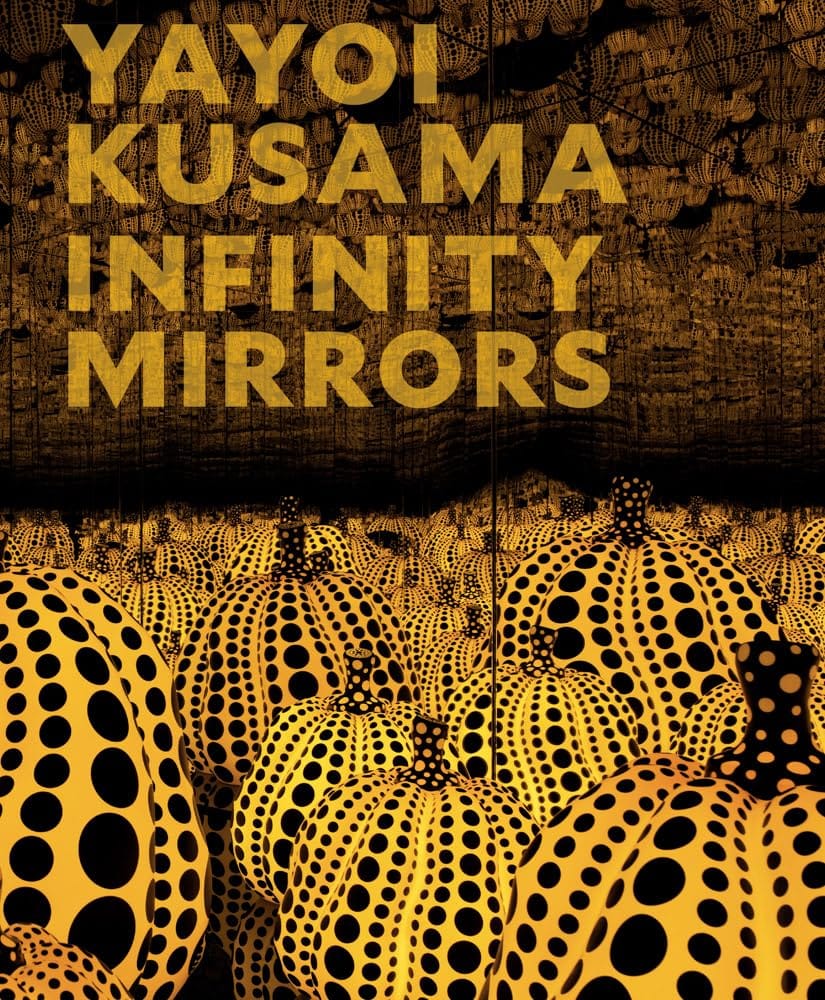
Yayoi Kusama: Infinity Mirrors
The exhibition catalog from the 2017 Hirshhorn retrospective. Six scholars, six rooms, full-color documentation with critical apparatus unavailable elsewhere in book form. If you want to understand the rooms rather than just experience them, this is the book.
Yayoi Kusama: All About My Love
Covers the full range of Kusama’s career with strong reproduction quality and attention to work from recent decades. For the reader who wants the arc rather than a single series.
Further Reading
Two books belong on the shelf for anyone who wants the argument, not just the image. For a broader list of essential art reading, see our best art books guide.
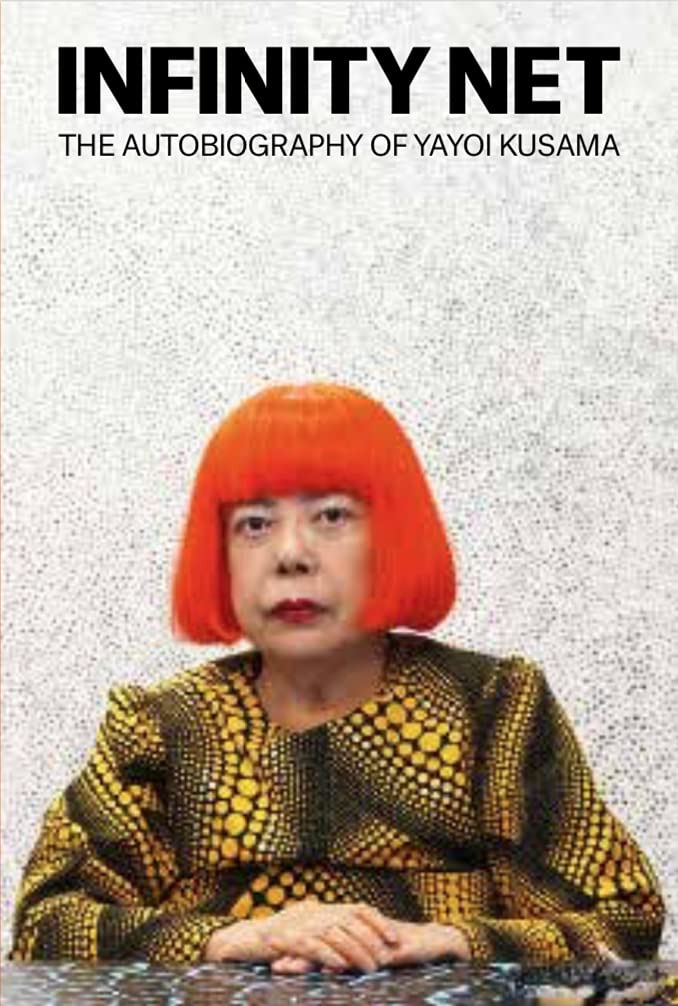
- Yayoi Kusama, Infinity Net: The Autobiography of Yayoi Kusama, trans. Ralph McCarthy (University of Chicago Press / Tate Publishing): The primary source. Kusama’s own account of her childhood hallucinations, her New York years, and her return to Japan. The only place to understand the origin of the visual system in her own words.
- Mika Yoshitake, ed., Yayoi Kusama: Infinity Mirrors (Prestel, 2017): Six distinct scholarly perspectives on the Infinity Mirror Rooms from the definitive retrospective catalog. Includes historical context, formal analysis, and documentation of installations that were temporary.
Frequently Asked Questions
What is Kusama’s art style?
Kusama’s work is most accurately described as conceptual art, with attributes drawn from feminism, minimalism, surrealism, art brut, pop art, and abstract expressionism. This is the description used by most major museum sources, including MoMA. The range reflects her position across multiple movements rather than full membership in any single one. She arrived in New York when Abstract Expressionism was dominant, exhibited alongside Minimalists, prefigured Pop, and sustained a feminist political engagement in the 1960s and 1970s. She is most productively understood as an artist who used the available vocabulary of her era to build something that belonged to none of those movements completely.
What is the meaning behind Kusama’s dots?
The dots originated as hallucinations, patterns Kusama experienced involuntarily from childhood, which she drew to contain and externalize. Their meaning in the work is tied to three things: origin in uncontrolled perception, the theory of self-obliteration (the individual absorbed into pattern, the suffering self dissolved into the boundless), and the formal logic of infinity (repetition that exceeds counting). The dots are not decorative. They are a record of what Kusama’s perceptual system produced and a method of converting that production into something stable.
Why are polka dots so important to Yayoi Kusama?
Because they were not a choice. Kusama did not adopt polka dots as a style. She drew what she saw when she could not stop seeing it. The dots were the specific form her hallucinations took: fields of repeating marks that covered everything in her visual field. The importance of the dot to her practice is that it is the direct transcription of her perceptual experience. Everything else in the visual system (the nets, the mirror rooms, the pumpkins, the Louis Vuitton handbags) follows the same logic: a simple unit repeated until it becomes something larger than itself.
What three things make Kusama unique as an artist?
First, she converted psychiatric experience into a visual system rather than using it as subject matter. The hallucinations are the formal method, not the theme. Second, the system is scalable in a way almost no other artist’s visual language is. The dots function on a 10-meter canvas, on a ceramic surface, on a mirrored architectural interior, on a mass-produced accessory. The logic holds at every scale. Third, she has sustained and self-consciously described the practice for more than 60 years, from the first drawings in 1939 through work produced in her mid-nineties. The longevity is not incidental. It is part of the formal claim: a visual system that does not exhaust itself.
Why does Yayoi Kusama use polka dots?
Kusama began experiencing hallucinations featuring dense fields of dots from around age 10. She started drawing them to contain the experience, to transfer the pattern from her visual field to paper. The dots were not a stylistic choice; they were the content of her hallucinations, and the repetition was the mechanism she found for managing them. The polka dots in her art and products are the same form she used to cope with a psychiatric condition she has lived with for over 80 years.
What are Yayoi Kusama’s Infinity Rooms?
The Infinity Mirror Rooms are installations Kusama has been creating since 1963. They use mirrored walls, ceiling, and often floor to multiply whatever objects are placed inside (LED lights, hanging orbs, dot-patterned forms) to create the visual impression of infinite space. Kusama has created more than 20 distinct rooms. Viewing times are typically 45 seconds to two minutes per visitor, as the perceptual effect is strongest at entry and diminishes as the eye adjusts.
Where does Yayoi Kusama live now?
Since 1977, Kusama has voluntarily lived in a psychiatric facility in Tokyo’s Shinjuku district. She walks from the facility to her studio each day. The arrangement is voluntary and working. She has produced some of her most celebrated work during the decades she has lived there.
What was the Yayoi Kusama Louis Vuitton collaboration?
Kusama collaborated with Louis Vuitton Creative Director Marc Jacobs in 2011–2012. Her dot patterns appeared on handbags, scarves, and jewelry, and pop-up installations featuring Kusama mannequins opened in Vuitton store windows worldwide. A second collaboration launched in 2023. The collaborations are the commercial extension of a visual system that was always scalable: the dot works at any price point.
How many Infinity Mirror Rooms has Kusama created?
Kusama has created more than 20 distinct Infinity Mirror Rooms across her career. They range from intimate one-person chambers to large gallery installations with reflecting pools. The Hirshhorn Museum’s 2017 Infinity Mirrors exhibition brought six rooms to the US on a traveling tour.
What is Yayoi Kusama’s most famous work?
The Infinity Mirror Rooms collectively constitute her most recognized body of work, particularly The Souls of Millions of Light Years Away (2013, The Broad, Los Angeles) and Aftermath of Obliteration of Eternity (Museum of Fine Arts, Houston). The large yellow pumpkin on Naoshima Island, Japan (1994), is among the most photographed individual art objects in Asia.

About Zoe Post
Zoe Post holds a BFA and a Master of Architecture from the School of the Art Institute of Chicago. She now works as a product marketing leader at an architectural product design firm, bringing hands-on industry perspective to everything she writes. At ADI she covers contemporary artists, textile and pattern design, and the design objects that sit at the boundary of art and function.