
Thomas McEvilley spent thirty years at Artforum arguing that Western art criticism had confused a local tradition for a universal standard. His 1999 survey of postmodern sculpture, Sculpture in the Age of Doubt, is where that argument becomes a demonstration. What modernism called transcendence was a historical position, not a fact about art.
What was McEvilley actually arguing — and why did it take thirty years for the art world to hear it?
The reason Thomas McEvilley could argue what he argued was that he had not been trained to see what everyone else in the room took for granted. His doctorate was in classical philology from the University of Cincinnati: Greek, Latin, Sanskrit, classical philosophy. Not in art history, not in the formalist critical tradition that ran from Clive Bell through Roger Fry through Clement Greenberg. Ingrid Sischy recruited him to write for Artforum around 1979. He arrived without the formation. That turned out to be the precondition of the work.
The flashpoint was a single show. In November 1984, McEvilley published “Doctor, Lawyer, Indian Chief” in Artforum (vol. 23, no. 3), a review of MoMA’s “Primitivism in 20th Century Art,” organized by William Rubin and Kirk Varnedoe. The exhibition brought together approximately 150 modernist works and 200 tribal artifacts. The tribal objects were displayed without interpretive context, positioned as formal parallels to the Western works surrounding them, as if the relevant question were “doesn’t this African mask look like a Picasso?” rather than “what was this mask for, what did it mean, who made it and why?” McEvilley’s argument was not that the juxtapositions were aesthetically wrong. It was that they were philosophically revealing. The curators had aestheticized the tribal objects while erasing their conceptual content, treating non-Western material culture as raw material for a Western story about modernism’s universal reach.
What happened next is more important than the review. Rubin and Varnedoe responded in Artforum’s letters section in early 1985, at length and with visible irritation. They defended their method. They explained why the show was organized as it was. And in doing so, they confirmed exactly what McEvilley had diagnosed. The assumption of Western primacy was so deeply embedded in their critical framework that they could not see it as an assumption. They experienced his critique as an attack on scholarship. He experienced their response as proof. The attempted refutation made the case stronger. According to the Brooklyn Rail’s 2013 obituary of McEvilley, after the essay’s publication, venues including Carnegie Internationals and worldwide Biennials began regularly featuring non-Western contemporary art. The argument had consequences.
His work is not a critique of Western art. It is a critique of the critical apparatus that declared Western art the only art worth having. That distinction is load-bearing. McEvilley was not interested in reversing the hierarchy, in saying that tribal objects were better than Picasso. He was interested in the fact that a hierarchy had been installed without acknowledgment, and that the installation had required invisible labor: the labor of deciding what counted as universal and what counted as local.
Stuart Hall and Edward Said were working the same intellectual territory in cultural theory and literary criticism. McEvilley was working it inside the art world’s premier critical journal. He left Artforum in the 1990s when, as the Brooklyn Rail noted, “it would no longer support his agenda” — which is its own evidence about the limits of institutional tolerance for that argument, even after the argument had won.
McEvilley later held a position as Distinguished Lecturer in Art History at Rice University and founded the Department of Art Criticism and Writing at the School of Visual Arts in New York. His reach extended into art education precisely because his critical method was teachable. It did not require taste. It required a procedure: ask what assumptions are doing the work that evidence should be doing. That procedure is what he gave to the field. It was not a gift the field was universally grateful for. But it changed what the formalist tradition McEvilley was pushing back against could still claim without embarrassment.
The argument Sculpture in the Age of Doubt is actually making
Sculpture in the Age of Doubt (Allworth Press, 1999) is not a survey in the way most art historical surveys work. Most surveys trace a sequence of movements and ask: what came next? McEvilley traces a sequence of philosophical positions and asks: what was being abandoned, and what did the abandoning make possible?
His starting point is the readymade. Duchamp’s decision to declare a manufactured object a work of art by repositioning it (by moving a urinal from a plumbing supply store to an exhibition context) was, in McEvilley’s reading, a philosophical act as much as an artistic one. It said: the criterion of art is not formal quality or medium-specific achievement. It is designation. And if art is designation, then the entire Greenbergian argument about painting’s self-purification, about the flatness of the picture plane as the authentic endpoint of Western painterly development, is not a universal aesthetic observation. It is a cultural declaration about whose designations count.
From Duchamp, McEvilley traces the argument through Pop Art‘s refusal of medium-specificity. Pop Art’s refusal of medium-specificity is not a style choice but a philosophical position. He continues through Minimalism’s interrogation of the object-space relationship, Conceptualism’s evacuation of the object itself, and Performance Art’s substitution of the artist’s body for any fixed art object. He discusses twenty-five sculptors, among them Jannis Kounellis, Lucas Samaras, and Louise Bourgeois. The selection is not arbitrary. Each occupies a specific position in an argument, not a point in a timeline.
The companion volume matters here. Art and Otherness: Crisis in Cultural Identity (McPherson, 1992) took on the institutional question. It addressed the MoMA, the Venice Biennale, the structures through which the art world decided what counted as contemporary and what counted as ethnographic. Sculpture in the Age of Doubt takes on the theoretical apparatus that made those institutional decisions feel natural. The argument is that Greenbergian formalism, the claim that medium-specificity was the criterion of authentic art, was not a neutral formalist observation. It was a cultural declaration dressed as aesthetic philosophy. Its roots, McEvilley argued in his essay “Heads it’s Form, Tails it’s not Content,” ran back through Neoplatonism: through Bell and Fry and the idea that significant form was a category of transcendence rather than a historically constructed preference. Greenberg did not invent this metaphysics. He inherited it from a specific tradition and deployed it as if it were a discovery.
The consequence of pulling that thread is that Color Field painting, the Greenbergian canon’s most privileged output, was never the teleological endpoint of Western art’s self-purification. It was one moment in one tradition’s attempt to enforce its own standards as universal. That is a different thing. And it is the thing that McEvilley spent thirty years demonstrating.
The Brooklyn Rail was right to note the tension in how this argument landed institutionally. McEvilley left Artforum when the journal would no longer support his agenda. The gallery world and the Biennial circuit opened up to non-Western art, but they opened up in a way that could absorb difference as variety without necessarily abandoning the critical apparatus that had produced the exclusion in the first place. By 2026, the evidence of whether this project succeeded or was commodified into a globalized art market was still contested. McEvilley’s work raised the question but could not answer it from 1999.
The essays that changed what Artforum would print
McEvilley’s critical legacy is not primarily in the books, though the books are where the arguments are most sustained. It is in the essays, written across roughly two decades for Artforum, that the arguments were first made and first contested.
“Doctor, Lawyer, Indian Chief” (Artforum, November 1984)
This is the review that started everything. The MoMA “Primitivism” show displayed approximately 150 modern works alongside 200 tribal artifacts, with the tribal objects positioned as formal parallels — look how similar this Fang reliquary figure is to Brancusi — without interpretive context, without acknowledgment of what the objects meant in the cultures that made them. McEvilley’s argument was not that the comparison was aesthetically wrong. It was philosophically wrong. It aestheticized non-Western objects while stripping their conceptual content, treating them as raw material for a Western story about modernism’s universality rather than as artifacts of thought. The exchange with Rubin and Varnedoe in Artforum’s letters pages in early 1985 became, as the Cooper Hewitt and subsequent scholarship have recognized, one of the most consequential debates in postwar American art criticism.
“The Global Issue” (Artforum, March 1990)
Six years after “Doctor, Lawyer, Indian Chief,” McEvilley tracked what had changed and what had not. His argument was that “multiculturalism,” then a contested political term, was not a program being imposed on the art world from outside but a description of what the art world was already becoming when it stopped treating Western-centric criticism as its default framework. The essay is a marker of where the debate stood at the turn of the decade.
“Arrivederci Venice: The Third World Biennials” (Artforum, September 1993)
This is the piece where McEvilley did the work on the ground. He covered biennials in New Delhi, Cairo, São Paulo, Istanbul, and Havana: not as satellite events measuring their distance from Venice, but as sites where postcolonial readjustment of the art world was being worked out in practice. The title is pointed: goodbye, Venice. The action is elsewhere.
Art and Otherness: Crisis in Cultural Identity (McPherson, 1992)
The essay collection that gathered the decade’s critical work. Twelve essays from the 1980s culture wars, anchored by “Doctor, Lawyer, Indian Chief.” Reading this alongside Sculpture in the Age of Doubt gives you both the institutional confrontations and the theoretical apparatus that explains why those confrontations mattered.
Sculpture in the Age of Doubt (Allworth, 1999)
The theoretical capstone. Twenty-five sculptors, from Duchamp’s readymade to Performance Art, traced not as a movement history but as philosophical evidence for a single proposition: the dissolution of belief in universal aesthetic values is the enabling condition of postmodern sculpture. The Museum of Modern Art‘s own subsequent acquisition and display practices shifted, however imperfectly, in the direction McEvilley’s argument pointed. The sculptures he discusses were made by artists the critical apparatus had no language for until that apparatus was changed.
Shop the collection
McEvilley wrote two books that belong together. Read one without the other and you have half the argument.
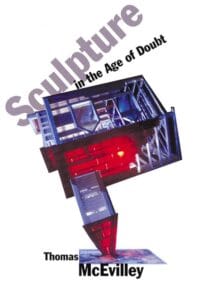
Sculpture in the Age of Doubt by Thomas McEvilley (Allworth Press, 1999): The primary text — the most sustained version of the argument about postmodern sculpture and the critique of formalist universalism. Twenty-five sculptors, from Duchamp to Performance Art, traced as philosophical evidence rather than movement history.
Art & Otherness: Crisis in Cultural Identity by Thomas McEvilley (McPherson, 1992): The companion collection — the institutional confrontations at MoMA and the Venice Biennale that give the theoretical argument in Sculpture in the Age of Doubt its stakes. Read this first if you want to understand why the theory needed to be made.
Further reading
If you want the intellectual foundation beneath McEvilley’s critical project — not the art world application of it, but the actual philosophical argument — there are two books worth reading alongside his.
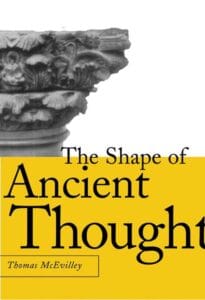
Thomas McEvilley, The Shape of Ancient Thought: Comparative Studies in Greek and Indian Philosophies (Allworth, 2001): The 768-page argument that Eastern and Western philosophy have been mutually constitutive from antiquity. This is the intellectual foundation beneath McEvilley’s claim that no single civilization owns the universal — the scholarly basis for what his art criticism assumed. If the art criticism is the argument, this is the proof.
Edward Said, Orientalism (Vintage, 1979): Said’s analysis of how Western discourse constructs “the East” as its other is the precise theoretical parallel to McEvilley’s analysis of how Western art criticism constructs “primitive” art as modernism’s raw material. Reading them together makes the argument of Sculpture in the Age of Doubt sharper — and makes visible the shared intellectual project that McEvilley was running inside the art world at the same moment Said was running it inside literary and cultural studies.
Frequently asked questions
What is Sculpture in the Age of Doubt about?
Sculpture in the Age of Doubt (Allworth Press, 1999) is Thomas McEvilley’s argument that postmodern sculpture — from Duchamp’s readymades through Pop, Minimalism, Conceptualism, and Performance Art — is best understood as a philosophical response to the collapse of belief in universal aesthetic values. McEvilley traces twenty-five sculptors not as a movement history but as evidence for a single proposition: that the dissolution of formalist universalism is what made a genuinely pluralist art world conceivable.
Who was Thomas McEvilley and why does he matter to contemporary art criticism?
Thomas McEvilley (1939–2013) was an American art critic, poet, and scholar whose doctorate was in classical philology rather than art history. He wrote for Artforum for approximately twenty years beginning around 1979, recruited by editor Ingrid Sischy. His training outside the formalist tradition gave him the critical distance to argue — in essays, books, and one famous Artforum review — that Western art criticism had confused a local tradition for a universal standard. His 1984 essay ‘Doctor, Lawyer, Indian Chief’ changed what major institutions would exhibit and how they would frame non-Western art. He later founded the Department of Art Criticism and Writing at the School of Visual Arts in New York.
What did McEvilley argue against Clement Greenberg’s formalism?
McEvilley argued that Greenbergian formalism — the claim that medium-specificity was the criterion of authentic art — was not a neutral aesthetic observation but a culturally specific metaphysics dressed as universalism. In his essay ‘Heads it’s Form, Tails it’s not Content,’ he traced the roots of formalist aesthetics in Clive Bell, Roger Fry, and Greenberg back through Neoplatonism, arguing that the claim that ‘significant form’ was a category of transcendence was a historical and cultural construction, not a fact about art. The consequence was that Greenberg’s defense of Color Field painting as the teleological endpoint of Western art’s self-purification was, in McEvilley’s reading, a declaration rather than a discovery.
What happened when McEvilley reviewed MoMA’s 1984 Primitivism exhibition?
McEvilley published ‘Doctor, Lawyer, Indian Chief’ in Artforum (vol. 23, no. 3, November 1984), attacking the exhibition ‘Primitivism in 20th Century Art’ organized by William Rubin and Kirk Varnedoe. His argument was that the show’s display of approximately 200 tribal artifacts alongside 150 modernist works — without interpretive context — aestheticized non-Western objects while erasing their conceptual content, treating them as raw material for a Western story about modernism’s universality. Rubin and Varnedoe responded at length in Artforum’s letters section in early 1985. McEvilley held that their defense of the method confirmed his diagnosis: the assumption of Western primacy was invisible to the curators because it was foundational to their framework. According to the Brooklyn Rail’s 2013 obituary, the essay subsequently changed exhibition practices at Carnegie Internationals, worldwide Biennials, and eventually at MoMA itself.
How does McEvilley’s work connect to postcolonial theory?
McEvilley was working the same intellectual territory as Edward Said and Stuart Hall — the question of how dominant cultural frameworks construct their others and present that construction as natural. Where Said analyzed how Western literary and scholarly discourse constructed ‘the East’ as an object of knowledge rather than a subject of history, McEvilley analyzed how Western art criticism constructed ‘primitive’ art as modernism’s raw material rather than as thought. The parallel is not coincidental. McEvilley’s training in Sanskrit and classical philosophy, and his interest in comparative thought across cultures, gave him a scholarly basis for the claim that no single civilization owns the universal — the same claim Said was arguing from a different disciplinary position.
Is Sculpture in the Age of Doubt still relevant today?
The argument McEvilley made in 1999 about postmodern sculpture is, if anything, more contested now than it was then — which makes the book more relevant, not less. The institutional diversification he tracked has continued, but so has the debate about whether that diversification represents genuine pluralism or a globalized art market that absorbs difference as variety without relinquishing the critical hierarchies that produced the exclusion in the first place. Sculpture in the Age of Doubt gives you the theoretical framework to think about that question clearly. The book also functions as an unusual kind of art historical document: a survey written from inside the argument it is tracing, by someone who had a stake in the outcome.
See also: Conceptual Art After Minimalism, New Genre Public Art, How to Read Conceptual Art

About Joe Post
Joe Post holds an MFA in Art from California Institute of the Arts (CalArts) and has done additional graduate work at the School of the Art Institute of Chicago. He founded Art Design Ideas to write about design as cultural argument — the decisions, contradictions, and assumptions built into the objects we live with.