
Conceptual art is work in which the idea or concept is the primary material. But knowing how to read conceptual art means resisting the urge to summarize it. The work is not the idea. It is the encounter between viewer, form, and concept, experienced in time.
The mistake conceptual art was designed to expose
The dominant critical framework in American art through the mid-1960s was Clement Greenberg’s formalism. In his 1960 essay “Modernist Painting,” Greenberg argued that painting’s historical mission was to purify itself. It should acknowledge the literal flatness of the canvas, the specificity of its medium, the purely optical character of its appeal. Sculpture should be sculptural; painting should be painterly. Retinal experience was the measure. What you could see and feel looking at the surface was the work.
Conceptual art emerged partly as a refusal of this framework, and partly as an escalation of the argument Marcel Duchamp had already made with his 1917 Fountain. The urinal was submitted to the Society of Independent Artists under the pseudonym R. Mutt and promptly rejected. Duchamp called his readymades “anti-retinal.” He meant that the visual appeal of an art object was beside the point; the question was what the object was doing conceptually. Greenberg’s entire system was built on exactly what Duchamp had set out to dismantle.
By the mid-1960s, the argument was ready to be formalized. Sol LeWitt did it in his 1967 “Paragraphs on Conceptual Art,” published in Artforum: “In conceptual art the idea or concept is the most important aspect of the work.” But LeWitt added something that gets dropped from the summary: “The idea becomes a machine that makes the art.” Not a caption. An engine.
This distinction matters more than anything else in the movement. LeWitt was not saying the concept is the artwork and the object is irrelevant. He was saying the concept generates the work. The work exists apart from the concept, even as it depends on it. Standing in front of a LeWitt wall drawing is not the same as reading the instructions that produced it. Joseph Kosuth’s One and Three Chairs (1965, MoMA permanent collection) makes the same argument structurally. There are three representations of a chair: the physical object, a photograph at actual scale, and an enlarged dictionary definition. They do not collapse into each other. The gap between them is the work.
Meanwhile, Lawrence Weiner’s 1968 “Declaration of Intent” transferred authority in a different direction entirely: “1. The artist may construct the piece. 2. The piece may be fabricated. 3. The piece need not be built.” The viewer became the site of instantiation. In Weiner’s term, the viewer is the “receiver.” This is not the same as saying the viewer decides what it means. It means the work is constituted in the encounter, not before it.
Conceptual art, then, was targeting two things simultaneously. It opposed the formalist reduction of art to retinal experience and the market logic of the art object as commodity. Lawrence Weiner’s work exists as language and can be reproduced by anyone. It is structurally non-collectable. It resists the gallery economy that, in part, it was made to resist. That resistance was not incidental. It was built into the form. Weiner understood this as clearly as he understood anything about his own practice, as documented in Alexander Alberro and Blake Stimson’s Conceptual Art: A Critical Anthology (MIT Press, 2000), which collects the primary documents of the movement.
The movement’s other targets were further afield. Conceptual art defined itself against the painting traditions that had preceded it, including the gestural abstraction of Abstract Expressionism. Abstract Expressionism insisted that the painted mark carried the trace of the artist’s body, emotion, presence. Against that, conceptual art proposed that the artist’s role was decision-making, not execution. The hand was not the point.
How to read conceptual art: why the wall text is not the work
The standard museum encounter with conceptual art runs like this. You approach a white-walled room. There is very little to see: a few lines drawn directly on the wall, a text applied in vinyl letters, or a folding chair next to a photograph of itself. You read the label. You receive the idea. You move on. This is precisely the failure mode the work anticipated.
Robert Barry’s All the things I know but of which I am not at the moment thinking — 1:36 PM; June 15, 1969 exists entirely as language. There is no object. You read the title and that is the work. But the experience of reading it is not the same as understanding it. The work asks you to hold an impossible mental state: everything Barry knew at that specific moment, inaccessible to you. You feel the edges of that impossibility. Reading the wall label tells you what the work is. It does not constitute the encounter.
Sol LeWitt’s wall drawings are worth dwelling on here because they make the problem visible at a structural level. LeWitt designed his drawings as sets of written instructions. The rule-based systems LeWitt and others developed were the conceptual armature from which actual installations were generated. Any institution that purchases a LeWitt wall drawing is purchasing the certificate of authenticity and the instructions. They are not purchasing the specific marks on a wall; those get painted over when the exhibition ends. What the viewer encounters in the room is one instantiation of an idea. The concept is present but not fully available. It hovers behind what you can see.
This is the distinction between idea content and durational form. Most museum visitors collapse this distinction. The idea content is what you can summarize: “LeWitt made drawings from rules.” The durational form is what you inhabit when you stand in the room. You experience the physical presence of something generated by a rule you cannot see, the relationship between the geometric order on the wall and the time it took to produce it and the time you spend looking. These are not the same experience. The wall text gives you the first. Only the actual encounter gives you the second.
Weiner’s formulation confirms this. When he placed authority with the receiver, he was saying the work requires a specific kind of attention. It must be temporal and unresolved. You inhabit the gap between the instruction and its execution, between language and thing. This is not a comprehension move but a durational one.
There is a parallel tendency worth noting alongside conceptual art proper. The parallel systems-based practice that emerged from the same moment similarly externalized artistic decision-making. It removed the artist’s hand from execution, replaced intuition with rule, presence with instruction. The family resemblance between conceptual art and systems art is strong enough that the distinction between them is worth holding lightly.
This is also where the article’s thesis runs directly against Kosuth’s own position. In his 1969 essay “Art After Philosophy,” Kosuth argued that the work of art is a proposition. The conceptual content of the work is the work, and comprehending the proposition fully exhausts what the artwork has to offer. On this account, once you have understood what One and Three Chairs is proposing about representation and language, you have received the work completely. The physical object in the room adds nothing the idea does not already contain.
This is a serious position, not a naive one, and it has force: Kosuth is right that you cannot separate the meaning of a conceptual work from its conceptual structure. But the durational model corrects his conclusion without dismissing his premise. Knowing what a proposition means is not the same as inhabiting its consequences in a body, in a room, across time. There is a gap between understanding a rule and living under it. Between reading that Kawara’s paintings record days that have passed and actually standing in front of one, holding that fact in the presence of the object. The proposition is the structure. The encounter is what happens to you while the structure operates. Kosuth’s account has no room for the second term.
The implication for the viewer is not comfortable. The work cannot be consumed in the way that a painting can be consumed. You cannot stand in front of a Rothko for ninety seconds and leave having had the experience. But conceptual art asks for something different from what Rothko asks for. It does not demand immersive duration but attentive inhabitation of an unresolved space. The Stanford Encyclopedia of Philosophy’s entry on Conceptual Art frames this as a question of “cognitive value” versus “aesthetic value,” but that framing concedes too much to the comprehension model. The experience of a good conceptual work is not primarily cognitive. It is temporal. It happens in the gap.
Five works that demonstrate how the encounter works
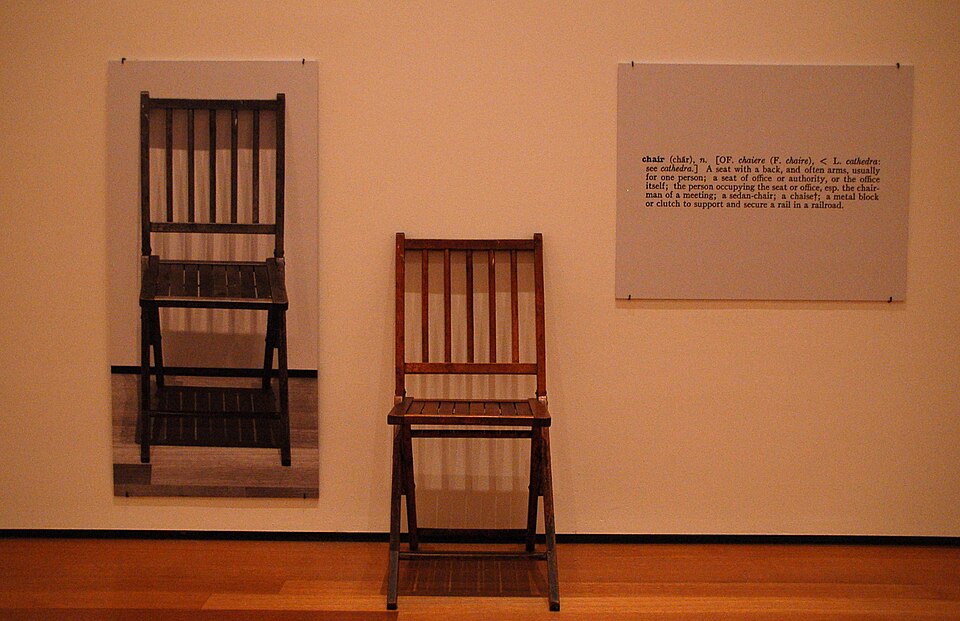
Joseph Kosuth, One and Three Chairs, 1965 (MoMA)
A folding chair. A life-scale photograph of the folding chair, taken in the exact spot where the chair stands. An enlarged photostatic copy of the dictionary definition of “chair” — the word, not the object. Kosuth drew on Plato’s theory of forms and, implicitly, on Wittgenstein’s philosophy of language. The work engages the question of what the relationship is between a word and the thing it names, between a representation and the reality it represents.
None of the three versions resolves the others. The chair is not explained by its photograph. The photograph is not explained by the dictionary definition. All three are inadequate representations of each other, and that inadequacy is not a failure. It is the work. Standing in front of One and Three Chairs is not the same as knowing that it asks questions about representation. The knowing comes immediately, in the first thirty seconds. What you do with the next ten minutes is the encounter.
Sol LeWitt, Wall Drawing #1, 1968
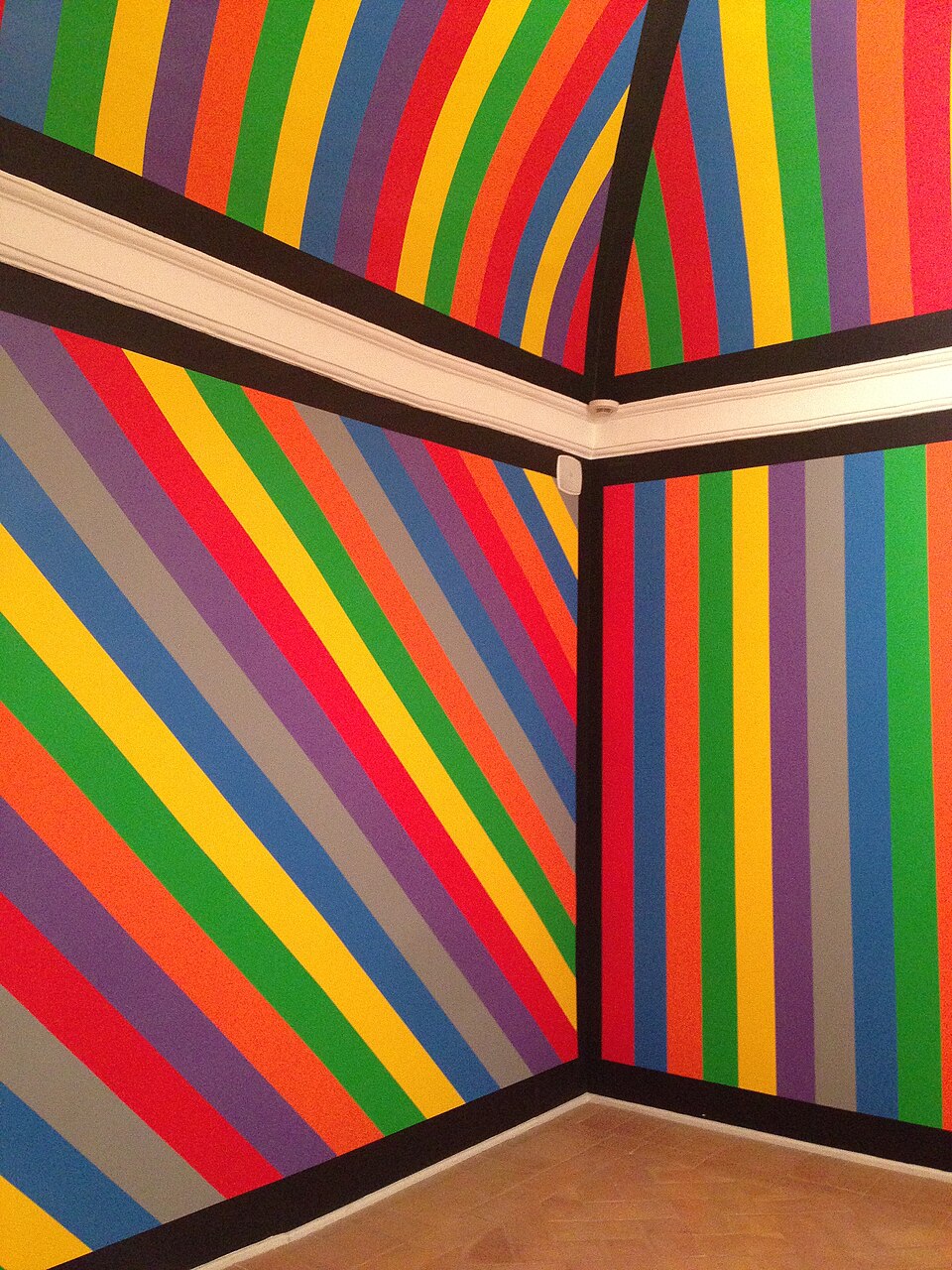
The first wall drawing LeWitt executed. The instructions are to draw lines in four directions: vertical, horizontal, diagonal left, diagonal right. Cover the wall. Use pencil. The work is not the marks. The work is the instruction that generated the marks. Any institution can execute this. The marks are an instantiation.
What the viewer encounters is not instructions. They encounter the physical density of thousands of pencil marks on a large white wall. You see the mark of time, of labor, of a rule made material. The rule that generated this is absent from what you see. Its presence is implied by the systematic character of what you see. You are in the middle of a thought you can only partially apprehend.
Lawrence Weiner, A Translation from One Language to Another, 1969
Text on a wall reads: “A 36″ × 36″ REMOVAL TO THE LATHING OR SUPPORT WALL OF PLASTER OR WALLBOARD FROM A WALL.” No action takes place. The piece describes a removal that has not occurred. The viewer stands in front of a statement about a material event. The gap, the wound in the architecture, exists only in language.
The conditional space Weiner creates here is his consistent subject. The work is not the removal. It is the space between the instruction and its execution. Weiner holds that space open without resolving it. This is the durational encounter in its most stripped form.
Robert Barry, All the things I know but of which I am not at the moment thinking — 1:36 PM; June 15, 1969
The title is the entire work. Reading it takes a moment. Fifteen seconds, perhaps, the first time through. The timestamp — 1:36 PM, June 15 — places you in an irretrievable moment in someone else’s mind. The specificity is its own argument. This is not a general philosophical statement about knowledge and consciousness. It is a snapshot of a particular interior at a particular instant.
The work stages the impossibility of its own representation. What Barry knew at 1:36 PM on June 15, 1969, is not accessible to you. The title points at something and withholds it simultaneously. The encounter is brief but exact. You are made aware, for a moment, of the category of inaccessible interiority, and then the moment passes.
On Kawara, Date Paintings (Today series), 1966–2013
Each canvas shows only the date it was painted, in the language of the country where Kawara was working that day. If he could not complete the painting by midnight, he destroyed it. The series ran from 1966 until his death in 2013. It spanned nearly five decades, as documented in the MoMA collection records.
The subject of each painting is a day that has already passed. You encounter it as a static object. The gap between the painting’s subject and its form is not incidental. It is structural. The subject is a day, a duration, a span of time lived through. The form is a flat canvas with numerals on it. The painting cannot give you the day. It can only mark its having existed. Standing in front of a Date Painting, you are standing in front of a record of time that will not surrender its contents. The encounter is with that refusal.
Shop the collection
Both recommendations here are books, because the most useful companion objects for conceptual art are texts. The primary sources and the historical framework are what you need. No manufactured object matches what good criticism and primary documentation can do for this work.
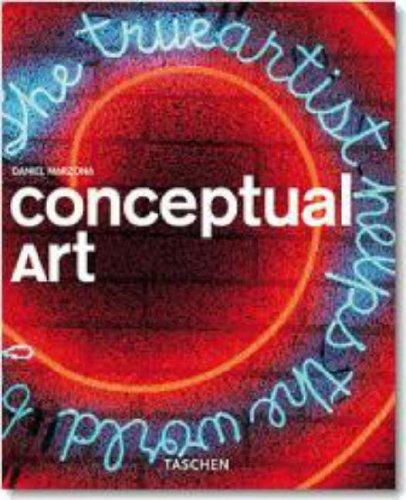
Daniel Marzona and Uta Grosenick, Conceptual Art (Taschen, 2005): A dense visual survey. 192 pages of reproductions with brief critical texts and a historical essay. The format handles the subject well: short interventions, strong images, no false accessibility. A useful companion for someone building their eye for this work.
Tony Godfrey, Conceptual Art (Phaidon, 1998): The standard single-author account. Godfrey was Programme Director of the MA in Contemporary Art at Sotheby’s Institute, London, and his 448-page treatment remains the most rigorous single-volume survey available. Not a coffee table book. Worth owning if this territory matters to you.
Further reading
The two books below are not surveys. They are the archive and the framework. Read them in the order listed if you are new to this territory.
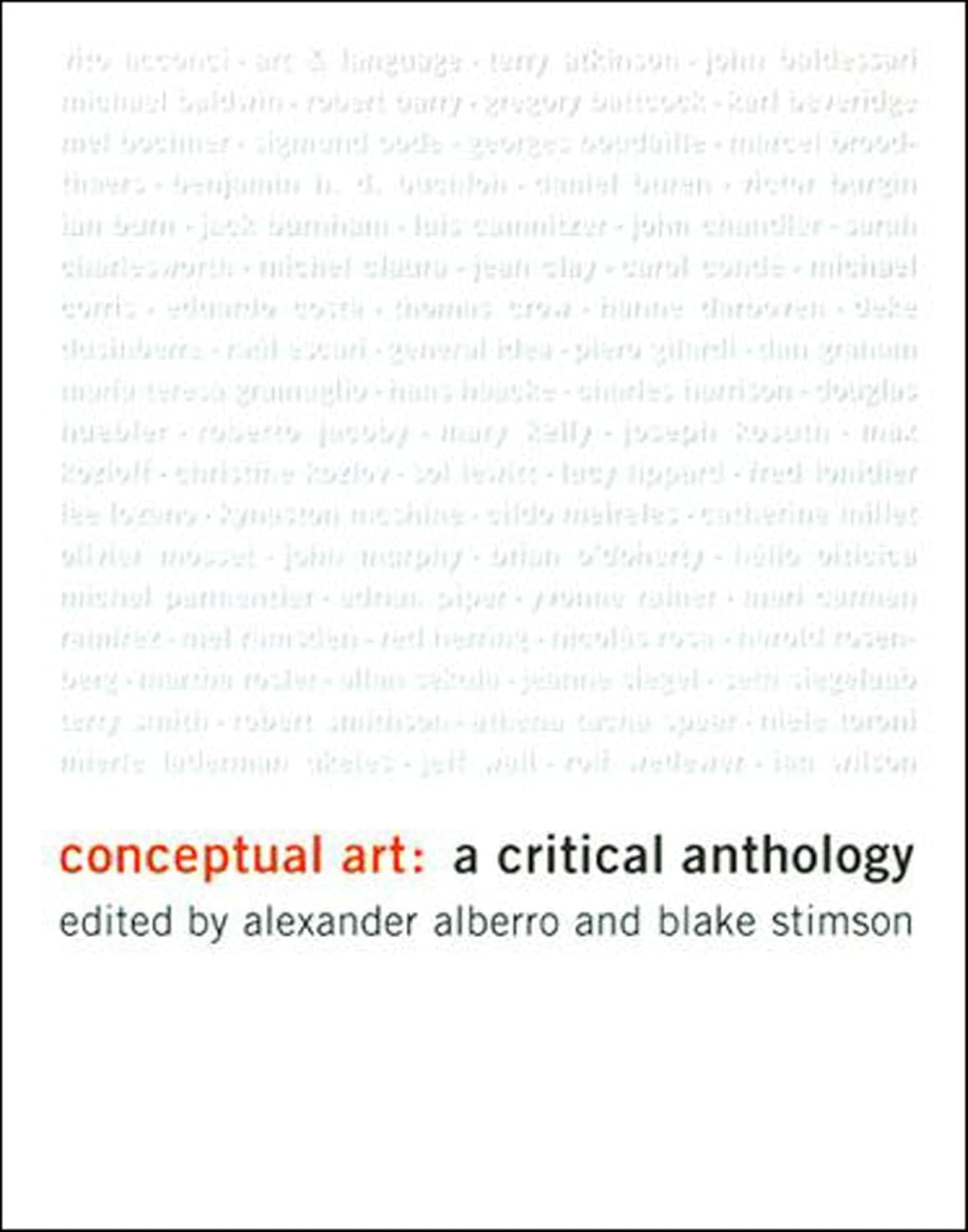
Alexander Alberro and Blake Stimson (eds.), Conceptual Art: A Critical Anthology (MIT Press, 2000): 624 pages of primary source documents. Artists’ statements, original manifestos, critical texts, and translated material not previously available in English comprise this collection. This is the movement’s own voice, not a history of it. Read before you read about it.
Hal Foster, Rosalind Krauss, Yve-Alain Bois, and Benjamin Buchloh, Art Since 1900: Modernism, Antimodernism, Postmodernism (Thames & Hudson, 2004): This book places conceptual art inside the full critical argument of twentieth-century art theory. It covers Greenbergian formalism, the Pictures Generation, and post-structuralism. The conceptual art chapters gain their force from the fifty years of argument that precede them. This is the book that explains why the stakes were what they were.
Frequently asked questions
What is conceptual art, and how is it different from abstract art?
Conceptual art is work in which the idea or concept is the primary material. The art can exist as an instruction, a text, a performance, or an object, but the conceptual decision is what the artist considers determinative. Abstract art, including the gestural abstraction conceptual art defined itself against, prioritizes visual and material qualities. It emphasizes color, mark, surface, form. Abstract Expressionism, for instance, treated the painted mark as the carrier of emotional presence. Conceptual art rejected this. The mark’s visual character was beside the point.
How do you experience conceptual art if there is no object to look at?
You experience it the same way you experience any work that operates through language. Attend to what the language is doing, not just what it is saying. Robert Barry’s text-only works exist as duration. The time it takes to read them, the mental state they place you in, the impossibility they stage — these constitute the work. The absence of an object is not a deficiency. It is a deliberate formal choice, and the choice has content.
Why does conceptual art often look so minimal or simple?
Because the visual complexity was not the point. Sol LeWitt’s wall drawings are visually simple by design. The interest lies in the gap between the instruction (the concept) and what you encounter in the room (the execution). Making the visual surface complicated would have redirected attention toward the wrong thing. The simplicity is a redirect. Look here, not there.
Is the wall text part of the artwork in conceptual art?
No. The wall text is an institutional addition that tells you about the work’s conditions and context. It is not the work. In some cases — Lawrence Weiner’s language-based pieces, for instance — the text on the wall is the work, but it was placed there by the artist as the artwork, not by the museum as an explanation. The distinction matters. The institution’s label is interpretation; the artist’s text is the thing itself.
How do you know if a piece of conceptual art is any good?
The question is serious and deserves a straight answer. A conceptual work is successful when the gap it stages generates a genuine experience that cannot be reduced to the concept. The gap exists between concept and form, between instruction and execution, between language and object. On Kawara’s Date Paintings work because standing in front of one produces something that the idea “a painting of a date” does not produce. The concept is necessary but insufficient. If a conceptual work can be fully substituted by its wall text — if knowing the idea is the same as having encountered the work — then the work has not found its form. The idea has not become a machine, in LeWitt’s sense. Good conceptual art leaves a remainder that the summary cannot account for.
Can you appreciate conceptual art without understanding the theory behind it?
Yes. But knowing the theory changes what you can attend to. A viewer who has never heard of Wittgenstein can stand in front of Kosuth’s One and Three Chairs and feel the work’s strangeness. The three representations do not resolve. The gap is real even without the philosophical apparatus. But the viewer who knows that Kosuth was engaging directly with questions of linguistic meaning and representational adequacy can inhabit that gap with more precision. The theory does not manufacture the experience. It sharpens the attention.
See also: Conceptual Art After Minimalism, Why Artists Follow Rules, West Coast Conceptual Art, The Best Books on Conceptual Art

About Joe Post
Joe Post holds an MFA in Art from California Institute of the Arts (CalArts) and has done additional graduate work at the School of the Art Institute of Chicago. He founded Art Design Ideas to write about design as cultural argument — the decisions, contradictions, and assumptions built into the objects we live with.