
Conceptual art after minimalism describes the art practices that emerged in the mid-1960s and took minimalism’s reduction of the object to its furthest conclusion: the idea itself. Where minimalists stripped sculpture of composition and expression, conceptualists asked whether the physical object was necessary at all. The dominant period ran roughly from 1965 to 1975.
What Minimalism Left on the Table — and What Conceptualism Picked Up
By the mid-1960s, minimalism had done something that turned out to be irreversible. Donald Judd, Carl Andre, Dan Flavin, Robert Morris, and Sol LeWitt had stripped the art object of composition, expression, illusion, and personal touch. What remained was physical presence: a stack of steel boxes, rows of fluorescent tubes, a grid of bricks on the floor. The work existed as object among other objects in a room, refusing to mean anything beyond what it was.
That reduction raised a question the minimalists may not have anticipated. If what mattered was the idea informing the object’s shape, scale, and placement — the decision to use this material at this scale in this space — then what, exactly, was the physical object adding? You could describe a minimalist sculpture in words. You could photograph it. You could give someone the specifications and let them fabricate it. What did the original object have that the description lacked?
Sol LeWitt was working through both movements simultaneously, which is why he is the hinge figure in this history. His early structures were minimalist. His 1967 “Paragraphs on Conceptual Art,” published in Artforum, formalized the leap: “In conceptual art the idea or concept is the most important aspect of the work. When an artist uses a conceptual form of art, it means that all of the planning and decisions are made beforehand and the execution is a perfunctory affair. The idea becomes a machine that makes the art.”
That last sentence is not a metaphor. It is a working definition of what the next ten years would produce.
The institutional context matters. Both movements emerged in New York in the mid-1960s, at a moment when the art world was intensely competitive and polemical. As James Meyer argues in Minimalism: Art and Polemics in the Sixties (Yale, 2001), “minimalism” was never a coherent movement — it was a contested field built retrospectively around six figures. The artists themselves disputed the label, disputed each other’s positions, and disputed what the work was doing. Conceptualism inherited that argument and pushed it somewhere those six figures had not been willing to go.
It is worth noting the longer lineage here, because it runs through two distinct traditions that fed minimalism from different directions. One was the Bauhaus: a school that combined craft, fine art, and industrial design around the idea that form should arise from material logic and function, not from applied decoration. The Bauhaus argued for structural meaning, the position that what a thing is made of and how it is made should determine what it looks like.
The other tradition was Adolf Loos’s anti-ornamentalism: a philosophical and moral argument, made in his 1908 essay “Ornament and Crime,” that decoration was a sign of cultural regression, that the advanced modern person expressed themselves through the absence of ornament. Loos was not making a manufacturing argument; he was making an ethical one. These two lineages converge in minimalism but through different channels. The Bauhaus gave minimalism its discipline of material and making. Loos gave it a moral vocabulary for stripping away the decorative. Conceptualism extended both: if structure and material are what matter, why is the material still there at all?
Why the Idea Became the Art — and What Was Lost When the Object Left
Joseph Kosuth’s One and Three Chairs (1965) is the paradigm case, and it is worth describing precisely rather than summarizing. Kosuth installed a folding chair in a gallery. Mounted on the wall beside it was a full-scale photograph of that same chair. Mounted beside the photograph was an enlarged photostat of the dictionary definition of “chair.” Three presentations of the same concept existed in the space: the object, the image, and the language. Each was equally valid in the work’s logic. The work refuses to let you settle on one. The photograph is not a record of the chair; it is another form of the chair. The definition is not a label; it is another form of the chair. The chair itself is not the original; it is one instance of the concept. One and Three Chairs is held in the permanent collection at the Museum of Modern Art.
Kosuth pushed the argument further in his 1969 essay “Art after Philosophy,” published in three parts in Studio International. Drawing on Wittgenstein’s language philosophy and A.J. Ayer’s logical positivism, Kosuth argued that art’s only legitimate subject is art itself: artworks are essentially propositions, and the question of whether they are good propositions is the only question worth asking. Traditional media (painting, sculpture) were irrelevant to that inquiry. The physical object was a carrier, not the content.
Lawrence Weiner’s 1968 “Declaration of Intent,” published in Statements (Seth Siegelaub, 1968), went further than Kosuth. Its three clauses stated: the artist may construct the piece; the piece may be fabricated; the piece need not be built. Weiner was making a claim about where the work resided: in the language, not in the material. A Weiner work is a description of a material relationship (steel placed on concrete, paint applied to a wall), and that description is the work regardless of whether anyone fabricates it.
The term “dematerialization” comes from Lucy R. Lippard’s 1973 anthology Six Years: The Dematerialization of the Art Object from 1966 to 1972 (Praeger, 1973; reissued University of California Press, 1997), which documented over 900 works, events, and documents from the period. Lippard was not describing a settled movement from outside it; she was an active participant and advocate who had watched the evacuation of physical substance happen in real time.
Here is where the intellectual honesty matters, even for a site that runs affiliate links. If the object disappears, so does the commodity. Conceptualism’s most radical gesture was also a direct attack on the art market’s fundamental mechanism — the unique, ownable, sellable object. You cannot sell a set of instructions in the same way you sell a canvas. You cannot sell a gas released into the Mojave Desert at all. That tension drove much of the polemical heat of the period. It also explains the movement’s institutional absorption and relative neutralization by the late 1970s: the market found ways to commodify even the instructions.
The design movements that followed took different lessons from this. Memphis, launching in 1981, took conceptualism’s anti-functionalism (the willingness to let an object refuse its use) and redirected it back into the decorative. Where Weiner said the object need not exist, Memphis said the object could exist as pure provocation, without the labor of being useful. That is a cousin of conceptualism’s anti-objecthood, and a considerably more comfortable one for the furniture market.
The work of Karen Kilimnik shows one thread of what came after: an art practice that plays with the boundaries between the image, the object, and the staging of both, without fully committing to any one of them. The conceptualist question of what form the work should take, and whether it needs a form at all, remains live in contemporary practice decades past the period Lippard was documenting. Another thread went into time-based media: video installation art took dematerialization literally, replacing the object with duration, projection, and the viewer’s own body in space.
Five Works That Show What Happened After the Object Stopped Mattering
The five works below are not a survey. They are five points on a line: five demonstrations of the same argument arriving at different conclusions.
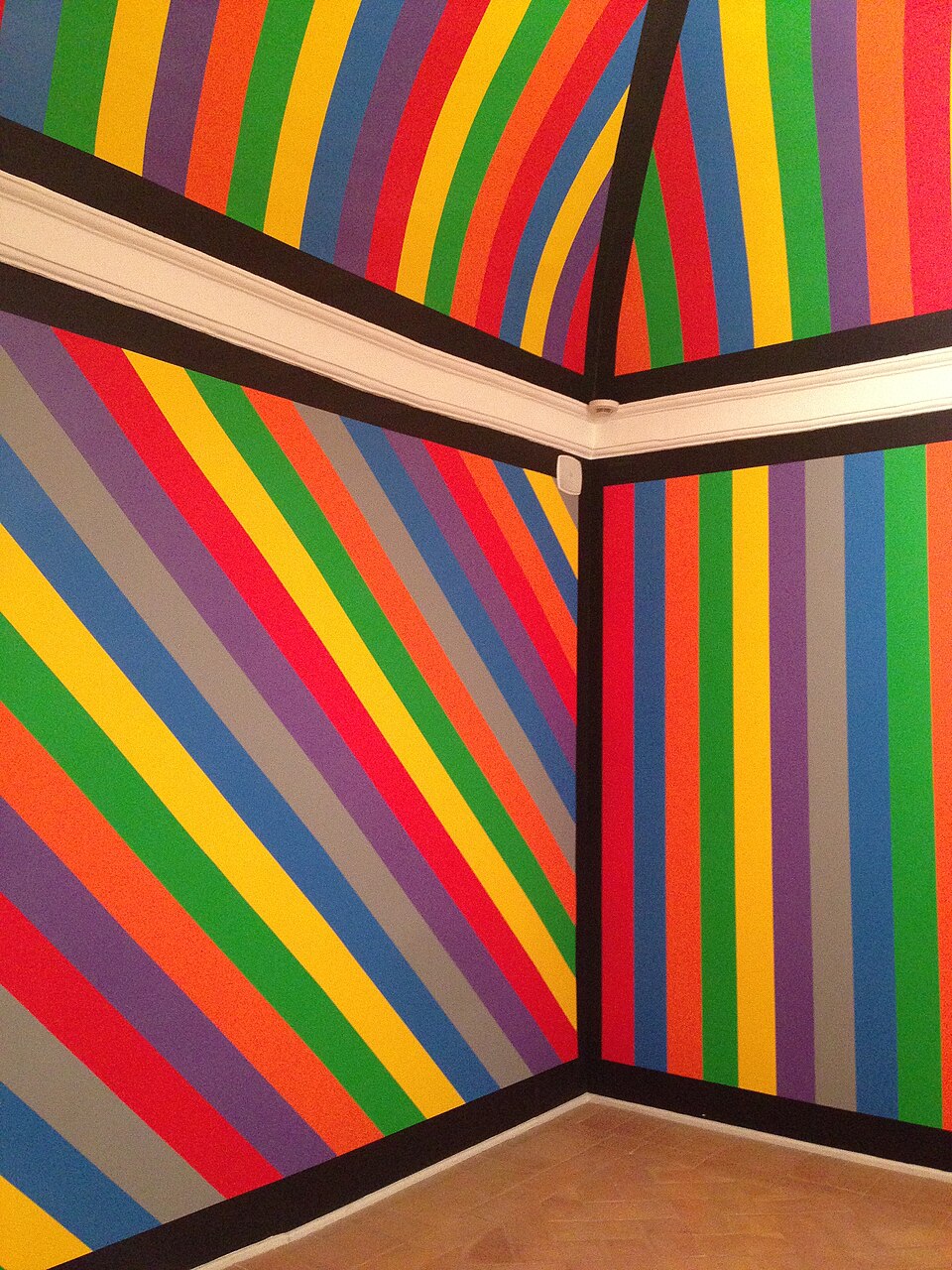
Sol LeWitt, Wall Drawing #1 (1968)
LeWitt wrote a set of instructions for drawing lines on a wall. Assistants executed them. The work exists as rules, not as an object: any wall the instructions are applied to is an instance of Wall Drawing #1. LeWitt’s contribution (the artist’s labor, as it is usually described) was the algorithm, not the execution. The drawing can be destroyed and remade. The drawing can be made by someone who has never met LeWitt. What persists is the instruction set, and the instruction set is the artwork.
Joseph Kosuth, One and Three Chairs (1965, MoMA)
Described above in detail: the folding chair, the photograph, the definition. What the work forces you to do as you stand in front of it is interrogate your own assumptions about which of the three is “real.” Most visitors settle on the physical chair. The work is designed to make you doubt that settling.
Lawrence Weiner, Statements (1968)
Published as a book by Seth Siegelaub, Statements presented sculptures as text descriptions only. No fabrication required, no gallery space required. A reader with the book possessed the works in the only sense that mattered: linguistically. The book is a collection of art objects that weighs less than a pound.
On Kawara, Today Series (date paintings, from 1966)
Small canvases bearing only the date of their making, in the language of wherever Kawara was that day. If the painting was not completed by midnight, it was destroyed. The content of each work is exactly what its title says: a date. Not a representation of a date, not a meditation on time; the date itself, written in a specific language in a specific place by a specific hand on a specific day. Duration and location as sole subject matter. The ultimate reduction, and the one that most forcefully removes any role for aesthetic judgment: you cannot say this date painting is more or less beautiful than that one.
Robert Barry, Inert Gas Series (1969)
Barry released noble gases (helium, neon, argon, krypton, xenon) into the atmosphere over the Mojave Desert and documented the releases in photographs. The “work” dispersed invisibly into the air. It cannot be seen, owned, transported, installed, or reproduced except as a record of the release. Barry made art that was, by design, uncollectable. That is the logical endpoint of dematerialization: not just an object you cannot sell, but an event you cannot even point to.
Shop the Collection
Two books are worth owning for this subject. Not five. Two. The Godfrey for the critical argument; the Marzona for the visual archive of what minimalism actually looked like before conceptualism stepped in.

Tony Godfrey, Conceptual Art (Phaidon, 1998): Phaidon’s Art and Ideas format structures the argument around specific works rather than timelines; it is the format you want on a shelf, not a coffee table, because it actually makes an argument rather than assembling one.
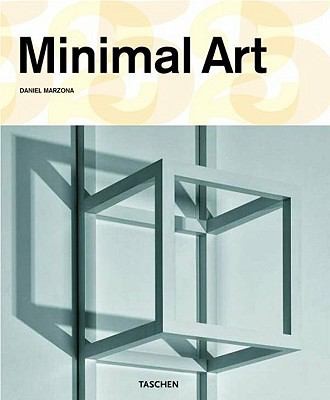
Daniel Marzona, Minimal Art (Taschen, 2005): The Taschen survey covers the six core minimalist figures in dense visual sequence; it is useful alongside the Godfrey as the “before” to conceptualism’s “after,” and the image archive is the strongest reason to own it.
Further Reading
These two books are the primary documents. If you read the Lippard, you are reading the period as it understood itself. If you read the Meyer, you understand what the period was inheriting, which changes how you read the Lippard.
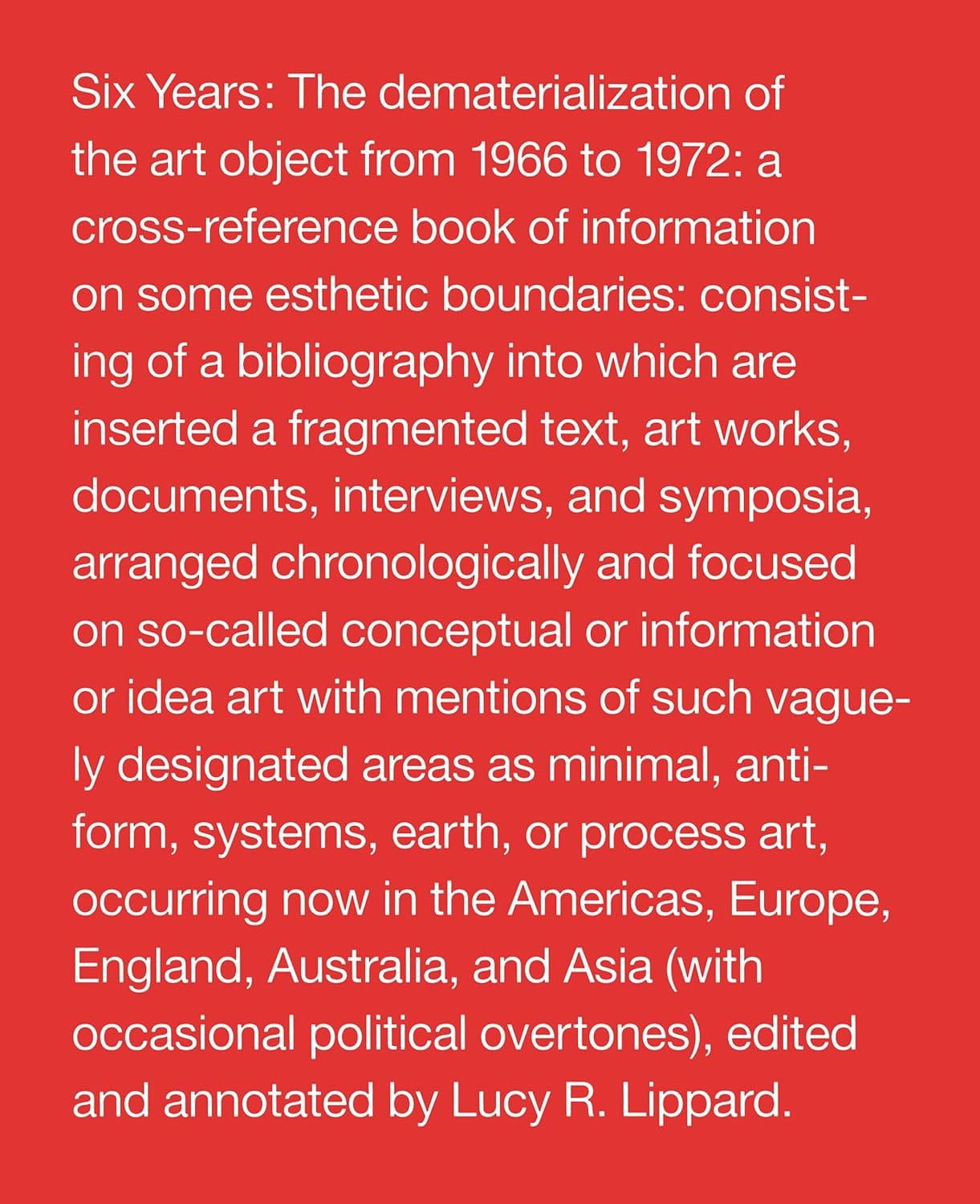
Lucy R. Lippard, Six Years: The Dematerialization of the Art Object from 1966 to 1972 (University of California Press, 1997): This is the primary document: an anthology, argument, and archive in one, written by someone who was present for the events it is cataloguing. There is no substitute for reading it as both a critical text and a period artifact.
James Meyer, Minimalism: Art and Polemics in the Sixties (Yale University Press, 2001): Meyer’s argument that “minimalism” was a retrospective construction built around a contested field changes how you think about what conceptualism was reacting to, complicating the clean before/after story. Read this and you will understand the dispute; read it alongside Lippard and you have the full argument. Additional reading on design and art criticism can be found in our best art books guide.
Frequently Asked Questions
What is conceptual art and how is it different from minimalism?
Minimalism stripped the art object of composition, expression, and illusion, leaving physical presence and spatial relationship. Conceptual art drew minimalism’s logical conclusion: if what matters is the idea informing the object, the object itself is optional. Minimalism kept the object; conceptualism interrogated whether keeping it was justified. The two movements share the same argument; they disagree about its endpoint.
Why did artists stop making physical objects in the 1960s?
The short answer is that minimalism had demonstrated the idea was more important than the form, and a generation of artists took that demonstration seriously. Sol LeWitt’s 1967 “Paragraphs on Conceptual Art” formalized the position. Lawrence Weiner’s “Declaration of Intent” in 1968 made it operational. The longer answer involves the art market: if the object is the commodity, refusing the object is a political act. Both answers are true.
Who were the main artists associated with conceptual art after minimalism?
Sol LeWitt (the hinge figure, working in both movements simultaneously), Joseph Kosuth, Lawrence Weiner, On Kawara, Robert Barry, and Douglas Huebler in the United States. The British group Art & Language (Terry Atkinson, Michael Baldwin, David Bainbridge, and Harold Hurrell, formed in Coventry in 1968) pursued a purely linguistic approach to art analysis. Robert Pincus-Witten coined the term “Postminimalism” in 1971 for the related work of Eva Hesse, Robert Smithson, and Walter De Maria, who used minimalist reduction while reintroducing material contingency and the body. In painting, Ellsworth Kelly represents the hard-edge abstractionist strand that ran parallel to conceptualism’s dematerialization — reducing painting to color and shape without abandoning the object. For what this meant specifically for sculpture, see Sculpture in the Age of Doubt.
Is conceptual art a rejection of minimalism or an extension of it?
Extension. The cleanest way to see this is through LeWitt, who was making minimalist sculptures before he wrote “Paragraphs on Conceptual Art.” He did not change his position; he followed it to its conclusion. Conceptualism did not argue that minimalism was wrong; it argued that minimalism had not gone far enough. If the idea is primary, the object is secondary. Minimalism kept the object. Conceptualism asked: why?
What does “dematerialization of the art object” mean?
The term comes from Lucy R. Lippard’s 1973 anthology, which documented the evacuation of physical substance from art practice between 1966 and 1972. Dematerialization means the progressive removal of material form from the work: from sculpture to photography of sculpture to instructions for sculpture to language alone. Robert Barry’s Inert Gas Series (1969), in which noble gases were released invisibly into the atmosphere, is the terminal case: a work that cannot be seen, owned, or reproduced except as documentation.
How did conceptual art challenge the art market?
Directly and deliberately. The art market depends on the unique, ownable, sellable object. Conceptualism attacked all three properties: a set of instructions is not unique (it can be copied); a gas dispersed in the Mojave Desert is not ownable; a description of a material relationship published in a cheap artist’s book does not sell the way a canvas does. The movement was partly absorbed by the late 1970s; the market found ways to commodify the documentation, the instructions, the artist’s books. But the challenge was real, and the artists making it knew exactly what they were doing.
See also: How to Read Conceptual Art, Systems Art Explained, The Best Books on Conceptual Art, West Coast Conceptual Art

About Joe Post
Joe Post holds an MFA in Art from California Institute of the Arts (CalArts) and has done additional graduate work at the School of the Art Institute of Chicago. He founded Art Design Ideas to write about design as cultural argument — the decisions, contradictions, and assumptions built into the objects we live with.