


Jean-Michel Basquiat was an American painter who worked in New York from 1980 until his death in 1988. His Jean-Michel Basquiat art (crowns, anatomy diagrams, crossed-out words, corporate logos alongside slave ship imagery) was not raw self-expression. It was a systematic argument about race, institutional power, and who fine art was built to exclude.
What SAMO was actually saying
In 1978, Basquiat and a collaborator named Al Diaz began writing on walls. Their tag was SAMO (Same Old Shit) and it appeared across lower Manhattan in the form of sentences: “SAMO© AS AN ALTERNATIVE TO GOD.” “SAMO© AS AN END TO MIND WASH RELIGION, NOWHERE POLITICS AND BOGUS PHILOSOPHY.” These were not tags in the conventional sense. Tags mark territory; they announce a name. SAMO© wrote arguments.
The locations were specific. SoHo in 1978–1980 was the gallery district, the place where the art world’s institutional machinery operated. SAMO© appeared where dealers, critics, and collectors would see it. The audience was not a general public; it was the gatekeepers. Basquiat was writing on the walls of the room he intended to enter.
In 1980, he ended the project by spray-painting “SAMO IS DEAD” across the same streets. The announcement was timed exactly: Basquiat had gotten the attention he needed and was ready to move indoors. The work started appearing in galleries that year. He was 19.
Basquiat was born December 22, 1960, in Park Slope, Brooklyn. His father Gérard was born in Port-au-Prince, Haiti; his mother Matilde was Puerto Rican, born in Brooklyn. He grew up speaking English, French, and Spanish. He was Black and Latino in a New York art world that was neither. The art world of the early 1980s was extremely white and extremely male in its critical and commercial apparatus, even as it was beginning to absorb artists of color on a selective basis. SAMO© was the thesis statement: the gatekeeping apparatus was not a neutral system of quality judgment. It was a system of exclusion that tracked race and class.
At 21, Basquiat became the youngest artist to participate in Documenta in Kassel, Germany. At 22, he was among the youngest to exhibit at the Whitney Biennial. The institutional recognition came fast, in part because he was good, and in part because the institutional machinery was looking for someone it could absorb without having to change.
How Basquiat built an argument on canvas
Basquiat’s mother gave him a copy of Gray’s Anatomy during a childhood hospitalization. He returned to this book throughout his career. The anatomy diagram, medical and precise and stripped of race and name, appears repeatedly in his paintings as a figure that is simultaneously universal (inside the skin, every body is the same) and a record of specific historical violence (the reduction of Black bodies to category, specimen, property). The diagram is what the medical gaze produces; the crown above the figure is Basquiat insisting on the subject’s humanity.
The three-pointed crown appears in dozens of canvases. It marks heroes, saints, and specifically Black cultural figures: Charlie Parker, Dizzy Gillespie, Jesse Owens, Joe Louis. These are not ironic crowns. They are assertions of dignity in a visual tradition that routinely rendered Black figures as servants, criminals, or absences. Basquiat placed the crown directly over his subjects and meant it.
The text mechanism, words written then crossed out with a horizontal bar, is one of Basquiat’s most precise formal inventions. The viewer reads the word and sees its cancellation simultaneously. The word is not deleted; it is marked. This enacts erasure as a visible event rather than a completed one. The crossed-out word remains legible. The violence that produced the erasure is recorded in the same gesture.
Corporate logos and brand names appear alongside images of poverty, police violence, and slavery. Mobil, Tiffany, Ideal. These are not political cartoons. Basquiat was not illustrating an argument. He was placing things in proximity and letting the composition hold the relationship. The viewer makes the connection or doesn’t; the painting has made the proposition regardless.
His relationship with Andy Warhol (1982–1987) complicates every simple account. They met on October 4, 1982. The same day, Basquiat made Dos Cabezas: two portrait heads, his and Warhol’s, side by side. They collaborated formally in 1984–1985, producing jointly-attributed canvases. Their joint show at the Tony Shafrazi Gallery in 1985 was poorly received; several reviews described Basquiat as Warhol’s discovery or protégé. One Village Voice review called him Warhol’s “mascot.” Basquiat was hurt by this framing, which positioned him as the product of white institutional sponsorship rather than a peer.
The relationship was more complicated than that reading allows. Warhol needed what Basquiat had: downtown credibility, critical energy, an unembarrassed relationship to race and power as subject matter. Basquiat needed what Warhol had: access, commercial infrastructure, the imprimatur of the most famous artist alive. Both knew what they were doing. Neither was naive.
Jean-Michel Basquiat art: specific paintings, specific arguments
Untitled (Skull) (1981): One of the earliest canvases in the mature mode. A fragmented skull, partly medical diagram and partly abstraction, with dripping paint and scrawled text. Basquiat was 20. The skull is not morbid decoration; it is a reminder that the body inside the skin is biologically identical across race.
Charles the First (1982): A tribute to Charlie Parker, nicknamed “Bird.” Crowns, musical notation fragments, crosses, and the text: “MOST YOUNG KINGS GET THEIR HEADS CUT OFF.” Parker died at 34. The painting is about genius, about the specific kind of recognition given to Black artists (celebrated and consumed), and about what “legacy” means when the culture that produces genius is also the culture that destroys it. Basquiat died at 27.
Hollywood Africans (1983): Three figures in Hollywood, Basquiat himself and his collaborators Toxic and Rammelzee, identified by name in the text. The canvas is annotated with words: “WHAT IS BOSSANOVA,” “SUGARCANE,” “TOBACCO,” “GANGSTERISM.” Sugar and tobacco are plantation crops; gangsterism is a category applied to Black men; bossanova is an Americanized Brazilian music form. The painting asks what it means to be Black in an entertainment industry built on the appropriation of Black culture.
Defacement (The Death of Michael Stewart) (1983): On September 15, 1983, New York City transit police arrested a young Black graffiti artist named Michael Stewart for writing on a subway wall and beat him into a coma. He died two weeks later. Basquiat made this painting in Warhol’s studio. Two police figures beating a body. The painting was made quickly, privately, not for exhibition. It is grief recorded as image.
Shop the Collection
There are two books that handle Basquiat’s work as argument rather than as spectacle.
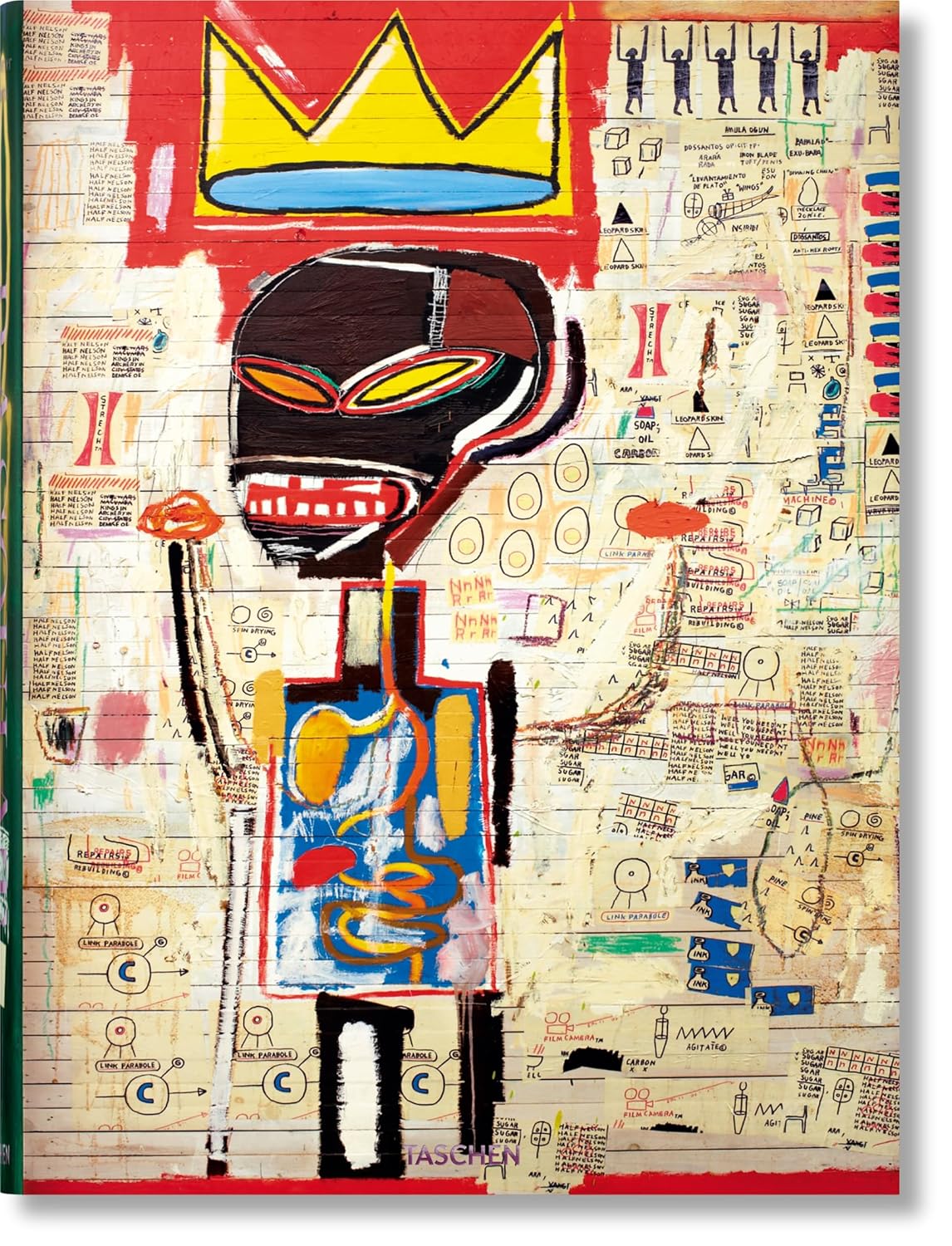
- Jean-Michel Basquiat, ed. Eleanor Nairne (Taschen, XXL edition): The most comprehensive single-volume reproduction of the paintings at large scale. Nairne’s essay handles the cultural argument without reducing Basquiat to his biography or his market value.
- The Notebooks by Jean-Michel Basquiat (Princeton University Press): A facsimile edition of eight rarely seen notebooks, the source material the paintings were drawn from. Words, images, lists, diagrams. Essential for anyone who wants to understand the visual system from the inside rather than from the outside.
Further Reading
Two books earn their place here.
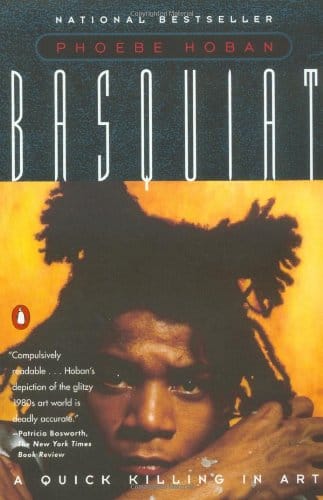
- Phoebe Hoban, Basquiat: A Quick Killing in Art (Penguin): The standard biography. Hoban traced the full arc from SAMO to international fame and also documented the 1980s New York art market, the galleries, the dealers, the auction houses, which is inseparable from understanding what Basquiat was working against and within simultaneously.
- Dieter Buchhart and Antonia Hoerschelmann, Jean-Michel Basquiat: Of Symbols and Signs (Prestel, 2021): Focuses specifically on the visual language: the crown, the crossed-out word, the anatomy diagram, the corporate logo. Treats the work as a coherent symbolic system rather than raw autobiography.
Frequently Asked Questions
What was SAMO and who created it?
SAMO (Same Old Shit) was a graffiti identity created by Basquiat and collaborator Al Diaz between 1978 and 1980. They wrote aphoristic and satirical sentences, not tags, across lower Manhattan, specifically in neighborhoods where galleries and art institutions were concentrated. Basquiat ended SAMO in 1980 by spray-painting “SAMO IS DEAD” across SoHo, at the moment he was ready to begin showing paintings in galleries.
What do the crowns mean in Basquiat’s paintings?
The three-pointed crown is an assertion of dignity and distinction. Basquiat placed crowns above figures he considered heroes (jazz musicians, athletes, historical figures) as an insistence that they be read as royalty rather than as cultural property. The crown is not ironic. In a visual tradition that routinely rendered Black figures as servants or absences, the crown was a direct counter-argument.
How did Basquiat know Andy Warhol?
They met October 4, 1982, through a mutual contact. Basquiat painted Dos Cabezas, two portraits (his and Warhol’s), the same day. They collaborated formally in 1984–1985, producing jointly-attributed works. Their joint exhibition at the Tony Shafrazi Gallery in 1985 was poorly reviewed, with some critics describing Basquiat as Warhol’s discovery. The relationship was a transaction of mutual benefit and mutual use.
Why did Basquiat use anatomy diagrams in his work?
His mother gave him a copy of Gray’s Anatomy during a childhood hospitalization. The anatomy diagram reappears throughout his work because it presents the human body as universal (inside the skin, identical across race) while the work around it makes visible the specific historical violence directed at Black bodies. The diagram is the medical gaze; the crown above it is the refusal of that gaze.
What is Basquiat’s most expensive painting?
Untitled (1982), a painting of a skull, sold at Sotheby’s New York in May 2017 for $110.5 million. The buyer was Japanese billionaire Yusaku Maezawa. At the time of sale, it set the auction record for an American artist.
Where can you see Basquiat’s work today?
Major public collections with significant Basquiat holdings include the Whitney Museum of American Art and the Museum of Modern Art in New York, the Broad in Los Angeles, and the Fondation Louis Vuitton in Paris. His work also appears frequently at auction and in temporary exhibitions worldwide. The Brooklyn Museum held an important retrospective posthumously in 1992–1993.
For the broader context of this work, see the Design Legends hub — profiles of the designers and movements that shaped modern design. For Basquiat’s contemporaries in the same Pop Art tradition, see the profile of Yayoi Kusama and our guide to Pop Art design culture.
See also: Kehinde Wiley, Image, Memory, and Violence in Contemporary Painting

About Joe Post
Joe Post holds an MFA in Art from California Institute of the Arts (CalArts) and has done additional graduate work at the School of the Art Institute of Chicago. He founded Art Design Ideas to write about design as cultural argument — the decisions, contradictions, and assumptions built into the objects we live with.