
Kehinde Wiley is an American portrait artist who places Black subjects in the compositional structures of canonical European portraiture — works by Titian, Van Dyck, Jacques-Louis David — using those conventions’ own visual language of power to show how completely they encoded race while claiming universality. Born 1977, Los Angeles; MFA Yale 2001.
The canon wasn’t neutral — Wiley just made that visible
European portraiture from the 15th through 19th centuries was not a neutral recording technology. It was a grammar of entitlement, and that grammar was selective. The heroic compositional formats — the elevated stance, the implied upward gaze of the viewer, the gesture of command, the diagonal thrust of the equestrian pose — were reserved for a specific kind of subject: white men of noble or military rank. The “universal” subject was a very particular subject, and the conventions were built to carry him.
Wiley completed his MFA at Yale in 2001 and followed it with an artist residency in Harlem. The residency gave him the process that became structural to his practice: approaching men on Harlem streets and inviting them to pose. He called the quality he was looking for “a spirit of self-possession”: the same quality those European compositions were engineered to project onto the bodies of aristocrats and generals. The collision between subject and format was not metaphorical. It was compositional.
The formal move is deceptively simple: take poses directly from canonical paintings (Jacques-Louis David’s Bonaparte Crossing the Grand Saint-Bernard Pass, Titian’s equestrian portraits, Van Dyck’s aristocratic formats) and give them to Black men in contemporary streetwear. Wiley described his use of French Rococo sources as follows: “I use French Rococo influences, with its garishness and vulgarity, to complement the flashy attire and display of ‘material consumption’ evident in hip-hop culture” (multiple interview citations, including MyArtBroker). The phrasing is deliberately irreverent, but what he’s naming is a structural equivalence: both Rococo display and hip-hop style are grammars of status. The question his canvases ask is why one of them gets to call itself fine art.
The critical frame that fits most precisely here is bell hooks’ concept of the “oppositional gaze”: the confrontational direct stare that Wiley’s subjects deliver to the viewer, refusing the comfortable one-way consumption of the Black body that European art institutionalized. Where Titian’s sitters were painted to be possessed by the viewer’s eye, Wiley’s subjects look back. That’s not a stylistic choice. It’s a structural inversion of the power relation the format was designed to enforce.
This argument, that the compositional conventions of the broader tradition of contemporary portraiture were never politically neutral, is what Wiley’s practice exists to make visible. He stated his own position plainly: “interrogating the notion of the master painter, at once critical and complicit” (TheArtStory, corroborated Wikipedia). Both halves of that formulation matter. The complicity is not evasion. It is the condition that gives the critique its force. You can only expose the grammar by working inside it.
What happens when the heroic format meets the wrong subject
The formal vocabulary Wiley borrows was not merely aesthetic convention. Contrapposto stance, foreshortened limbs, dramatic uplighting, the diagonal energy of an equestrian composition: these are not decorations on top of the subject matter. They are the argument the painting makes about the subject’s relationship to power. To give those conventions a different subject is to make the argument visible as argument. The format survives; its original exclusivity becomes the thing the work is about.
The backgrounds in Wiley’s paintings operate on a different logic from the posed figures. Ornate Rococo patterns, Baroque textile motifs, wallpaper-derived imagery: they flatten the pictorial space, refuse depth, and compete with the figure for visual attention. The effect is deliberate: heroic convention in unresolved tension with decorative excess. The depth that European portraiture relied on to convey psychological interiority is replaced by surface. The figure commands the viewer’s eye but fights for it at the same time. Wiley: “My work is not about paint. It’s about paint at the service of something else” (TheArtStory).
The contemporary details (sneakers, basketball jerseys, team caps, branded clothing) are not ironic decoration and are not comment on hip-hop culture as such. They are the 21st-century equivalent of the 17th-century markers of status the original formats were built to carry: armor, ermine, sword. The same grammar, different vocabulary. The substitution makes the grammar legible as grammar rather than as nature.
The “World Stage” series extended this formal argument internationally, applying European compositional formats to contemporary subjects from Nigeria, India, China, Brazil, Jamaica, and Israel/Palestine. The series is documented in the collection of the Museum of Modern Art, among 25 other institutional holdings including the Metropolitan Museum of Art and the Victoria & Albert Museum. The point the series makes is that the compositional power grammar Wiley is working with is not just a Western problem. It is an exported grammar, and its traces are everywhere. The works from different countries don’t translate local cultures into European formats so much as they show how much those formats had already arrived.
Other painters of Wiley’s generation engage with art-historical citation; another contemporary artist whose work engages with art-historical citation in a different register is Karen Kilimnik, whose romantic-period references carry a different kind of irony. Wiley’s use of citation is more frontal, less elliptical. The borrowing is at full scale. The substitution is at full scale. There is no room for the viewer to miss the argument.
Street casting remains the formal engine. Approximately 80% of Wiley’s subjects are approached in urban areas specifically for that quality of self-possession (AnOther Magazine interview). The process produces a particular kind of subject: not a professional model, not a celebrity, not someone already certified as portrait-worthy by existing institutions. Someone who carries the compositional authority the format demands but has been systematically excluded from the formats that distribute it.
Wiley’s statement about this is the cleanest he has made about the stakes of the practice: “Painting is about the world that we live in. Black men live in the world. My choice is to include them. This is my way of saying yes to us” (Smithsonian oral history archive).
Five Kehinde Wiley works that prove the argument
Napoleon Leading the Army over the Alps (2005)
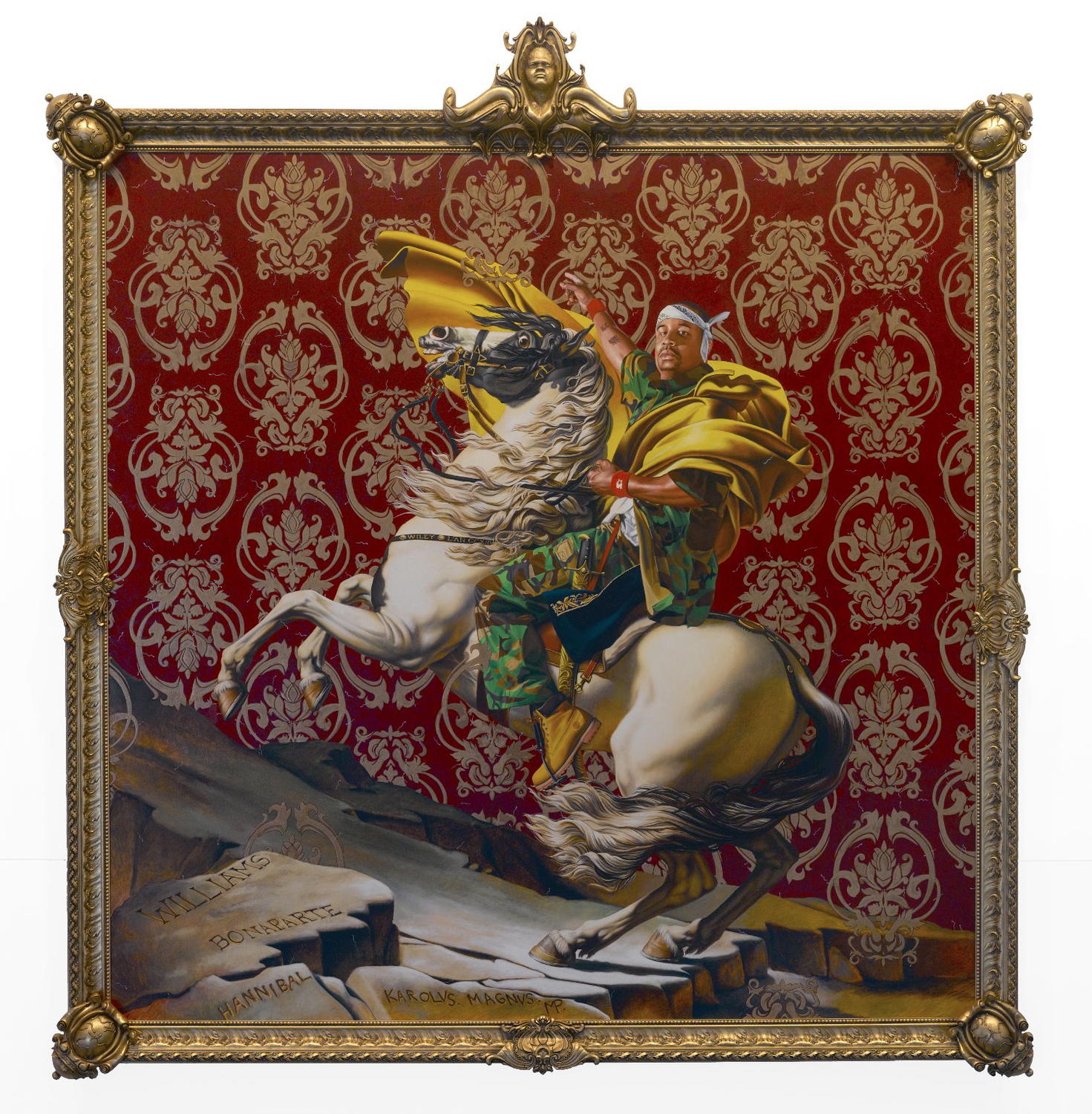
This is the clearest statement of the method. Jacques-Louis David painted Bonaparte Crossing the Grand Saint-Bernard Pass in 1801 as a commission from the Spanish Crown, a work of political propaganda requiring that a specific kind of authority be projected onto a specific body. Wiley took the composition scale-for-scale and gave it to a Black man in contemporary clothing: Timberlands, hoodie. Where David’s rock face reads “NAPOLEON,” Wiley’s reads “WILLIAMS.” The substitution makes explicit what the original suppressed: the heroic format was built to carry a specific kind of subject, and “NAPOLEON” was the license that permitted it.
The work is not a parody of David. The scale is real, the painted surface is real, the compositional authority is real. It’s the original argument being made with different material. What was invisible in David, the selectivity of the format, becomes the painting’s subject.
Femme Piquée par un Serpent (2008)
After Alexandre Clésinger’s 1847 marble sculpture. A young Black man reclines in a pose of sexualized vulnerability that Clésinger designed for a female subject. Considerable critical argument surrounded this pose at the time of the original’s Salon debut concerning the propriety of depicting a woman in such explicit physical extremity. Wiley takes that pose and rotates not only race but gender convention within it. The original’s erotics (the vulnerability, the surrender, the specific way the body is offered to the viewer’s gaze) become strange when the subject changes. That strangeness is the point. The conventions that made Clésinger’s pose “appropriate” for a woman’s body carry their assumptions into the new work and expose them there.
Judith Beheading Holofernes (2012)
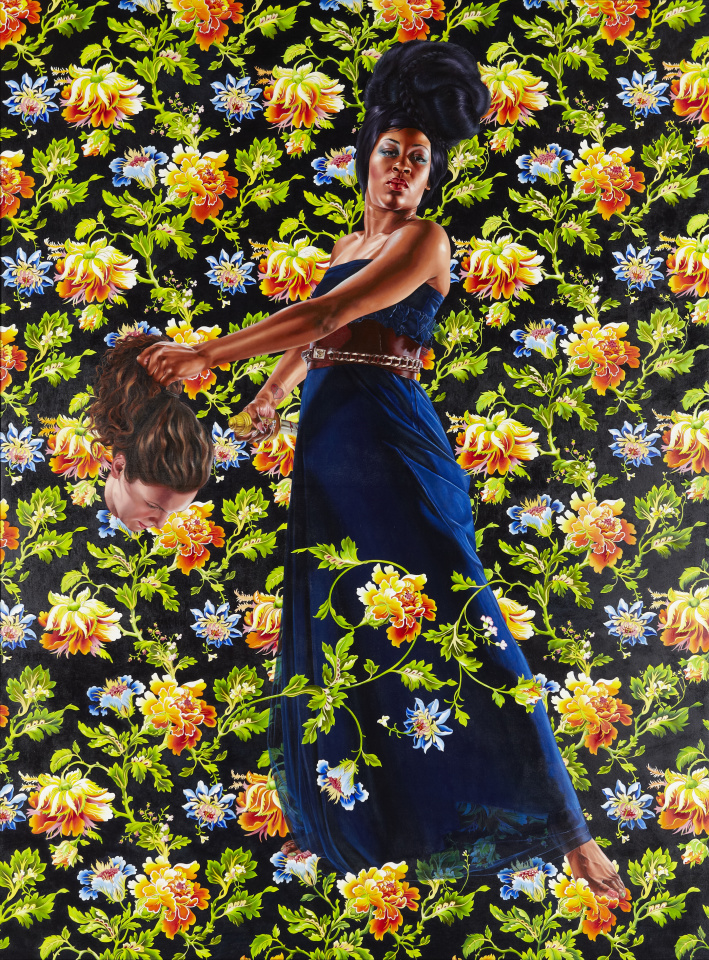
From a series Wiley centered on women. The Judith tradition in Western painting, from Caravaggio through Artemisia Gentileschi, frames female power as exceptional, monstrous, or justifiable only through extremity. Judith can be heroic because the occasion is maximum. Wiley’s subject delivers the coup de grâce with no expression of extremity at all. The pose is matter-of-fact, almost casual. That casualness is the argument: the heroic format can carry a Black woman’s authority as easily as it carried a general’s. The format isn’t strained. It accommodates her completely. The strain was always in the decision not to use it.
Portrait of Barack Obama (2018)
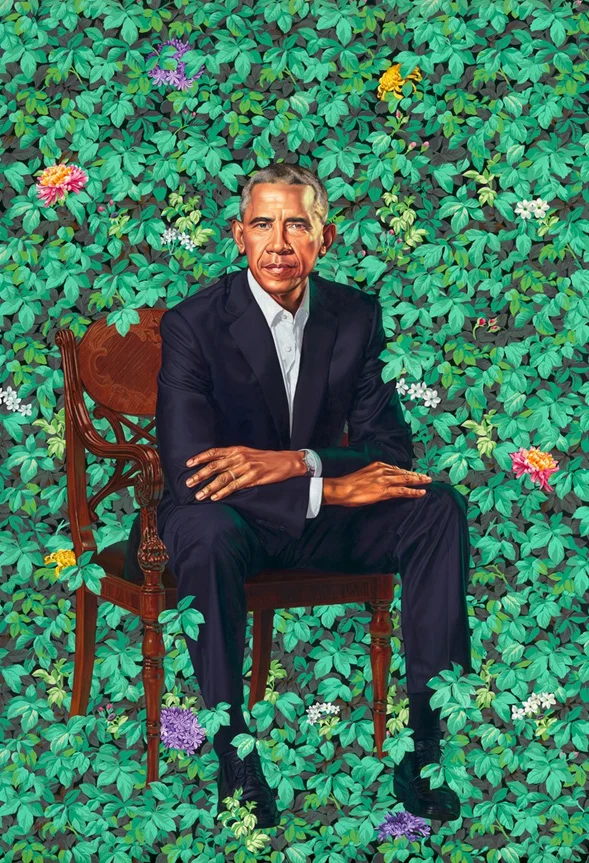
The Smithsonian’s National Portrait Gallery commission. First presidential portrait painted by a Black artist. Wiley’s handling of the commission made one sharp formal decision: Obama faces the viewer directly, breaking with the three-quarter profile convention of official portraiture. That convention implies deference or measured distance. The floral background (jasmine for Hawaii, chrysanthemum for Chicago, African blue lily for Kenya) maps biography onto the picture plane in the Rococo idiom Wiley has always used, but with a biographical specificity that the original Rococo backgrounds never had. The flowers aren’t decorative. They are a record. The painting is held at the Smithsonian’s National Portrait Gallery, Washington, D.C.
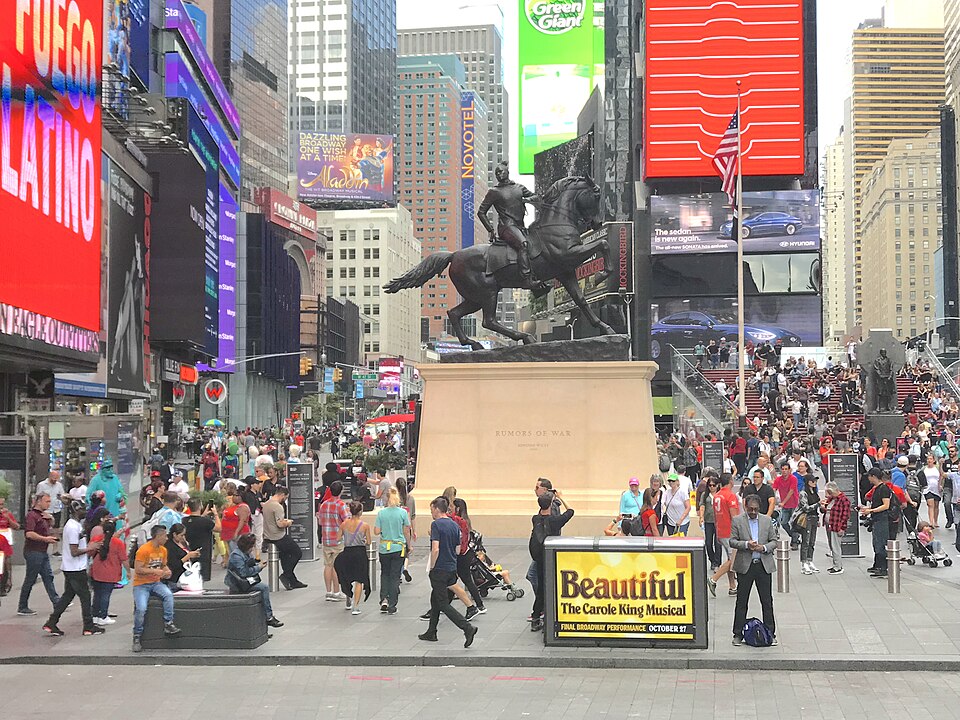
Rumors of War (2019)
Bronze equestrian sculpture, Virginia Museum of Fine Arts and Times Square. After the Confederate equestrian monuments of Richmond, Virginia. A young Black man in a hooded sweatshirt and sneakers occupies the exact posture and the exact compositional authority of the Confederate general. Wiley asked: “What does it mean to make a monument in this country?” (multiple press sources).
The Confederate monuments were made in the equestrian heroic tradition precisely because that tradition communicates what their makers wanted to communicate: that the person on the horse belongs there. Rumors of War makes the same argument with a different subject and lets the viewer feel what the original argument was actually claiming. The canonical format survives intact. What the monuments were suppressing, that the equestrian heroic form was always a political assertion, never a neutral record of distinction, becomes the work’s subject.
This is where the practice arrives: not commentary on the monuments, but the same compositional logic turned toward the subjects the monuments were built to exclude. The format wasn’t wrong. The selection criterion was.
Shop the Collection
Wiley’s practice spans more than two decades, and the monographs track how the argument developed. These two are the ones to own.
- Kehinde Wiley: An Archaeology of Silence (DelMonico Books/Rizzoli, 2023): The catalogue for Wiley’s most formally demanding series (large-scale paintings of fallen, prone Black figures after Hans Holbein the Younger’s Dead Christ in the Tomb) and the clearest test of the practice’s thesis. Claudia Schmuckli’s essay confronts directly the tension between the work’s celebratory formal ambition and its subject matter of Black mortality.
- Kehinde Wiley: A New Republic (Prestel/Brooklyn Museum, 2015): The major retrospective catalogue covering 2001 to 2015, the essential account of how the formal argument developed across series, from early Harlem street casting through The World Stage to the brink of the Obama commission. The essays by Eugenie Tsai and Connie H. Choi are criticism, not catalog copy.
Further Reading
These are the books that give you the critical apparatus the practice deserves, along with the context to read Wiley’s moves as the specific arguments they are.
- Connie H. Choi, Eugenie Tsai, et al., Kehinde Wiley: A New Republic (Prestel, 2015): Not a coffee-table book. Tsai and Choi frame Wiley’s formal interventions within American art history in ways that hold up to sustained critical pressure. The catalogue accompanied the Brooklyn Museum retrospective: the place to start if you want the argument without the gloss.
- Claudia Schmuckli, Kehinde Wiley: An Archaeology of Silence (DelMonico Books, 2023): The most conceptually serious catalogue in Wiley’s bibliography. Schmuckli’s essay does not look away from the fact that the practice’s most ambitious recent work takes Black mortality as its subject. Essential reading.
- Stephanie Emerson, Kehinde Wiley: Colorful Realm (Roberts Projects, 2024): Documents Wiley’s engagement with Japanese art-historical conventions, showing that the formal argument of his practice extends well beyond the European canon to any tradition that used visual hierarchy to assign or deny dignity. The thesis turns out to be portable.
Frequently Asked Questions
What is Kehinde Wiley known for?
Kehinde Wiley is known for large-scale portrait paintings that place Black subjects (typically men sourced through street casting in urban areas) in the compositional poses and formats of canonical European portraiture. He borrows directly from painters like Titian, Van Dyck, and Jacques-Louis David. The subjects wear contemporary streetwear. The floral and ornate Rococo backgrounds are original to his practice. His 2018 commission of the Portrait of Barack Obama for the Smithsonian’s National Portrait Gallery brought his work the widest public attention. He received an honorary doctorate from Yale University in 2024.
How does Kehinde Wiley choose his subjects?
Approximately 80% of Wiley’s subjects are sourced through street casting: he approaches strangers in urban areas who possess, as he has described it, “a spirit of self-possession” (AnOther Magazine interview). The approach is not casual. The quality Wiley is looking for is the same quality the heroic European compositional formats were designed to project onto aristocratic and military subjects. Finding it in contemporary strangers rather than in historically credentialed figures is a structural argument about where authority actually lives, as opposed to where the canonical formats assumed it resided.
Why did Kehinde Wiley paint the Obama portrait?
Wiley was commissioned by the Smithsonian’s National Portrait Gallery in 2018, the first Black artist to paint an official U.S. presidential portrait for that institution. His formal decisions were deliberate departures from official portraiture convention: Obama faces the viewer directly rather than in three-quarter profile, breaking the traditional implication of deference or measured distance. The background maps biographical geography (jasmine for Hawaii, chrysanthemum for Chicago, African blue lily for Kenya) in the Rococo idiom Wiley has used throughout his career, but with a specificity the Rococo tradition never attempted.
What is the meaning of the backgrounds in Kehinde Wiley’s paintings?
The ornate backgrounds serve at least two functions simultaneously. Formally, they flatten the pictorial space that European portraiture relied on for psychological depth, forcing the figure and the decorative surface into visual competition rather than hierarchy. Thematically, Wiley draws on Rococo patterns, Baroque textile motifs, and (in the World Stage series) regional wallpaper and textile traditions from the countries where subjects are cast. The backgrounds refuse the neutral dark spaces of canonical portraiture that positioned the figure as the singular, serious center. They compete. That competition is the point.
Where can I see Kehinde Wiley’s work in person?
Wiley’s work is held by more than 25 institutions. The Portrait of Barack Obama is permanently installed at the Smithsonian’s National Portrait Gallery in Washington, D.C. Rumors of War is permanently sited at the Virginia Museum of Fine Arts in Richmond. The Metropolitan Museum of Art, the Museum of Modern Art, and the Victoria & Albert Museum East all hold works from his practice. The Brooklyn Museum held the major 2015 retrospective “A New Republic,” and the de Young Museum in San Francisco presented “An Archaeology of Silence” in 2022.
Is Kehinde Wiley’s work political?
Yes, in the specific sense that the compositional choices are arguments about power. Wiley has described his own position as “interrogating the notion of the master painter, at once critical and complicit” (TheArtStory). The complicity is structural. You can only use the European portrait tradition’s authority to expose its exclusions by working inside that authority. The politics are not applied to the paintings as subject matter; they are produced by the formal decisions. Which formats get used for which subjects is a political question the paintings answer by demonstrating what the formats can actually carry when you remove the original selection criterion.
See also: Luc Tuymans, Image, Memory, and Violence in Contemporary Painting, Jean-Michel Basquiat

About Joe Post
Joe Post holds an MFA in Art from California Institute of the Arts (CalArts) and has done additional graduate work at the School of the Art Institute of Chicago. He founded Art Design Ideas to write about design as cultural argument — the decisions, contradictions, and assumptions built into the objects we live with.