
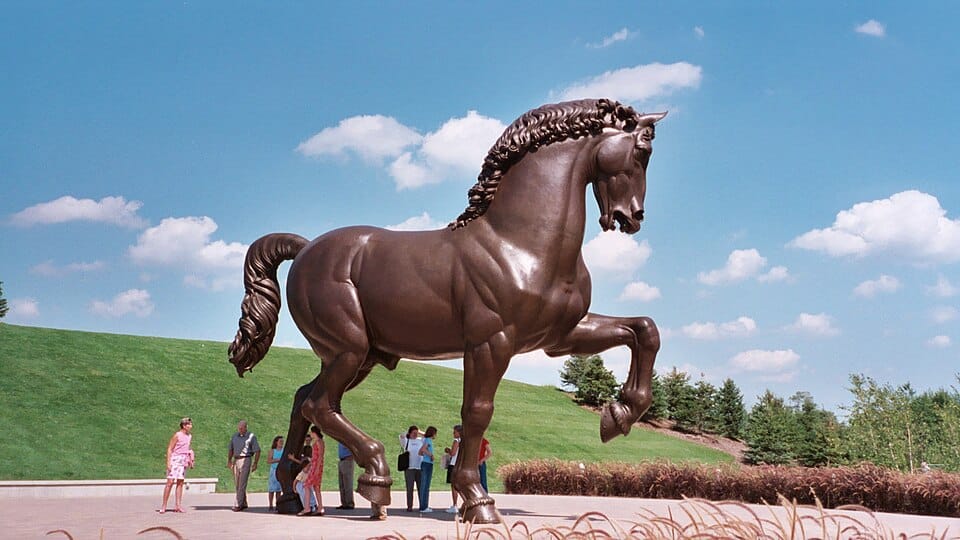
The American Horse is the Grand Rapids bronze cast of Leonardo da Vinci’s unfinished horse monument, also known as Il Cavallo or Leonardo’s Horse. The 24-foot bronze sculpture by Nina Akamu stands at Frederik Meijer Gardens & Sculpture Park in Grand Rapids, Michigan.
I.
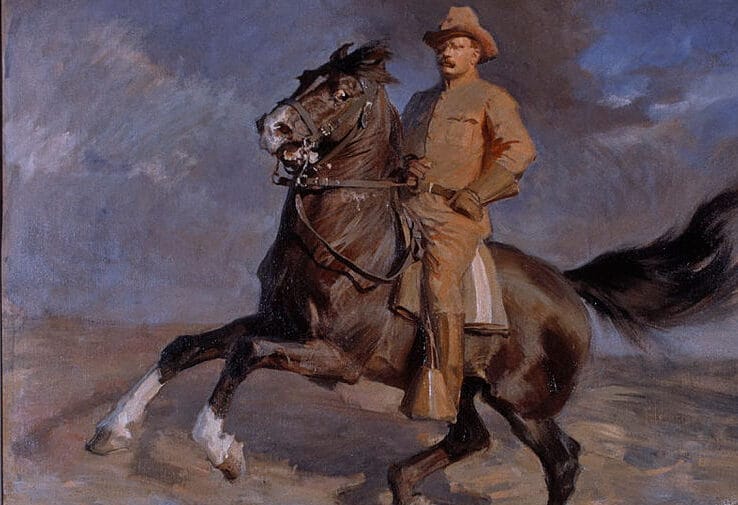
On October 22, 2007, President George W. Bush stood at a podium in the Roosevelt Room of the White House to make a statement on troop levels in Iraq. Behind him hung an equestrian painting: a man on horseback, military khaki, dramatic sky, ornate gold frame. Tadeusz Styka’s 1909 portrait of Theodore Roosevelt as a Rough Rider.
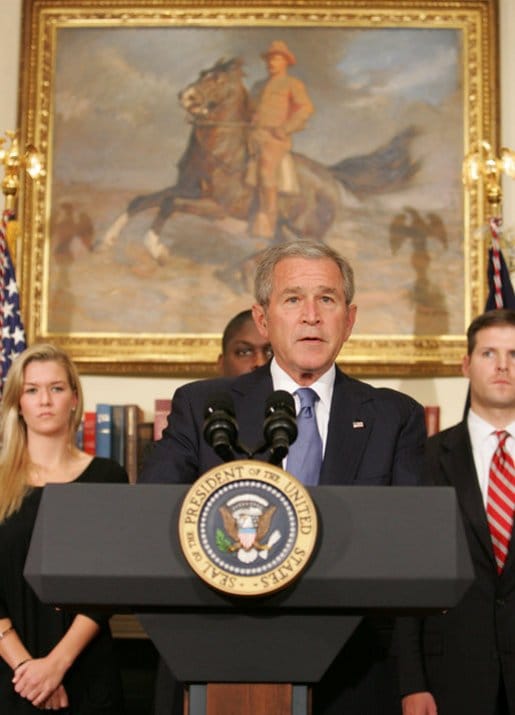
The painting was not merely decoration. It participated in the room’s rhetoric. For decades, presidents have conducted state business in this room, frequently in front of images like this one, while journalists and photographers recorded arrangements that would circulate in newspapers and textbooks and memory. Within the room’s accumulated display conventions, it makes available the claim that the man at the podium stands in a line that includes the man in the painting, who rode against the Spanish Empire and became president because of it.
This essay is about what that painting is doing. More specifically, it is about what the horse in the painting is doing. The horse precedes the painting. The painting precedes the podium. And all three belong to a recurring pattern in Western imperial image-making, visible across roughly five centuries, in which the horse does particular kinds of work.
Across Western imperial image-making, the horse recurs as a privileged form for aestheticizing force and organizing legitimacy. This is about the recurring visual and narrational form, not a total explanation of empire. The claim is not universal. It is patterned. The horse is not the cause of conquest, nor does it determine how violence will be narrated. But it repeatedly offers a visual form through which contested force can be rendered as elevated, historical, and rightful. The question is what kind of work that form is called on to do. This tradition becomes especially active where the legitimacy of violence is not given but contested — where the image is recruited to do work the moral argument has not settled, in conquest, colonial war, and imperial administration where the other side’s claim remains visible. Across the traditions this essay examines, the horse recurs in three registers: as military technology, whose actual tactical role has often been overstated; as representational form, the equestrian portrait or monumental bronze by which power presents itself as already historical and already beautiful; and as nominative caption, through which violence is stabilized as heroism, heritage, or background.
The horse recurs in three registers: as military technology, whose actual tactical role has often been overstated; as representational form, the equestrian portrait or monumental bronze by which power presents itself as already historical and already beautiful; and as nominative caption, through which violence is stabilized as heroism, heritage, or background.
These registers are not identical, and they are not always simultaneous, but they recur together often enough to form a visible pattern. What recurs is an alignment of military use, visual elevation, and narrative classification — observable, but not coordinated. The pieces need no conspiracy, only the persistent pressure of commissions, canons, and media that find the same forms useful.
The horse is not interchangeable with other imperial symbols. The sword hangs at the hip. The ship retreats to the horizon. The cannon points from a fixed position. The horse does something distinct: it physically elevates its rider above the crowd, conferring the view from above as a bodily fact. It combines living power with evident mastery — the rider controls an animal capable of violence. That combination, controlled living force and literal elevation, produces a symbolic authority no inanimate instrument reproduces in quite the same way.
Ulrich Raulff, in Farewell to the Horse: A Cultural History, describes the horse as uniquely both phoros — a carrier of weight — and semiophoros — a carrier of signs. “The more horses forfeit their worldly presence,” he writes, “the more they haunt the minds of a humanity that has turned away from them.” The bronze castings, the painted portraits, the room named for the Roosevelt presidents — these are the semiophoros function continuing after the phoros function has been superseded. The cavalry is gone. The sign persists.
A skeptic can push here. If the Rough Riders had charged in early armored cars, and mounted militias had attacked in Toyota Hilux technicals, would the racial sorting and memory-work have been any different? Probably not. The nominative register — caption, narrative, institutional silencing — does not require the horse. White supremacy and state power do not need an equestrian form to distribute violence across categories of heroism and atrocity. Contemporary military imagery rarely translates into monumental bronze in the same way. The horse is what makes the tradition aesthetic rather than merely functional — what converts force into heritage rather than just force into record.
The pattern persists through state commissions, museum canons, art education, and repeated circulation in media that normalize these forms as historical rather than contingent. Tracking that pattern, and the work it does, is this essay’s project.
II. Veracruz, 1519
The story most Americans learn about horses and the conquest of the Americas goes approximately like this. In April 1519, Hernán Cortés landed near present-day Veracruz with eleven ships, six hundred men, a handful of cannons, and sixteen horses. Over the next two years, through a combination of superior technology, disease, alliances, and bold leadership, he and his men overthrew the Aztec Empire, which at its peak controlled territory and populations numbering in the millions. In the popular account, the horses are central. The Indigenous peoples of Mesoamerica had never seen such animals. They were terrified. The Spanish, mounted and armored, rode over populations that had no tactical response to cavalry. This is, broadly, the narrative in Jared Diamond’s Guns, Germs, and Steel (1997) and in the PBS companion series of the same name.
Recent scholarship has substantially complicated this narrative.
Ross Hassig, in Mexico and the Spanish Conquest (1994, revised 2006), argues that horses functioned in Spanish forces primarily as status symbols. Men who brought horses received double shares of spoils, one for their service and one for their mount. Cortés himself preferred to fight on foot. In the terrain and climate of the Valley of Mexico, with its causeways, ravines, and canals, cavalry was frequently more liability than advantage. Indigenous warriors adapted rapidly, drawing horses into narrow passes, targeting their legs, learning specific shouts and whistles that startled them. Within months, the shock of the mounted Spanish had been absorbed and tactically countered.
Enrique Rodríguez-Alegría’s “Narratives of Conquest, Colonialism, and Cutting-Edge Technology” (American Anthropologist, 2008) goes further. The premise that Indigenous technologies were rapidly overwritten by superior European ones, he shows, is an artifact of colonial historiography rather than of archaeology. Obsidian weapons, Indigenous engineering, Indigenous agricultural systems persisted for generations after contact, often performing better than their European analogues. The image of the stone-age savage confronted by the steel-wielding conqueror was produced retrospectively to justify an outcome that had been produced by something else entirely.
That something else was Indigenous political division, exploited by Spanish alliance-building. The conquest of Tenochtitlán was carried out by an alliance of Tlaxcalans, Totonacs, and other Indigenous polities, numbering by some estimates two hundred thousand warriors at the final siege, most of whom went unrewarded and whose contribution was written out of Spanish chronicles. The conquest, as Hassig puts it, was less a Spanish victory than a victory of Indians over other Indians that the Spanish exploited to their own advantage.
If the horse was not militarily decisive, what was it doing? The evidence is indirect but persistent. Spanish chronicles devote disproportionate attention to equestrian encounters relative to their tactical significance. The retrospective histories amplify that attention further. The symbolic weight placed on the horse’s presence at Veracruz exceeds anything its battlefield performance could warrant. What the horse appears to have been doing is what horses repeatedly do in this pattern of image-making: performing power and signifying superiority, working in the register of image to produce the civilizational hierarchy the conquest was concurrently building on the ground. The horse appears to have been more important to the conquest’s retrospective self-image than to its battlefield decisiveness.
A note on scope. The horse has other lives outside this essay’s concern. Mongol, Scythian, Arab, and Persian equestrian traditions built their own image-making practices with their own politics, many of which predate or contradict anything that could be called a Western visual tradition. Plains Indian equestrian cultures, as Pekka Hämäläinen has shown, developed within two generations of Spanish contact into whole economies and cosmologies that used the horse against and beyond the imperial frame. This essay does not treat those traditions as variations on a Western pattern, and it does not argue that the horse is inherently an imperial form. It argues only that within Western imperial image-making, the horse has done a particular kind of recurring work. That work is worth naming, separately from whatever horses have done elsewhere. And the existence of these other traditions — the Comanche use of horse culture to contest and contain American expansion for more than a century, as Hämäläinen documents in The Comanche Empire (2008) — is evidence not that the Western tradition is universal, but that it is a contested pattern rather than a closed loop. Patterns that require that much sustained military force to maintain are patterns being continuously pressured from outside.
This matters because the narrative outlived the conquest. It helps explain why the older story still circulates so powerfully, and why the horses that the Spanish rode are still recognizable in the bronze that Fred Meijer commissioned and in the painting behind George W. Bush.
III. Il Cavallo, Milan, and The American Horse in Grand Rapids
The sculpture now called The American Horse in Grand Rapids is the American cast of Leonardo da Vinci’s unfinished horse project, better known in Italy as Il Cavallo.
The tradition Leonardo was entering had been active for a generation. Donatello’s Gattamelata (1453) in Padua was among the first major Renaissance revivals of the equestrian monument — a mercenary general fixed on a public plinth, military authority made permanent in bronze. Verrocchio’s Bartolomeo Colleoni (begun 1480, Venice) extended the form: another condottiere, another public square, the animal and rider caught in the instant of commanded force. Both were commissioned by city-states that wanted military power to appear already historical, already inevitable. Leonardo’s commission from Sforza in 1482 was the next move in an established tradition.
In 1482, Ludovico Sforza, Duke of Milan, commissioned the young Leonardo da Vinci to cast a bronze equestrian statue honoring his father Francesco. The statue was to stand three times life-size, an unprecedented scale, a monument that would announce the Sforza line as one of the great dynasties of Europe. Leonardo spent seventeen years on the project, studying equine anatomy, engineering a new casting technique involving inverted molds and circular ovens, and producing a clay model of the horse at full size.
The horse was never cast. The seventy-nine tons of bronze reserved for the casting were diverted, as the Duke needed cannons. In 1499, French forces invaded Milan. The Duke fled. French archers, according to legend, used the clay horse as target practice. By the sixteenth century, the horse existed only in Leonardo’s notebooks and in the memory of those who had seen it.
For almost five hundred years, Leonardo’s horse was a productive absence. It represented Renaissance ambition interrupted by political violence, genius left uncompleted, the sublime unfinished. Art historians wrote about it. Artists cited it. Its non-existence was as generative as most of the period’s actual monuments.
In 1977, an American retired airline pilot and art collector named Charles Dent read a National Geographic article about the horse. He decided to build it. He decided, specifically, that he would build it and give it to the city of Milan, in his words, “as a gesture of appreciation from the American people for all the Renaissance has meant to our own culture.” He founded a non-profit, Leonardo da Vinci’s Horse, Inc. He worked on the project until his death in 1994. His will left his estate to the effort.
The labor of actually making the horse went to the Japanese-American sculptor Nina Akamu, who suspended a commission for a Japanese-American internment memorial in order to take the assignment. Akamu determined that Dent’s existing model could not be salvaged and began from scratch, studying Leonardo’s notebooks and anatomical sketches for three years to produce a horse that honored Leonardo’s artistic principles rather than attempting to reproduce a lost original.
The money came from Fred Meijer, CEO of the Midwestern superstore chain, who had seen an article about the project in 1996 and asked himself, as he later put it, “Well, wouldn’t that be a good project for the gardens?” He pledged two and a half million dollars. He also commissioned a second casting from the same mold, which would come to Grand Rapids.
On September 10, 1999 — chosen as a best-guess 500th anniversary of the clay model’s destruction in 1499 — the horse was unveiled in Milan. One month later, its twin was dedicated at Frederik Meijer Gardens in Grand Rapids. Meijer named it The American Horse.
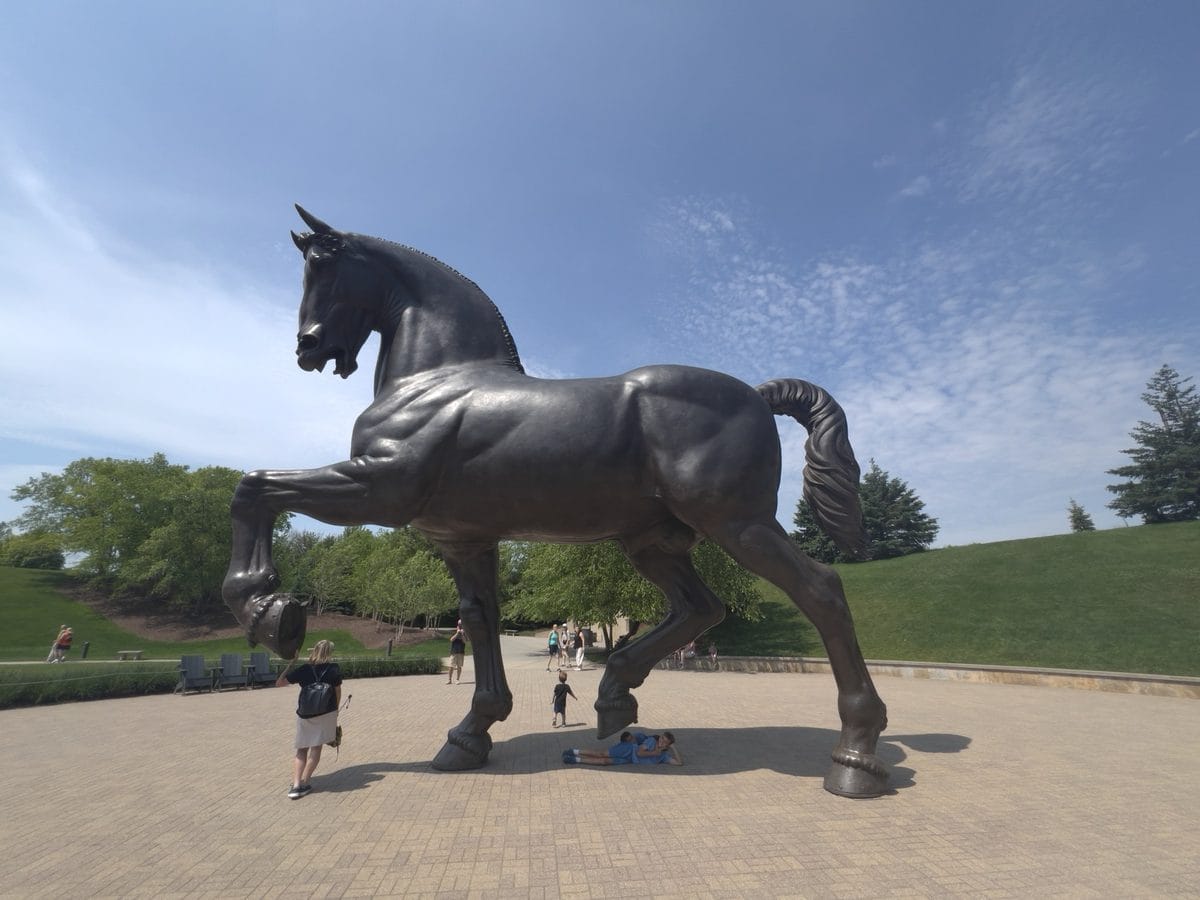
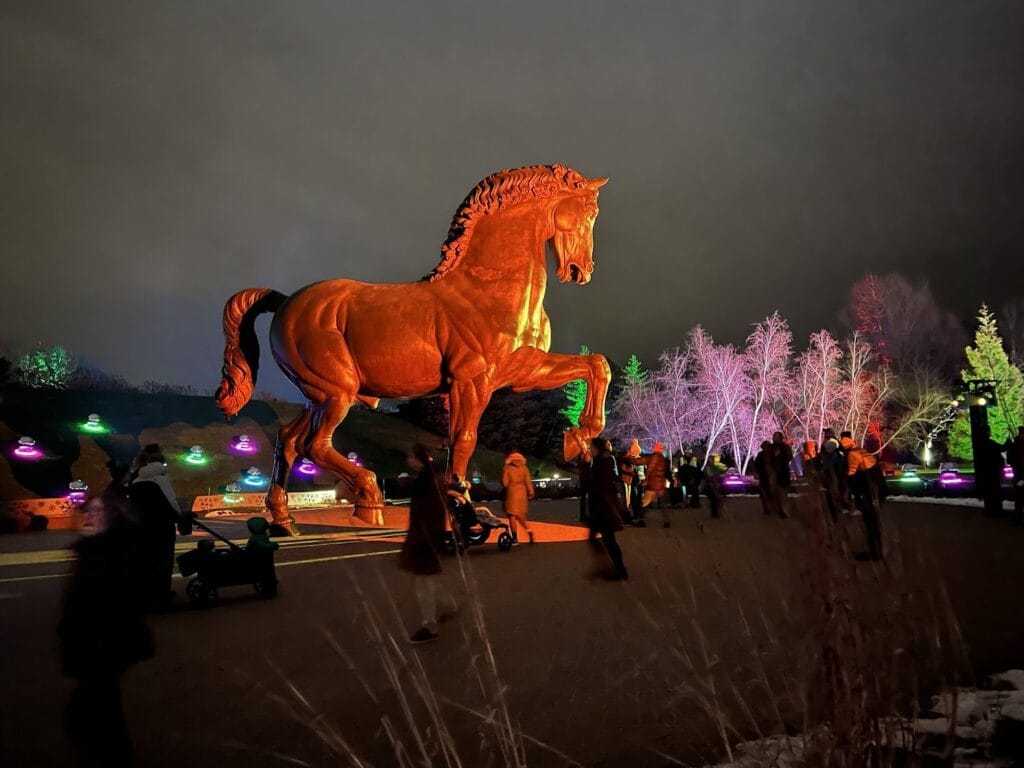
There is a 2011 retrospective in MLive, written by Joanne Bailey-Boorsma on the occasion of Meijer’s death, that describes the project with unambivalent reverence. Read carefully, it is a document of the convention at work. “They did a wonderful job,” Meijer tells the reporter, of the Dent foundation’s decades of effort and Akamu’s three years of study, “having the dream, and hiring Nina, especially hiring Nina, to complete the statue. Then we came along with the money.”
Consider what has happened. A European Renaissance project conceived for a Milanese duke has been adopted by an American non-profit, executed by a Japanese-American sculptor, financed by an American retail billionaire, named “American,” and installed in a private sculpture park bearing the financier’s name. Leonardo’s name is carved into the horse’s right eye. Charles Dent’s name is carved into the left eye. Fred Meijer’s name is on the gardens, on the literature, on the Renaissance Education Center that opened the following year. Nina Akamu’s name appears in the press materials.
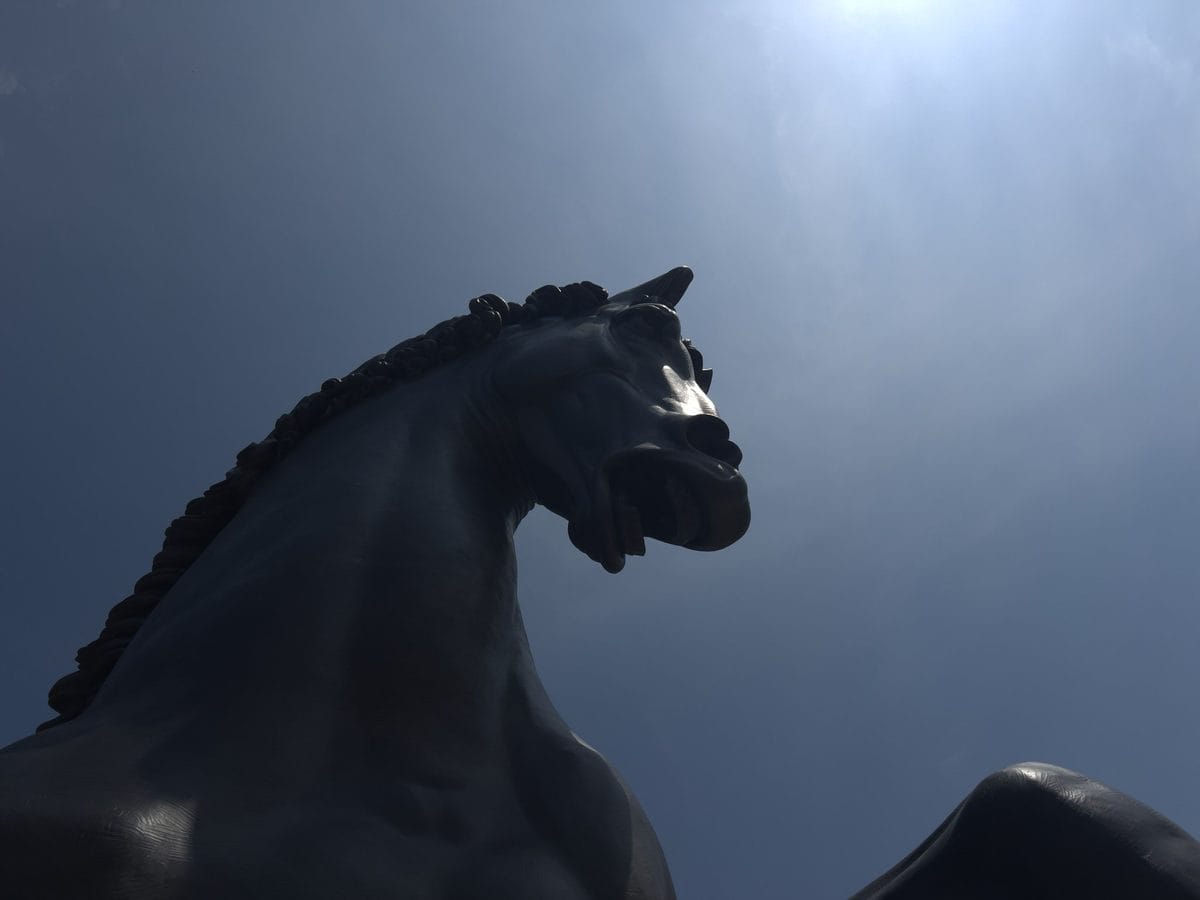
What the Meijer project reveals is not a reenactment of conquest, but the afterlife of its visual grammar. A form once tied to dynastic and military legitimacy now circulates as culture, philanthropy, and appreciation. That shift matters. It shows how thoroughly the equestrian monument has been naturalized as heritage. A Renaissance commission for a Milanese duke can be recast by an American donor, renamed The American Horse, and installed in a private sculpture park without the historical conditions of the form appearing as part of its public meaning. The issue is not equivalence. It is inheritance, naming, and the ease with which power’s old forms reappear as neutral culture.
The horse was never just Meijer’s. Equestrian monuments across the Western tradition perform variations on the same move at their own scales. The Robert E. Lee monument in Richmond, before it was finally removed in 2021. David’s Napoleon Crossing the Alps (1801) depicts the First Consul on a rearing white stallion in a mountain storm; Napoleon actually crossed the Saint Bernard Pass on a mule in fair weather, but David carved HANNIBAL and KAROLUS MAGNUS into the foreground rocks and the painting was commissioned five times. Each is a different performance of the same claim, inflected by its time and patron.
The function of the monument is not to commemorate power. It is to perform it, publicly, in terms that present the power as already historical, already beautiful, already complete. It converts force into heritage, and heritage into inheritance — something nobody had to claim because it arrived already beautiful.
IV. The Counter-Tradition
This visual tradition has had dissenters inside Western art itself. These artists do not argue against the horse. They refuse to let it stay still.
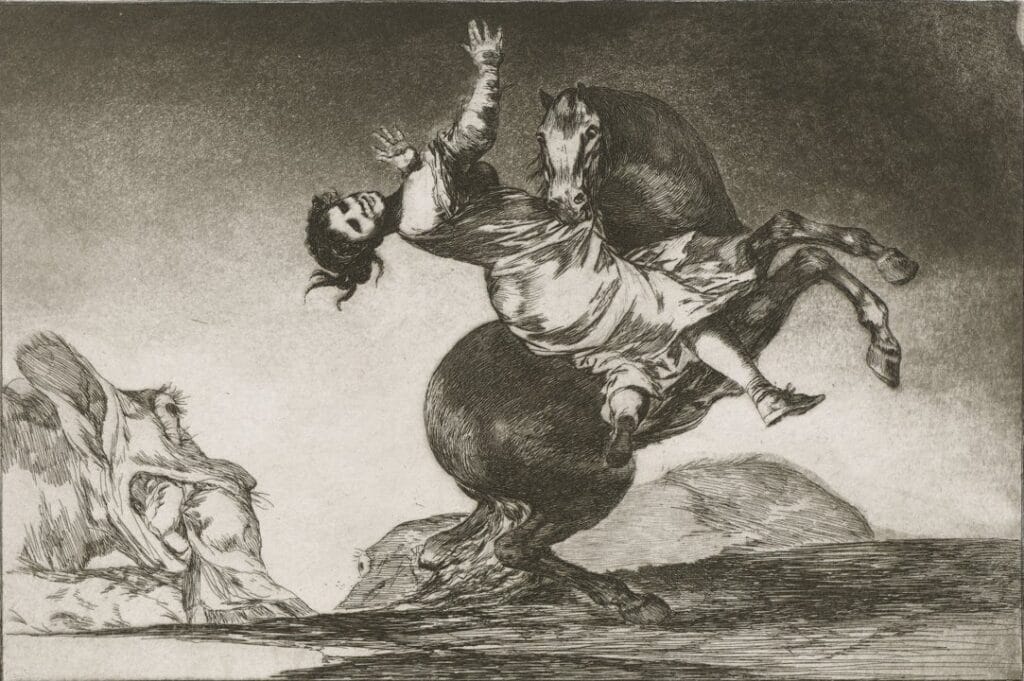
Francisco Goya’s etching A Woman and a Horse, Let Someone Else Master Them (La mujer y el potro, que los dome otro, 1819–1823, published 1875) depicts a rearing horse abducting a woman across a landscape whose features resolve into strange monsters. The National Galleries of Scotland, which holds the print, notes that it draws on an old tale of a man transformed into a horse who kills a woman’s husband and seizes her — animal instinct driving the story, not reason or right. Let someone else. Goya’s horse is not the monument’s horse. It is violent, sexual, uncontainable, sublime. It is what the monument is designed to forget about the animal it memorializes.
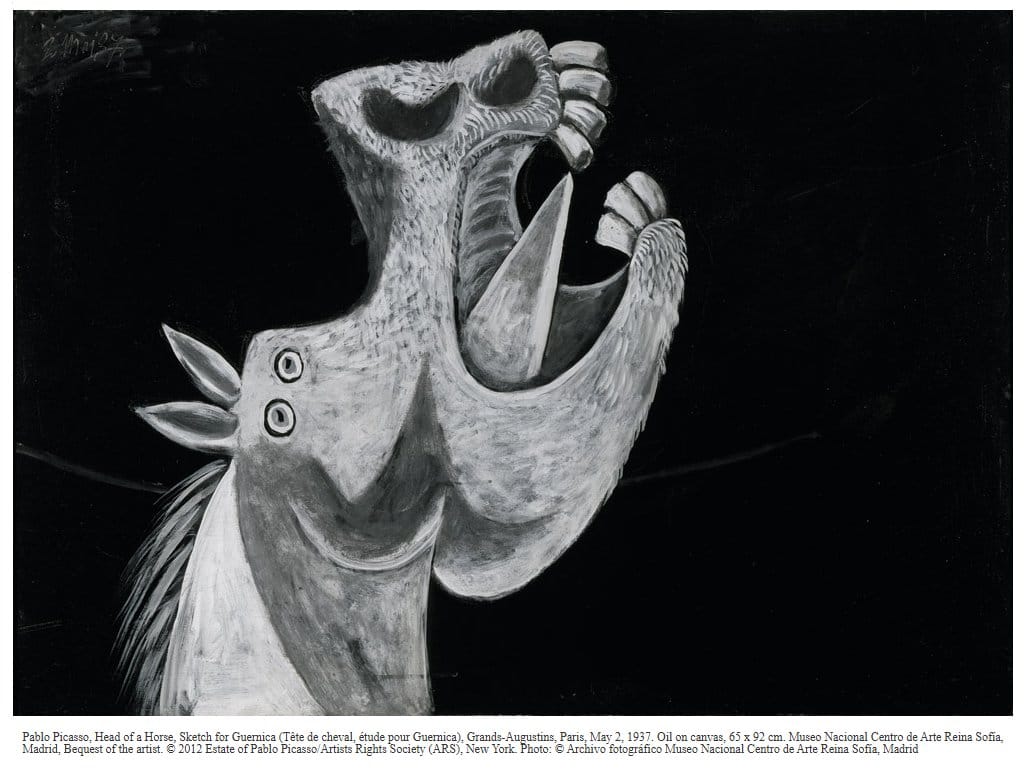
Pablo Picasso’s Guernica (1937), painted in response to the Nazi and Fascist bombing of the Basque town of Guernica during the Spanish Civil War, places the screaming, pierced horse at the center of the composition. Picasso declined to offer an allegorical key to the painting, insisting publicly that the symbols are not symbols — the horse is a horse, the bull is a bull. Yet the horse is visibly the war’s innocent victim, the population under bombing, the body onto which the violence of the tradition is transferred.
Maurizio Cattelan’s La Ballata di Trotski (The Ballad of Trotsky, 1996) answers the tradition from within it. Cattelan was born in Padua, where Donatello’s Gattamelata still stands — the model every subsequent Italian equestrian commission was answering. His response is to hang a taxidermied horse from the ceiling by a rope around its neck. The vertical axis of the monument is preserved and inverted: the horse is elevated, but by a noose. His gallery describes the work as “a monument to the paralysis of a universal utopia and the usurpation of romantic idealism by the darker side of human nature.” The Trotsky of the title is specific. The Red Army’s cavalry used the same visual grammar — mounted force as revolutionary legitimacy — that the imperial tradition had always used. Cattelan hangs that horse too. The revolutionary form and the imperial form share the grammar, and the grammar ends the same way.
Berlinde De Bruyckere’s installation In Flanders Fields (2000) takes that logic one step further. Where Picasso’s horse is screaming, mid-wound, De Bruyckere’s horses are already past that — fallen, massive, still. The work consists of life-size equine figures collapsed on the ground, their bodies draped in fabric that reads simultaneously as shroud and as an act of care. The equestrian monument suppresses a specific fact: World War I killed an estimated eight million horses, animals whose service produced no bronze, no pedestal, no room named after them. De Bruyckere makes that suppression her subject. The title’s reference to John McCrae’s poem is precise — “In Flanders Fields” is itself about the obligation to remember what the official record omits. The installation asks what a monument to the horse would look like if the horse were the subject rather than the platform.
Four works, across nearly two centuries, each attacking a different register: the representational form, the aesthetic elevation, the monument’s vertical logic, the institutional erasure.
The counter-tradition extends beyond the European studio. Plains Indian ledger art, produced across the second half of the nineteenth century by Lakota, Cheyenne, Arapaho, and other artists on the paper of military and commercial ledger books, offers a counter-image produced from inside the tradition’s intended conquest rather than from its cultural center. Where the equestrian monument fixes the rider from above — static, inevitable, already historical — ledger art depicts horses in motion: flat, lateral, dynamic, often carrying warriors in the act of counting coup rather than territorial seizure. Gerald Vizenor calls this quality “transmotion” — native sovereignty expressed as movement, refusing the stasis of the imperial monument. Howling Wolf, a Southern Cheyenne artist, drew warfare and courtship scenes over the inventory pages of a white trader’s ledger book, physically overwriting the bureaucratic record of empire with a narrative of survival. The view from above is replaced by the view from inside the encounter, made by the people the tradition was designed to overwrite. Hämäläinen documents that Comanche horse culture used equestrian mastery as political leverage against American expansion for more than a century. The ledger drawings are the visual register of that leverage. They are not nostalgic images. They are arguments. The visual tradition was contested not only from within the European studio, but from the frontiers it sought to close.
The counter-tradition has an American strand as well, and it works differently. Kara Walker’s The Jubilant Martyrs of Obsolescence and Ruin (2015) takes the Confederate Memorial Carving at Stone Mountain, Georgia — often described as the largest Confederate monument in existence, Jefferson Davis, Robert E. Lee, and Stonewall Jackson on horseback, carved into granite — and asks the question the monument was designed never to raise. In Walker’s version, Jefferson Davis’s horse is bound at the hoof and being carried on the back of a female slave. The monument’s foundation is now the subject. The horse is not on the pedestal. It is being borne. Walker places at the center of the image what the equestrian tradition placed beneath it, outside the frame, unnamed. The monument names its riders. Walker names what the monument required to stand.
None of these works appear in the Roosevelt Room. None of them would appear behind a president making a statement on troop levels. They cannot perform the same work. That is what makes them useful.
The tradition is not stable, and the counter-tradition is not powerless. In February 2003, the tapestry copy of Guernica that hangs outside the United Nations Security Council was covered with a blue curtain before Colin Powell’s speech making the case for the invasion of Iraq. Martin Warnke noted that the horse’s hindquarters remained visible above Powell’s face during the broadcast — the institutional frame could muffle the painting but not erase it. The counter-tradition still has force, or there would be no reason to cover it. In 2019, Kehinde Wiley installed Rumors of War in Times Square — a life-size bronze equestrian monument with a young Black man in street clothes and sneakers in the saddle. It moved to permanent installation in Richmond, a few blocks from where the Lee monument had stood.
V. The Roosevelt Room
The horse has been superseded as military technology but not as sign. It need not be primary. It need only remain available — as animal, as image, as the name on a room.
Return, now, to the photograph. President Bush at the podium; Styka’s Roosevelt on the wall behind him. The president makes a statement on a war whose death toll has been estimated very differently depending on method, including excess mortality estimates in the hundreds of thousands, framed by a painting of a man who rode to the presidency on the image of a cavalry charge, presiding over the consolidation of American overseas empire.
Within the room’s accumulated display conventions, the claim of succession is made legible without requiring it to be spoken. This is a claim about legibility, not causation; the image makes a relation available without determining how it is taken up. The form needs no intention. Only a painting, a podium, and a press corps.
The three registers converge here. The painting remains on the wall because the room bears Roosevelt’s name. Roosevelt’s war fame helped carry him to the presidency — the nominative register doing the work the other two made possible. That fame persists as heroism more easily than the imperial violence it helped authorize persists as public memory. The cameras record the podium, the frame, and the name on the wall, then distribute the whole arrangement as ordinary background.
The imperial war that followed was the Philippine-American War, which produced, by some estimates, as many as two hundred thousand Filipino civilian dead, alongside documented practices including concentration camps and lethal orders issued in specific campaigns. Paul Kramer’s The Blood of Government (2006) treats it as the American empire’s founding act, and the proving ground for the racial categories that would structure American imperial practice across the twentieth century. Trouillot’s framework in Silencing the Past names what followed: history is produced by silences as much as by speech. The cavalry charge is fixed as heroism. What it served is not in the room. That silence is structural. It is what the room requires.
In the United States, this tradition often works by translation. Imperial violence is not usually presented under the name of empire. It is translated into frontier romance, civic memory, presidential lineage, or cultural patronage. The Rough Rider becomes heroism. The monument becomes heritage. The caption does the rest.
The nominative register is the caption: Roosevelt Room. Not conquest room. Not Philippine-American War room. Roosevelt Room. And the caption is what this essay has been tracking — not the violence, which is legible enough, but the grammar that decides which violence becomes heritage and which becomes atrocity.
The task of criticism, and of the artists this essay has tracked, is to refuse the caption.
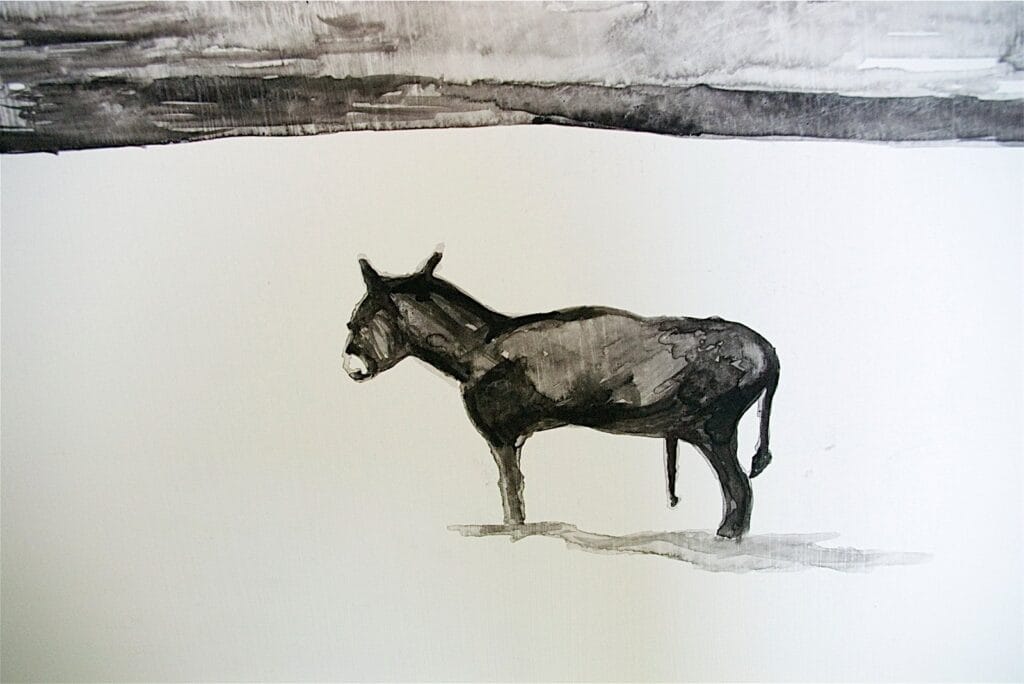
Let someone else master them.
Related essays on the equestrian tradition
- Il Cavallo: Leonardo da Vinci’s Horse — The five-century arc of the Gran Cavallo, from Ludovico Sforza’s 1482 commission through the bronze’s 1999 casting in Milan and Grand Rapids.
- Nina Akamu, Sculptor — The American sculptor who discarded the prior model entirely and built Leonardo’s horse from scratch, resolved the biomechanical failures, and cast it twice.
- Frederik Meijer Gardens & Sculpture Park — The Grand Rapids institution that funded and commissioned the American cast, and what its collecting philosophy argues about who public sculpture is for.
- Largest Equestrian Statues in the United States — A ranked survey of the most significant American equestrian bronzes by scale and artistic ambition, from the Oñate monument to the Mustangs of Las Colinas.
- Leonardo da Vinci as Sculptor — Why Leonardo’s primary identity was as a sculptor trained under Verrocchio, and what the Codex Madrid II reveals about his foundry engineering.
FAQ
What is The American Horse in Grand Rapids?
The American Horse is a 24-foot bronze sculpture by Nina Akamu at Frederik Meijer Gardens & Sculpture Park in Grand Rapids, Michigan. It is the American cast of Leonardo da Vinci’s unfinished horse monument, often referred to as Il Cavallo or Leonardo’s Horse.
Is The American Horse the same as Leonardo’s Horse?
Yes, in the sense that The American Horse is the Grand Rapids cast of the project completed from Leonardo da Vinci’s unfinished Sforza horse commission. The Milan cast is usually called Il Cavallo, while the Grand Rapids cast is titled The American Horse.
Where is The American Horse located?
The American Horse is located at Frederik Meijer Gardens & Sculpture Park in Grand Rapids, Michigan.
Who made The American Horse?
The American Horse was sculpted by Nina Akamu, who reworked the project in the late 1990s and completed the full-size bronze casts unveiled in 1999.
Why is it called The American Horse?
The Grand Rapids cast was named The American Horse when it was installed at Frederik Meijer Gardens, distinguishing it from the Milan cast while also marking its American institutional setting.
Sources
Academic
- Raulff, Ulrich. Farewell to the Horse: A Cultural History. Allen Lane, 2017.
- Hassig, Ross. Mexico and the Spanish Conquest. Longman, 1994; revised University of Oklahoma Press, 2006.
- Rodríguez-Alegría, Enrique. “Narratives of Conquest, Colonialism, and Cutting-Edge Technology.” American Anthropologist, 2008.
- Hämäläinen, Pekka. “The Rise and Fall of Plains Indian Horse Cultures.” Journal of American History, Vol. 90, No. 3, 2003.
- Hämäläinen, Pekka. The Comanche Empire. Yale University Press, 2008.
- Vizenor, Gerald. Manifest Manners: Postindian Warriors of Survivance. Wesleyan University Press, 1994.
- Warnke, Martin. “The Guernica Cover-Up in the United Nations in 2003: Politics and the Suppression of the Concrete Realities of War.” WZB Berlin Social Science Center, 2003.
- Kramer, Paul A. The Blood of Government: Race, Empire, the United States, and the Philippines. University of North Carolina Press, 2006.
- Trouillot, Michel-Rolph. Silencing the Past: Power and the Production of History. Beacon Press, 1995.
Cultural / Literary
- Browne, Alix. “A Horse, of Course.” Gagosian Quarterly, November 17, 2023. https://gagosian.com/quarterly/2023/11/17/essay-a-horse-of-course/
- Cattelan, Maurizio. La Ballata di Trotski (The Ballad of Trotsky). Taxidermy, rope, 1996.
- De Bruyckere, Berlinde. In Flanders Fields. Installation, 2000. Exhibited in Luc Tuymans, “Sanguine/Bloedrood,” BOZAR, Brussels, 2018. https://www.culturedmag.com/article/2018/09/15/luc-tuymans-sanguine-bloedrood/
- Walker, Kara. The Jubilant Martyrs of Obsolescence and Ruin. Cut paper and adhesive on wall, 2015.
- Goya, Francisco. A Woman and a Horse, Let Someone Else Master Them (La mujer y el potro, que los dome otro, plate 10 of Los Disparates). Etching, aquatint, drypoint, 1819–1823, published 1875. National Galleries of Scotland, Edinburgh. https://www.nationalgalleries.org/art-and-artists/34072
- Picasso, Pablo. Guernica. Oil on canvas, 1937. Museo Reina Sofía, Madrid.
Popular / Foil
- Diamond, Jared. Guns, Germs, and Steel. W.W. Norton, 1997; PBS companion series, 2005.
- Bailey-Boorsma, Joanne. “Re-exploring Frederik Meijer’s Legacy.” MLive, 2011.
Monuments Referenced
- Donatello. Gattamelata. Bronze, 1453. Piazza del Santo, Padua.
- Verrocchio, Andrea del. Equestrian Statue of Bartolomeo Colleoni. Bronze, begun 1480, completed 1496. Campo Santi Giovanni e Paolo, Venice.
- Akamu, Nina. The American Horse. Bronze, 1999. Frederik Meijer Gardens & Sculpture Park, Grand Rapids.
- Wiley, Kehinde. Rumors of War. Bronze, 2019. Times Square / Virginia Museum of Fine Arts, Richmond.
- Styka, Tadeusz. Theodore Roosevelt as Colonel of the Rough Riders. Oil on canvas, 1909. White House Collection.

About Joe Post
Joe Post holds an MFA in Art from California Institute of the Arts (CalArts) and has done additional graduate work at the School of the Art Institute of Chicago. He founded Art Design Ideas to write about design as cultural argument — the decisions, contradictions, and assumptions built into the objects we live with.