

Vitra vs HAY: two serious design companies, one Swiss and one Danish, that sit at opposite ends of a similar argument about what furniture should be. Vitra sells the modernist canon at premium prices; HAY builds a new one at accessible ones. Their price overlap, $20–$200, is where the comparison gets interesting.
What Vitra vs HAY is actually arguing about
Two different bets on where design authority comes from. That is the comparison. Not price, not aesthetic preference, not which one photographs better on Instagram. The actual question is: does authority derive from custody of the past, or from the quality of what you’re making right now?
Vitra was founded in 1950 by Willi and Erika Fehlbaum in Birsfelden, Switzerland. The Fehlbaums visited New York in 1953 and met Charles and Ray Eames; by 1957 they were manufacturing Eames and George Nelson designs for the European market under license. They added Verner Panton in 1967. The Panton Chair was widely recognized as the first cantilever chair made entirely of plastic, a technical fact worth sitting with. Then Jean Prouvé, Alexander Girard, Jasper Morrison. The pattern is consistent: Vitra identifies work that makes a durable argument about furniture and acquires the rights to keep making it. The Vitra Design Museum campus in Weil am Rhein includes buildings by Frank Gehry (1989), Zaha Hadid (1993), Tadao Ando (1993), and Herzog & de Meuron (VitraHaus, 2010). It is the physical extension of that positioning. This is a company that built a museum around its own catalog. You do not do that if you think of yourself as a furniture manufacturer.

HAY was founded in 2002 by Rolf and Mette Hay in Copenhagen, launched in 2003, with an explicit mission: contemporary furniture at accessible prices with serious design intent. Their roster reads differently from Vitra’s. Ronan and Erwan Bouroullec, Nathalie Du Pasquier, Stefan Diez, Naoto Fukasawa. These are living designers building their reputations in real time, not dead masters whose work was settled before HAY existed. Herman Miller acquired a majority stake in 2019, which is a real fact that belongs in this comparison (more on that below). But the design direction has not visibly changed since the acquisition.
The argument, laid out plainly: Vitra’s authority derives from historical custody. It holds the licenses. When you buy a Vitra Eames chair, you are buying the authorized original, in the same sense that a Folio Society edition of a novel is the authorized edition, the one that got the typography and the binding right. HAY’s authority derives from a different claim: we are building the canon right now, and in twenty years you will see that we were right. Neither position is stronger in the abstract. They are genuinely different bets.
Vitra’s authority derives from historical custody. HAY’s authority derives from a different claim: we are building the canon right now.
Where Vitra wins, where HAY wins, and where it depends
The comparison across four categories doesn’t resolve cleanly into a winner. That is not evasion. It is the honest result of comparing two companies with different mandates.
Price
Vitra’s entry point is not furniture. It’s the Miniatures Collection: 1:6 scale replicas of the chairs in their catalog, accurate to the originals in construction, material, and colorway. These run $50–$200. The Eames Lounge Chair & Ottoman in miniature costs roughly $80. The actual Eames Lounge Chair in Vitra’s production costs $5,000–$7,000 new. That gap is not an accident. It is a market architecture. Vitra knows that most of its admirers cannot afford its furniture. The Miniatures Collection is how they stay in those people’s homes anyway.
HAY’s entry point is the object itself. The Colour Crate M runs around $35. It is a polypropylene storage crate. It folds. It comes in colors: navy, dusty rose, cream. Each shade was chosen by someone with a sensibility, not just a production department. HAY’s furniture starts around $200 and runs to $800 for upholstered pieces. The gap between their admirers and their catalog is narrower.
Budget entry point: HAY. Investment-grade furniture: Vitra, and not even close.
Design pedigree
Vitra holds the licenses for Eames, Nelson, Panton, Prouvé, and Girard. These are the canonical objects of 20th-century furniture. If you want to own an authorized Eames DSW chair (fiberglass shell, wire base, Eiffel legs, first produced in 1950), Vitra is the manufacturer. Reproductions exist. They have the shape. What they cannot do is call it an ‘Eames chair’ and mean it. For a full look at what Vitra makes available at different price points, the best Vitra products guide covers the current catalog in depth.
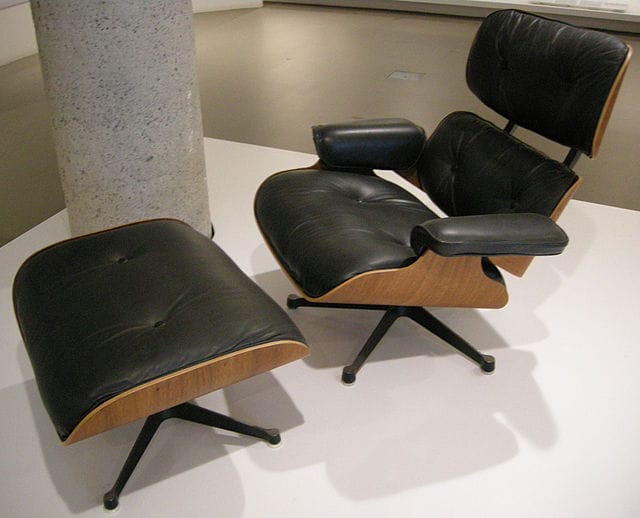
HAY’s designers are building reputations rather than maintaining legacies. The Bouroullec brothers work with both Vitra and HAY, which is itself an argument about the two brands: the same design practice can serve the historical custodian and the contemporary builder simultaneously, which suggests the boundary between these two positions is more permeable than the comparison makes it seem. HAY has Fukasawa, whose work for Muji defines one version of democratic design; Du Pasquier, whose colorist practice comes from Memphis and represents a direct lineage from design history’s more playful branch. HAY is not without pedigree. It is without the specific pedigree of certified design-historical objects.
Neither wins outright. The question is whether you want to own a piece of settled design history or bet on what is becoming history now. For broader context on where HAY sits in the Scandinavian tradition, the Scandinavian design products guide is worth reading alongside this comparison.
Color and character
Vitra makes disciplined color choices. The palette reads as institutional: museum-quality neutrals, period-accurate colorways for the vintage pieces, a range that says “we have thought about this very carefully.” It is the palette of a company that considers itself a steward.
HAY operates differently. The Colour Crate exists as an argument that utility objects should be joyful. The shade of navy on that crate is not accidental. It is a color-direction decision made by people who thought hard about it. HAY’s broader furniture and accessory range treats color as a primary design variable rather than a finishing decision. It is exuberant without being careless, which is harder to achieve than it looks.
HAY wins for color range and domestic warmth. Vitra wins for disciplined restraint. These are not the same category of victory.
Accessibility and entry point
This is where the comparison gets most interesting, because both brands are reachable at the $20–$200 tier, and the choice between them at that level is a genuine statement about what you want from design.
A Vitra miniature at $80 is a collectible. It is not furniture. It is a 1:6 scale object that sits on a shelf and says something about what its owner cares about. Some buyers find this deeply satisfying: a legitimate piece of design history in the room, at a price that doesn’t require a five-figure furniture budget. Others find it unsatisfying precisely because it is not the thing.
A HAY Colour Crate at $35 is a functional object. You put things in it. It also happens to have been designed by people who thought carefully about material and color. The satisfaction is different: not “I own a miniaturized piece of history” but “the objects I use daily are worth paying attention to.”
Both are legitimate positions. The choice between them is the comparison.
A Vitra miniature at $80 is a collectible. A HAY Colour Crate at $35 is a functional object. The satisfaction is different, and so is what you’re saying when you choose one.
What you’re actually getting with each brand
Vitra — Pros:
- The licenses are real. A Vitra Eames chair is the authorized object; everything else is an interpretation of it. That distinction matters to some buyers and not at all to others. If it matters to you, Vitra is the only option.
- The Vitra Design Museum and campus represent an institutional commitment to design culture that goes beyond product marketing. Rolf Fehlbaum built a museum. That is a different order of seriousness than a brand heritage page.
- The Miniatures Collection solves an actual problem: how do you own a piece of the canon when the canon costs five figures? It is an elegant solution to a real market gap.
Vitra — Cons:
- Premium pricing puts most furniture beyond casual buyers. The entry point for actual furniture is around $400 for the Eames DSW; the Lounge Chair starts at $5,000. These are not prices for someone furnishing a first apartment.
- Heritage dependency. Vitra’s strength is also a constraint. The brand is built around 20th-century masters, and the newer additions to its roster (Morrison, Arad, Bouroullec) have not generated the same cultural weight as the canonical pieces. The catalog has a gravitational center that is sixty years old.
- The Miniatures Collection is a collectible. Some buyers find this unsatisfying; they want the chair, not a sculpture of the chair.
HAY — Pros:
- Democratic-design philosophy without sacrificing material integrity. The Colour Crate is a genuinely well-made object at a price that does not require a design budget.
- Color range that treats color as a primary design variable. In the serious-design segment, this is relatively rare. Most brands at this price point use color as decoration. HAY uses it as argument.
- Building a contemporary canon. The Bouroullec and Fukasawa collaborations are design relationships with historical weight. HAY is making things that will be in design history surveys in thirty years.
HAY — Cons:
- No equivalent to the Miniatures Collection. There is no affordable symbolic entry point into “owning HAY” the way there is into owning Vitra. You either buy the furniture or you don’t.
- Herman Miller’s 2019 majority acquisition introduces commercial pressures that a family-owned company does not face. Rolf and Mette Hay remained involved in design direction after the acquisition, and there is no public evidence of compromised design independence as of 2026. But the long-term question is real and worth naming.
- HAY furniture at $200–$800 is not dramatically cheaper than Vitra’s entry-level pieces. The price advantage is real at the object level ($35 crate vs. $50 miniature); it is less clear at the furniture level.
Which Should You Choose?
Choose Vitra if: you are buying furniture as a long-term investment and want the authorized original, not an approximation of it. If you are the kind of buyer for whom the difference between an authorized Eames DSW and a reproduction matters, and that difference is real in the precision of the weld, the quality of the fiberglass, the exact colorway, Vitra is the only choice. The Miniatures Collection also works if you want a piece of the canon in your home without the furniture budget to match: a Vitra miniature on a shelf is not a compromise, it is a different kind of object. See the best Vitra products guide for a full breakdown of the catalog.
Choose HAY if: you are furnishing a contemporary space with a real budget and want objects that were designed with seriousness. The color range is unmatched in this segment. The Bouroullec and Fukasawa work is the real thing, not licensed history. If you are interested in owning a piece of what is becoming canonical rather than what already is, HAY is the more interesting bet. For context on how HAY sits in the broader Scandinavian design tradition, the Scandinavian design products guide is worth reading alongside this comparison.
The honest third option: buy both at the overlap. A Vitra miniature and a HAY Colour Crate on the same shelf make a more interesting argument about design history than either does alone. One says: here is where we came from. The other says: here is what we are doing with it.
Where to buy, checked 20 September 2026: neither brand is on Amazon.com right now. The Vitra Miniatures Collection listings and the HAY Colour Crate this page used to link have all gone out of stock, and Amazon carries only the Vitra books below. Vitra sells the miniatures direct at vitra.com and through the Vitra Design Museum shop; HAY sells the Colour Crate direct at hay.com and through Design Within Reach and MoMA Design Store in the US. Prices are the same or better direct, and both brands ship from US stock.
Further Reading
Two books that put both brands in context, one for each side of the comparison.
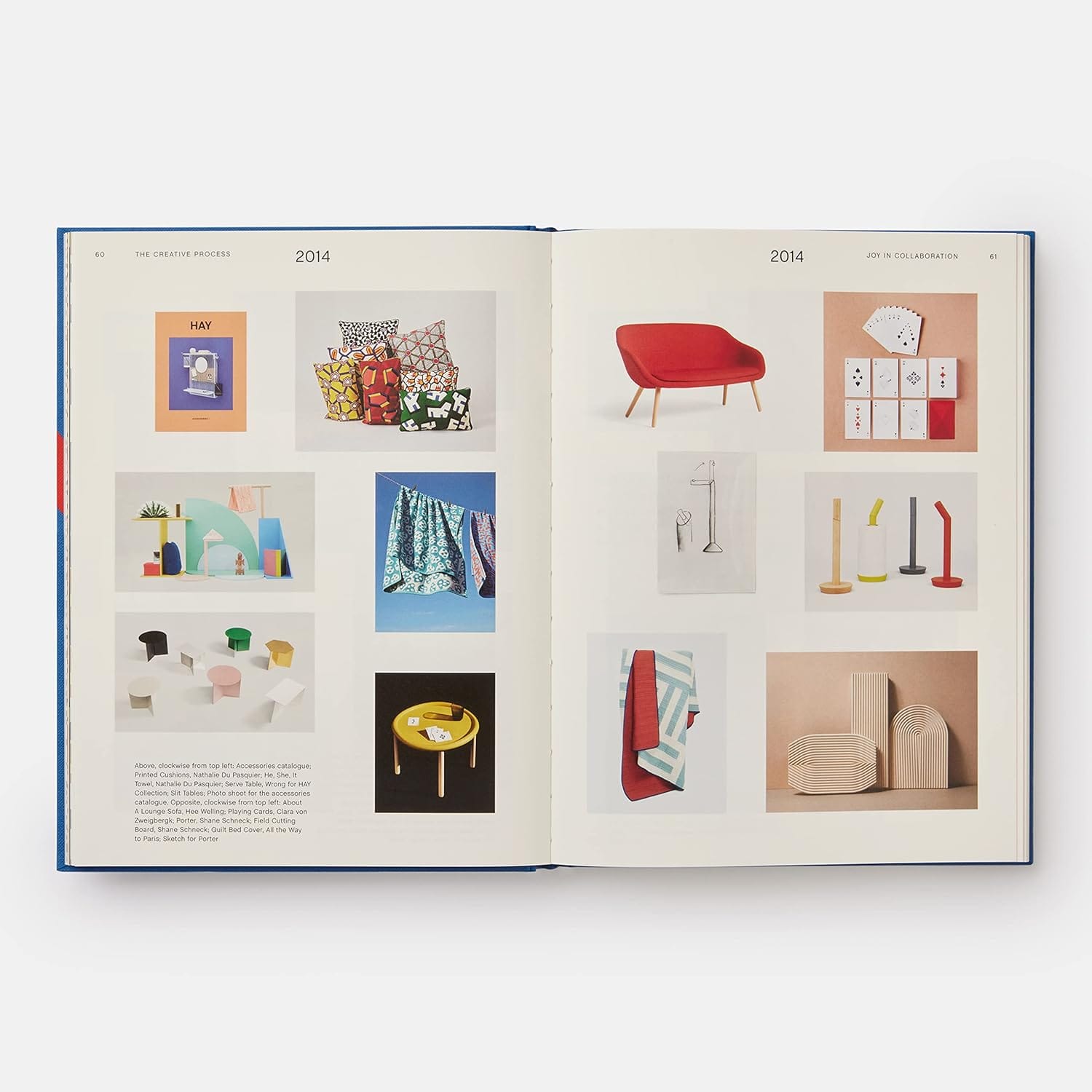
Kelsey Keith (ed.), HAY (Phaidon, 2022)
The definitive monograph on a 20-year-old brand. 600 images, essays by Keith and contributors, direct access to the Bouroullec and Fukasawa collaborations. Published at the brand’s 20th anniversary; as close to primary source as a design monograph gets.
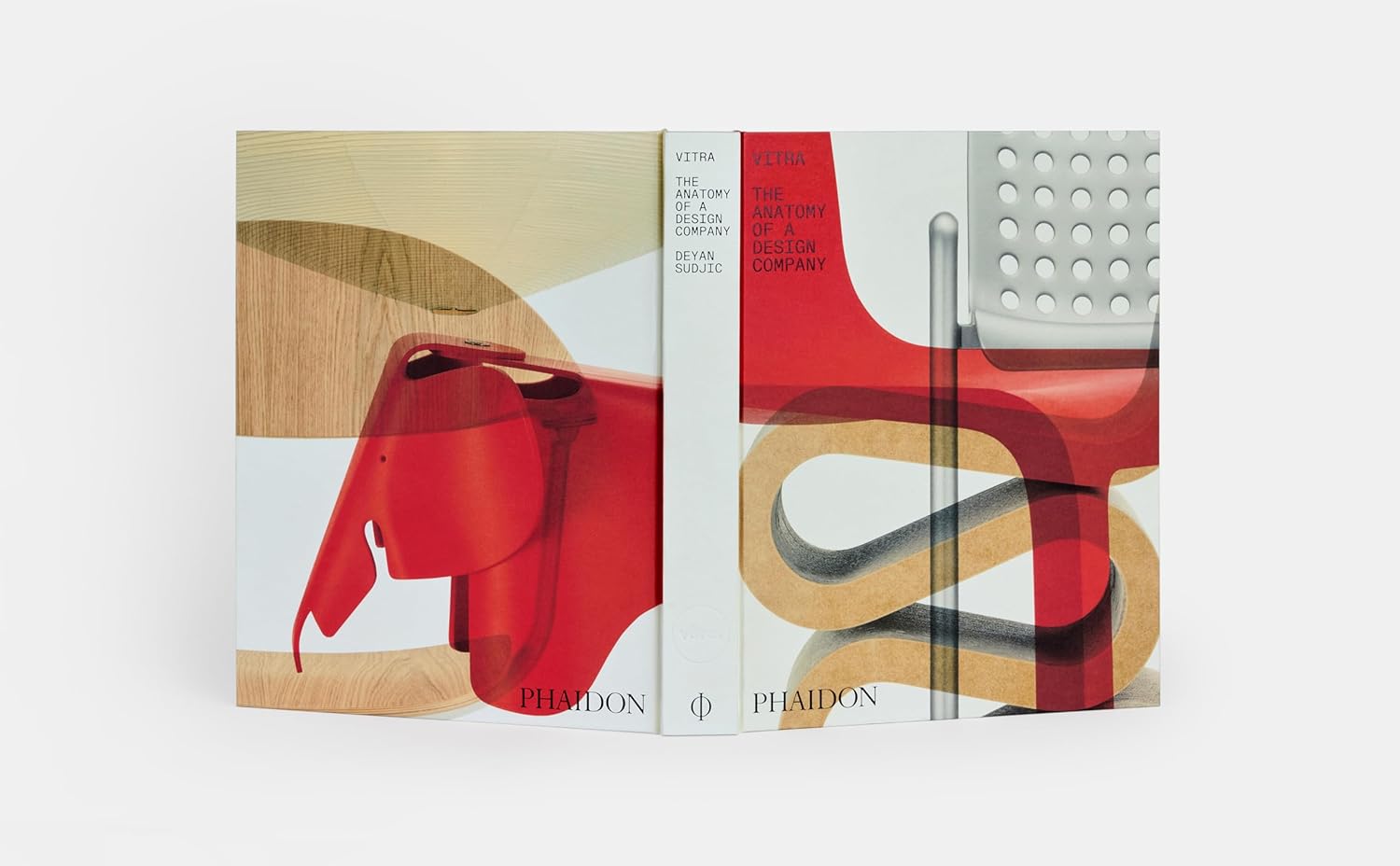
Deyan Sudjic, Iwan Baan, Karen Stein, Vitra: The Anatomy of a Design Company (Phaidon, 2023)
Sudjic is the former director of the Design Museum, London. He writes about Vitra from inside design institution culture, not as a brand journalist. The Iwan Baan photography of the Weil am Rhein campus justifies ownership on its own terms.
Frequently Asked Questions
What is the difference between Vitra and HAY?
Vitra is a Swiss manufacturer that holds the production licenses for 20th-century design classics: Eames, Nelson, Panton, Prouvé. It positions itself as the custodian of that canon. HAY is a Danish brand founded in 2002 that works with contemporary designers to produce furniture and objects at accessible prices. Vitra’s authority derives from certified design history; HAY’s derives from building new design history in real time.
Is HAY owned by Herman Miller?
Yes. Herman Miller acquired a majority stake in HAY in 2019. Rolf and Mette Hay remained involved in the brand’s design direction after the acquisition, and there is no public evidence that the design philosophy changed as a result. The ownership fact is worth knowing: it introduces commercial pressures that a family-owned company doesn’t face. But it has not visibly compromised the brand’s output as of 2026.
Are Vitra miniatures worth buying?
They are if you understand what you are buying. A Vitra miniature is a collectible, not furniture: a 1:6 scale replica of a design classic, accurate to the original in construction, material, and colorway. For buyers who want a piece of the authorized design canon in their home without a five-figure furniture budget, the Miniatures Collection is a genuine solution. For buyers who want to actually sit in the chair, it isn’t the answer.
How does HAY compare to Vitra on price?
At the object tier ($20–$200), HAY is generally cheaper for functional items: a HAY Colour Crate runs around $35, while Vitra’s entry point is the Miniatures Collection at $50–$200. At the furniture tier, the gap narrows. HAY furniture starts around $200, Vitra’s entry-level pieces (Eames DSW) start around $400, and the Lounge Chair runs $5,000–$7,000. Both brands are reachable at the lower tier; the real price difference is in what you get for your money at each level.
Is Vitra or HAY better for a contemporary home?
For a contemporary home, HAY’s color range and accessible price points give it a practical edge. HAY’s objects integrate into daily domestic life: furniture you use, storage you see every day, rather than functioning as design-historical relics. That said, a Vitra miniature on a shelf and a HAY crate on a table make a better argument together than either does separately.
Where can I buy Vitra miniatures?
Direct from vitra.com, from the Vitra Design Museum shop, and from authorized Vitra retailers in major cities. As of September 2026 the Miniatures Collection is not stocked on Amazon.com; the listings that used to carry the Eames Lounge Chair and DSW miniatures have been withdrawn, so check the brand channels first.

About Joe Post
Joe Post holds an MFA in Art from California Institute of the Arts (CalArts) and has done additional graduate work at the School of the Art Institute of Chicago. He founded Art Design Ideas to write about design as cultural argument — the decisions, contradictions, and assumptions built into the objects we live with.