
Il Cavallo, Leonardo da Vinci’s colossal equestrian monument, was commissioned by Ludovico Sforza in 1482 but never cast in bronze. The 24-foot clay model was destroyed by French troops in 1499. Five centuries later, American pilot Charles Dent and sculptor Nina Akamu completed what Leonardo could not: a bronze horse unveiled in Milan in 1999 and cast again in Grand Rapids as The American Horse.
What Ludovico Sforza was actually asking Leonardo to do
In 1482, Ludovico Sforza, Duke of Milan, did not commission an artwork. He commissioned a statement. The monument was to memorialize his father Francesco Sforza, and it was to be the largest equestrian statue in the world. Those two requirements are inseparable. The scale was the argument. Milan’s dominance over its rivals was to be declared in bronze, at a size that made denial impossible.
The scale was the argument. Milan’s dominance over its rivals was to be declared in bronze, at a size that made denial impossible.
Sforza ruled a state that needed to be seen. He was not yet formally duke when the commission went to Leonardo. He was regent, consolidating power, watching the Italian city-states calculate their allegiances. A monument to his father was also a monument to his own legitimacy. Statecraft, as often, was taking the form of bronze.
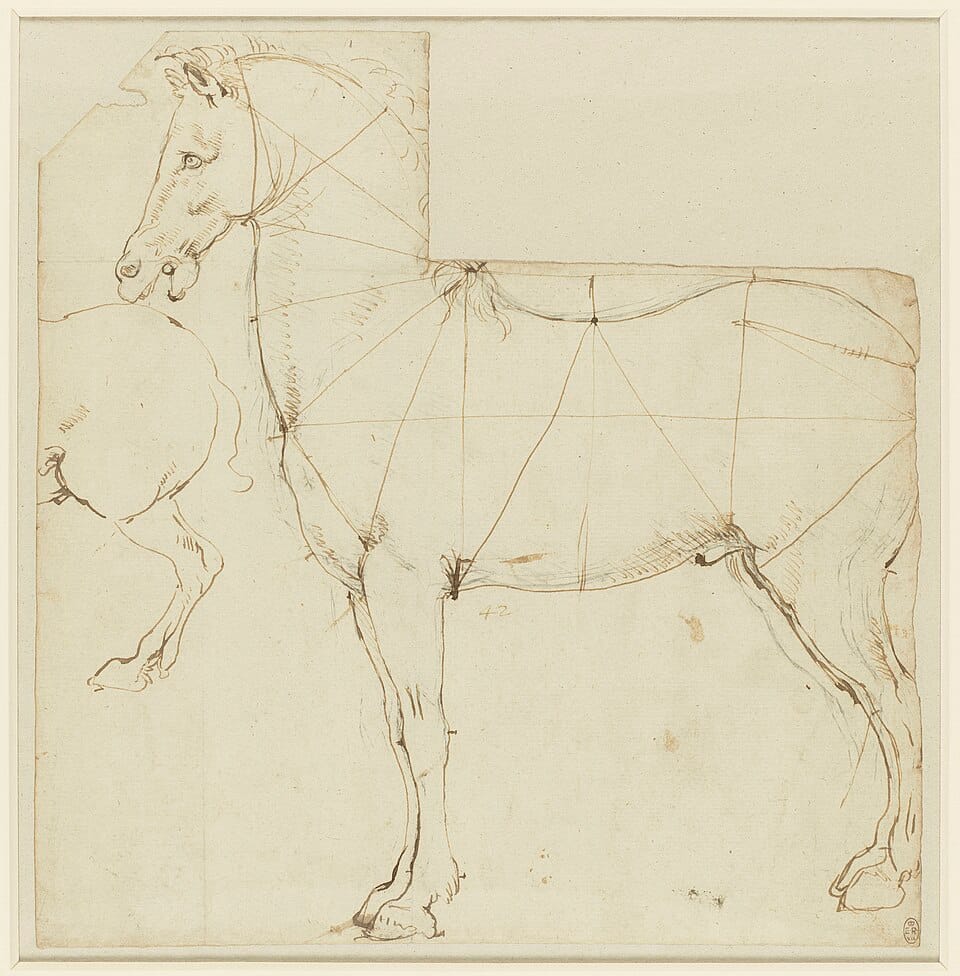
Leonardo arrived in Milan from Florence, where he had spent years working for the Medici. He spent the next seventeen years inside this project alongside other work including The Last Supper, neither of which he finished. The horse required his sustained attention in a way that is legible now in the density of the preparatory archive. The Windsor Collection at the Royal Collection Trust holds anatomical studies of horses from approximately 1490, black chalk drawings that trace the muscle groups of animals Leonardo watched and measured at the Sforza stables. These were not gesture sketches. They were engineering documents.
In November 1493, the full-scale clay model, twenty-four feet high, was exhibited in Milan. Baldassare Castiglione later cited it in Il Cortegiano as a measure of Leonardo’s achievement. On December 20, 1493, Leonardo wrote that he was ready to begin casting. That decision never became action.
The reason was not failure of will. It was material reality.
Why casting 80 tons of bronze was genuinely impossible in 1493
The metallurgical problem with il cavallo Leonardo da Vinci designed is specific enough to be worth stating with precision, because every account that calls it merely “ambitious” understates what Leonardo was actually attempting.
The horse required approximately 70 to 75 tons of bronze in a single casting. That figure alone was without precedent. No foundry in Europe had attempted anything near this volume in a single pour. The technical bottleneck was temperature: molten bronze begins to cool the moment it leaves the furnace. In a pour of this scale, maintaining uniform temperature across the entire volume of the mold was, with fifteenth-century furnace technology, not solvable. Gas pockets form where the metal cools unevenly. The structural result is catastrophic.
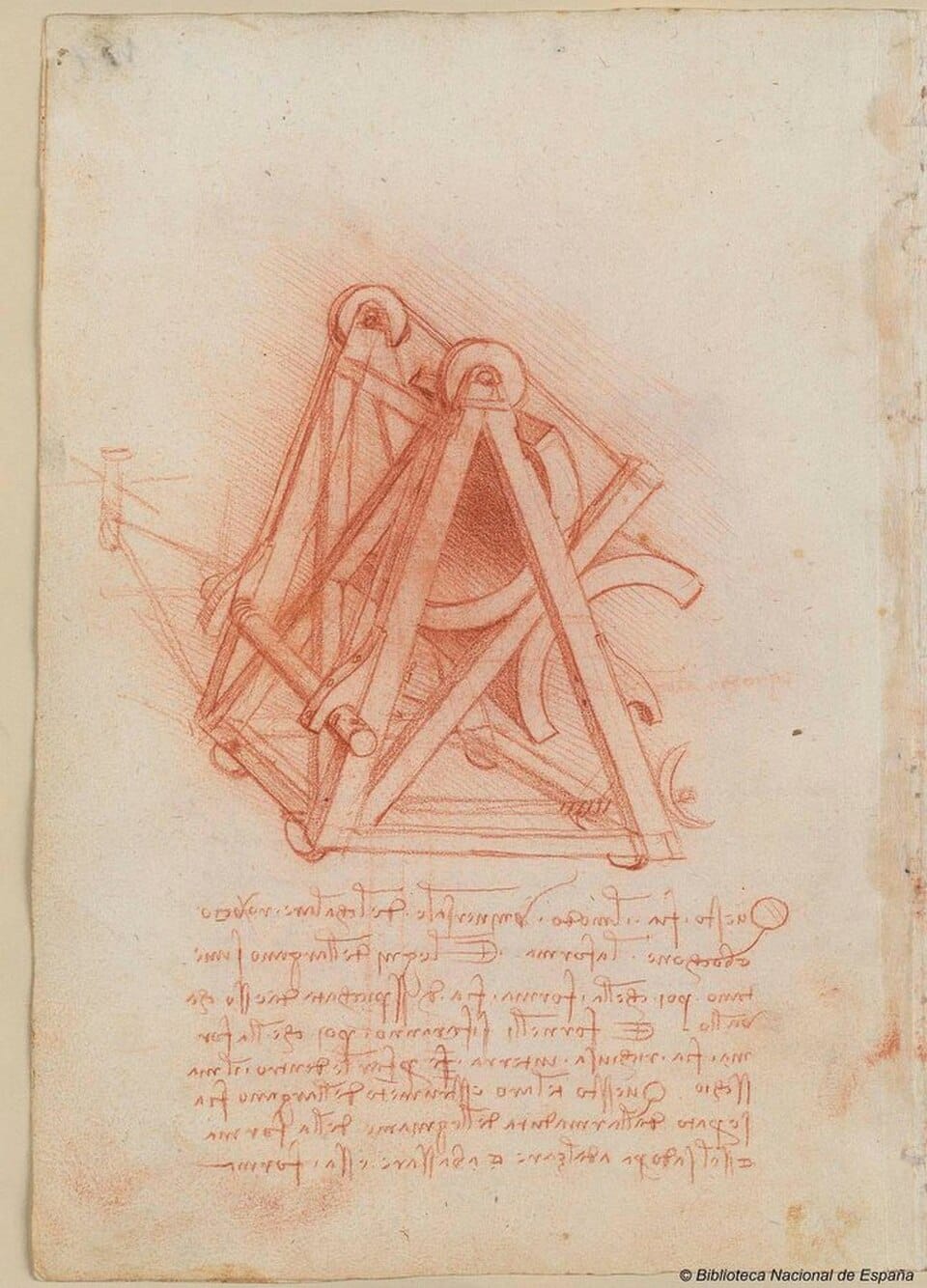
Leonardo knew this. Codex Madrid II, a casting notebook rediscovered in 1966 at the Biblioteca Nacional in Madrid and now recognized as one of the most important technical documents of the Renaissance, contains folios 141 through 157 of casting notes and red chalk drawings dated from 1491 onward. The notebook describes a mold composition of coarse river sand, ashes, ground brick, egg white, and vinegar, soaked in Greek pitch or linseed oil. It describes furnace designs. It describes a casting method that was horizontal rather than vertical, the horse lying on its side rather than standing upright.
The horizontal decision came from a specific engineering problem Leonardo documented directly: if cast upright, the head of the horse would sit one braccio from the Lombardy plain’s water table. His Codex Madrid II note reads: “if I were to cast it upside down the water would be only one braccio away…the head one braccio from the water would be affected by damp, and the cast would not take.” The water table problem was not aesthetic. It was a constraint that made vertical casting in that location a technical impossibility regardless of available bronze.
In October 1492, the architect Giuliano da Sangallo visited Leonardo in Milan and discussed what he called “the impossibility” of casting the horse as a single piece. This was not retrospective dismissal. Da Sangallo was a practicing architect who understood foundry work. His judgment was a professional contemporary assessment.
In November 1494, the question became moot. Ludovico redirected the collected 70 tons of bronze to his father-in-law Ercole d’Este for cannons to resist Charles VIII of France’s invasion. The Battle of Fornovo followed on July 6, 1495. The French then occupied Milan in 1499, and soldiers used the clay model as an archery target. Weather completed what the arrows started.
The modern vindication came from an unexpected direction. The Institute and Museum of the History of Science in Florence ran computational fluid dynamics simulations using FLOW-3D software to model Leonardo’s casting methods. Both the vertical and horizontal systems he described, the simulation concluded, could have worked. The pour of 70 or more tons would have taken three to four minutes. The engineering was sound. The foundry capacity of 1493 was not.
This is the specific irony that makes il cavallo worth understanding: Leonardo had solved the problem analytically before the technology existed to execute the solution.
What survived when the horse did not
Leonardo died on May 2, 1519, without casting it. Giorgio Vasari memorialized the horse project in Lives of the Artists (1550 and 1568 editions) as one of Leonardo’s defining unfinished works, which established its cultural status for the next four centuries while doing nothing to recover it.
What survived were the drawings. The Windsor Collection at the Royal Collection Trust holds horse anatomical studies from approximately 1490, accession number 912321, that became the primary interpretive document when reconstruction became possible. Codex Madrid II, undiscovered until 1966, added the engineering specifications. Together they represent what the horse would have been, in the language of the person who designed it.
For over four hundred and fifty years after Leonardo’s death, no serious reconstruction attempt was made. This is not surprising. The metallurgical problem appeared insurmountable at any moment before modern foundry practice. The clay model was gone. The only evidence was drawings and notes in a notebook that, until 1966, nobody had seen.
The long silence also reflects something about how the Renaissance is consumed: as a period of genius and loss, where the unfinished works are proof of ambition rather than problems to solve. The horse existed as cultural monument, as literary reference, as historical footnote. Nobody was seriously asking whether it could be built.
Until one retired pilot in Pennsylvania read an article and decided it could.
The retired pilot who spent 17 years on a dead man’s promise
Charles C. Dent was born in 1917 in Allentown, Pennsylvania, the second of eight children. He spent thirty-six years flying for United Airlines, from DC-3s through the Boeing 747, and retired in 1977. He was an amateur artist and a collector of Renaissance bronzes and marbles. He was not an obvious candidate to complete a five-hundred-year-old commission.
In 1978, he read a National Geographic article about Leonardo’s horse from the September 1977 issue. His response, according to the Da Vinci Science Center biography, was not admiration. It was decision. He would complete the horse “as an expression of gratitude for Leonardo and the Renaissance,” and as a gesture of international peace. The framing was characteristically American in its optimism and characteristically specific in its motivation. Dent was not trying to replicate a masterpiece. He was trying to honor a debt.
He built a Dome Studio on his farm in Allentown. He made more than twenty-five preliminary wax and clay studies. He consulted two of the leading scholars in their fields: Sir John Pope-Hennessey, former director of the Victoria and Albert Museum and the British Museum, and Dr. Carlo Pedretti, UCLA’s Leonardo specialist and at the time the most authoritative voice on the da Vinci archive. In 1982, he incorporated Leonardo da Vinci’s Horse, Inc. as a nonprofit. In 1988, he began an eight-foot clay model.
Funding required selling pieces from the Renaissance collection he had spent a career assembling. He called these sales “hay for The Horse.” The projected cost came to nearly $2.5 million. He sold what he had to sell.
He called these sales “hay for The Horse.” The projected cost came to nearly $2.5 million. He sold what he had to sell.
Dent was diagnosed with ALS, Lou Gehrig’s disease, and died on December 25, 1994. He had worked seventeen years without completing the project. Leonardo had worked seventeen years without casting it. This parallel is not a coincidence the story needs to manufacture. It is simply what the numbers are.
He bequeathed his remaining private art collection to Leonardo da Vinci’s Horse, Inc. The sale raised more than one million dollars. He had spent his life, his collection, and his health on a monument to someone else’s unfinished work. That is either the purest form of admiration or the saddest story in American Renaissance patronage. It might be both.
Why she had to throw out everything Dent had built
When Leonardo da Vinci’s Horse, Inc. hired sculptor Nina Akamu in 1997, the problem she inherited was not a project in progress. It was a project that needed to start over.
Dent’s model had anatomical problems that revision could not correct. The horse read as squat, with a neck that was too short for the scale. These were not minor issues. At twenty-four feet, proportional errors become structural arguments. The model was not salvageable.
Akamu’s method for beginning again was precise. She assembled all surviving Leonardo horse sketches and produced overlays, enlarged to identical scale, to identify the proportional system Leonardo had used consistently across multiple drawings. Where the drawings agreed, she had a governing proportion. Where they diverged, she had a decision to make.
The neck was one of those decisions. Akamu’s finished horse has a neck approximately two vertebrae longer than anatomically correct. This was deliberate. In Leonardo’s sketches, the dramatic head position makes the neck read as longer than strict anatomy would produce. Akamu matched the visual logic of the drawings, not the logic of the actual animal. Carlo Pedretti advised that the head position reflect late fifteenth-century classical imagery, and the neck length followed from that.
Akamu and seven assistants built the twenty-four-foot model by enlarging the eight-foot version using mechanical enlarging equipment, then refining the muscle forms by hand. The model was divided into more than sixty sections, each approximately four square feet, to make casting manageable. Tallix Art Foundry in Beacon, New York used sand molding for most sections and the lost-wax process for delicate areas including the mane, ears, tail, and forehead. The material was silicon bronze alloy #872, over thirteen metric tons, assembled on a stainless steel armature of type 304. The pedestal is Carrara marble. The final patina was applied in Milan.
What Tallix did in Beacon, New York in the 1990s was, in essence, what Leonardo had designed in Codex Madrid II in 1491: a sectional casting approach that solved the problem of scale by dividing it. The specific materials and technology differed entirely. The structural logic did not.
September 10, 1999: from Milan to Grand Rapids
Two casts of the horse were produced, and they went to two locations: one to Milan, one to Michigan.
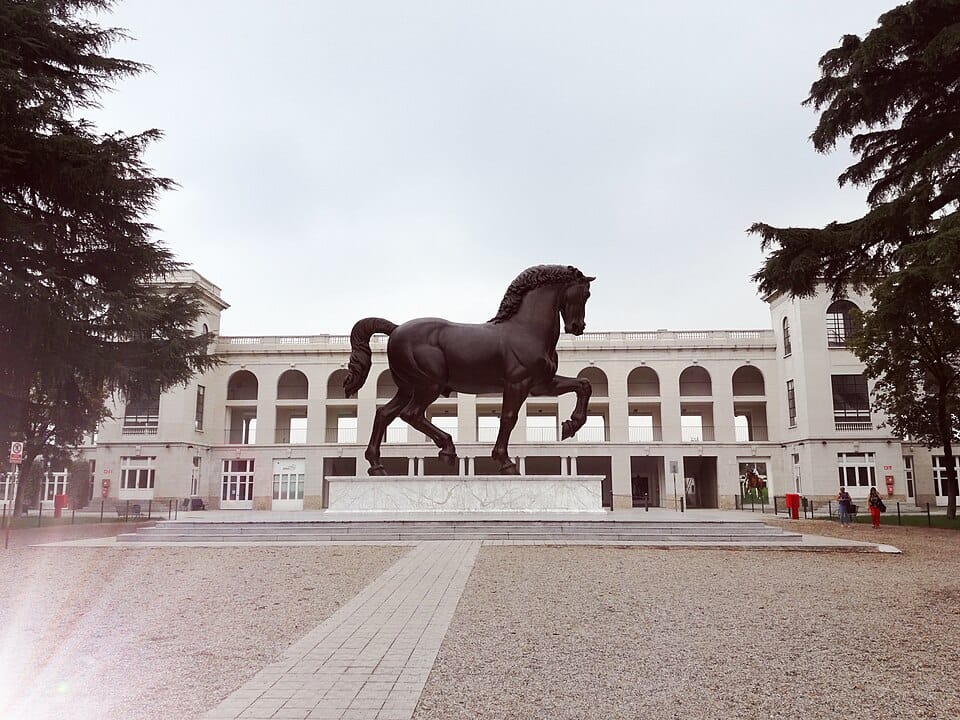
The Milan horse was unveiled on September 10, 1999, at the Ippodromo Snai San Siro, formally presented as a gift from the American people to Italy. The cultural diplomacy was explicit. The post-Cold War period had produced a specific appetite for gestures of international solidarity that were also legible as cultural restitution: returning to Italy, in bronze, what Italy had lost to war and weather five centuries earlier. The horse now stands in San Siro Hippodrome Cultural Park.
The American cast went to Grand Rapids, Michigan. Frederik Meijer Gardens and Sculpture Park dedicated The American Horse on October 7, 1999. Also 24 feet tall and accompanied by a sculpture education center with exhibits on the casting process, the Grand Rapids horse has become a site for exactly the kind of contextual education the project required: not just the object, but the argument it represents. The ADI essay on The American Horse covers the cultural meaning of the Michigan cast in detail, including what it means for an American institution to hold what is, formally, Leonardo’s commission fulfilled.
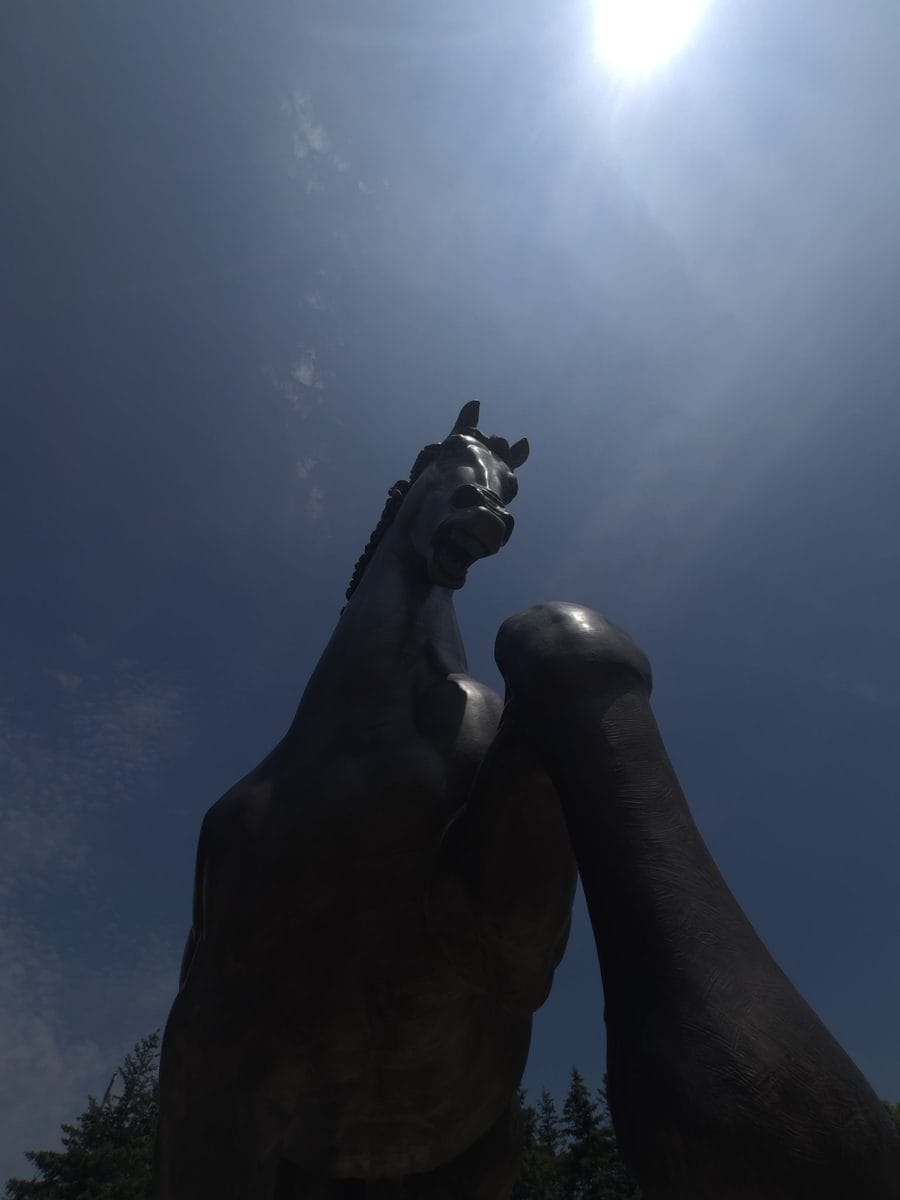
The program of smaller casts extended the project further. A 2.5-meter bronze was dedicated at Leonardo’s birthplace in Vinci, Tuscany, on November 17, 2001. A 12-foot cast stands at the Charles C. Dent Memorial Garden at The Baum School of Art in Allentown, Pennsylvania, dedicated October 4, 2002, in Dent’s hometown. A further 8-foot cast was dedicated in Sheridan, Wyoming, on August 20, 2014.
The distribution of the smaller casts is not incidental. The project was never about Milan alone. It was about completing something that had been declared impossible, and then showing the proof in as many places as would accept it.
517 years at a glance
Commission — Ludovico Sforza asks Leonardo to create the world’s largest equestrian statue honoring his father Francesco Sforza.
Clay model exhibited — The full-scale 24-foot clay model is displayed in Milan to public acclaim. Leonardo notes on December 20 that he is ready to begin casting.
Bronze requisitioned — Ludovico redirects 70 tons of collected bronze to his father-in-law Ercole d’Este for cannons to resist Charles VIII’s invasion.
Model destroyed — French troops occupy Milan and use the clay model as an archery target. Weather completes the destruction.
Leonardo dies — May 2, 1519. The horse uncast. Vasari memorializes it in Lives of the Artists as one of Leonardo’s defining unfinished works.
Codex Madrid II discovered — Leonardo’s 34-page casting notebook, lost for centuries in Madrid’s Biblioteca Nacional, is rediscovered. It contains the full metallurgical specifications for the bronze pour.
Dent reads the article — Retired United Airlines pilot Charles Dent reads a National Geographic piece on Leonardo’s lost horse and decides to complete it as “an expression of gratitude for Leonardo and the Renaissance.”
LDVHI incorporated — Leonardo da Vinci’s Horse, Inc. established as a nonprofit. Dent begins selling pieces from his Renaissance bronze collection to fund it — “hay for The Horse.”
Dent dies — December 25, 1994. ALS. He had worked 17 years on the project—the same span Leonardo worked—without completing it. His art collection is bequeathed to LDVHI; the sale raises over $1 million.
Akamu starts over — Nina Akamu is hired after Dent’s model is found anatomically unsalvageable. She overlays all surviving Leonardo sketches at identical scale to derive his proportional system and builds a new 24-foot model with seven assistants.
Il Cavallo unveiled in Milan — September 10, 1999. The bronze horse is presented as a gift from the American people to Italy at the Ippodromo Snai San Siro, exactly 500 years after the clay model was destroyed.
The American Horse installed — October 7, 1999. The second full-size cast is dedicated at Frederik Meijer Gardens in Grand Rapids, Michigan. The 517-year commission is fulfilled.
Shop the Collection
The two books below are the right starting points for understanding both Leonardo’s engineering and the specific history of the Sforza horse. The necklace, which carries Leonardo’s own horse drawing, is for readers who want the project to have a physical presence.
Walter Isaacson, Leonardo da Vinci (Simon & Schuster, 2017)
Isaacson draws on Codex Madrid II in a way accessible to a general reader without simplifying the engineering; this is the book to start with if you are coming to Leonardo without prior context.
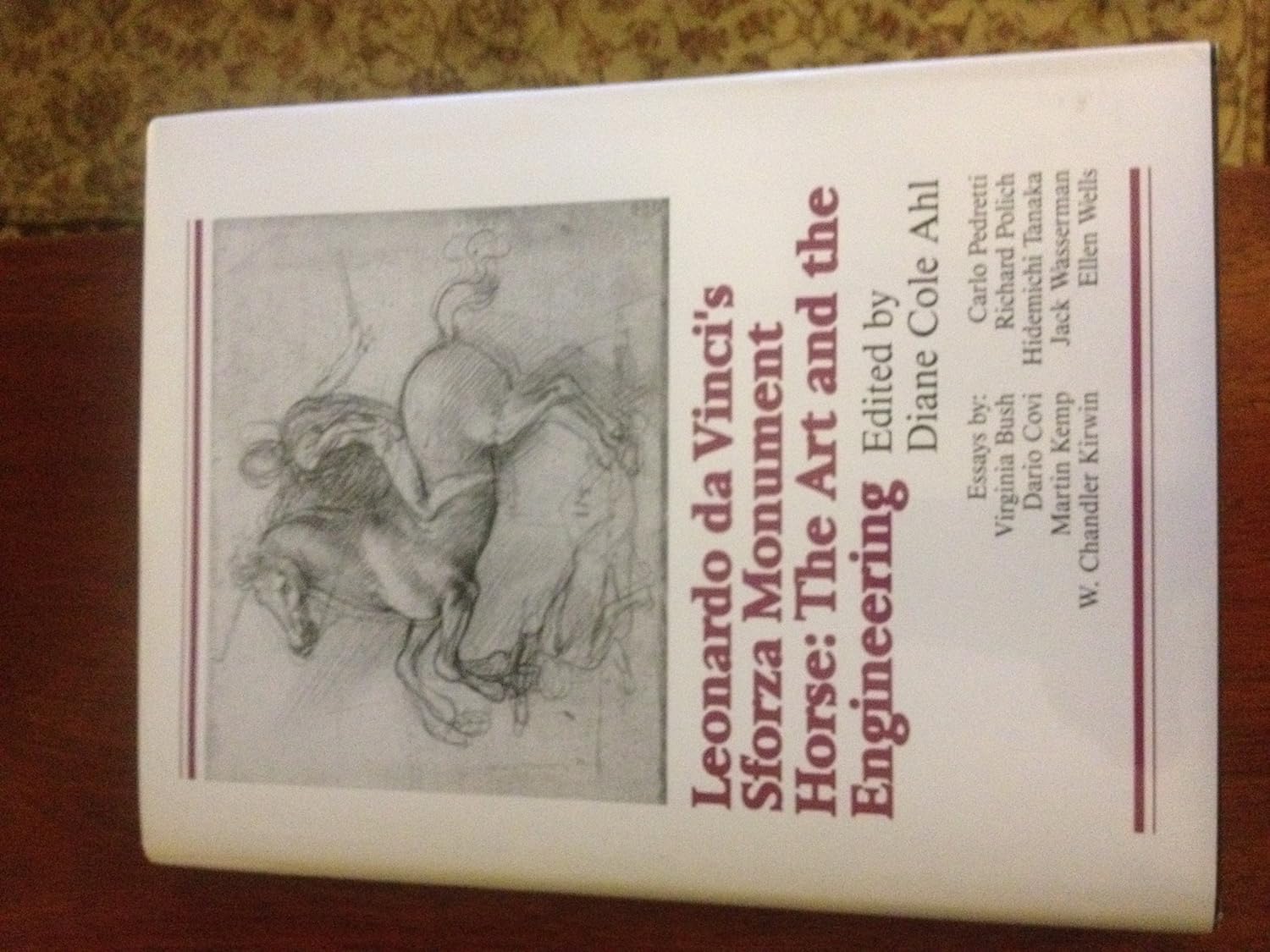
Diane Cole Ahl (ed.), Leonardo Da Vinci’s Sforza Monument Horse: The Art and the Engineering (Associated University Presses, 1995)
Ten essays by Renaissance art historians and bronze-casting specialists; if the metallurgical argument in this article interested you, this is the monograph that goes deeper.
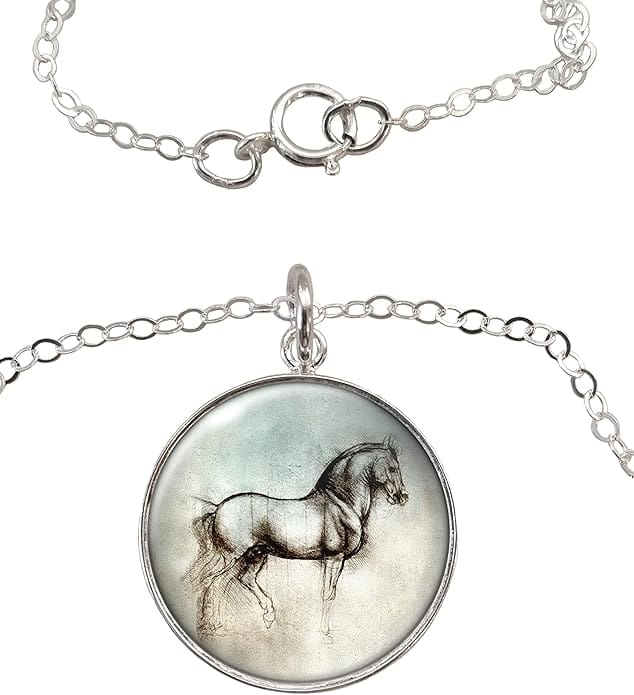
Leonardo Gran Cavallo sterling silver necklace
The Gran Cavallo image in .925 sterling, for readers who want something more personal than a desk object.
Further Reading
There are two books that cover the Sforza horse with enough rigor to be worth owning rather than just consulting.
- Walter Isaacson, Leonardo da Vinci (Simon & Schuster, 2017): Isaacson’s research into the Madrid Codices and the Windsor Collection gives the horse project its proper weight inside the full scope of Leonardo’s work; the best single-volume account for a reader without prior Leonardo context.
- Diane Cole Ahl (ed.), Leonardo Da Vinci’s Sforza Monument Horse: The Art and the Engineering (Associated University Presses / Lehigh University Press, 1995): The only book-length scholarly treatment of the Sforza horse specifically; 87 plates and ten specialist essays covering the art history, bronze-casting technology, and equine anatomy problems that Akamu had to resolve five centuries after Leonardo identified them.
Frequently Asked Questions
What happened to Leonardo’s horse?
Leonardo’s full-scale 24-foot clay model was exhibited in Milan in November 1493 but never cast in bronze. In November 1494, Ludovico Sforza redirected the 70 tons of bronze collected for the casting to Ercole d’Este for cannons to resist Charles VIII’s invasion of Italy. When French troops occupied Milan in 1499, they used the clay model as an archery target. Weather completed the destruction. The horse was entirely lost.
Why was Leonardo’s horse such a challenge to cast in bronze?
The scale was the core problem. The horse required approximately 70 to 75 tons of bronze in a single pour, a volume that had no precedent in European foundry practice. Maintaining uniform temperature across that volume of molten metal, with fifteenth-century furnace technology, was not possible without risking gas pockets and structural failure. Leonardo designed a horizontal casting method documented in Codex Madrid II to address the water table problem, and his engineering was later validated by FLOW-3D computational simulations at the Institute and Museum of the History of Science in Florence. The casting was analytically sound. The available technology was not.
Where is the Gran Cavallo located today?
Two full-size 24-foot casts exist. The primary cast stands at the Ippodromo Snai San Siro in Milan, Italy, unveiled September 10, 1999. The American cast, known as The American Horse, stands at Frederik Meijer Gardens and Sculpture Park in Grand Rapids, Michigan, dedicated October 7, 1999. Smaller casts are located in Vinci, Tuscany (2.5 meters, dedicated 2001), Allentown, Pennsylvania (12 feet, dedicated 2002), and Sheridan, Wyoming (8 feet, dedicated 2014).
What is the history of the Gran Cavallo and how did it get made?
Ludovico Sforza commissioned Leonardo da Vinci in 1482 to create the world’s largest equestrian statue honoring his father Francesco Sforza. Leonardo spent seventeen years on the project, completing a full-scale clay model in 1493, but the bronze casting never happened. The clay model was destroyed by French soldiers in 1499. In 1978, retired American pilot Charles Dent decided to complete the project; he founded Leonardo da Vinci’s Horse, Inc. as a nonprofit in 1982. Dent died of ALS on December 25, 1994, without completing it. Sculptor Nina Akamu was hired in 1997, started the model from scratch after finding anatomical problems with Dent’s work, and the bronze was cast at Tallix Art Foundry in Beacon, New York, and unveiled in Milan in September 1999.
Who completed Leonardo’s horse after 500 years?
Sculptor Nina Akamu completed the horse. She was hired by Leonardo da Vinci’s Horse, Inc. in 1997 after the original model built under Charles Dent’s direction was found to have anatomical problems that could not be corrected by revision. Akamu overlaid all surviving Leonardo sketches at identical scale to derive his proportional system, then built a new 24-foot model with seven assistants. The casting was done at Tallix Art Foundry in Beacon, New York.
Are there other casts of Leonardo’s horse outside of Milan?
Yes. The American Horse at Frederik Meijer Gardens in Grand Rapids, Michigan is a second full-size 24-foot cast, not a scaled-down version. Beyond the two full-size casts, smaller versions exist at Leonardo’s birthplace in Vinci, Tuscany (a 2.5-meter bronze dedicated November 17, 2001), the Charles C. Dent Memorial Garden at The Baum School of Art in Allentown, Pennsylvania (a 12-foot cast dedicated October 4, 2002), and in Sheridan, Wyoming (an 8-foot cast dedicated August 20, 2014).

About Joe Post
Joe Post holds an MFA in Art from California Institute of the Arts (CalArts) and has done additional graduate work at the School of the Art Institute of Chicago. He founded Art Design Ideas to write about design as cultural argument — the decisions, contradictions, and assumptions built into the objects we live with.