
Dieter Rams’s best-known products are the Braun objects he designed between 1955, when he joined the German company, and 1997, when he retired as its head of design. The canon: the SK 4 radio-phonograph (1956, with Hans Gugelot), the T3 pocket radio (1958), the TP 1 portable radio and record player (1959) and the ET 66 calculator (1987, with Dietrich Lubs). Outside Braun, his 606 Universal Shelving System (1960) for Vitsœ is still made today.
The collection spans radios, calculators, record players, and shavers, and it makes a single sustained argument: products should withdraw from attention rather than demand it.
Rams didn’t think he was making beautiful things
The transparent acrylic lid on the SK 4 record player arrived in 1956 not because Rams wanted to make something beautiful. The original metal cover vibrated during testing, so it was replaced with clear acrylic — a material chosen because it solved a problem, not because it looked good. The decision turned out to be aesthetically defining. That sequence matters: function first, beauty as a consequence.
Rams joined Braun in 1955 as an interior architect, initially working on showrooms and trade fair installations. He had trained in carpentry and then architecture at the Kunstgewerbeschule Wiesbaden between 1948 and 1953, and his formation was spatial and material rather than industrial. When he was named head of design in 1961, he brought that architectural logic to product design at a moment when postwar German consumerism was pushing objects toward decoration and spectacle.
The Braun company had already committed to a Functionalist philosophy before Rams arrived. Artur and Erwin Braun, who inherited the company from their father Max Braun in 1951, had brought in Otl Aicher and the network of designers connected to the Ulm School of Design (Hochschule für Gestaltung, founded 1953). Hans Gugelot, a faculty member at Ulm who co-designed the SK 4 with Rams, was the institutional link between Ulm’s rigorous Functionalism and Braun’s products. Rams gave that philosophy material form.
The argument Rams was making was that a product serving its function completely, without performing its own importance, was the only honest form a product could take. This formulation eventually became the Ten Principles of Good Design, which Rams developed after asking himself, as he later described on the Vitsœ website: “Is my design a good design?” The principles were not a manifesto he wrote and then went to implement. They were a description of a practice he had already been conducting for years.
What happens when a product gets out of the way
The phrase “Weniger, aber besser” means less, but better. It is not minimalism as style. It is a position on the relationship between a product and its user. A product that draws attention to itself competes with its user for their attention. Rams’s argument was that this competition is a form of dishonesty: the product is claiming more importance than it deserves.
The ET 44 pocket calculator, designed with Dietrich Lubs, makes this argument visibly. The buttons are color-coded by function group. Arithmetic operations in one color, memory functions in another. The eye distinguishes mathematical categories without reading text labels. The visual grammar does organizational work that labeling alone cannot. This is not decoration; it is communication through color. The ET 66 (1987), which extended this system, is the direct ancestor of the iPhone calculator. Apple’s design team under Jonathan Ive reproduced the ET 66’s interface logic so closely that the formal parallel is not in dispute. Ive wrote the foreword to Sophie Lovell’s 2011 Phaidon monograph on Rams.
The T 1000 radio, introduced in 1963, was a world receiver, with separate sections for FM and for long, medium and short wave. Its aluminium casing carries no surplus markings. The tuning window sits flush with the surface. The knobs are calibrated for single-function clarity. The engineering ambition and the visual restraint are inseparable: what Rams achieved in that object was a product where the equipment disappears into its use, leaving the listener with the sound rather than with an awareness of the machine producing it.
Four objects that prove the argument
SK 4 “Phonosuper” (1956)
Co-designed with Hans Gugelot, the SK 4 combined a radio and a record player in a white steel housing with a transparent acrylic lid. The visible mechanics (the turntable, the arm, the motor housing) are unashamed of their function. The nickname “Snow White’s Coffin” (Schneewittchensarg) came later, from the combination of white housing and transparent cover. MoMA holds one in its permanent collection. The SK 4 established that electronics did not need to hide inside furniture-style casings to earn a place in a domestic interior.
TP 1 combination unit (1959)
A portable record player and transistor radio combined in a single object with aluminium brackets, a leather carry handle, and a headphone output. It received the Supreme Award at the Interplas exhibition in London in 1961. Understood correctly, the TP 1 was the first mobile music experience: a complete personal audio system you could carry. The Sony Walkman arrived twenty years later.
T 1000 “World Radio” (1963)
A world receiver with separate sections for FM and for long, medium and short wave. Aluminium casing. Analogue tuning. Braun made it from 1963 to 1967. Form follows the engineering exactly, with no elements added that the function does not require. The T 1000 is a demonstration that “world radio” need not mean elaborate controls or aggressive industrial design.
ET 44 calculator
Designed with Dietrich Lubs, color-coded by function group. The interface language it established: group operations by color, keep the surface flush, avoid decorative elements. That is the same language Apple used when the iPhone calculator launched in 2007. The ET 44 is the object that most clearly demonstrates that Braun design was not about a look but about a method for organizing information on a surface.
Shop the Collection
There are two books worth owning on the Braun design objects Dieter Rams produced. Not four. Not the complete library. Two.
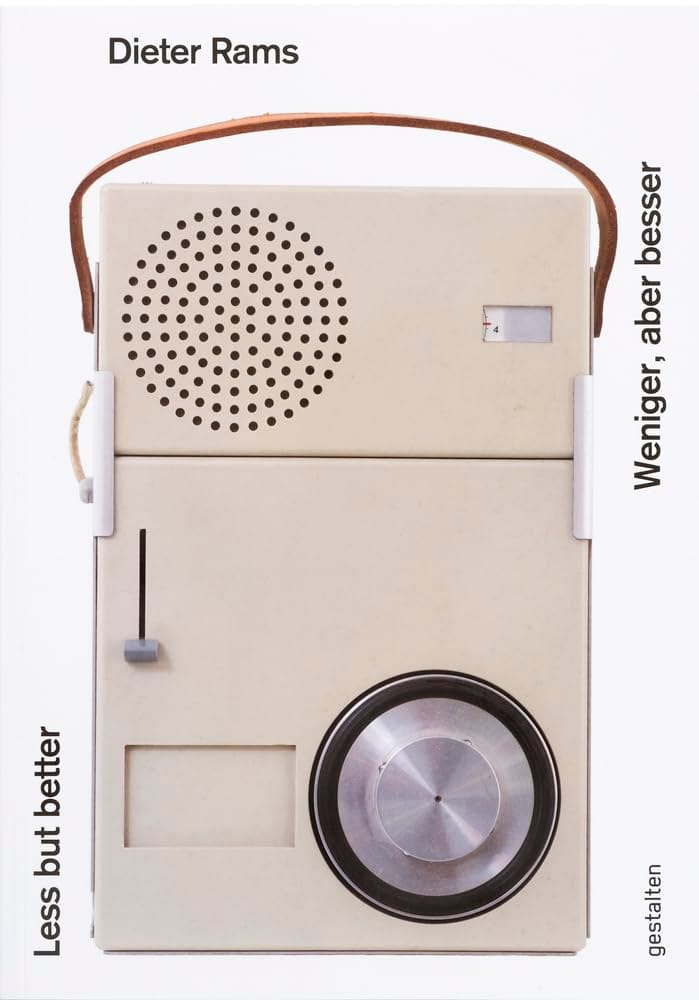
- Dieter Rams, Less But Better (Gestalten, 2014): Rams’s own essays on design responsibility and the Ten Principles in a bilingual English/German edition — the primary text for understanding why the collection looks the way it does, in his own words, without interpretation by a third party.
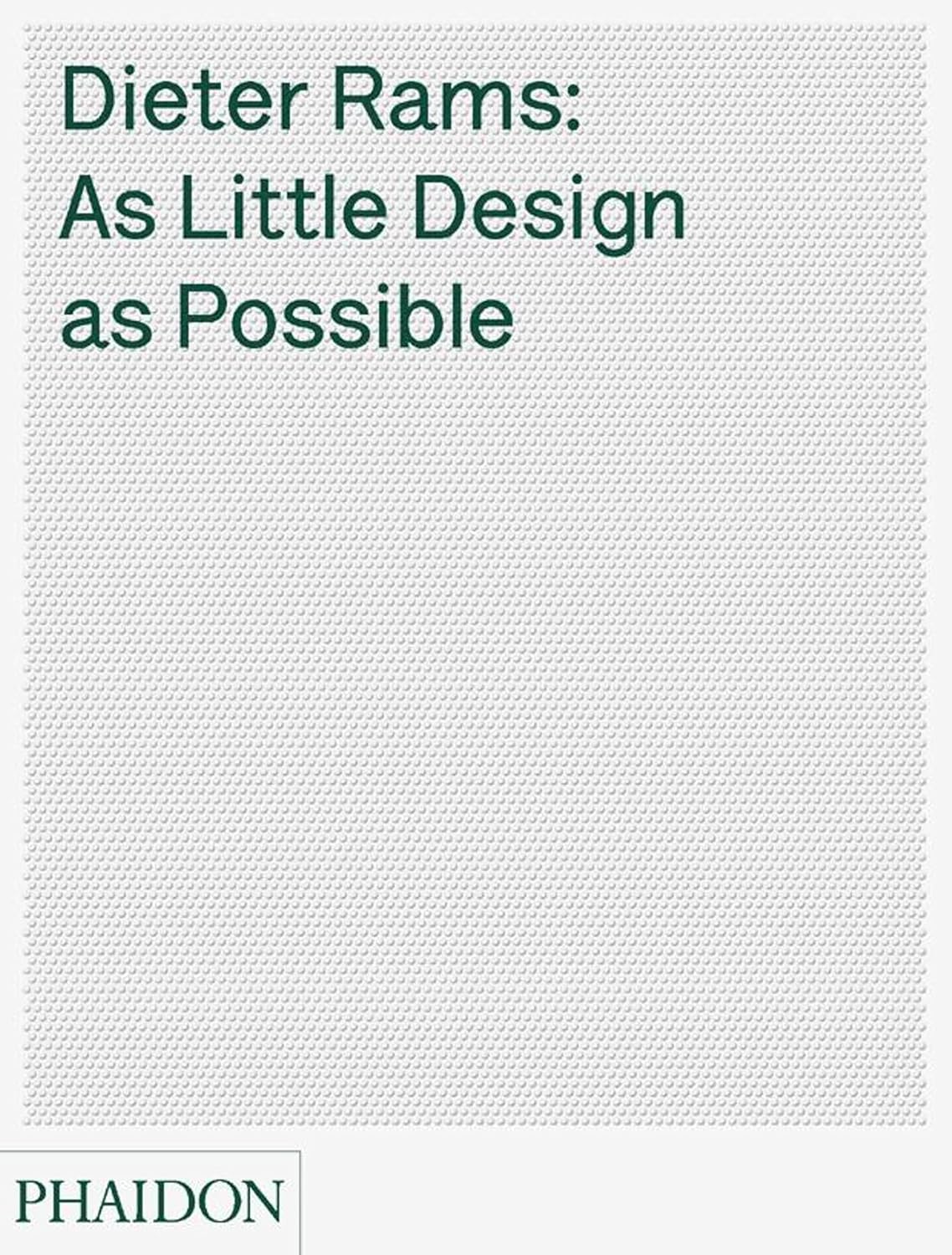
- Sophie Lovell, Dieter Rams: As Little Design as Possible (Phaidon, 2011): The standard monograph on the Braun body of work, comprehensively documented with Jonathan Ive’s foreword situating Rams’s influence on the design generation that followed.
Further Reading
These two books provide the critical and scholarly apparatus that the monographs above do not.
- Klaus Klemp & Keiko Ueki-Polet, Less and More: The Design Ethos of Dieter Rams (Gestalten, 2009): The exhibition catalogue from the Seibu Museum of Art touring show: 808 pages organized by product category with critical essays. The closest thing to a complete scholarly account of the Braun years.
- Cees W. de Jong et al., Dieter Rams: Ten Principles for Good Design (Prestel): Walks each principle through concrete Braun product examples, useful if you want more than the aphorisms and want to see exactly how a given principle translates into a specific design decision.
Frequently Asked Questions
What are the most famous Braun design objects by Dieter Rams?
The most widely cited Braun design objects by Dieter Rams are the SK 4 “Phonosuper” record player (1956, co-designed with Hans Gugelot), the T 1000 “World Radio” (1963), and the ET 44 pocket calculator (co-designed with Dietrich Lubs). All three are in major museum collections. The TP 1 combination record player and radio (1959) is also frequently cited as a formal precursor to later portable audio devices.
Why did Dieter Rams use transparent lids on Braun products?
The transparent acrylic lid on the SK 4 (1956) was not a stylistic decision. The original metal cover vibrated during testing and was replaced with acrylic because acrylic solved the problem. The visual effect, with mechanics visible and unashamed of their function, was a consequence of a material decision made for functional reasons, not an aesthetic ambition.
How did Dieter Rams influence Apple’s product design?
Jonathan Ive, Apple’s chief design officer during the development of the iPhone and iMac, has cited Rams as his primary influence. The iPhone calculator app, introduced in 2007, reproduces the layout and color-coding logic of the Braun ET 66 calculator (1987, designed by Rams and Dietrich Lubs) closely enough that the formal relationship is widely documented. Ive wrote the foreword to Sophie Lovell’s 2011 monograph on Rams.
What is the difference between the Braun ET 44 and ET 66 calculators?
Both were designed by Rams and Dietrich Lubs. The ET 44 introduced color-coded button groupings as a system for organizing arithmetic operations visually. The ET 66 (1987) refined and extended this system. The ET 66 is the specific model most often cited in relation to the iPhone calculator layout, though both belong to the same design lineage.
Where can I buy original Braun products designed by Dieter Rams?
Original Braun products designed by Rams are available through vintage design dealers, auction houses, and platforms such as 1stDibs, Chairish, and eBay. Condition and production year affect value significantly. The SK 4, TP 1, and T 1000 are the most sought-after and the most expensive. The ET 44 and ET 66 calculators are more widely available at lower price points.
Are Braun products designed by Rams still in production?
Braun continues to manufacture some product categories (shavers, kitchen appliances), but the specific objects Rams designed during his tenure (1955–1997) are no longer in production. Vitsœ continues to manufacture the 606 Universal Shelving System and 620 Chair Programme, which Rams designed for Vitsœ rather than Braun and which remain in production as new items.
What is Dieter Rams’ most famous design?
The SK 4 radio-phonograph of 1956, co-designed with Hans Gugelot and nicknamed “Snow White’s Coffin” for its white body and clear acrylic lid. It moved home electronics away from the look of traditional furniture, and MoMA holds one in its collection. His longest-lived design is the 606 Universal Shelving System (1960) for Vitsœ, which is still sold with only minor changes from the original.
Does Dieter Rams still design?
Not as a working product designer. Rams, born in Wiesbaden in 1932, retired as Braun’s head of design in 1997 at the age of 65. He continues to work with Vitsœ, the furniture company that still makes his 606 shelving system and 620 Chair Programme, and his principles remain the subject of books, exhibitions and lifetime-achievement awards.
What is Dieter Rams’ most famous quote?
“Less, but better” (in German, “Weniger, aber besser”). It is the short form of his tenth principle, “Good design is as little design as possible,” and the title of his own 1995 book. Another line often attributed to him: “Indifference towards people and the reality in which they live is actually the one and only cardinal sin in design.”
What are Dieter Rams’ 10 principles?
Good design is innovative, makes a product useful, is aesthetic, makes a product understandable, is unobtrusive, is honest, is long-lasting, is thorough down to the last detail, is environmentally friendly, and is as little design as possible. Rams arrived at them by asking himself “Is my design a good design?” The Dieter Rams design principles guide takes them one at a time.
For the broader context of this work, see the Design Legends hub — profiles of the designers and movements that shaped modern design. The philosophical framework behind these objects is covered in the Dieter Rams design principles guide. For books on the Rams canon, see best Dieter Rams design books.

About Joe Post
Joe Post holds an MFA in Art from California Institute of the Arts (CalArts) and has done additional graduate work at the School of the Art Institute of Chicago. He founded Art Design Ideas to write about design as cultural argument — the decisions, contradictions, and assumptions built into the objects we live with.