
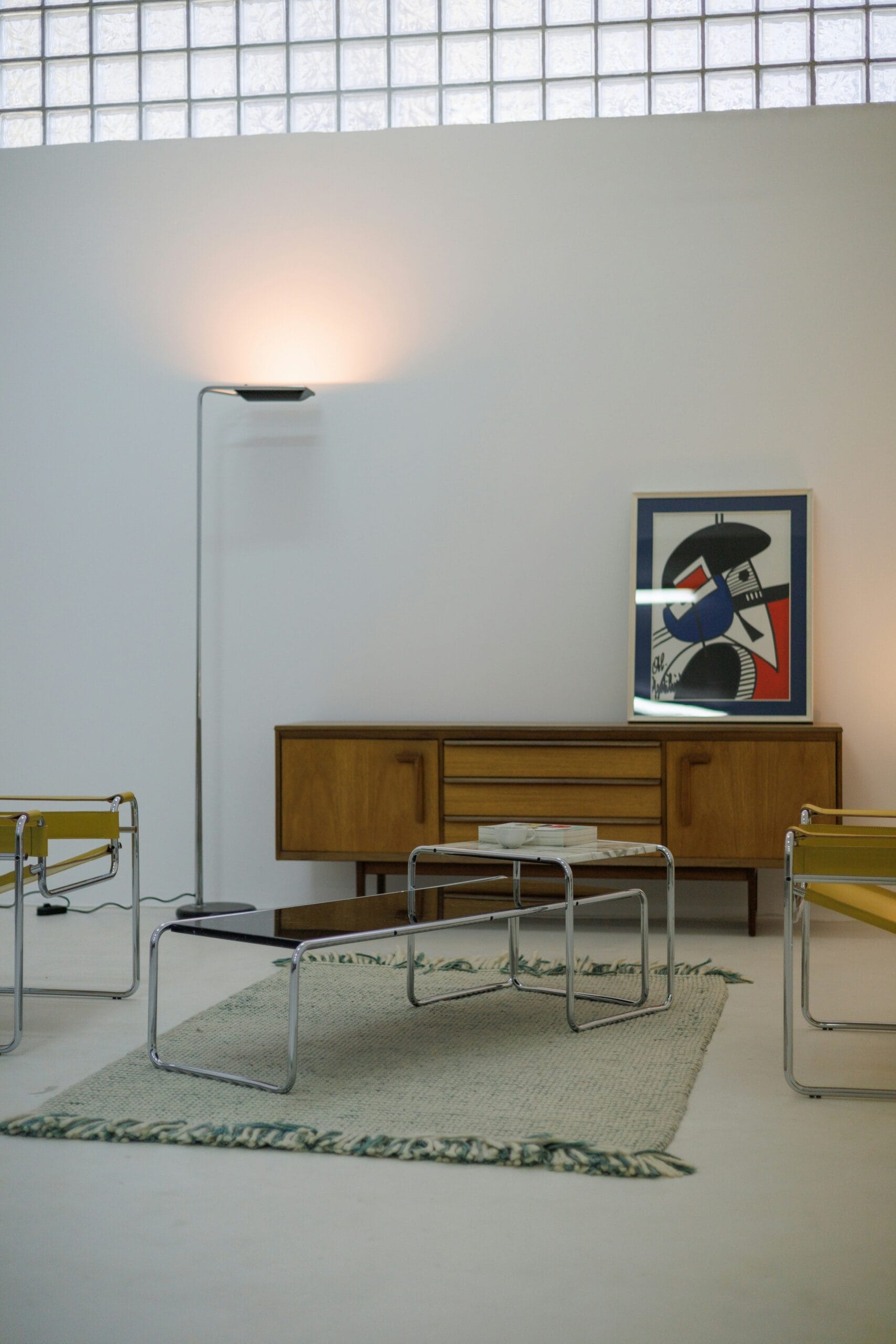
The Wassily Chair is a tubular steel and leather strap armchair designed by Marcel Breuer at the Bauhaus in 1925–1926. Originally called the Model B3, it was first manufactured by Thonet in the late 1920s. The name “Wassily” came decades later, applied by Italian manufacturer Gavina after discovering its connection to painter Wassily Kandinsky.
Breuer Didn’t Set Out to Make a Chair
In 1925, Walter Gropius moved the Bauhaus from Weimar to Dessau. Marcel Breuer, then twenty-three years old, was appointed junior master of the carpentry workshop. That same year, he bought his first bicycle — an Adler — and noticed something: the handlebars were tubular steel. Light, rigid, manufacturable. He had been circling a problem about furniture, and the handlebars gave him the answer.
What is so special about the Wassily Chair? The direct answer is this: it was the first piece of furniture built from industrial steel tubing rather than craft materials, it proved that comfort does not require mass, and it turned furniture design into a manufacturing argument rather than a craft argument. Everything that came after — including most of what we now call modern furniture — owes a structural debt to what Breuer worked out in that Dessau workshop.
It is my most extreme work — the least artistic, the most logical, the least cozy, and the most mechanical.
The problem Breuer was solving was specific. The traditional club chair, the deep padded armchair that sat in every middle-class interior in Europe, was heavy, expensive, and required skilled hand labor to produce. It was a symbol of bourgeois comfort in the most literal sense: its bulk was part of its message. Breuer wanted to strip that message down. The Bauhaus ethos, as Gropius formulated it across every workshop, held that form should follow industrial process, not the inherited vocabulary of craft.
Mannesmann, the German steel manufacturer, had recently perfected a process for making seamless pipe (Wikipedia, Wassily Chair). Breuer contacted them directly. The chair he designed was only possible because that technology had just arrived. He was not choosing tubular steel for aesthetic reasons. He was choosing it because it was the lightest structural material a twenty-three-year-old in Dessau could bend with available tools.
Breuer’s own description of the finished chair was characteristically unsentimental. He called it “my most extreme work, the least artistic, the most logical, the least cozy, and the most mechanical” (cited in Dezeen, Invaluable.com). That is not false modesty. That is the design thesis stated plainly.
What the Wassily Chair’s Tubular Steel Actually Meant in 1925
The Wassily is a club chair with the stuffing removed. Every element that made a traditional armchair heavy — the solid frame, the padding, the upholstery — is either eliminated entirely or reduced to its minimum structural equivalent. The seat, back, and armrests are stretched straps. The frame is a single continuous bent pipe.
A club armchair with all the stuffing taken out — what remains is just enough to hold a body.
The effect is visual lightness that is also structural integrity. The chair holds a person without communicating mass. This was the argument: you don’t need bulk to feel held. The steel does with geometry what wood and padding did with volume.
A material detail matters here, and most accounts soften it. The original straps on the Model B3 were not leather. They were Eisengarn, a waxed-cotton thread translated literally as “iron yarn,” developed by Margaretha Reichardt (1907–1984), a student in the Bauhaus weaving workshop, who experimented with and improved the thread specifically for use on Breuer’s tubular steel furniture (Wikipedia, Wassily Chair). The material was chosen for its tension properties, its durability under the stress of a stretched structural element, and — consistent with the rest of the project — because it was industrially produced.
The leather version came later, when Italian manufacturer Gavina reissued the design in the postwar period. Gavina’s version is the one that entered the design canon, the one that MoMA and the Metropolitan Museum hold in their collections, the one most people picture when they hear “Wassily Chair.” But it is not Breuer’s original material decision. Knowing this changes the reading: the Eisengarn version is a more rigorous object, more committed to the manufacturing logic that drove the whole design.
Breuer described the chair as a reduction to “purest form,” but that phrase can mislead. He was not making art. He was demonstrating that furniture could be produced in a factory, shipped flat, and assembled without specialized craft knowledge. That is a radical claim in 1925. This is also, incidentally, a description of the supply chain that now governs most furniture production globally.
When Knoll acquired Gavina in 1968, the Breuer tubular steel designs moved into the Knoll catalog, where they remain (Wikipedia, Wassily Chair). The “Wassily” name is a Knoll trademark. The underlying design patent has expired, which is why reproductions are legal — but they cannot legally use the name. Breuer’s tubular steel proved that a chair could be built from one continuous industrial material; Verner Panton’s pursuit of a single-material form would push that logic further, eliminating even the leg.
Three Moments Where Breuer Made the Same Argument
For more on how Bauhaus principles translate into a contemporary home, see our Bauhaus design home guide.
The Wassily Chair was not a single insight. It was the beginning of a method Breuer applied across the next forty years, first in furniture, eventually in architecture. For Marcel Breuer’s full design history, including the Cesca Chair and his transition to architecture, see the Marcel Breuer profile.
Model B3 / Wassily Chair (1925–1926)
Bent tubular steel, Eisengarn straps. The first furniture produced using steel tubing. Not a craft object but a product of manufacturing process. First produced by Thonet as “Model B3” in the late 1920s, reissued by Gavina in the postwar period with leather straps, now produced by Knoll.
Cesca Chair / Model B32 (1928)
Cane seat and back, tubular steel cantilever frame. Breuer’s most commercially successful design and still in production. The cantilever principle removes the rear legs entirely, using the frame’s flex as a structural element — doing what wood structurally cannot. (Note: cantilever chair priority is disputed among Breuer, Mart Stam, and Mies van der Rohe, all working independently in approximately the same period.)
Laccio Tables (1925–1926)
Tubular steel and laminated board, designed as companions to the Wassily. The same logic applied to surfaces: industrial materials, visible structure, flat planes. Still produced by Knoll.
Whitney Museum of American Art, New York (1966)
Breuer’s architectural career produced this brutalist landmark. Raw concrete, bold geometry, function expressed through structure. The same argument in a different material at a different scale. It demonstrates that Breuer’s design thinking was not furniture-specific; it was a method.
Shop the Collection
The authentic Knoll Wassily Chair sells for approximately $2,000 and up. Nothing comes close at that level — the Knoll is the object, and reproductions are reproductions. If the Knoll price is out of reach, a secondhand Knoll Wassily is the better route: the chair has been in production since 1968 and licensed examples turn up regularly at auction and on resale sites.
Further Reading
Three books. If you want to understand the Wassily Chair, you need to understand the Bauhaus — not as a style but as an argument about what design is for.
Magdalena Droste, Bauhaus: 1919–1933 (Taschen, updated 2019 edition) — The standard scholarly account. Droste covers Breuer’s workshop in detail, including the tubular steel period. It is the Bauhaus book that belongs on a shelf. View on Amazon
Frank Whitford, Bauhaus (Thames & Hudson, World of Art series) — The most readable single-volume introduction to the Bauhaus for a general reader. It covers the philosophical arguments that made the Wassily possible without requiring prior art history training. View on Amazon
Frank Whitford, The Bauhaus: Masters and Students by Themselves (Overlook Press) — Primary sources: diaries, letters, and manifestos from Gropius, Kandinsky, Klee, Breuer, and others. For readers who want to hear Breuer in his own words. View on Amazon
For a complete list of recommended Bauhaus reading, see our best Bauhaus design books guide.
Frequently Asked Questions
Why is it called the Wassily Chair?
The name came from Italian manufacturer Gavina, not from Breuer. Gavina discovered that Wassily Kandinsky, who was on the Bauhaus faculty at Dessau when Breuer designed the chair, had admired it enough that Breuer made him a personal duplicate for his quarters. When Gavina reissued the design in the postwar period, they named it “Wassily” after the Kandinsky connection. Breuer never called it that. The chair’s original designation was simply Model B3.
Who designed the Wassily Chair and when?
Marcel Breuer (1902–1981), born in Pécs, Hungary. Breuer designed the chair in 1925–1926 at the Bauhaus in Dessau, where he had been appointed junior master of the carpentry workshop. He was twenty-three years old. The design was first manufactured by Thonet in the late 1920s.
What materials is the Wassily Chair made from?
The frame is bent tubular steel, sourced from Mannesmann’s seamless pipe manufacturing process. The straps on the original Model B3 were Eisengarn, a waxed-cotton thread developed by Bauhaus weaving student Margaretha Reichardt specifically for Breuer’s tubular steel furniture. The leather strap version came later, when Gavina reissued the design postwar. The Knoll version currently in production uses leather straps.
What era was the Wassily Chair?
The Wassily Chair is a product of the Bauhaus modernist period, designed in 1925 at the height of the Dessau Bauhaus. It belongs to the broader modernist project of the 1920s, which held that industrial processes should determine form, not inherited craft traditions. It predates mid-century modernism by roughly two decades and is more accurately understood as part of the European interwar avant-garde.
What inspired the Wassily Chair design?
A bicycle. In 1925, Breuer purchased an Adler bicycle and noticed the lightness and rigidity of its tubular steel handlebars. He began experimenting with the material as a structural alternative to wood for furniture. The Mannesmann company’s recent development of seamless steel pipe made the experiment industrially viable. The chair that resulted was the first furniture built entirely from bent steel tubing.
Is the Wassily Chair still in production?
Yes. Knoll has produced the Wassily Chair since acquiring the Gavina Group in 1968. The Knoll version, with leather straps, is the authorized production. The design patent has expired, so reproductions are legally manufactured and sold by other companies, but they cannot use the “Wassily” name, which is a Knoll trademark.
How to identify a genuine Wassily Chair?
The authenticated Knoll version carries Knoll markings and sells for approximately $2,000 and up. The design patent has expired, which means reproductions are entirely legal, but they cannot use the “Wassily” name. The material tell is leather versus Eisengarn: the original Breuer design used waxed-cotton Eisengarn straps; the Knoll production version uses leather. If a chair is marketed as a “Wassily Chair” at a price well below $2,000, it is a reproduction sold under a different name (such as “Wassily-style” or “Breuer-style”). The frame should be chromed seamless tubular steel; examine the welds and the quality of the leather or strap tension. A genuine Knoll piece will have documentation.
How does the Wassily Chair connect to Bauhaus design principles?
The Bauhaus ethos, as stated by Gropius and practiced across the workshops, held that form should follow industrial process rather than inherited craft tradition. The Wassily Chair is that principle made literal: a chair built entirely from factory-produced materials, using no upholstery, no carved wood, no hand skills that a machine could not replicate. Breuer’s own description of it as “the least artistic, the most logical” is accurate — it was not designed to be beautiful. It was designed to be producible.

About Joe Post
Joe Post holds an MFA in Art from California Institute of the Arts (CalArts) and has done additional graduate work at the School of the Art Institute of Chicago. He founded Art Design Ideas to write about design as cultural argument — the decisions, contradictions, and assumptions built into the objects we live with.