

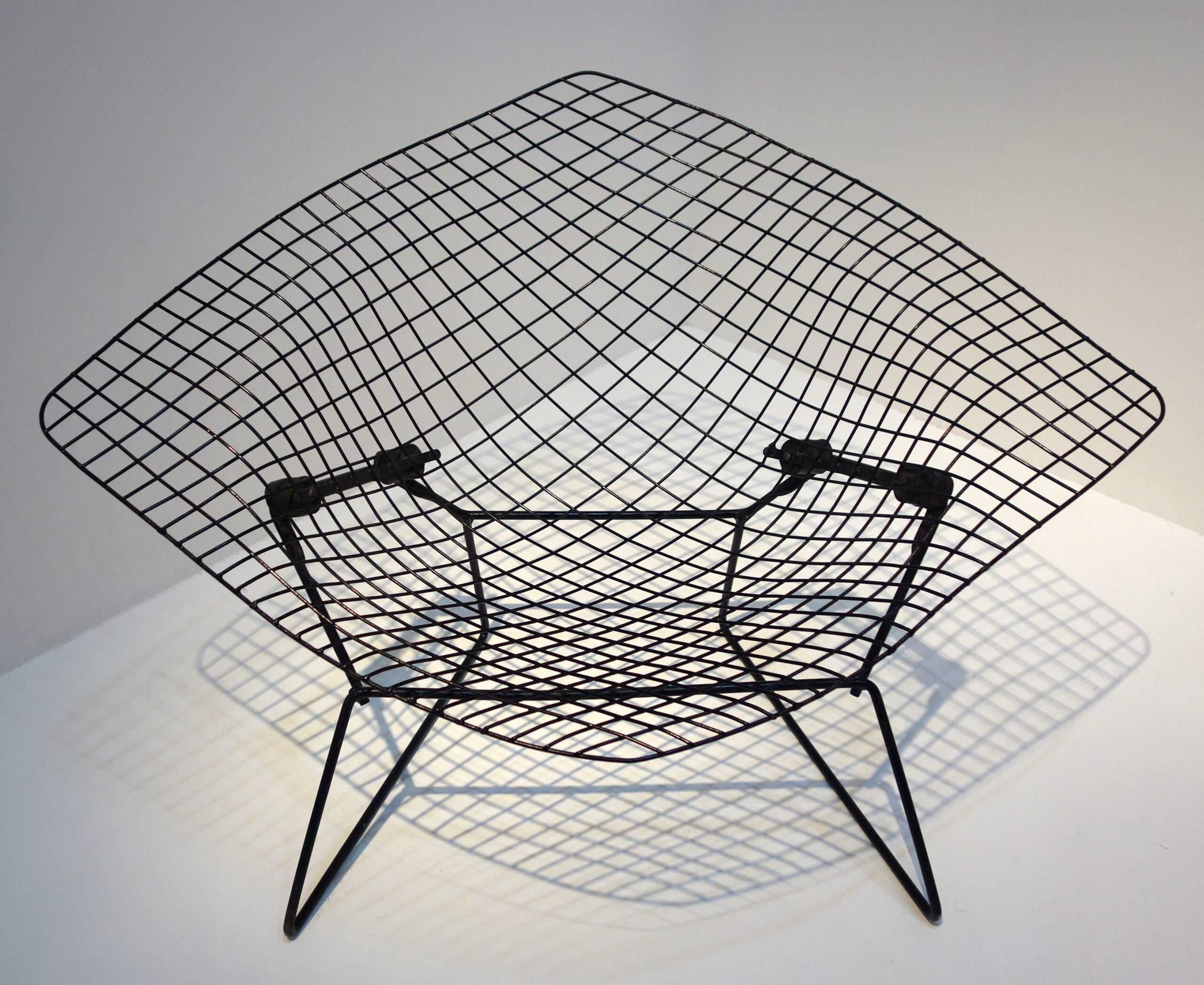
Harry Bertoia (1915–1978) was an Italian-born American sculptor and furniture designer best known for the Bertoia Collection, a group of wire chairs he designed for Knoll in 1952. The Diamond Chair, his most recognized work, is constructed from welded steel rods bent into a lattice form. It remains in continuous production at Knoll today.
What Bertoia Was Actually Making When He Designed a Chair
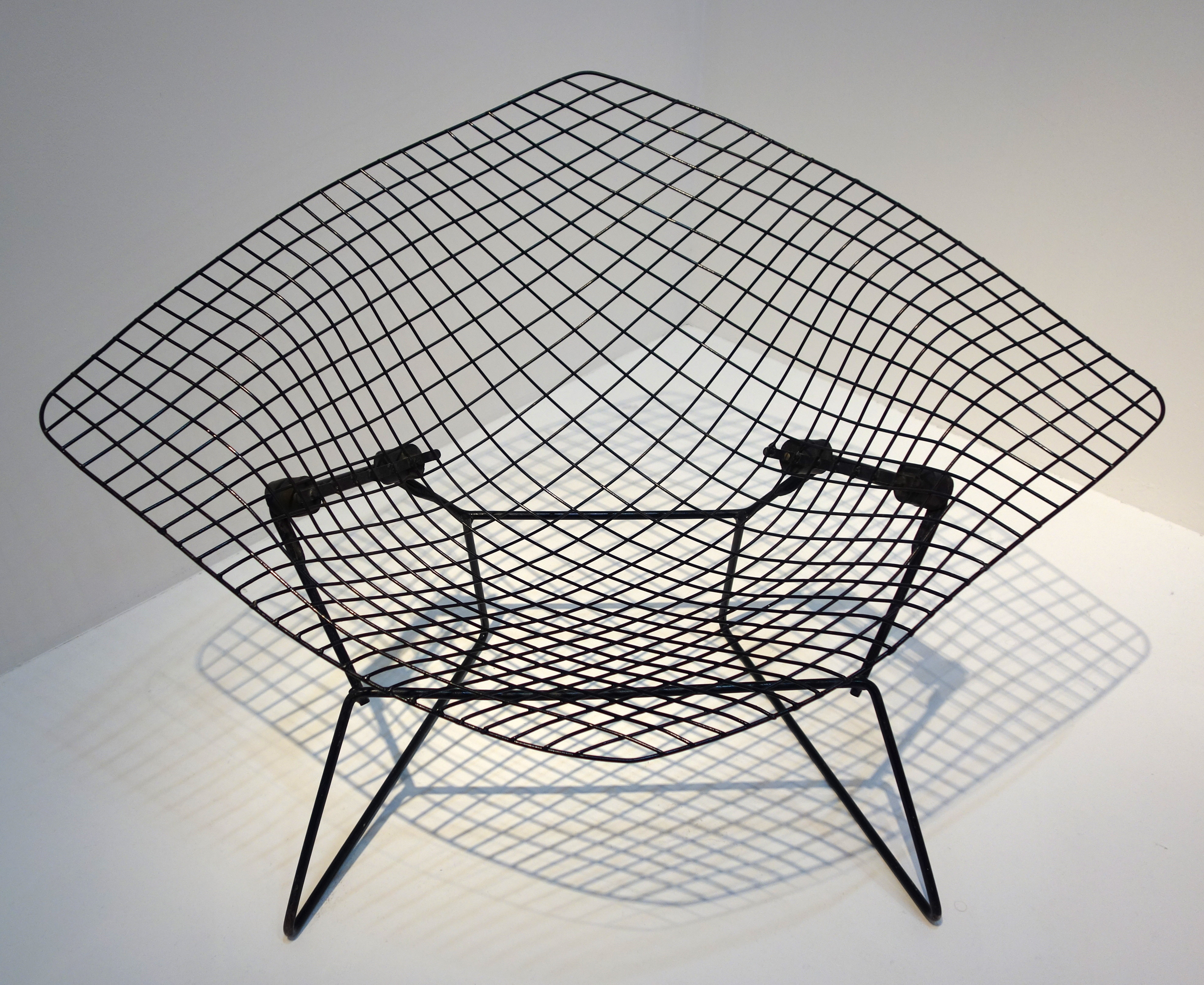
The mistake is to read the harry bertoia diamond chair as a furniture decision. It was a material argument, about what steel could do when you stopped treating it as a building material and started treating it as a drawing medium in space.
Bertoia arrived at Cranbrook Academy of Art in 1937 on a scholarship, and he arrived as a painter. Eliel Saarinen, then directing the school, redirected him into the metal workshop, a room that had been closed. Bertoia reopened it, taught jewelry and metalwork, and spent the next several years learning what metal wanted to do when you shaped it by hand. At Cranbrook he met Charles and Ray Eames, Florence Knoll, and Eero Saarinen. It was a collision of people who would define the shape of the American interior for the next four decades, and it happened in a converted mansion in Bloomfield Hills, Michigan.
The Eames chapter is contested. Bertoia moved to California in 1943 to work with Charles and Ray Eames, and he stayed through 1950. What he contributed during those years is widely held to include foundational work on the wire grid explorations that became the Eames wire furniture line. He received no attribution. The Eames studio’s official record does not credit him. Design historians have noted the gap; none has fully resolved it. The honest position is that something happened in that studio between 1943 and 1950 that Bertoia’s later work makes legible: the wire lattice as structure, as the object’s only material logic. The official record leaves that chapter blank.
When Florence Knoll invited him to Pennsylvania in 1950, the offer was specific: a studio, a salary, and no brief. Do what you couldn’t do before. The five pieces Bertoia designed over the next two years were not designed as a furniture collection. They were an investigation, conducted in steel rod, into whether a chair could be mainly absence. His own account of the Diamond Chair was not a marketing line: “They are mainly made of air, like sculpture. Space passes right through them.” It was a statement of intent about what the object was doing in a room.
They are mainly made of air, like sculpture. Space passes right through them.
The chairs entered a decade that had designated mid-century modern design as the aesthetic of the American professional class. It was common for mid-century modern designers to frame their furniture work in sculptural or spatial terms—Eero Saarinen and George Nelson did the same. What makes Bertoia’s case distinct is the completeness of his exit: he stopped designing furniture in his mid-thirties, never returned, and spent the last twenty years of his life making objects that had no commercial application at all. Bertoia’s work went into that world. But his argument was never about the market. The chairs paid for the argument.
Why a Chair Made of Air Is Harder to Make Than It Looks
The Diamond Chair’s structural problem was not aesthetic. It was mechanical: how do you make an open lattice of steel rods strong enough to support a seated adult, without thermal treatment, without compromising the visual transparency that makes the form work?
Bertoia chose steel for two properties that pointed in opposite directions. Steel rod is strong enough to hold shape under load. It is also malleable enough to be bent into curves without heat. The Diamond Chair’s form is a diamond-shaped shell that cradles the sitter, achieved by hand-bending individual rods to preset angles and welding them at each intersection of the grid. The lattice distributes the sitter’s weight across the geometry of the form rather than concentrating it through traditional structural members. The chair holds you the way a hammock holds you: through network, not mass.
This is still how the chair is made. Dezeen documented the construction process in October 2024, noting that each chair requires hand-bending by skilled workers using what they called a “primitive method of construction.” The form that reads as industrial (chrome and steel, hard lines) is in practice closer to jewelry at architectural scale. The production process has not been automated because it cannot be automated without losing the dimensional precision that the lattice’s structural logic requires. Knoll has been making them continuously since 1953.
Each chair requires hand-bending by skilled workers using what Dezeen calls a ‘primitive method of construction.’
The finish options Bertoia designed address the same problem from the outside. Rilsan, a nylon-dipped adhesive-fused coating, bonds a protective layer to every rod in the lattice without adding weight. The chair can go outside. The chrome options treat the steel as light-reflective surface: the lattice catches light along its curves, and the chair becomes partially dematerialized in the room, which is what Bertoia wanted.
The Barcelona Chair, designed for a specific architectural moment in 1929, is heavy and expensive because it makes its argument through mass and material richness. The Diamond Chair makes the opposite argument. The Barcelona Chair tells you it is a throne. The Diamond Chair tells you it is almost not there.
By the mid-1950s, the royalty arrangement Bertoia had negotiated with Knoll was generating enough income to allow him to stop designing furniture entirely. He spent the remaining two decades of his life making sculpture. The Knoll chairs funded the work he considered his actual practice. The Eames design philosophy was predicated on the idea that good design and industrial production were the same project. Bertoia’s relationship to production was more ambivalent: he used it as patronage, then left.
The Objects That Prove Bertoia Was Not a Furniture Designer
Diamond Chair (1952, Knoll). Welded steel rod lattice in a diamond-shaped shell. Available in polished chrome, satin chrome, and rilsan nylon-dipped finish. The chair’s structural argument is that form distributes load. No padding required, though seat and back cushion options exist. In continuous production at Knoll since 1953. The MoMA collection includes Bertoia wire works; the Cooper Hewitt Smithsonian Design Museum holds examples as well. This is the chair that makes the argument: wire is sculpture, and sculpture is sometimes a seat.
Bird Chair and Ottoman (1952, Knoll). The wider, more enveloping wire form, larger than the Diamond Chair and designed for a more relaxed posture. The ottoman uses the same lattice grid scaled to a footrest. Where the Diamond Chair is angular and upright, the Bird Chair is accommodating. The vocabulary is the same: rod, lattice, open form. But the scale shifts it closer to a nest than a seat. It shows that Bertoia’s wire logic could expand without losing coherence.
Side Chair (1952, Knoll). The most minimal of the five Knoll pieces. A slimmer lattice profile, designed as a dining or side chair rather than a lounge form. No cushion required. The grid distributes the sitter’s weight through geometry, not upholstery. The Side Chair is the proof-of-concept stripped of any ambiguity: a chair built from almost nothing, and it works.
General Motors Technical Center Commission (1953). Bertoia’s first major architectural sculpture, arranged with Eero Saarinen, who was designing the complex. This was the point at which the Knoll royalties made it financially possible to accept commissions for objects with no commercial application. Over the following two decades, Bertoia completed more than fifty public sculpture commissions. The chairs made the sculpture career possible; the sculpture career was the point.
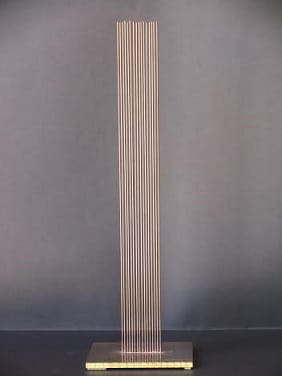
Sonambient Sculptures (1960s–1978). Clusters of metal rods (bronze, beryllium copper, and steel) arranged in standing arrays, designed to ring when struck or moved by wind. Bertoia coined the word “sonambient” as a compound of sound and environment. He recorded eleven vinyl LP albums of the sculptures’ sound, made in the barn on his Bucks County, Pennsylvania property. The Cranbrook Art Museum holds examples in its collection. The Sonambient works are not a footnote to the Diamond Chair. Bertoia considered the chairs the means and the sound sculptures the end. He was making, across four decades, a single investigation into what metal does when you let it speak: first as line in space, then as line that rings.
Shop the Collection
The most direct way to live with the Diamond Chair’s logic without the Knoll price, alongside the definitive account of Bertoia’s full practice.

Bertoia: The Metalworker — Beverly H. Twitchell (Phaidon, 2019)
Twitchell’s volume is the definitive single-book account of Bertoia’s full range: the jewelry he made at Cranbrook, the wire furniture for Knoll, the monoprints he produced in parallel with both, and the Sonambient sculptures. It refuses the furniture/sculpture division that most accounts of his work enforce. If you want to understand why Bertoia considered the chairs a detour and the sound works a destination, this is where you start.
Further Reading
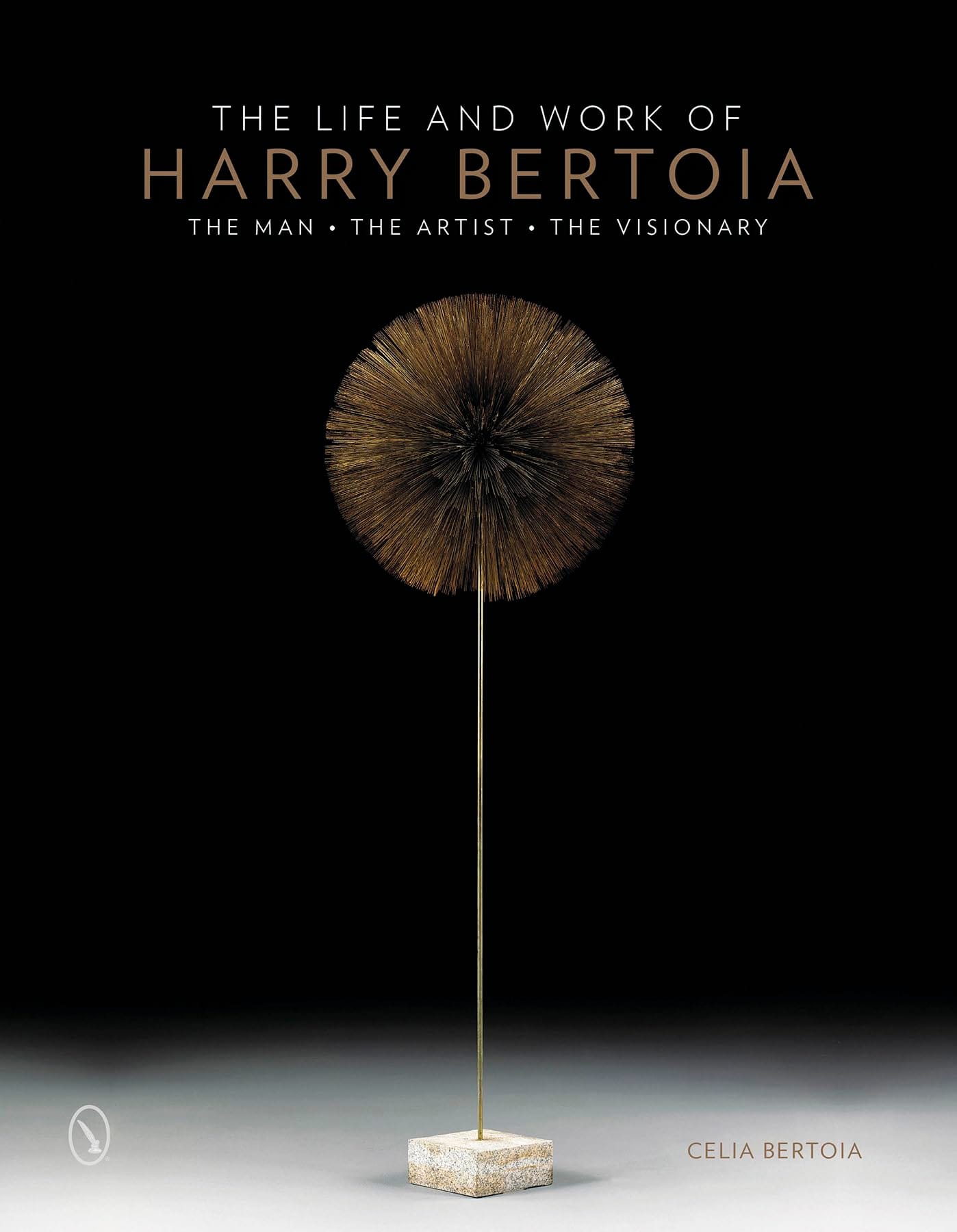
The Life and Work of Harry Bertoia — Celia Bertoia (Schiffer, 2015)
Written by his daughter. This is not criticism from outside the work. It is the closest the reader gets to the interior record: the shape of a life from within, the barn in Bucks County, the Sonambient sessions, the relationship between the furniture income and the sculpture practice. Twitchell gives you the critical account; Celia Bertoia gives you the human one.
Frequently Asked Questions
What is the Bertoia Diamond Chair made of?
The Diamond Chair is made from welded steel rods bent into a lattice form without thermal treatment. The finish options are polished chrome, satin chrome, and rilsan, a nylon-dipped adhesive-fused coating that bonds to each rod in the lattice without adding significant weight.
Who made the original Bertoia Diamond Chair?
Harry Bertoia designed the Diamond Chair for Knoll in 1952. It entered production in 1953 and has been manufactured continuously since then. Knoll remains the sole authorized producer of the original design.
Why did Harry Bertoia stop designing furniture?
By the mid-1950s, the royalty arrangement Bertoia had negotiated with Knoll was generating enough income to allow him to devote himself entirely to sculpture. He considered the furniture a means rather than an end. The chairs paid for the work he considered his actual practice: first the large-scale commissioned sculptures, then the Sonambient sound works.
How much does an authentic Bertoia Diamond Chair cost?
New Knoll Diamond Chairs typically start around $1,500 to $2,000 for the basic frame and increase depending on finish and cushion options. Vintage Knoll examples in good condition command similar or higher prices in the secondary market. Licensed Knoll examples also turn up secondhand for considerably less.
Is Harry Bertoia considered a sculptor or a furniture designer?
Both, and the distinction mattered to Bertoia himself. He trained as a painter and metalworker, designed furniture for that single decade, and spent the remaining twenty-plus years of his career making sculpture. Most design histories categorize him as a furniture designer because the Diamond Chair is his most recognized object. Bertoia’s own account suggests he would have disagreed: the chairs were mainly made of air, like sculpture, and air is not a furniture material.
What are the Sonambient sculptures?
The Sonambient sculptures are standing arrays of metal rods (bronze, beryllium copper, steel) designed to produce sound when struck or moved by wind. Bertoia coined the term “sonambient” as a compound of sound and environment. He made them from the early 1960s until his death in 1978, recording eleven vinyl LP albums of the sculptures’ sound in the barn at his Bucks County, Pennsylvania property. The Cranbrook Art Museum holds examples in its collection.

About Joe Post
Joe Post holds an MFA in Art from California Institute of the Arts (CalArts) and has done additional graduate work at the School of the Art Institute of Chicago. He founded Art Design Ideas to write about design as cultural argument — the decisions, contradictions, and assumptions built into the objects we live with.