
The Eames design philosophy rests on a single argument: good design belongs to everyone. Working from their Venice, California studio from 1943 to 1988, they used molded plywood, fiberglass, and aluminum to produce furniture for mass manufacturing, a deliberate argument against the handcraft tradition that kept well-made things scarce.
What was the Eames design philosophy?
The furniture that dominated American middle-class homes in the 1940s divided cleanly into two categories. There was handcrafted work: well-made, expensive, and available to the people who could afford expensive things. And there was the mass-produced alternative, cheap in the sense of price and cheap in the sense of quality. The assumption built into this division was that it was permanent: the materials and methods that made furniture affordable were the same materials and methods that made it bad.
Charles and Ray Eames entered that argument with a specific position. Charles had come to Cranbrook Academy of Art in Bloomfield Hills, Michigan, in 1940 as head of the Department of Design. Ray Kaiser arrived as a student. They married in June 1941. By 1943 they had opened a design office in a converted Bay Cities Garage at 901 Abbot Kinney Boulevard in Venice, Los Angeles, a studio that would operate for the next forty-five years.
The position Charles articulated was direct: “We want to make the best for the most for the least” (Herman Miller, “Design Q&A: Charles and Ray Eames”). This is not a corporate mission statement polished after the fact. It is a design constraint. Every material decision, every manufacturing process they pursued, was a test of whether that sentence could be made true.
Eames did not arrive at the molded shell alone: the 1940 MoMA entry was a collaboration with his co-winner Eero Saarinen, who spent the next seventeen years pushing the same idea further.
The postwar period gave the argument its urgency. Returning veterans needed furniture for new homes. The market was enormous. The question was whether someone would build the infrastructure to deliver well-designed objects into it, or whether design would remain what it had largely been: something for the upper rooms of the income distribution.
Pat Kirkham, in Charles and Ray Eames: Designers of the Twentieth Century (MIT Press, 1995), frames their project as fundamentally democratic in the philosophical sense: they believed that quality of form and quality of experience should not be rationed by income. That belief was not ornamental. It determined what materials they worked in and why.
Why plywood was a political material
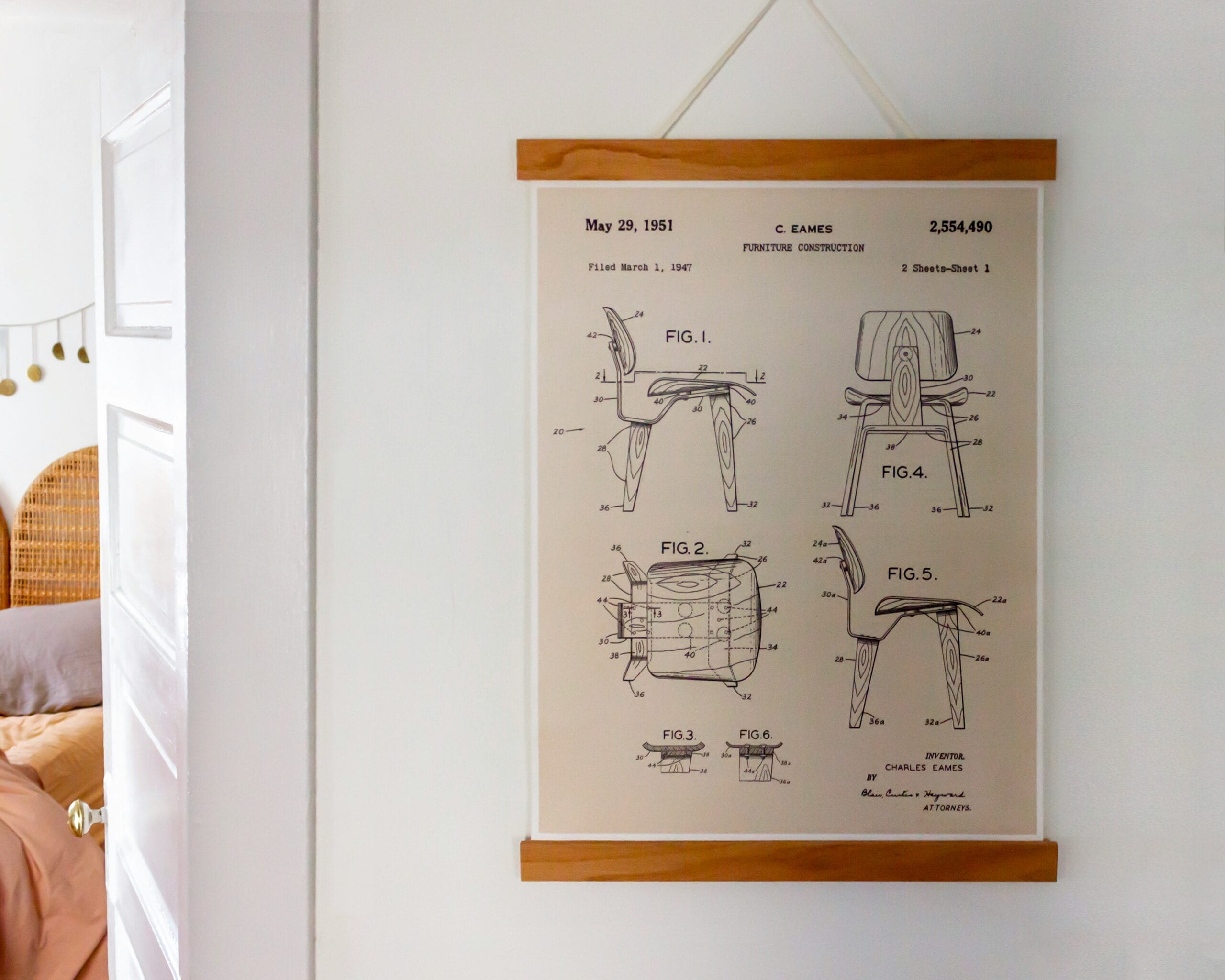
When the Eames Office began its serious furniture work during World War II, the U.S. Navy needed molded plywood splints and stretchers for field medicine. The Eameses took the contract. The wartime production research addressed a specific technical problem: how to shape plywood into compound curves without cracking it, and how to maintain dimensional accuracy in fabrication. That work became the foundation for the LCW and DCM chairs that followed (Library of Congress, “The Work of Charles and Ray Eames: A Legacy of Invention”).
This matters because the material choice was not aesthetic. Plywood was workable, manufacturable, and cheap enough to keep the final price accessible. The technical problem was the same one the Navy contract had posed: how do you form a plywood seat that fits the human body? The wartime solution produced the civilian application.
The LCW (Lounge Chair Wood, 1945) illustrates the logic precisely. The seat and back shells are birch or ash plywood, compound-curved to distribute the body’s load across the surface rather than concentrating it at a few pressure points. The shock mount connecting seat shell to base — rubber joints that allow the seat to flex as the body shifts — is built into the structure rather than added as foam. That flex is a specific ergonomic argument dressed up as a manufacturing decision.
The fiberglass shell chair of 1950 extended the same logic into a different material family. Fiberglass-reinforced plastic could hold compound curves that wood grain would resist. The Eameses entered the MoMA International Competition for Low-Cost Furniture Design in 1948 and won first prize for seating. The competition brief was “good design at low cost.” The shell chair was the answer.
Ray Eames stated the principle directly: “What works good is better than what looks good because what works good lasts” (documented at Eames Office). The formal qualities of Eames furniture — the curves, the surfaces, the apparent elegance — are a byproduct of solving for function and cost. They are not the point. They are what happens when the point is pursued rigorously.
The Eameses worked across four material families: molded plywood, fiberglass-reinforced plastic, bent wire mesh, and cast aluminum. Each represented a different manufacturing argument, addressing different price points, different use cases, different production infrastructure. Together they constituted a body of work that made the thesis hard to dismiss: treating the design problem and the manufacturing problem as the same problem produced furniture that sold.
The chairs that made the argument
LCW (Lounge Chair Wood), 1945. The shock-mount joint connecting seat shell to base is the structural invention here. It allows the seat to flex with the sitter rather than resisting movement. No cushion is required. The chair holds its form through compliance, not rigidity. Originally produced by Evans Products Company; Herman Miller acquired the design in 1949.
DCM (Dining Chair Metal), 1946. The same seat shell as the LCW, mounted on a tubular steel base. The formal argument is explicit: the design is material-agnostic. What matters is the ergonomic form of the seat. The base is a production variable, not a design decision. This was a demonstration that the thesis scaled.
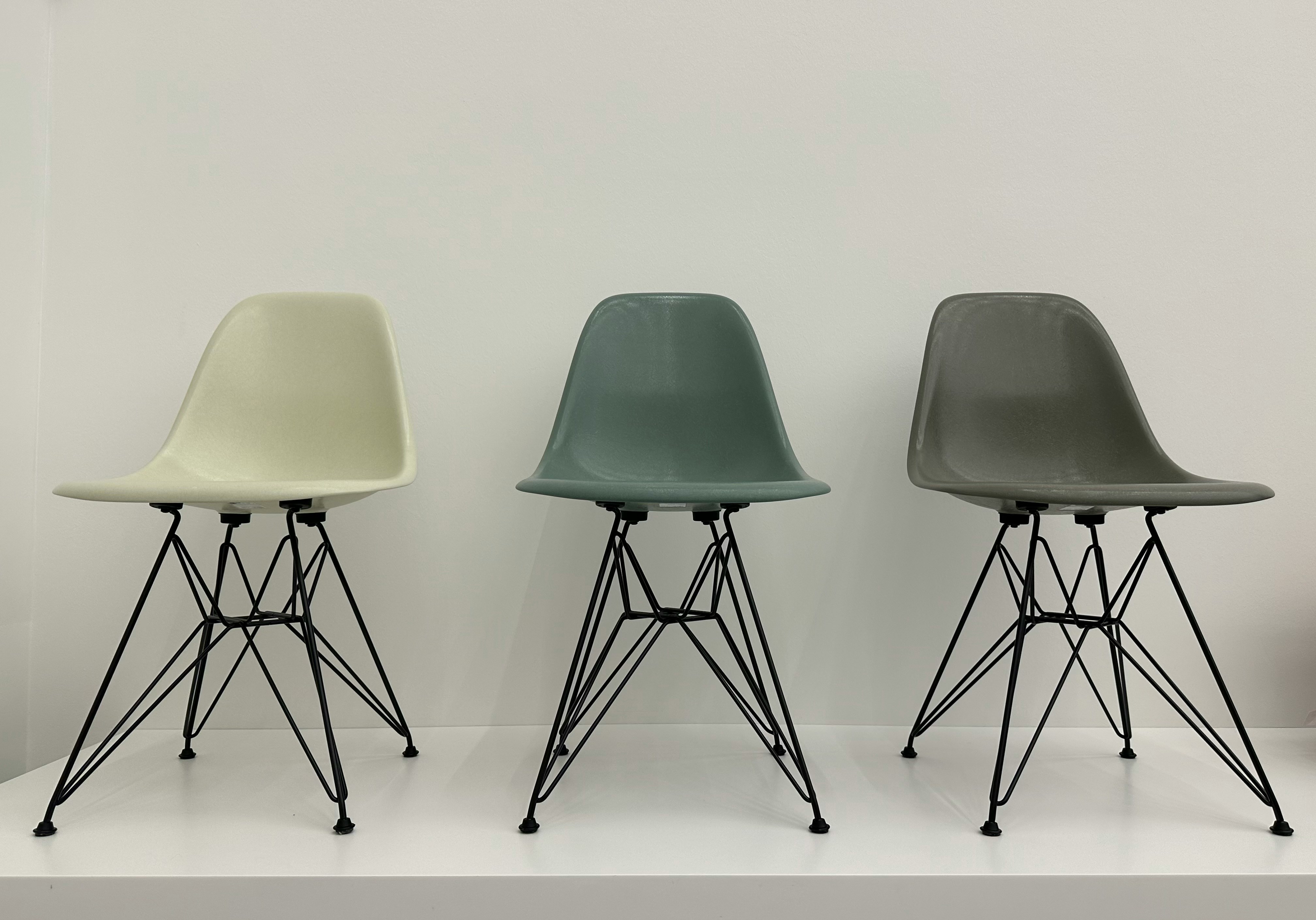
Fiberglass Shell Chair (DAR/DAX/DAW/DSW), 1950. Fiberglass allowed the compound curve the Eameses had been trying to achieve in plywood without the constraints of wood grain direction. The DAR used a wire rod base. The DSW used wooden dowel legs. The DAX mounted on an X-base. These were not separate chairs; they were one shell designed to pair with a range of bases at different price points. The modular system was itself an argument: the same quality of form, priced differently through production choices.
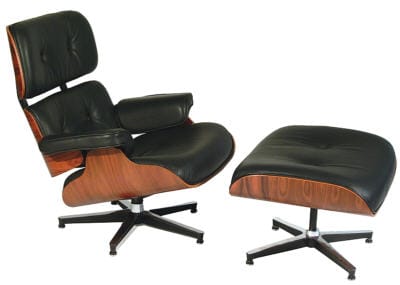
Eames Lounge Chair and Ottoman (670/671), 1956. The seeming contradiction. The 670 is expensive. It used Brazilian rosewood veneer (Herman Miller transitioned to walnut in the 1990s as Brazilian rosewood became scarce and was later added to CITES Appendix II in 2017), leather cushions, and cast aluminum. It does not belong in the “best for the most for the least” category.
The honest account is that the 670 is a different project. It is the Eameses asking what the best possible lounge chair would be if cost were not the constraint. The Vitra Design Museum documents the lounge chair as a piece designed for deep relaxation and tactile pleasure — a different brief from the democratic furniture program. Whether that contradicts the democratic thesis depends on whether you think a practice is defined by its most expensive piece or its body of work.
Eames Aluminum Group (EA 105–119), 1958. Designed for the Miller House in Columbus, Indiana. The frame is cast aluminum; the seat is a sling of vinyl or fabric stretched between the frame rails. The chair looks expensive. The materials are not. It has been in continuous production since 1958 — sixty-seven years — which suggests the form holds up.
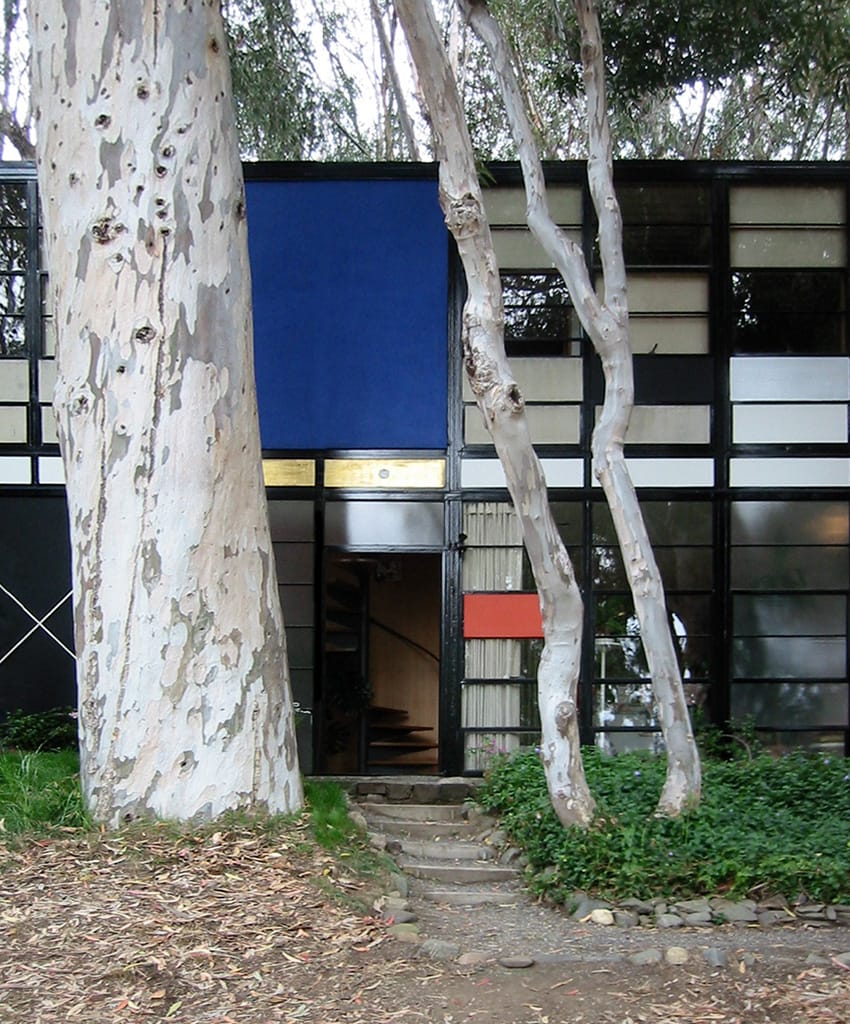
Beyond furniture, the Eames Office produced exhibition design, film, and architecture — most famously Case Study House No. 8 (the Eames House, 1949) in Pacific Palisades. The house applied the same logic as the furniture: standard industrial components assembled into a livable whole at a cost below bespoke construction. The Design Museum London profiles the Eameses as practitioners who refused to separate the domestic from the industrial.
Shop the Collection
The authorized Eames designs are produced by Herman Miller in North America and Vitra in Europe. The prices are what they are. If what you want is the shell chair form in a functional, well-reviewed product at a price that reflects the mass-manufacturing argument the Eameses were making, these are worth considering.
Eames Furniture Sourcebook (Vitra Design Museum)
The material studies, prototype iterations, and production variations across Herman Miller and Vitra runs — the Vitra Design Museum catalogue is where the documentation lives. Not a coffee-table book. A reference. Shop on Amazon
Further Reading
Daniel Ostroff (ed.), An Eames Anthology (Yale University Press, 2015)
Writings, film scripts, interviews, letters, and speeches by Charles and Ray Eames in their own words. Not a critical study. The primary material. Any serious reading of the Eameses begins here. Shop on Amazon
Eames Demetrios, Eames: Beautiful Details (Ammo Books, 2014)
A photographic study of the details that define Eames work: the rubber shock mounts, the edge profiles, the hardware, the joint solutions. Eames Demetrios is Charles and Ray’s grandson; the book has the access that comes with that. Shop on Amazon
Frequently Asked Questions
What was the Eames design philosophy?
The Eames design philosophy is summarized in Charles Eames’ stated constraint: “the best for the most for the least.” This was not a slogan. It was a design directive. Every material choice and manufacturing process the Eames Office pursued was evaluated against whether it could produce high-quality, ergonomically sound furniture at a price accessible to ordinary households.
Why did Charles and Ray Eames use plywood and fiberglass instead of traditional materials?
Because plywood and fiberglass could be formed into compound curves using industrial processes at a cost that traditional solid wood joinery could not match. The material choices were manufacturing arguments: industrial fabrication reduces unit cost, which reduces the price to the buyer. The Eameses pursued whichever material family could deliver the ergonomic form they wanted at the price point they were targeting.
What is the difference between an original Eames chair and a reproduction?
Original Eames chairs are produced exclusively by Herman Miller (North America) and Vitra (Europe and Middle East) under license from the Eames Foundation. They are manufactured to specific material and dimensional tolerances that reproductions do not replicate. The shell chair’s compound curve, the shock-mount compliance of the LCW, the edge profiles on the lounge chair: these are the result of process documentation that reproduction manufacturers do not have access to. The form may be similar. The manufacturing decisions embedded in it are not.
Is a secondhand Eames chair worth buying?
Usually, yes. Herman Miller has made the shell chairs and the lounge chair in large numbers for decades, so licensed examples are common on the secondhand market and hold up well. A used licensed chair is a better object than a new unlicensed one at a similar price. Check for the Herman Miller label and, on a lounge chair, the shock mounts and shell laminate.
Who made the original Eames chairs — and who makes them now?
The LCW and DCM were initially produced by Evans Products Company beginning in 1945 and 1946 respectively. Herman Miller acquired the Eames line from Evans in 1949 and has produced it continuously since. Herman Miller remains the authorized North American manufacturer. Vitra produces the same designs for Europe and the Middle East under a separate licensing arrangement. Both manufacturers use the Eames Foundation’s documentation.
What was Charles Eames’ most famous quote about design?
“We want to make the best for the most for the least” — documented at eamesoffice.com and corroborated in Herman Miller’s published interviews with the Eameses. A second quote worth noting is Ray Eames’: “What works good is better than what looks good because what works good lasts.” Both are precise statements of the same position, arrived at from different angles.
A different version of that argument — applied to portable instruments rather than seating — runs through the work of Teenage Engineering, whose OP-1 Field treats music-making as a designed experience from the first touch.
The Eames chairs sit among the most examined objects in twentieth-century furniture. For comparisons and context, see the Iconic Furniture Design hub and the profile of the Barcelona Chair — the other canonical benchmark of the modernist furniture argument. For an in-depth review of the lounge chair, see the Eames Lounge Chair review. For the best office chair options in the Eames line, see best Eames office chairs. Before buying one secondhand, see how to identify an authentic Eames Lounge Chair.

About Joe Post
Joe Post holds an MFA in Art from California Institute of the Arts (CalArts) and has done additional graduate work at the School of the Art Institute of Chicago. He founded Art Design Ideas to write about design as cultural argument — the decisions, contradictions, and assumptions built into the objects we live with.