
Marcel Breuer was a Hungarian-American architect and furniture designer who studied and taught at the Bauhaus from 1920 to 1928. His marcel breuer chair designs, the Wassily Chair (1925) and the cantilever Cesca Chair (1928), established tubular steel as the primary material of modernist furniture and remain in production today.
What Breuer Was Arguing When He Picked Up a Bicycle
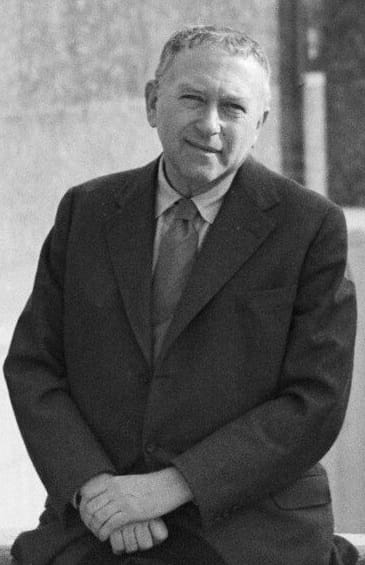
The argument Breuer was making in 1925 was not aesthetic. It was structural. He looked at the tubular steel handlebar of his Adler bicycle, machine-bent, seamless, capable of bearing weight in multiple directions, and understood that it was a better material for furniture than anything the hand-made tradition could offer. Not prettier. Better: lighter, stronger, cheaper to replicate, immune to the grain failures that plagued wood.
He arrived at the Bauhaus in 1920 as one of its youngest students, after a brief stint at the Academy of Fine Arts in Vienna. By 1924, at age 22, he ran the carpentry workshop, the same workshop that was still using traditional materials, still treating furniture as a craft problem. The move to Dessau in 1925 changed that frame entirely. Walter Gropius had just made the school’s relationship to industry explicit. The faculty Breuer joined as a Master — Kandinsky, Albers, Klee, Moholy-Nagy — were all working with the same question: what does making mean when machines can make it?
Breuer’s answer, in tubular steel, was more direct than most. He took the material from which industrialization had already built bicycles, plumbing, and aircraft frames, and showed that it could do the same thing for the human body at rest. The Adler handlebar was not a charming anecdote. It was evidence.
The Adler handlebar was not a charming anecdote. It was evidence.
That move from craft workshop to machine production is part of what the canon of modernist furniture was built on, and Breuer’s chairs sit at the center of that argument. Not because they look like the future, but because they solved a problem the hand-craft tradition had not thought to ask.
Why the Marcel Breuer chair that matters most isn’t the famous one
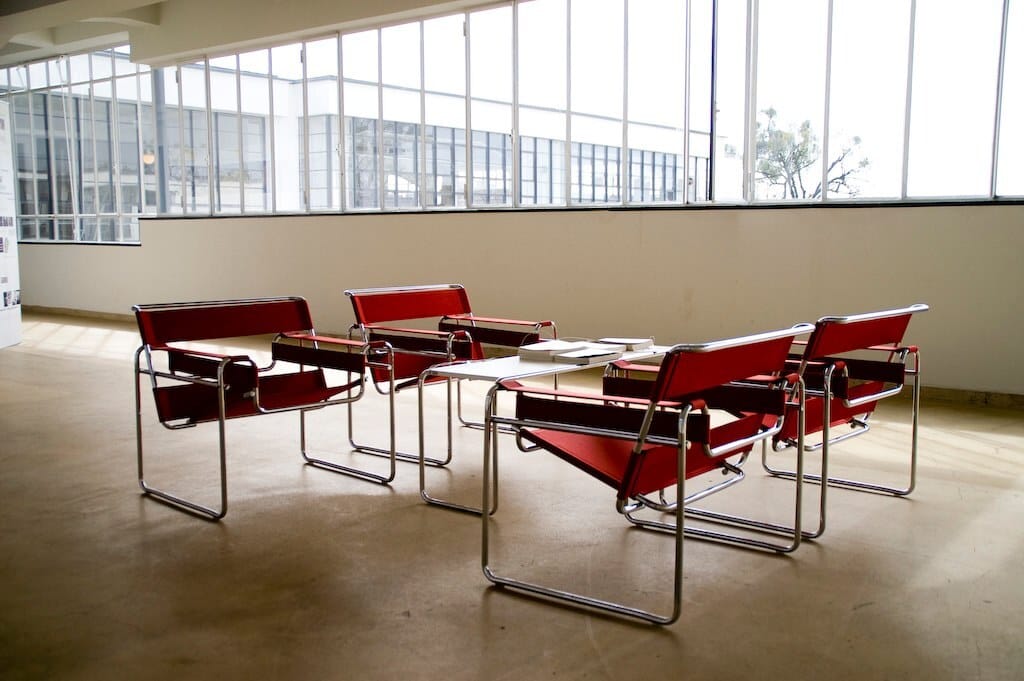
The Wassily Chair (Model B3, 1925–26) gets more attention, and that is reasonable: it was the first, it is more visually dramatic, and Knoll’s current licensed production keeps it circulating. But the Wassily Chair’s design history is, at bottom, a story about replacing wood and leather with steel and leather. The frame changes; the logic of the chair, four legs, a seat, a back, does not.
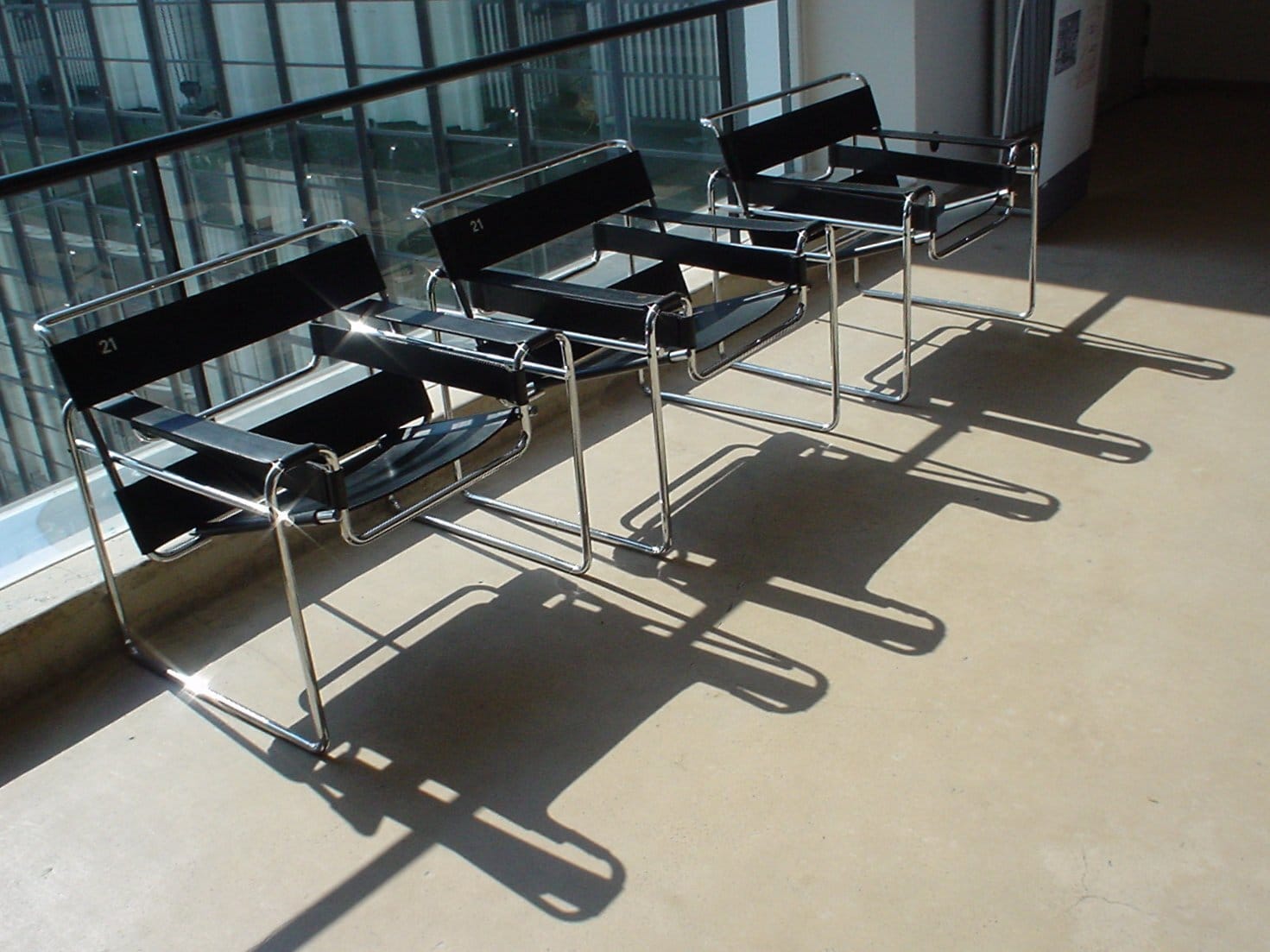
The Cesca Chair (Model B32, 1928) makes a different claim. A cantilevered seat with no rear legs, depending entirely on the spring of bent steel to absorb the sitter’s weight. The human body no longer rests on a static structure: it sits on a structure that flexes and responds. That is a structural argument, not a stylistic one. The form follows from the material’s capacity, not from a decision about what chairs ought to look like.
The caning complicates the picture in a productive way. Breuer placed a natural, woven material inside an industrial steel frame: cane seat, cane back set within continuous polished steel. The tension between those two materials is not a compromise. It is the point. The Cesca does not pretend that natural and industrial are the same language; it holds them in deliberate contrast.
The Cesca does not pretend that natural and industrial are the same language; it holds them in deliberate contrast.
One historiographical note deserves attention. The Cesca is often described as the first cantilevered chair, but that claim is contested. Mart Stam designed the S 33 in 1926, and Mies van der Rohe produced the MR10 and MR20 in 1927, both before Breuer completed the Cesca in 1928. The Knoll documentation on the Cesca’s history acknowledges this priority dispute rather than resolving it. What Breuer’s version did, more than the others, was demonstrate how to combine the cantilever principle with commercial production at scale. That is why the Cesca, and not the S 33, is still in licensed production today.
The naming of both chairs, incidentally, is a later invention. Neither the Wassily nor the Cesca carried those names when Breuer designed them. Both were renamed in the 1960s by Italian manufacturer Gavina: the Wassily after learning that Wassily Kandinsky had received an early prototype and admired the design, the Cesca after Breuer’s daughter Francesca. Breuer himself never used either name. That gap between the design act and the marketing name matters: what Gavina was doing in the 1960s was selling nostalgia for a movement that had been suppressed by fascism, reconstituted at Harvard, and dispersed across postwar American universities. The names are part of that story, not part of Breuer’s.
Mies van der Rohe and Breuer were working in tubular steel at the same moment and from different directions, a parallel the Barcelona Chair’s design history illuminates from Mies’s side. The two designers arrived at the cantilever through different structural arguments. Breuer’s came from the bicycle frame. Mies’s came from his reading of structural engineering as formal argument. That they produced similar chairs in the same three-year window was not coincidence.
The objects that made the argument
Wassily Chair (Model B3), 1925–26
The Wassily Chair’s frame uses the same diameter tubing Breuer measured on his Adler bicycle handlebar, approximately 20mm, the module that determined every dimension of the piece. Seat, back, and arms are leather slings within a continuous polished steel structure: the body is held but not enclosed, suspended rather than supported. The Museum of Modern Art holds an early example in its permanent collection, documenting the chair’s position as a defining object of the modernist period. Knoll holds the current license and produces it in chrome-plated steel with leather in several colors.
Cesca Chair (Model B32), 1928
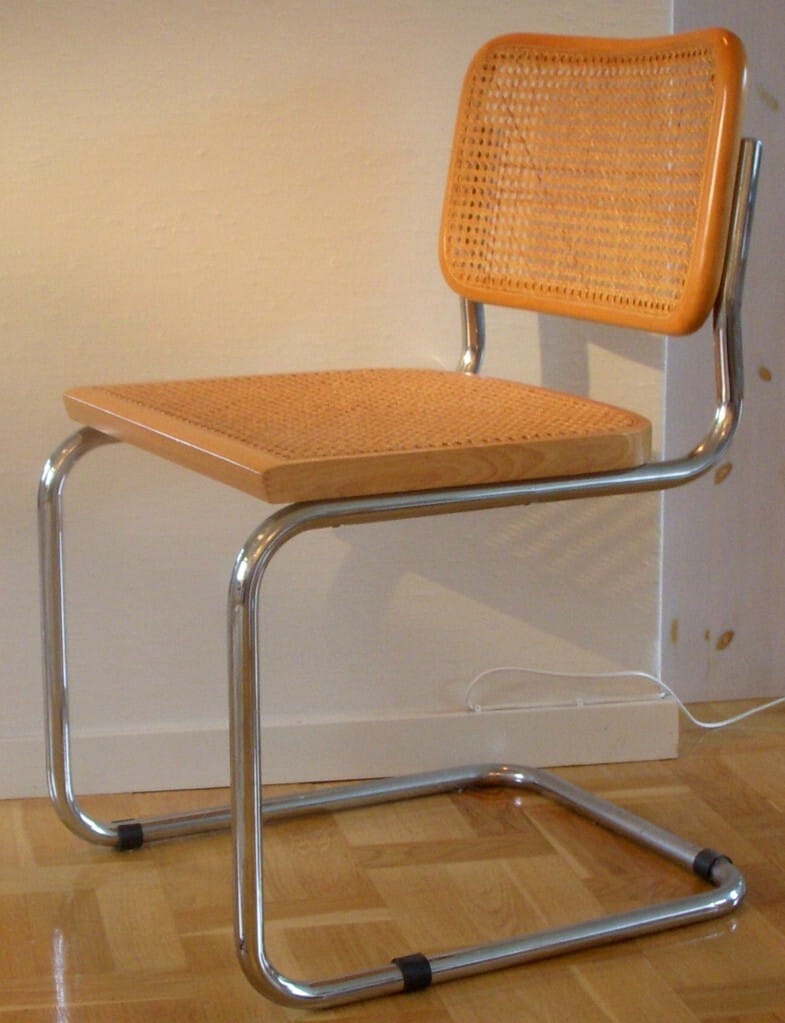
A single length of tubular steel bent into a continuous cantilevered loop, with a beechwood or walnut frame supporting a caned seat and back. The side chair is the B32; the armchair version is the B64. The caning, a material Breuer lifted directly from traditional Viennese chair production, is not decorative nostalgia. It is the lightest, most open weave available, which means the chair reads as air-and-frame rather than as upholstery. Breuer left the Bauhaus in 1928, the same year he completed this design, and it is worth noting that the school itself was already under political pressure that would force it to close entirely by 1933.
Laccio Tables, 1925
Designed alongside the Wassily Chair, the Laccio tables are two rectangular steel-frame pieces at different heights and are the first tubular steel tables. Knoll produces them still, in the original proportions, with laminate tops in several finishes. They belong with the Wassily Chair not as accessories but as part of the same argument: that steel could furnish an entire room without wood, without upholstery, without any material that required a craftsman’s hand to work.
Whitney Museum of American Art, 945 Madison Avenue, New York, 1966
Breuer spent the second half of his career building. After emigrating to London in 1935 and then to the United States in 1937, where he joined Walter Gropius at Harvard’s Graduate School of Design, he moved entirely into architecture. The Whitney building at 945 Madison Avenue is his most significant New York commission: raw concrete, travertine, and granite; trapezoidal windows that widen as they rise; an inward-tilting facade that refuses the street rather than engaging it. The building held the Whitney’s collection from 1966 to 2014. It now operated as The Met Breuer under the Metropolitan Museum until 2020. The Cesca’s logic runs through the building’s entire exterior: structure made visible, material used without apology.
UNESCO Headquarters, Paris, 1958
Co-designed with Pier Luigi Nervi and Bernard Zehrfuss. The UNESCO building demonstrates that the argument Breuer had been making since 1925 scaled to the monumental: structure as form, material as language, the machine not as threat to design but as its instrument. That a furniture designer from the Bauhaus carpentry workshop ended up building the headquarters of an international organization in Paris is not a biographical curiosity. It is the logical extension of the same position.
Where to Buy the Originals
Knoll makes both chairs under license and sells them directly. ADI links only to licensed makers and their dealers. Prices were checked at knoll.com in September 2026.
- Knoll Wassily Chair, $4,373. The chair that started tubular steel furniture, with the leather slings held in tension across the frame. It rewards a reading corner rather than a desk.
- Knoll Cesca Caned Side Chair, $1,380. The cantilever you can use every day, with a bentwood frame and hand-woven cane. Armchair and upholstered versions are also available.
For those exploring the full range of Bauhaus furniture still in production, Breuer’s tubular steel pieces are the strongest entry point. Both the Wassily and the Cesca have been manufactured under license for over sixty years without revision to their original specifications.
Further Reading
Two books. Not three.
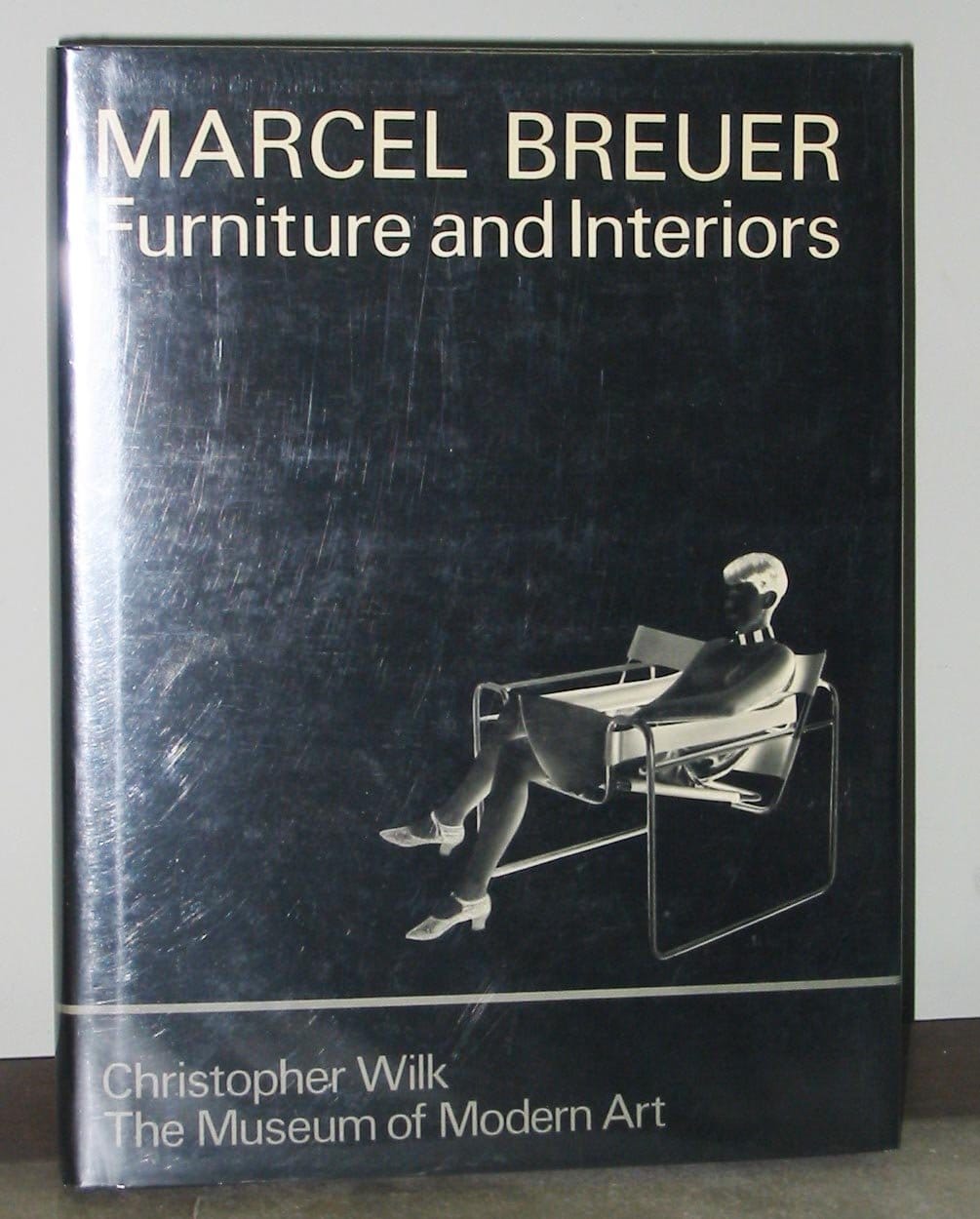
Christopher Wilk, Marcel Breuer: Furniture and Interiors (Museum of Modern Art, 1981)
Wilk’s MoMA catalogue is the primary scholarly monograph on Breuer’s furniture, tracing the full development from the Bauhaus carpentry workshop to tubular steel. Its black-and-white photographs are documents rather than decoration, showing chair dimensions, material samples, and workshop drawings. If you want to understand how Breuer’s thinking changed between 1922 and 1928, this is where to start.

Robert McCarter, Breuer (Phaidon, 2016)
McCarter covers both the furniture and the architecture with equal seriousness, which matters for a designer who spent the second half of his career building universities and museums. The Phaidon format gives the buildings the space they need. It is the only single-volume study of the full career that does not subordinate one half of it to the other.
Frequently Asked Questions
What is the Marcel Breuer Wassily Chair?
The Wassily Chair (Model B3) is a steel-frame lounge chair designed by Marcel Breuer at the Bauhaus in 1925–26. Breuer modeled its tubular steel frame on the handlebar diameter of his Adler bicycle. The seat, back, and arms are leather slings within the steel structure. It was renamed the “Wassily” in the 1960s by Italian manufacturer Gavina, after learning that Wassily Kandinsky had received an early prototype. Knoll holds the current production license.
What is the difference between the Wassily Chair and the Cesca Chair?
The Wassily Chair is a lounge chair with four legs and leather slings for seat, back, and arms, a steel-and-leather interpretation of traditional seating structure. The Cesca Chair is a cantilevered side chair with no rear legs: the seat is supported entirely by the spring of a bent steel loop. The Cesca makes a more structurally radical argument. The Wassily changed the material; the Cesca changed the structural logic of what a chair can be.
Who named the Wassily Chair after Kandinsky?
The chair was named by Dino Gavina, the Italian manufacturer who reissued the design in the 1960s. Gavina learned that Wassily Kandinsky had received one of Breuer’s early prototypes while both were at the Bauhaus in Dessau and had admired the design. Kandinsky did not commission the chair, and Breuer never called it the Wassily. The name is a retroactive marketing decision, not a design attribution.
Is the Cesca Chair the first cantilevered chair?
The claim is disputed. Mart Stam designed the S 33 in 1926, and Mies van der Rohe produced the MR10 and MR20 cantilevered chairs in 1927, both before Breuer completed the Cesca in 1928. What is not disputed is that the Cesca became the cantilevered chair most widely produced and sold. The priority question is a real historiographical argument; Breuer’s claim to have invented the cantilever chair outright is not supportable.
Where are Marcel Breuer chairs made today?
The Wassily Chair is produced under license by Knoll, which holds the rights and manufactures it to the original specifications. In the United States the Cesca is also made by Knoll, which acquired the Gavina company that relaunched Breuer’s designs in 1968. Chairs sold under either name by other manufacturers are not the licensed products.

About Joe Post
Joe Post holds an MFA in Art from California Institute of the Arts (CalArts) and has done additional graduate work at the School of the Art Institute of Chicago. He founded Art Design Ideas to write about design as cultural argument — the decisions, contradictions, and assumptions built into the objects we live with.