
Kara Walker’s silhouette art cuts black paper into scenes of the antebellum South — graphic, seductive, and unresolved. Since her 1994 New York debut, she has staged slavery as an ongoing wound rather than a closed chapter. The form she chose was never decoratively neutral: the silhouette carries its own American history of racial reduction.
The silhouette was never an innocent form
The silhouette arrived in American domestic life as a middle-class portrait technology. It was affordable, rapid, and defined by an act of reduction. You collapsed a person into a black profile. The detail that made someone who they were disappeared. What remained was an outline.
Walker recognized that this formal operation was also how the racial stereotype functioned. The stereotype, like the silhouette, works by reducing a complex human being to a recognizable flat shape. Her choice of medium was not aesthetic preference — it was argument. The form was already doing the work before she cut a single figure.
That argument took its biographical charge from a specific displacement. Walker was born in Stockton, California in 1969 and moved at thirteen to Stone Mountain, Georgia, when her father Larry Walker, a painter and professor, accepted a position at Georgia State University. Stone Mountain is a town that hosted active Ku Klux Klan events. The California Walker had known, however imperfectly integrated, had not prepared her for this. In a 1999 interview at the Museum of Modern Art, Walker described what the move produced: “when I was coming along in Georgia, I became black in more senses than just the kind of multicultural acceptance that I grew up with in California. Blackness became a very loaded subject, a very loaded thing to be — all about forbidden passions and desires, and all about a history that’s still living, very present.”
She earned a BFA from Atlanta College of Art in 1991, then completed an MFA in painting at Rhode Island School of Design in 1994, per Wikipedia. Her debut came that same year, while she was still finishing her degree, at The Drawing Center in New York. The work was a 25-foot cut-paper wall installation titled Gone: An Historical Romance of a Civil War as It Occurred Between the Dusky Thighs of One Young Negress and Her Heart. She was twenty-four years old. The title’s deliberate excess parodies the sentimental register of plantation fiction. This announced that the work was not straightforward critique. It was seduction and horror staged together, in the same visual language as the parlor portraits that lined Victorian drawing rooms.
The work arrived at the height of the culture wars. Questions about identity, representation, and the politics of imagery in American art were acute. Walker’s silhouettes sat at the junction of the American painting that preceded her, the Abstract Expressionist generation’s claims about individual freedom and pure form, and the pointed, politically conscious work of artists like Basquiat’s street-level confrontation with the same history. But where Basquiat worked in accumulation and noise, Walker worked in reduction and silence.
The reception was not uniformly welcoming. Some Black artists and critics, most prominently the painter Betye Saar, objected to what they saw as exploitative reproduction of racist imagery without adequate critical framing. Saar mounted a correspondence campaign against Walker’s work in the late 1990s, arguing that staging degrading imagery, however critically intended, reinscribed it. This debate belongs in the record as intellectual history, not as a damage-control footnote. It confirms that the work operated as Walker intended. Work that produces only agreement has not done much.
The MacArthur Foundation awarded Walker a fellowship in 1997, when she was twenty-eight, one of the youngest recipients in the program’s history.
What Kara Walker’s silhouette art does that painting cannot
The silhouette’s formal properties and Walker’s critical argument about stereotype are not parallel claims. They are the same claim. “The silhouette says a lot with very little information,” Walker told Patricia Zohn in a Huffington Post interview published February 29, 2008, “but that’s also what the stereotype does.” The medium and the subject share the same operating logic.
The silhouette says a lot with very little information, but that’s also what the stereotype does.
Painting gives you enough information to individuate. The face has features. The body has posture. The light falls in a particular way. The silhouette removes all of this. What remains is readable as type — a shape associated with a role, a gender, or a race. The viewer, trained on decades of American visual culture, fills in the rest. What they fill in is what they were taught. Walker’s formal choice makes the viewer’s own cultural conditioning part of the image.
This operates most powerfully at scale. Walker’s installations are room-sized. The figures are at or above human scale. The viewer does not stand at a safe gallery distance, looking at history framed on a wall. They stand inside it. The spatial logic of the work is immersive rather than illustrative.
The ambiguity built into the silhouette form compounds this. Without identifying features, it is genuinely difficult to determine which limbs belong to which figures, whether an act is being committed or resisted, who holds power in a given exchange. This formal indeterminacy is deliberate. The viewer is forced to complete the image and implicated by what they supply.
Harper’s Pictorial History of the Civil War (Annotated) (2005), documented at the Smithsonian American Art Museum, makes this layering literal. Walker took lithographic enlargements from the 1866 Harper’s Weekly illustrated history of the Civil War (the official visual record) and screenprinted her silhouette figures directly over them. The figures excluded from the official historical account are superimposed on it, inhabiting the same visual field. The effect is something like annotation and something like haunting.
Darby English, whose essay in Ian Berry et al., Kara Walker: Narratives of a Negress (MIT Press, 2003) established the critical vocabulary for the scholarship that followed, has argued that Walker’s work refuses both uplift and victimhood as organizing frames. The scenes are aesthetically seductive and morally uncontainable. This is not a failure of the work to resolve itself. It is the work’s method.
Five works that carry the argument
Gone: An Historical Romance of a Civil War as It Occurred Between the Dusky Thighs of One Young Negress and Her Heart (1994)
Walker’s debut at The Drawing Center remains the clearest statement of the formal and political logic that organizes everything that follows. At approximately 25 feet wide, the cut-paper wall installation presents what appear at first to be pastoral silhouette scenes: the decorative register of the 18th-century parlor tradition Walker was invoking. Closer inspection reveals rape, mutilation, and servitude staged in the same graceful profile shapes. The work is beautiful in precisely the way that makes it disturbing. The decorative tradition does not provide ironic distance. It is the mechanism of the horror.
Insurrection! (Our Tools Were Rudimentary, Yet We Pressed On) (2000)
Cut-paper silhouettes combined with colored light projections. The colored light casts the viewer’s own shadow into the tableau on the wall. This is not metaphorical implication. The viewer’s body becomes a literal participant in the scene. Walker removes the last available escape. You cannot watch this work without being in it.
Harper’s Pictorial History of the Civil War (Annotated) (2005)
A portfolio of 15 prints. Each takes a lithographic enlargement from Harper’s Weekly’s 1866 illustrated Civil War history and overlays Walker’s screenprinted silhouette figures directly onto the source image. The official historical record (what was deemed worth documenting and circulating as American collective memory) physically overwritten by what it excluded. The word “annotated” in the title is precise. This is commentary on a primary document by someone who was not invited to contribute to it.
A Subtlety, or the Marvelous Sugar Baby… (2014)
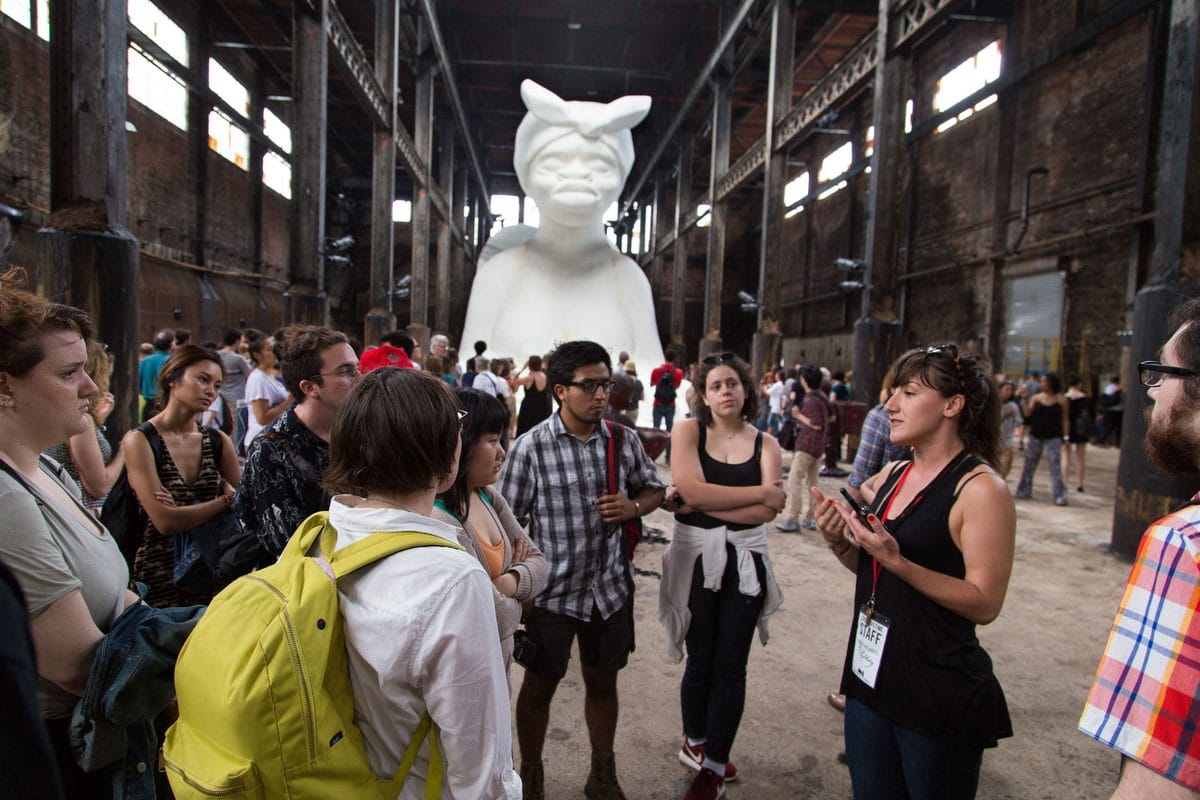
Site-specific installation in the Domino Sugar Refinery in Williamsburg, Brooklyn, commissioned by Creative Time ahead of the building’s demolition. A sphinx figure approximately 75 feet long and 35 feet tall, with a Black woman’s head, coated entirely in white sugar. Accompanied by smaller attendant figures made from brown sugar. The refinery’s history, a century of sugar production in a city whose commercial fortunes were built on the slave labor of the Caribbean sugar trade, was the subject. The figure was temporary by design: dismantled at the close of the exhibition, the building demolished separately afterward.
The figure was deliberately temporary. The installation was dismantled at the close of the exhibition. The building was demolished separately afterward.
Fons Americanus (2019)
A 13-meter-tall fountain, commissioned as the Hyundai Commission for the Tate Modern Turbine Hall in London. Walker modeled the structure on the Victoria Memorial outside Buckingham Palace (the imperial monument as formal template) and subverted its iconography to narrate the transatlantic slave trade. Materials: cork, metal, wood, jesmonite. Non-permanent, recyclable. Water flowed from the central figure’s breasts and throat. The Tate’s documentation of the commission describes it as occupying the space of imperial commemoration while refusing its premises. Like A Subtlety, the fountain was dismantled and its materials recycled after the exhibition closed. The choice to build in temporary materials while occupying the space of permanent monuments is itself an argument about what gets preserved and what doesn’t.
Walker’s recent work has moved into three dimensions and kinetics. Fortuna and the Immortality Garden (Machine) (2024), a major commission for SFMOMA, comprises eight automated figures including a 7-foot-tall prophetess named Fortuna, drawing on Octavia Butler’s Parable of the Sower and the tradition of Bunraku puppetry. The cut-paper silhouettes and the autonomous robotic figures are not different bodies of work. They are the same inquiry at different scales.
Shop the collection
Kara Walker’s prints and editions are sold at primary market through Sikkema Malloy Jenkins in New York and Sprüth Magers in Berlin, London, and Los Angeles; not on Amazon. There are no Walker-branded consumer products available through retail channels, and padding this section with unrelated products would be dishonest. What you can own, and what will actually serve the work, are the two books that have done the most to establish serious critical terms for Walker’s practice. If you are thinking about living with art that argues, work that earns its place by asking something of the viewer, these are where the thinking about Walker is.
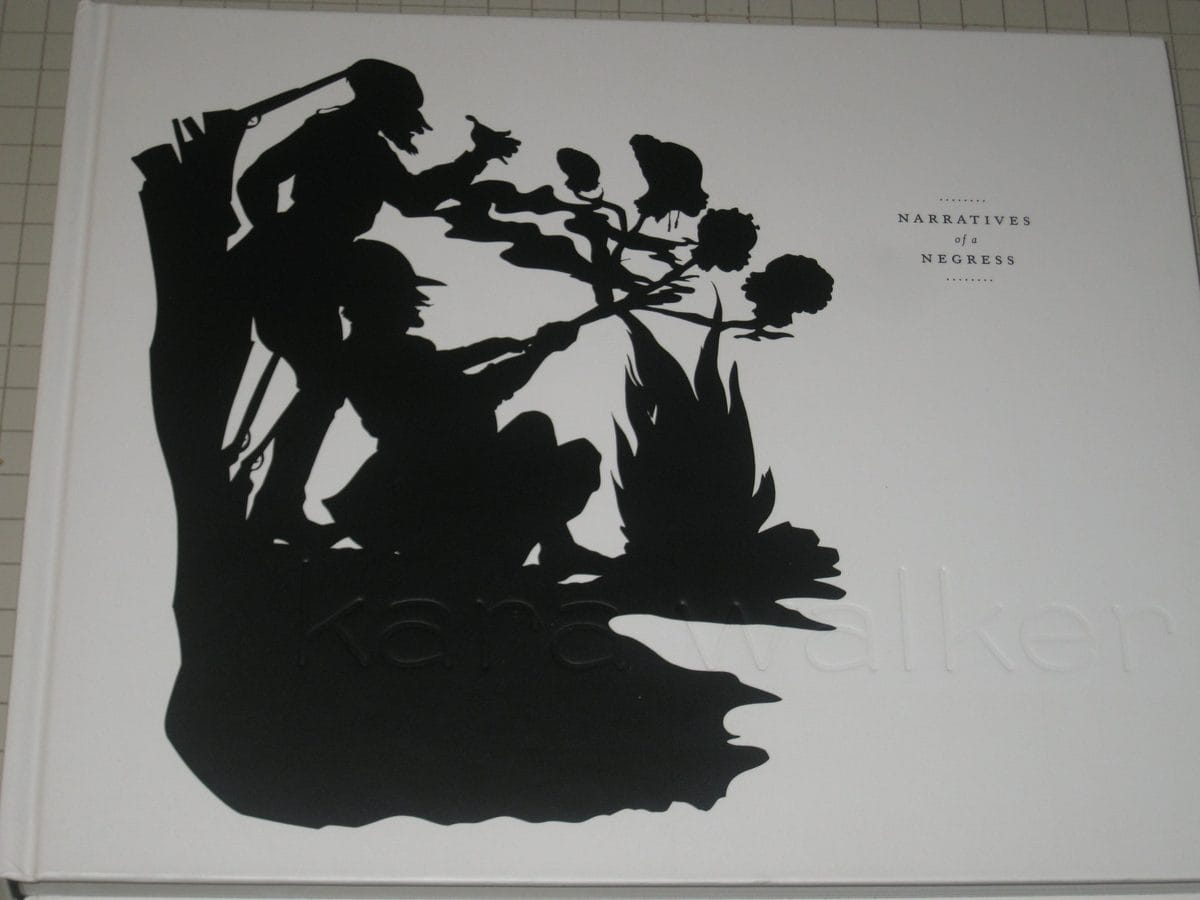
Kara Walker: Narratives of a Negress
The catalogue for the first major survey exhibition of Walker’s work, covering the cut-paper practice from Gone (1994) through the early 2000s: the period that established the formal and conceptual vocabulary the later monumental works build on. Darby English’s essay is the critical text that set the terms for serious Walker scholarship.
Seeing the Unspeakable: The Art of Kara Walker
Shaw’s sustained close reading of four specific works is the most rigorous formal analysis of Walker’s silhouette practice in book form. This book makes the formal argument (it explains what the cuts are doing) rather than contextualizing the politics from a distance.
Frequently asked questions
What is Kara Walker known for?
Kara Walker is known for large-scale cut-paper silhouette installations that depict scenes of the antebellum American South: slavery, violence, desire, and power staged in the visual language of 18th-century decorative portraiture. Her debut work Gone (1994) established this practice, and she has extended it into site-specific sculpture, print portfolios, and, more recently, robotic installation. She received a MacArthur Fellowship in 1997 at age 28.
Why does Kara Walker use silhouettes?
Walker uses the silhouette because its formal properties and her critical subject share the same logic. The silhouette reduces a person to an outline: exactly the operation the racial stereotype performs. By working in the parlor tradition of decorative profile portraiture, Walker stages American racial history inside a form that was itself a product of that history. As she stated in a 2008 interview with Patricia Zohn, the silhouette “says a lot with very little information, but that’s also what the stereotype does.”
What is the meaning behind Kara Walker’s art?
Walker’s work refuses to separate aesthetic seduction from historical violence. The scenes in her silhouette installations are visually beautiful, graceful figures in pastoral arrangements, and they depict rape, servitude, and mutilation. This doubleness is the argument: that American culture has always found ways to make its history of racial violence decorative and consumable. The work does not offer resolution. The viewer is implicated in the act of looking, and in what they bring to complete the image.
Where can you see Kara Walker’s art?
Walker’s work is held in major institutional collections including the Museum of Modern Art (MoMA), the Metropolitan Museum of Art, and the Smithsonian American Art Museum. Her 2005 print portfolio Harper’s Pictorial History of the Civil War (Annotated) has been exhibited at SAAM, the New-York Historical Society, and the Met. Her 2024 installation Fortuna and the Immortality Garden (Machine) is on view at SFMOMA through spring 2026. Current gallery representation is through Sikkema Malloy Jenkins in New York and Sprüth Magers in Berlin, London, and Los Angeles.
Is Kara Walker still making new work?
Yes. Walker has expanded into new work across multiple forms in recent years. Her 2024 SFMOMA commission Fortuna and the Immortality Garden (Machine), a kinetic installation of eight automated figures, is currently on view through spring 2026. In October 2024, she opened a solo exhibition, “The High and Soft Laughter… In the Colorless Light of Day,” at Sikkema Malloy Jenkins in New York. She has been a faculty member in the MFA program at Columbia University since 2003.
What was the Domino Sugar Factory installation about?
A Subtlety, or the Marvelous Sugar Baby… (2014) was a site-specific installation commissioned by Creative Time for the Domino Sugar Refinery in Williamsburg, Brooklyn, ahead of the building’s demolition. Walker created a sphinx figure approximately 75 feet long and 35 feet tall, with a Black woman’s head, coated in white sugar, accompanied by smaller attendant figures made from brown sugar. The work addressed the history of sugar production and its entanglement with the slave labor of the Caribbean trade: the economic foundations that the refinery’s century of operation rested on. The installation was temporary by design and was dismantled at the close of the exhibition. The building was demolished separately afterward.

About Joe Post
Joe Post holds an MFA in Art from California Institute of the Arts (CalArts) and has done additional graduate work at the School of the Art Institute of Chicago. He founded Art Design Ideas to write about design as cultural argument — the decisions, contradictions, and assumptions built into the objects we live with.