
Jessica Bronson is an American video and installation artist whose work examines what happens to landscape when it arrives through a screen. Working since the early 1990s, she uses long takes, slow accumulation, and sensory disorientation to place viewers inside the gap between direct perception and mediated image. That gap, in her practice, is the landscape itself.
What does it mean to watch a desert when the camera has already decided what you see?
Jessica Bronson’s video art enters a specific argument that Los Angeles was having with itself in the early 1990s. On one side: the confessional single-channel tape, raw testimony, the camera as diary. On the other: cathedral-scale immersive projection, the gallery as total environment. Bronson’s move was neither. She wanted the apparatus visible. She wanted the frame noticed.
Her formation matters here. She completed a B.S. at the University of New Mexico in 1987, with prior study in biomedical engineering at Louisiana Tech University. These disciplines treated perception as a system to be measured, not a mood to be evoked. She then took an MFA at Art Center College of Design, Pasadena, in 1994, where the methodological rigor of the sciences carried directly into her studio thinking. That engineering background gave her something most video artists of her generation didn’t bring: a concern with how an instrument distorts what it records, not just what it records.
The decade she came up in changed what surveillance footage meant culturally. Aerial surveillance and security cameras predate the 1990s by decades; what shifted was their normalization inside domestic media cycles. The freeway chase, shot from a news helicopter, became a genre of evening television. Bronson’s world picture (1998, MOCA Los Angeles) drew directly from that material. Two large curved screens. Helicopter footage of LA freeways, combined with found surveillance tape. Mirror-image projections. As the Museum of Contemporary Art, Los Angeles exhibition description put it: “What becomes important in world picture is not so much the drama of the spectacle as those moments in between, the moments of disruption, with pregnant pauses and blank screens inserted among the images.”
The chase was the drama the surveillance apparatus was built to deliver. Bronson deliberately evacuated that drama. What remained was the frame, the pause, the apparatus itself.
The work earned Bronson the 1998 MOCA/Citibank Emerging Artist Award and the 1999 Louis Comfort Tiffany Grant. But the awards are incidental. The point was the argument she had figured out how to make: the mediated landscape is not a transparent window onto a place. It is a set of prior decisions — angle, duration, framing — that the viewer inherits without being told.
How Jessica Bronson turned the surveillance feed into a question about perception
The formal strategy Bronson developed is specific and consistent. She shoots on location — California desert, clouds, sky — and she appropriates existing footage. The distinction between the two categories, original and found, is what she refuses to maintain. This is not simply a claim about authorship. It is a claim about hierarchy: the original recording does not hold privileged status over the appropriated one, because both have already been processed by an instrument before the viewer arrives. Capture and appropriation are the same act at a different remove. What collapses is the indexical hierarchy — the assumption that a shot made by the artist carries more direct access to the subject than one borrowed from the archive.
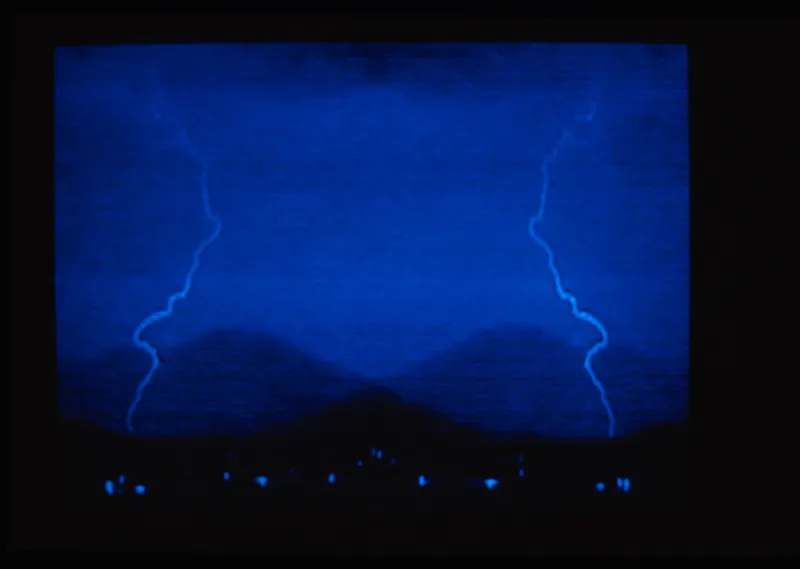
Panamint Tilt (2000, Artpace San Antonio) makes this argument in the clearest possible terms. The subject is the California desert near the Panamint Mountains, shot with a wide-angle lens. The lens distorts the topography. Bronson then doubles and reverses the image: mirror-image projections that convert landscape into moving pattern, an abstraction that did not require digital manipulation, only the logic of the wide-angle frame taken to its conclusion. A companion monitor diptych, doubled sunset, fractures the same source material into what the Artpace exhibition description called “kaleidoscopic proportions.”
The desert is still there, in the sense that the pixels came from a desert. But what you see is what the instrument made of it.
Heaps, Layers, and Curls (BAMPFA MATRIX 194, September 16–November 11, 2001) extends this into a different scale. Three screens, mural-scale. The subject: clouds chosen, as the BAMPFA press release noted, because they “can be identified yet not really recognized, since they are in constant flux and motion.” Over the cloud imagery, Bronson layered voice transmissions from NASA mission control and a space shuttle cockpit. Nature at ground level sits alongside outer space at the audio layer. Atmospheric time and astronomical time run simultaneously in the same room.
Her work has been situated, in curatorial writing, in relation to “structuralist film, the genre of classical cinema, Minimalist sculpture, and the poetics of video language” (BAMPFA press release, 2001). The structuralist reference is precise: structuralist film (Michael Snow, Hollis Frampton, Ernie Gehr) was also interested in making the apparatus visible. In Snow’s Wavelength (1967), a 45-minute zoom across a loft is the film — the camera’s trajectory is not a vehicle for narrative but the subject itself. Frampton’s Zorns Lemma (1970) replaces letters of the alphabet with images in a systematic substitution until the structure of substitution becomes the content. Bronson’s mirror-image doublings follow the same logic: the frame constraint — wide-angle distortion, the doubled projection — becomes the subject, not the desert it recorded. She is working inside this tradition, not citing it. She is also working inside what W.J.T. Mitchell, in Landscape and Power (University of Chicago Press, 2002), called the cultural force of the landscape image. His argument holds that landscape is never just scenery, that it carries and reproduces power. For Bronson, the surveillance feed was proof.
Five works where the screen becomes the subject
world picture (1998, MOCA Los Angeles)
Two large curved screens. Helicopter footage of LA freeway chases combined with found surveillance tape. The mirror-image projection meant that every car chase became its own abstract double. Bronson’s intervention was the editing logic: pregnant pauses, blank screens, the disruption of the spectacle she had been handed. The drama the surveillance apparatus promised was the thing she specifically refused to deliver. The work won the 1998 MOCA/Citibank Emerging Artist Award.
Panamint Tilt (2000, Artpace San Antonio)
Two large-scale projections of California desert near the Panamint Mountains. Wide-angle lens distortion turned topography into form. Doubled and reversed, the landscape became a moving pattern: geometric, abstract, and still somehow a desert. The companion monitor diptych, doubled sunset, fragmented the same source footage into something closer to a Rorschach test than a landscape photograph. The camera had already done the interpretive work before Bronson arrived.
Heaps, Layers, and Curls (2001, BAMPFA MATRIX 194, Berkeley)
Three screens, mural-scale projection. Subject: clouds in constant motion, chosen because they resist any stable image. Soundtrack: NASA mission control voice transmissions and shuttle cockpit recordings. The piece ran at the University of California, Berkeley Art Museum from September 16 to November 11, 2001. These weeks came after the September 11 attacks, when the sky had recently become a different kind of watched space. Whether Bronson intended that resonance or not, it was there.
perpetual perceptual (speculative spectrum) (2006, Pomona College Museum of Art, Project Series 33)
A pivot from projection to LED text. Fragments drawn from color theory and perception science appear at the edge of direct vision. The viewer sees them peripherally and loses them when looking straight on. Bronson works here in a tradition that goes back through James Turrell to the Minimalist interest in perceptual phenomenology. But where Turrell fills the room with light, Bronson gives the viewer language about light that the eye can only receive obliquely. The medium has changed; the argument is the same.
for Helen Keller (2006, Pomona College Museum of Art)
Shown in the same Pomona exhibition as perpetual perceptual, this LED text piece invokes non-visual perception as the frame for understanding how language and image relate. The title is not decorative. Keller understood landscape entirely through mediation: touch, smell, description. Bronson uses that figure to ask what the rest of us are actually doing when we think we are seeing.
Shop the collection
There is no Jessica Bronson monograph available on Amazon. She has not been the subject of a trade publication, which is its own kind of fact about how the art market values video artists who don’t make objects. The two books below are the strongest alternatives: they represent the critical tradition her work operates inside.
- W.J.T. Mitchell, Landscape and Power, Second Edition (University of Chicago Press, 2002): The book that reframed landscape as an instrument of cultural force. Mitchell’s argument holds that the landscape image is never just scenery, that it carries and reproduces power. This is the critical tradition Bronson works inside, even when her materials are freeway surveillance footage rather than nineteenth-century oil painting.
- Hito Steyerl, Duty Free Art: Art in the Age of Planetary Civil War (Verso, 2017): Steyerl’s essays on the screen-mediated image and the politics of image resolution describe territory Bronson had already mapped in practice. The overlap is real but partial: Steyerl’s “In Defense of the Poor Image” (e-flux, 2009) is primarily about circulation, labor, and the degraded image as political form. Bronson’s concern is perceptual rather than geopolitical. But both are working against the assumption that the image is a transparent window onto what it shows, and Steyerl is the best available theoretical companion for understanding why that argument matters.
Further reading
The scholarship on Bronson specifically is thin. The books worth owning are the ones that put her in context.
- W.J.T. Mitchell, Landscape and Power, Second Edition (University of Chicago Press, 2002): Mitchell’s foundational collection of essays on landscape as a cultural medium. The second edition adds contributions by Edward Said and Robert Pogue Harrison that extend his original argument. This is the critical infrastructure for understanding why Bronson’s choice of landscape as a subject is not a genre decision but a political one.
- Hito Steyerl, Duty Free Art: Art in the Age of Planetary Civil War (Verso, 2017): The best available critical writing on what happens to images when they circulate as data. Images get surveilled, compressed, degraded, rerouted. Steyerl is a filmmaker and essayist who has been thinking about these questions since the early 2000s. Her writing is the nearest thing to a theoretical account of the cultural territory Bronson mapped in practice.
Frequently asked questions
What is Jessica Bronson’s video art about?
Bronson’s video and installation art examines what happens to landscape when it arrives through a screen. Specifically, it explores how the camera’s prior decisions (framing, angle, duration, lens choice) become part of what the viewer receives as a perceptual experience. Her work is not documentary and not ambient. It is an argument about mediation: the camera does not record a place. It makes decisions about a place, and those decisions are the work.
Where has Jessica Bronson’s work been exhibited?
Bronson has exhibited at major institutions including the Museum of Contemporary Art, Los Angeles (1998 solo exhibition, world picture); Artpace San Antonio (2000, Panamint Tilt); the Berkeley Art Museum and Pacific Film Archive, BAMPFA MATRIX 194 (2001, Heaps, Layers, and Curls); the Walker Art Center; the Centre Pompidou in Paris; and the Pomona College Museum of Art (2006–2007). Her work has also been shown in solo exhibitions in New York, San Francisco, Berlin, and New Zealand.
How does Bronson use landscape in her video installations?
She films landscape directly (California desert, clouds, sky) and also works with appropriated footage of the same subjects. What matters to her is not the difference between the two but the sameness: in both cases, the camera has already made interpretive decisions before the viewer arrives. She then processes that material by doubling it, reversing it, and layering it with unrelated audio tracks to make the prior decisions visible. The landscape becomes a record of its own mediation.
What does “mediated landscape” mean in contemporary video art?
A mediated landscape is a landscape that reaches the viewer through a recording apparatus (camera, microphone, editing system) rather than through direct perception. In video art contexts, particularly since the 1990s, the term points to the question of whether the apparatus is transparent (a window onto the real) or opaque (a set of decisions that shape what the real looks like). Bronson’s work argues for opacity: the mediated landscape is not a reproduction of a place but a new thing made from the camera’s encounter with one.
Is Jessica Bronson still making work?
Bronson joined the faculty of the CalArts School of Art in 2001, where she taught for more than two decades. The CalArts Board of Trustees conferred Faculty Emeritus status on her in spring 2022. The most recent confirmed solo exhibition dates in the public record are from 2006–2007. Whether she has continued to make and show work since then is not confirmed in sources currently available.
How does Bronson’s engineering background relate to her art practice?
Before her MFA at Art Center College of Design, Bronson studied biomedical engineering at Louisiana Tech University and completed a B.S. at the University of New Mexico in 1987. That formation gave her a specific way of thinking about perception: not as a mood or an atmosphere but as a system with measurable variables. Lens choice, frame duration, image doubling: these are technical parameters that produce specific perceptual effects. Her work treats those parameters as the medium, not just as the means of recording something else.

About Joe Post
Joe Post holds an MFA in Art from California Institute of the Arts (CalArts) and has done additional graduate work at the School of the Art Institute of Chicago. He founded Art Design Ideas to write about design as cultural argument — the decisions, contradictions, and assumptions built into the objects we live with.