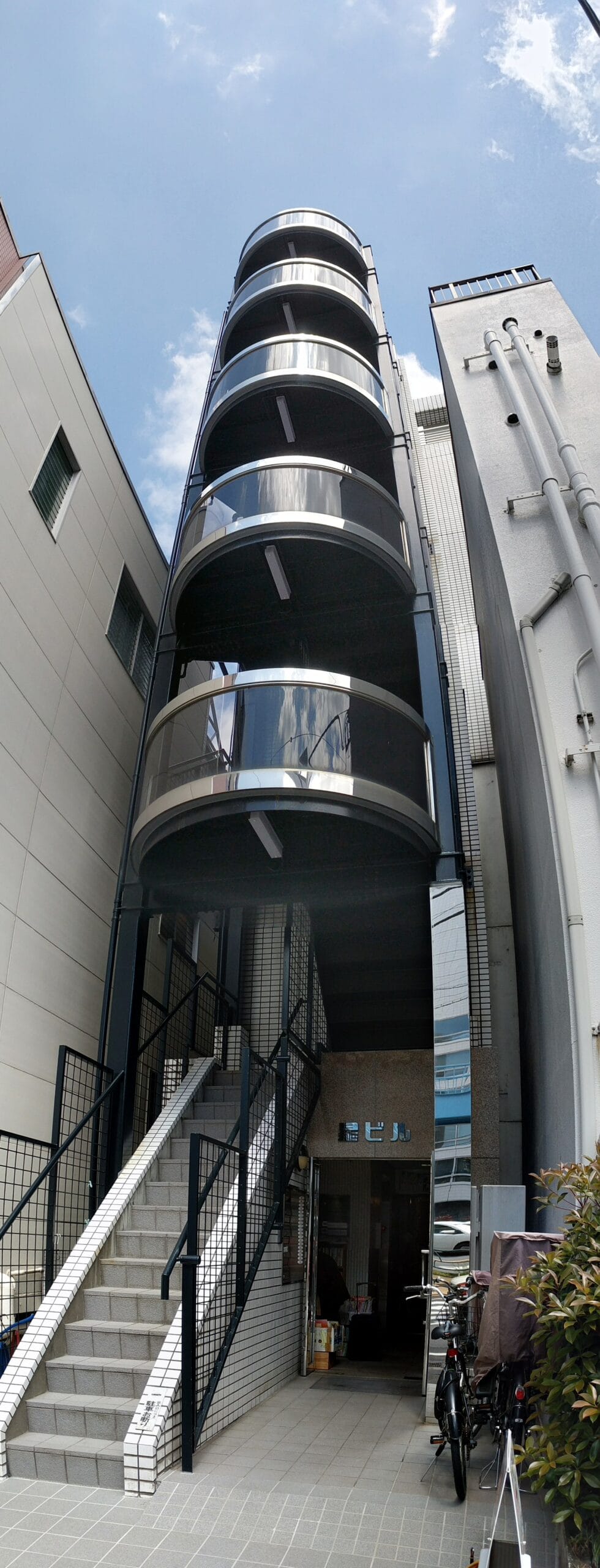
Pet architecture is the name the Tokyo practice Atelier Bow-Wow, founded by Yoshiharu Tsukamoto and Momoyo Kaijima, gave to tiny buildings squeezed into the city’s leftover spaces: triangular corner lots, gaps beside rail lines, slivers left over after road widening. Like pets, they are small, a little humorous and oddly charming. The architects surveyed them in the Pet Architecture Guide Book (World Photo Press, 2001), which shows what a city builds when its planning runs out of room.
Why Tokyo started running out of places to put buildings
Tokyo’s zoning problem isn’t that the planning system failed. It’s that the city predates the planning system, and the gap between the two produced an entirely different category of building.
Japan’s City Planning Law of 1968 imposed formal zoning categories on an urban fabric shaped by decades of inheritance, subdivision, and informal growth. The lots it encountered weren’t clean rectangles. They were triangular corners, narrow wedges beside rail lines, slivers of land left over after road widening: parcels the planning code couldn’t classify as buildable and couldn’t compel to remain empty. The law ran out of instructions at the edges, and the edges were everywhere.
Atelier Bow-Wow was founded in 1992 by Yoshiharu Tsukamoto and Momoyo Kaijima, both Tokyo Institute of Technology graduates, at the start of Japan’s post-bubble economic crisis. Construction had stalled. Rather than wait for commissions that weren’t coming, they started looking at what was already there. That act of looking — systematic, methodical, applied to the city’s most overlooked fabric — was itself an argument: that the most interesting architecture in Tokyo wasn’t being designed by firms with clients. It was being improvised by owners responding to lots that the planning system hadn’t figured out what to do with.
The research began in 1991 from a single observed building: a narrow spaghetti shop inserted into the dead space beneath a rooftop baseball batting centre in Shinjuku. Two programmes stacked by necessity. Neither could have existed on that site alone; together, they worked. From that one building, Tsukamoto and Kaijima went looking for more. They found hundreds.
The result was the Pet Architecture Guide Book, published in 2001 by World Photo Press: a survey of Tokyo’s smallest, strangest, most site-specific buildings. That same year Kaijima, Tsukamoto and Junzo Kuroda published Made in Tokyo through Kajima Institute Publishing, documenting a different category of Tokyo’s unofficial fabric: hybrid-programme buildings that combined functions no planning code had imagined together.
The timing matters. These books didn’t arrive during a period of Tokyo’s architectural confidence. They arrived during its crisis: a moment when the profession had good reason to look at what the city had already built and ask what it was actually saying. Tsukamoto’s own summary of the research direction remains the clearest statement of what they found: “The gap between use and form is very distinct. There is a space which opens at this point, which is always inspiring us,” he told the World Construction Network. That gap — between what the building is supposed to be and what the site forces it to become — is pet architecture’s subject.
The design brands working at the edge of function and form tend to operate from a similar interest in the constraint-driven object. Pet architecture is this at an urban scale: the site as brief, the planning code’s silence as permission.
What the book is actually arguing about cities
The Pet Architecture Guide Book is not a celebration of eccentricity. Flipping through its photographs, axonometric drawings, plans, and brief descriptions of dozens of documented buildings, you might mistake it for a collection of oddities: Tokyo’s architectural cabinet of curiosities. That reading misses the point.
The book’s argument is structural: every city produces architecture outside its own planning system, and that architecture is inevitable, not accidental. Pet architecture isn’t what happens when Tokyo gets weird. It’s what happens when any dense city with irregular inherited lot patterns meets a zoning code written for different conditions. The Tokyo case is extreme in scale. The logic is not Tokyo-specific.
A related term from the companion survey Made in Tokyo, “da-me architecture” (loosely translated as no-good architecture), captures something important about the methodology. These aren’t bad buildings that slipped through the system. They’re buildings that the system produced, buildings whose only honest response to their conditions was to be exactly as small, irregular, and improvised as the site demanded. The da-me designation is affectionate and precise: it acknowledges that these buildings fail every conventional measure of good architecture while insisting that the failure is the point.
Kaijima described the methodology in a 2019 interview with BOMB Magazine: “We’re interested in discovering and extending meanings already contained in what exists.” That formulation, discovering rather than imposing, runs through everything Atelier Bow-Wow did in that first research decade. The survey doesn’t argue that pet architecture is beautiful. It argues that it’s honest.
This positions the Pet Architecture Guide Book as an early contribution to what became a broader shift in architectural discourse toward the informal and vernacular. It anticipated by nearly a decade the conversations that would surround Rem Koolhaas’s work on Lagos, or the academic interest in informal settlements across the global South. But Atelier Bow-Wow’s framing was different: not romantic primitivism about the creativity of poverty, but a technical observation about what planning systems structurally produce when they encounter the city they didn’t plan.
The Memphis Design movement also positioned itself against official good taste, against the assumption that professional design culture defined what counted as valid design. Pet architecture makes a parallel argument at the level of urban fabric rather than designed objects: the planning system’s silence on a triangular lot is not the absence of architecture. It’s an invitation the site accepts on its own terms.
Tsukamoto currently holds a professorship at Tokyo Institute of Technology, where his work continues to explore these questions. Kaijima holds a professorship at ETH Zurich, where her research group operates under the heading of “Architectural Behaviorology,” a term for their sustained inquiry into “functional relationships between behaviour and environment across multiple scales,” as described on the ETH Zurich website.
In 2022, both received the Wolf Prize in Architecture, shared with Elizabeth Diller, with the jury citing their work’s “great sensitivity towards local contexts and the social impact of architecture.” The prize, documented by ArchDaily, noted that their work “highlights the importance to architecture of its ethnographic and inhabitation characteristics.” Kaijima was the third woman ever to receive the Wolf Prize in Architecture, which the prize committee established in 1978.
Five pet architecture buildings that prove the point
The Pet Architecture Guide Book works through documentation, not polemic. The buildings make the argument. Five of them are worth examining specifically.
The spaghetti shop beneath the batting centre
This is the building that started the research. Observed in 1991, it occupies the dead space under a rooftop baseball batting cage: a narrow food counter inserted into a void that wasn’t designed for anything. The two programmes are mutually dependent: the batting centre generates foot traffic that the spaghetti shop captures, and the spaghetti shop makes the site economically viable in a way that would be impossible if only one use were present. It’s a pet architecture type in its purest form: the accident that turns out to be exactly right.
Coffee Saloon Kimoto
A triangular structure with a stated maximum capacity of four customers. The entire programme (kitchen, service counter, seating) is fitted to a site the planning system produced by accident when two streets converged at an angle it never assigned to any use. The building doesn’t adapt the space to the programme; it builds the programme out of whatever the space allows. Four customers is not a failure of ambition. It’s the honest answer to what the lot can hold.
Mini House, Nerima, Tokyo (1999)
Atelier Bow-Wow’s own practice-built response to the conditions they were documenting. Eighty-four square metres across three levels, constructed on a temporary lot slated for freeway conversion: land that was, in planning terms, already spoken for and not yet claimed. The practice took the temporal condition of the site as a design constraint rather than a problem to be solved. It won the Tokyo Architect Society’s Gold Prize. The name references the miniskirt: small, precise, worn with intention.
House Tower, Shinagawa-ku, Tokyo (2006)
Eighteen and a half square metres of building on a forty-two square metre site. The constraint is so extreme that the building has no choice but to think vertically, stacking programme across multiple floors where a different lot would spread it horizontally. What the building gives up in ground coverage it recovers in section. The building is a diagram of what Tokyo’s residential condition actually requires from architects willing to accept the site on its own terms.
Billboard Building (Klein Dytham Architects)
Not part of Atelier Bow-Wow’s survey, and later than it: a Tokyo building by Klein Dytham Architects that takes the same logic into commissioned design, a building only a few metres deep, shaped around the billboard it carries. It shows the leftover-lot condition the Guide Book documented becoming a deliberate architectural brief.
The Scandinavian design tradition’s own relationship to modest domestic scale (the small-house culture, the summer cabin, the carefully proportioned room) addresses some of the same constraints through a different set of historical pressures. Pet architecture addresses them through the pressure of the site itself.
The contrast with the canonical furniture design is worth naming directly. The objects in that canon (the Eames lounge chair, the Barcelona chair, the Tulip table) are designed to be reproducible, exportable, placeless. They work in any room because they were designed for no room in particular. Pet architecture is the opposite: unrepeatable, site-specific, anonymous. No two pet architecture buildings are the same because no two leftover lots are the same. The canonical object aspires to transcend its conditions. Pet architecture accepts them.
Shop the Collection
There is one book to own here: the guide book itself. Listings often call it “Vol. 2” because it was number two in World Photo Press’s Living Spheres series; it is a single book, not the second of two.
- Pet Architecture Guide Book by Atelier Bow-Wow (World Photo Press, Living Spheres series): The primary document, the survey that defined pet architecture and made the structural argument through photographs, drawings, and brief descriptions. If you want to understand what the term actually means, start here rather than with the secondary writing about it.
Further Reading
These two books extend the argument into adjacent territory. Neither is a substitute for the Pet Architecture volumes, but both reward reading alongside them.
- Junzo Kuroda, Momoyo Kaijima and Yoshiharu Tsukamoto, Made in Tokyo (Kajima Institute Publishing, 2001): The companion volume to the Pet Architecture survey, focusing on hybrid-programme buildings, structures that combine uses the planning code never anticipated together. Different typological territory, same methodological rigour. The two projects together are the complete statement of what Atelier Bow-Wow was doing in that first research decade.
- Atelier Bow-Wow, Graphic Anatomy 2 (TOTO Publishing, 2014): The most complete visual document of Atelier Bow-Wow’s built work: axonometric drawings of their buildings at a scale that rewards sustained looking. Not a book about pet architecture per se, but about what happened when the practice turned the same analytical attention it applied to Tokyo’s fabric toward its own designs.
Frequently Asked Questions
What is pet architecture?
Pet architecture is Atelier Bow-Wow’s term for buildings constructed in Tokyo’s leftover urban spaces (triangular lots, gaps beneath elevated highways, narrow strips between buildings) that the city’s planning code neither anticipated nor prohibited. The term was formalized in the Pet Architecture Guide Book (World Photo Press, 2001), which documented dozens of these structures through photographs, drawings, and brief descriptions. The buildings share a common characteristic: their form is determined almost entirely by the shape of the site, with programme fitted to whatever the lot allows.
Where did the term “pet architecture” come from?
Yoshiharu Tsukamoto and Momoyo Kaijima of Atelier Bow-Wow coined the term during research that began in 1991, following the observation of a narrow spaghetti shop occupying the dead space beneath a rooftop baseball batting centre. The “pet” designation suggests something small, domesticated, and perhaps improvised: an affectionate term for buildings that couldn’t survive in a more formally planned environment. The full documentation appeared in the Pet Architecture Guide Book in 2001.
Why does Tokyo have so many pet architecture buildings?
Tokyo’s lot structure predates its modern planning code by decades. Japan’s City Planning Law of 1968 imposed zoning categories on an urban fabric shaped by prewar inheritance patterns, informal subdivision, and irregular growth, producing thousands of parcels too small, too oddly shaped, or too marginal to develop conventionally, but also too numerous to leave empty. Post-bubble economic conditions in the early 1990s, when Atelier Bow-Wow began their research, accelerated the conditions that made these buildings visible: with large-scale construction stalled, the small-scale improvised fabric of the city became easier to see.
How is pet architecture different from regular small-scale architecture?
The difference is the relationship between programme and site. Small-scale architecture typically adapts a site to serve a predetermined programme: you decide what you want to build, then find a lot that can hold it. Pet architecture inverts this: the lot is given, and the programme is whatever the lot can support. The result is buildings where the form is entirely determined by the site’s constraints rather than by any external design intention. In Made in Tokyo, Atelier Bow-Wow used a related term, “da-me architecture,” meaning roughly ‘no-good’, that acknowledges the buildings fail conventional measures while insisting that this failure is structurally honest.
Are there examples of pet architecture outside Japan?
The Pet Architecture Guide Book documents Tokyo buildings only, and the term was coined for Tokyo. But its argument is structural rather than cultural: any dense city with irregular inherited lot patterns will produce buildings of this type. Tokyo is an extreme case in terms of quantity and visibility, not a unique case in terms of underlying logic.
What is the Pet Architecture Guide Book and who wrote it?
The Pet Architecture Guide Book was published in 2001 by World Photo Press, Japan. Its primary authors are Yoshiharu Tsukamoto and Momoyo Kaijima of Atelier Bow-Wow, the Tokyo architecture practice they co-founded in 1992. The book documents dozens of Tokyo micro-buildings through photographs, axonometric drawings, site plans, and brief descriptions. The book appeared as volume 2 of World Photo Press’s Living Spheres series, which is why many listings call it “Vol. 2” and library catalogues date it 2002. It is the published record of the pet architecture research that Tsukamoto and Kaijima began in 1991.
Is pet architecture about houses for pets?
No. Pet architecture means buildings for people that behave like pets: small, odd and tucked into whatever space the city leaves over. Architecture made for animals is a separate subject. The best-known design project of that kind is Architecture for Dogs, organized by Kenya Hara in 2012, for which Atelier Bow-Wow, fittingly, designed a folding ramp that lets a dachshund reach its owner’s eye level.

About Zoe Post
Zoe Post holds a BFA and a Master of Architecture from the School of the Art Institute of Chicago. She now works as a product marketing leader at an architectural product design firm, bringing hands-on industry perspective to everything she writes. At ADI she covers contemporary artists, textile and pattern design, and the design objects that sit at the boundary of art and function.