

Allan Sekula was an American photographer, writer, and theorist who argued that photography had been aestheticized out of usefulness. Working from 1972 until his death in 2013, he built an alternative practice: photography combined with dense analytical text, tracking maritime labor and the global shipping economy that conventional documentary ignored.
What was Sekula actually arguing against?
Photography in the 1970s and 1980s had a problem: it had become respectable. The gallery photograph—silver gelatin, signed, editioned, matted—had achieved the cultural status of painting. That achievement, in Sekula’s view, was a kind of catastrophe. In his 1978 essay “Dismantling Modernism, Reinventing Documentary (Notes on the Politics of Representation),” published in The Massachusetts Review, he named it directly. Photography had retreated into formalism and subjectivism, abandoning its social function in exchange for walls.
His contemporaries in the Pictures Generation—Cindy Sherman, Richard Prince, Sherrie Levine—were working with photography’s cultural codes, manipulating the image as sign. That was a real intervention, but it was not Sekula’s. He was after something different: not the semiotic surface of photographs but their economic conditions. What did it cost to make them? Who benefited from their circulation? What did the practice of photography reveal and what did it systematically hide?
The biography matters here because it was not accidental. Sekula grew up in San Pedro, California (the Port of Los Angeles, one of the largest container ports in North America). His family moved there from Erie, Pennsylvania, in the early 1960s. He was not discovering the port as a metaphor for globalization. He grew up watching it. He trained at UC San Diego, completing his MFA in 1974 under faculty with rigorous Marxist commitments unusual in art schools of that era. The analytical framework he brought to photography came from that formation. He described himself as an “unashamed Marxist” who “consistently invoked the centrality of the labor theory of value,” according to sources collected on Monoskop.
What he was arguing against was photography’s role as ideology: the way documentary photography made labor visible selectively (the heroic face, the weary body, the Dorothea Lange composition) and then dissolved that visibility into aesthetics. The Walker Evans photograph in a museum is no longer about the family it depicts. It is about Walker Evans. Sekula’s position, articulated across essays and developed across three decades of practice, was that this transformation was not a side effect. It was the function.
He extended this argument in “The Body and the Archive” (1986), a foundational essay published in October 39 that traced how photography was deployed as a bureaucratic instrument of social control, specifically Alphonse Bertillon’s criminal identification system and Francis Galton’s eugenicist composite photographs, arguing that the archive is an instrument of power, not a neutral collection of images.
Why the images alone were never the point
There is a common complaint about Sekula’s photographs: they are underwhelming. A factory exterior. A container being lowered onto a ship. A port worker eating lunch. They do not have the compositional authority of Cartier-Bresson. They are not meant to. The underwhelming quality is not a failure of execution. It is an argument about what a photograph is for.
His method was to refuse the pleasures that make documentary photography palatable. The single print, the decisive moment, the image that resolves into meaning when you stop in front of it. All of these are pleasures organized around the act of aesthetic consumption. Sekula’s answer was to work in extended sequences: photographs combined with dense analytical essays, published together as a single work. The book and the exhibition were the unit. The individual print was not.
He called his approach “critical realism,” and the term requires unpacking. It was not socialist realism, which heroizes labor. It was not liberal documentary, which sentimentalizes poverty while leaving its conditions intact. It was materialist analysis of what photography systematically cannot see: the abstraction of capital, the offshore spaces of the global economy, the container box as the mechanism of production’s dispersal. He described the maritime world as “a world of gargantuan automation but also of persistent work, of isolated, anonymous, hidden work, of great loneliness, displacement and separation from the domestic sphere” (theforgottenspace.net). That sentence contains the whole project.
His practice was interdisciplinary in a way that resisted the boundaries that kept the art world comfortable. He worked in photo sequences, critical essays, slide projections, sound recordings, and film. The book was not documentation of the exhibition. It was an equal form, sometimes the primary form. This was a deliberate institutional positioning: he taught at the Photography and Media Program at California Institute of the Arts from 1985 until his death in 2013, not at a journalism school or a sociology department. He was addressing the art world from inside it, which meant his critique could not be dismissed as coming from outside.
His distinction from photographers who worked with photographic codes rather than economic conditions, from contemporaries working within pop art’s engagement with image culture, is worth sitting with. Sherman, Prince, and Levine were asking one question: what does the photographic image do to the thing it represents? Sekula was asking another: what does the photographic industry do to the labor it represents? These are different questions, and the difference produces entirely different bodies of work.
Five works that define the argument
Fish Story (1989–1995)
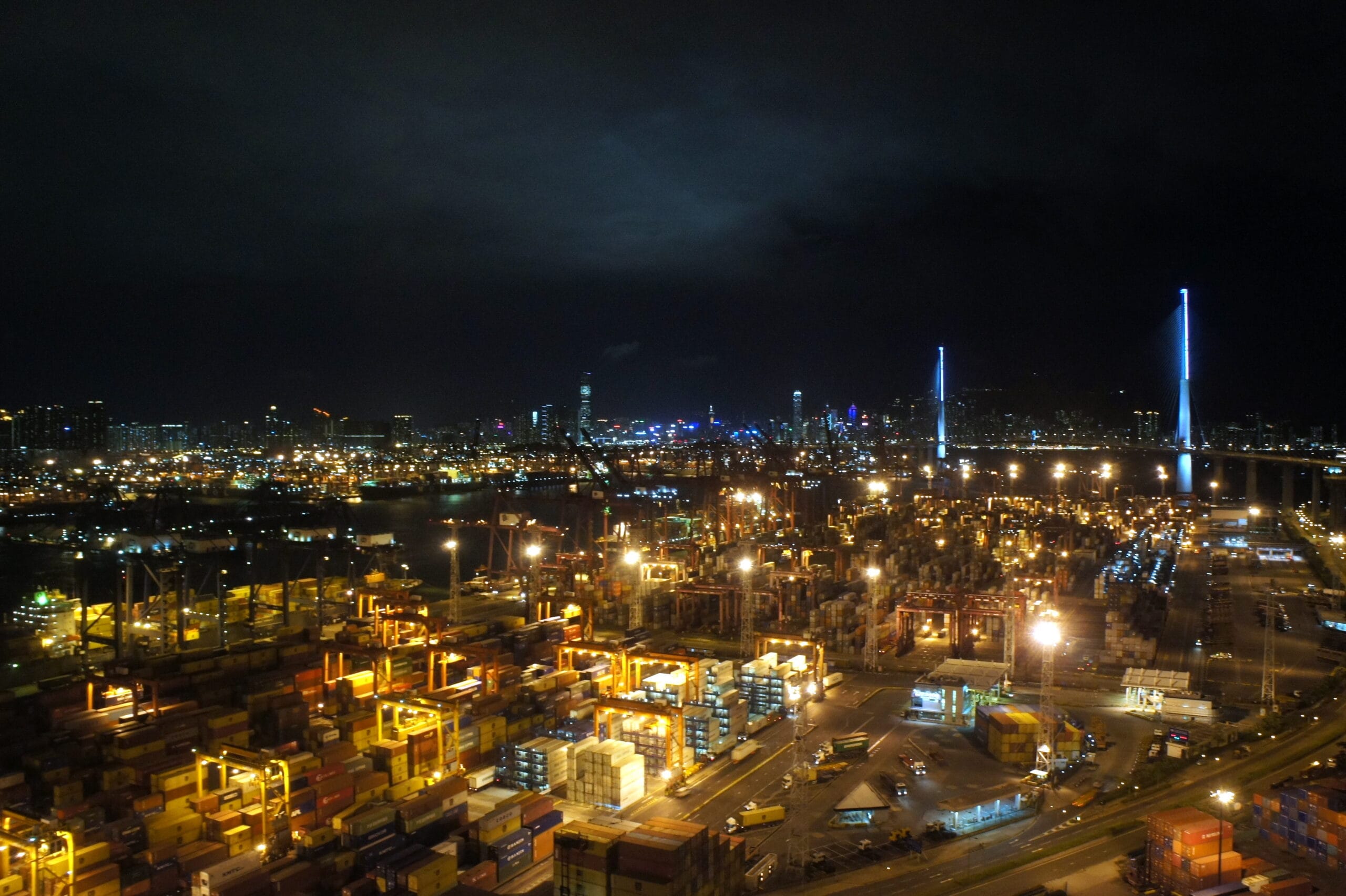
Fish Story is not about ships. This is worth stating plainly because the title suggests otherwise, and the images (container ports in Rotterdam, Los Angeles, Hamburg, and Yokohama) suggest otherwise. The work is about what the global economy looks like when you follow the cargo rather than the money. The container box, invented in the 1950s, made it possible to offshore production across the planet while making the mechanism of that dispersal invisible to most people who benefit from it. Sekula’s seven-chapter work, comprising over 900 color photographs interwoven with analytical essays, makes the infrastructure visible in a form that resists easy consumption.
Originally exhibited in Rotterdam in 1995, Fish Story toured extensively before appearing at Documenta XI in Kassel in 2002, the exhibition curated by Okwui Enwezor that many regard as the moment political art regained its place in the international art world. The work was published by Richter in 1995 and reissued by MACK Books in 2018, which is the edition currently in print.
Photography Against the Grain: Essays and Photo Works, 1973–1983 (1984/2016)
The theoretical foundation. Originally published by the Nova Scotia College of Art and Design in 1984, reissued by MACK Books in 2016, this volume integrates Sekula’s early essays with photo-works into a single argument about what photography is doing and what it should be doing instead. The essays “Photography Between Labor and Capital” (1983) and “Dismantling Modernism, Reinventing Documentary” (1978) are the clearest statements of his critical framework, and they are more accessible as an entry point than Fish Story itself. They’re useful for anyone who needs to understand the argument before encountering it at scale.
The Body and the Archive (1986)
Published in October 39 (Winter 1986): 3–64, and later republished in Richard Bolton’s edited collection The Contest of Meaning: Critical Histories of Photography (MIT Press, 1989), this essay became a fixture on photography history syllabi for a reason. It traced how photography was pressed into service as a tool of bureaucratic classification: Alphonse Bertillon’s criminal identification system, Francis Galton’s composite photographs of supposed “criminal types,” the biometric archive as an apparatus of surveillance and social control. The argument is that the archive does not neutrally collect images. It ranks, sorts, and disciplines the bodies it records. That this essay appeared in October, the journal that defined institutional critique for a generation, tells you where Sekula was being read and by whom.
The Forgotten Space (2010)
Co-directed with Noël Burch, this 112-minute documentary essay visits displaced farmers in Holland, underpaid truck drivers in Los Angeles, Filipino domestic workers in Hong Kong, and shipyard workers in South Korea. Its thesis is that the container box (Sekula’s recurring subject) is one of the most consequential mechanisms of late capitalism’s spread, and that its consequences are legible only if you follow the supply chain in person. The film won the FIPRESCI prize at the Venice Film Festival in 2010 and is distributed by Icarus Films. It is the most accessible entry point into Sekula’s work for viewers who have not encountered his photo-text practice.
Aerospace Folktales (1973)
The earliest major work, and in some ways the one that makes the method clearest. Sekula documented his father’s job at Lockheed, tracking the working conditions, management ideology, and labor relations of the aerospace industry through his own family. The domestic and the industrial are continuous, not separate spheres. The family as entry point into industrial capitalism (the insight that personal experience is not separate from structural analysis but is one form of it) defined everything that followed, including an aesthetic affinity with artists like Karen Kilimnik, who also worked at the intersection of image culture and institutional critique.
Sekula’s archive is held at the Getty Research Institute in Los Angeles, and his work is held in the permanent collections of the Museum of Modern Art, the Guggenheim, and the Centre Pompidou, as documented in institution records.
Shop the collection
Sekula’s books are not companion volumes to his practice. They are the practice. His photographs were designed to be encountered in sequence, interwoven with analytical text, at the scale of a book or an extended exhibition. Owning these volumes is the only way to encounter his argument on its own terms.
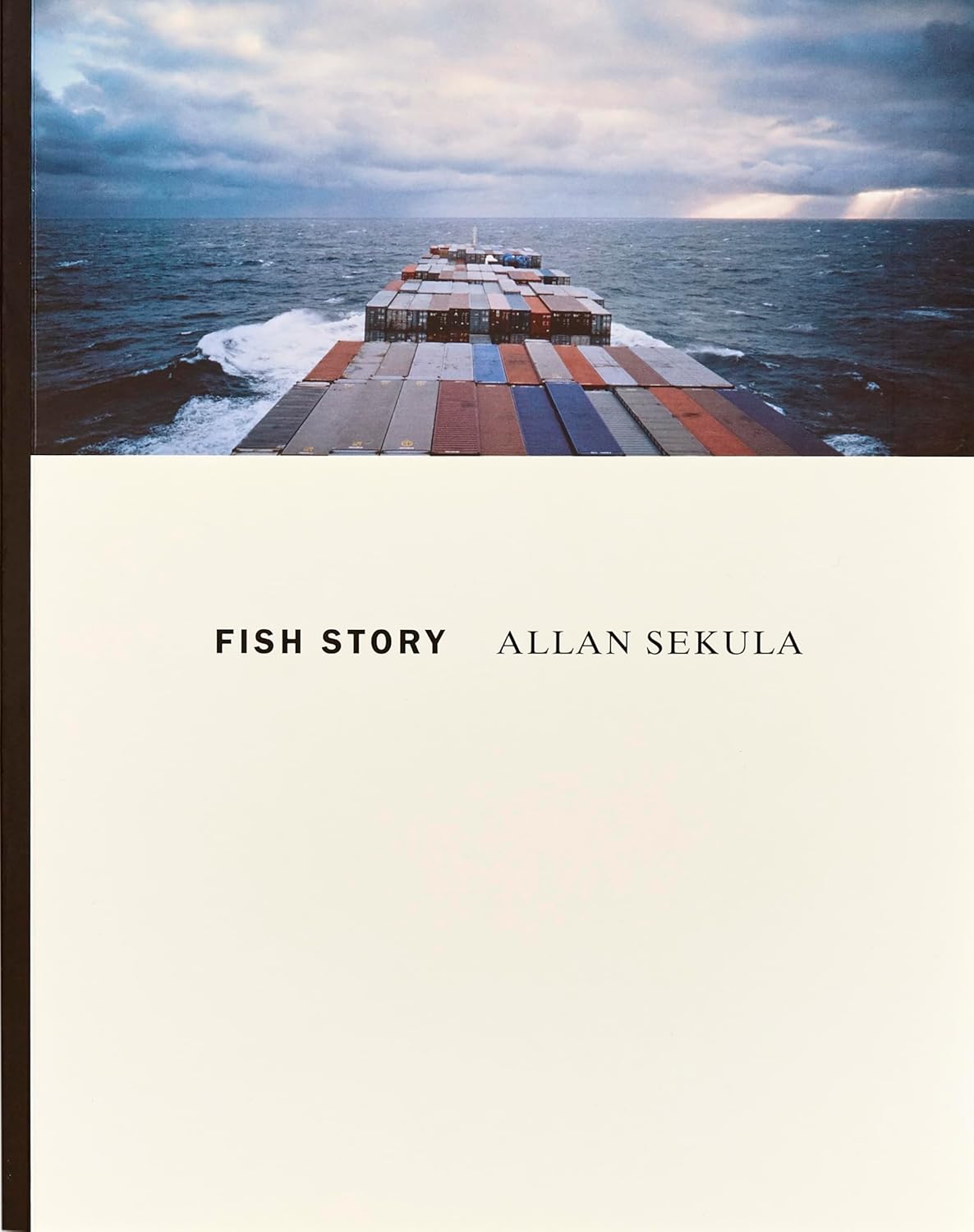
Fish Story by Allan Sekula (MACK Books, 2018): The primary work. 900+ photographs and analytical essays across seven chapters on maritime labor and global shipping. This is not a coffee table book. It is an argument in book form, and no secondary account substitutes for encountering the actual sequencing, pacing, and integration of text and image that makes it work.
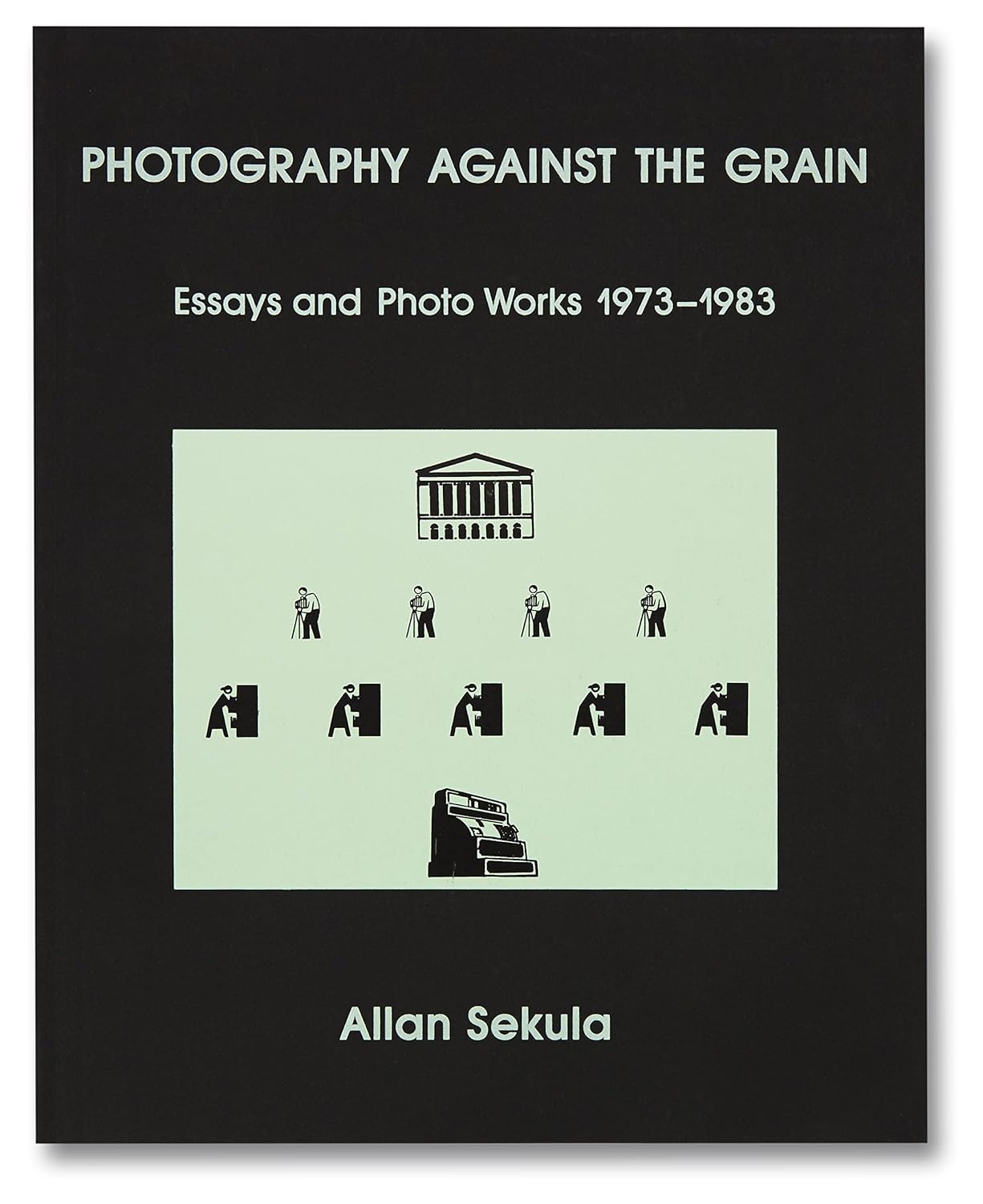
Photography Against the Grain: Essays and Photo Works, 1973–1983 by Allan Sekula (MACK Books, 2016): The theoretical foundation. If Fish Story is the argument at scale, Photography Against the Grain is where Sekula explains what the argument is. The essays “Photography Between Labor and Capital” and “Dismantling Modernism, Reinventing Documentary” remain the clearest statements of his critical framework.
Further reading
These are the three books worth owning for anyone who wants to understand Sekula’s full arc, not just the famous late works. For a broader ecosystem of photography criticism and theory, the photography criticism and theory section has additional recommendations.
Allan Sekula, Fish Story (MACK Books, 2018): The primary source. Read the essays first if the sequence of photographs is disorienting. Then go back and read the whole thing front to back. The argument is in the sequence, not in any individual photograph or any individual essay.
Allan Sekula, Photography Against the Grain: Essays and Photo Works, 1973–1983 (MACK Books, 2016): More accessible as a first entry than Fish Story. “Photography Between Labor and Capital” in particular rewards close reading. It is both a critique of existing documentary practice and a blueprint for what Sekula went on to build.
Allan Sekula, Dismal Science: Photoworks 1972–1996 (Illinois State University Museum, 1999): The definitive mid-career survey. Seven major projects with critical essays, useful for seeing the full arc from the early performance-based work through the mature maritime sequence. Out of print but findable, and worth the effort. The essays commissioned for this catalog are among the most useful secondary readings on Sekula’s method.
Frequently asked questions
What is Allan Sekula known for?
Sekula is known for Fish Story, a seven-chapter photo-text work on maritime labor and the global shipping economy completed between 1989 and 1995, and for a body of critical essays, particularly “The Body and the Archive” (1986) and “Dismantling Modernism, Reinventing Documentary” (1978), that became core texts in photography history courses. He taught at California Institute of the Arts from 1985 until his death in 2013.
What is Fish Story about?
Fish Story uses 900+ color photographs and analytical essays to examine containerized shipping and port labor across Rotterdam, Los Angeles, Hamburg, and elsewhere. Its argument is that the global economy is organized around a deliberately invisible infrastructure—the container shipping network—and that conventional photography, by aestheticizing what it depicts, has been complicit in that invisibility. The work was originally exhibited in Rotterdam in 1995 and appeared at Documenta XI in 2002.
How did Sekula use photography differently from documentary photographers?
Conventional documentary photography (Dorothea Lange, Walker Evans, the FSA tradition) isolated the compelling image and presented it as evidence of social conditions. Sekula’s critique was that this process aestheticized poverty and labor while leaving their structural causes intact. His response was to refuse the single image as the unit of argument. He worked in extended sequences, integrating photographs with dense analytical text into books and exhibitions that could not be reduced to a memorable print.
Why did Sekula focus on the sea and maritime labor?
Partly biography. He grew up in San Pedro, California, adjacent to the Port of Los Angeles, and watched container shipping from childhood. But his argument was also theoretical: maritime labor is one of the most consequential and least visible sectors of the global economy. The container box, invented in the 1950s, enabled the offshoring of manufacturing that restructured labor worldwide. Sekula’s claim was that the sea remained the central space of globalization, and that it had been made invisible by the same mechanisms (automation, abstraction, distance) that made global capitalism function.
What is Photography Against the Grain about?
Photography Against the Grain (originally Nova Scotia College of Art and Design, 1984; reissued MACK Books, 2016) collects Sekula’s early essays and photo-works into a single argument about photography’s social function. The two anchoring essays, “Photography Between Labor and Capital” (1983) and “Dismantling Modernism, Reinventing Documentary” (1978), critique both aesthetic modernism and liberal documentary as forms of photography that aestheticize their subjects while claiming to reveal them. The book is the theoretical foundation for everything Sekula did afterward.
Where is Sekula’s work held today?
Sekula’s archive is held at the Getty Research Institute in Los Angeles. His work is in the permanent collections of the Museum of Modern Art in New York, the Solomon R. Guggenheim Museum, and the Centre Pompidou in Paris. He died on August 10, 2013, in Los Angeles, from gastric-esophageal cancer, at age 62.

About Joe Post
Joe Post holds an MFA in Art from California Institute of the Arts (CalArts) and has done additional graduate work at the School of the Art Institute of Chicago. He founded Art Design Ideas to write about design as cultural argument — the decisions, contradictions, and assumptions built into the objects we live with.