
The largest equestrian statues in the United States range from Civil War memorials to contemporary bronze monuments, each measuring between 17 and 36 feet. This is a survey of the most significant by scale and artistic ambition, ranked, placed in context, and assessed as works of public sculpture rather than mere civic furniture.
Why Americans built so many horse statues, and what they were actually saying
The equestrian monument is a political form. It has been since Marcus Aurelius sat on his bronze horse in Rome in the second century, and every subsequent rider (every general, every king, every colonial governor) inherited that claim. In the United States, the form arrived in earnest in 1852, when Clark Mills cast Andrew Jackson for Lafayette Square in Washington, DC. It was the first equestrian statue in the world balanced solely on the horse’s hind legs, a technical achievement that was simultaneously a compositional argument: Jackson rearing up, commanding space, requiring the viewer to look up.
That grammar (viewer below, rider above) is the foundational statement of the American equestrian monument. Henry Kirke Brown’s George Washington followed in New York City in 1856, Thomas Crawford’s in Richmond, Virginia in 1858. Within a decade, the form had become the default language for commemorating military authority. Washington, DC accumulated more equestrian statues than any other American city, a density that reflected less about the quality of the commemorated figures than about the city’s function as a site for producing civic ideology.
The Beaux-Arts tradition, which dominated American monumental sculpture from the 1880s through the 1920s through institutions like the National Sculpture Society (founded 1893), gave the form its American accent: naturalistic rendering, dramatic physicality, surfaces that rewarded close inspection. Donald Martin Reynolds, in Masters of American Sculpture: The Figurative Tradition from the American Renaissance to the Millennium (Abbeville Press, 1993), documents how thoroughly the National Sculpture Society controlled commissions during this period, shaping both who got commemorated and how the commemorating was done.
One piece of received wisdom about these statues deserves attention, because it is entirely false: the idea that a horse’s leg position encodes the rider’s fate. The legend holds that two hooves raised means the rider died in battle, one raised means died of wounds, all hooves down means died of natural causes. Snopes rates this FALSE, PolitiFact concurs, and historian surveys of Washington, DC show only roughly one-third of the equestrian statues follow any such pattern. Sculptor Gary Casteel was direct about it: “Gettysburg artists didn’t employ any secret symbolism when they created their works. They just wanted the technical challenge of getting two feet off the ground, or the aesthetic impression of a single raised hoof” (quoted in Nations Classroom Tours). The persistence of this myth matters, though. It reveals how badly the public wants monuments to have a hidden grammar, to mean something beyond their literal surface. The statues themselves don’t offer that. So the public invents it.
What scale does to a horse: why the numbers matter
There is a version of this survey that treats scale as a ranking system, the bronze equivalent of a sports table in which 36 feet beats 24 beats 17. That version misses what scale actually does.
A 36-foot horse doesn’t invite contemplation. It demands subordination.
A 5-foot horse on a 3-foot pedestal is an object you approach and examine. An 8-foot horse on a 10-foot pedestal changes the angle: you look up, the rider looks past you, and the geometry of the encounter encodes a relationship. A 36-foot horse with no pedestal at all does something else entirely: it reorganizes the space around it. Your body becomes a unit of measurement. You are no longer a viewer examining a sculpture; you are a figure in the landscape that the sculpture defines.
The technical problems of large-scale equestrian bronze are inseparable from these spatial effects. Nina Akamu’s American Horse, at 24 feet and 15 tons, balances on two rear legs with a 3-ton stainless steel armature built to withstand seismic activity. The engineering is not separate from the art; it is the art. The rearing posture, the sense of arrested motion, the way the mass of the horse appears to float: all of this depends on engineering decisions that Akamu made in direct dialogue with the structural demands. The Oñate statue in El Paso, at 36 feet and 34,000 pounds, presents a different engineering proposition entirely. There, the sheer mass of the figure is itself the statement.
The shift in equestrian monument subjects across eras tracks this. Civil War generals required a certain kind of scale: commanding, above the viewer, asserting authority. Cyrus Edwin Dallin’s series of Native American riders (four sculptures made between 1890 and 1912, culminating in Appeal to the Great Spirit in Boston) used the same compositional grammar to very different ends, placing figures who were being displaced at the center of a form historically reserved for the displacing. Robert Glen’s Mustangs of Las Colinas (1984) abandoned the single-rider-on-pedestal formula entirely, replacing the political hero with nine horses in collective motion, subordinating no viewer to any human claim.
The riderless horse is the most radical move in this formal history. When the rider disappears, the political grammar of the form collapses. What remains is the horse: the question of what a horse means in public space when it is no longer carrying anyone’s authority. This is where Nina Akamu’s work becomes genuinely interesting, and it is where sculpture in the age of doubt has most directly shaped contemporary monumental practice.
The statues, ranked: scale, sculptor, and what each one argues
1. The Equestrian (Juan de Oñate), El Paso, TX, 36 ft, John Sherrill Houser, 2006
The largest equestrian bronze statue in the world stands in El Paso, Texas, at the intersection of two claims that the work refuses to reconcile. John Sherrill Houser and his son Ethan Taliesin Houser spent years on the figure, which was installed in September 2006 and dedicated April 21, 2007 as part of El Paso’s XII Travelers Memorial series, a thirteen-monument program commemorating 400 years of regional history. The statue weighs 34,000 pounds and sits on an eight-foot cement base, bringing the total height to 44 feet.
Juan de Oñate was a colonial governor of New Mexico in the late sixteenth century. He is celebrated by some as a founding father of the region; he is condemned by others as the man responsible for the Acoma Massacre of 1599, in which hundreds of Pueblo people were killed and survivors were subjected to amputation and enslavement. In January 1998, shortly before the work was commissioned, a group calling itself “Friends of Acoma” sawed off the right foot of an existing bronze Oñate statue in Alcalde, New Mexico, leaving a note: “Fair is Fair.” During the summer 2020 protests, demonstrators in Albuquerque demanded the removal of a different Oñate statue; police opened fire.
The El Paso statue survived these waves. But the scale is itself a position. A 36-foot monument to a contested figure is not neutral: it insists on the claim. Size is a political argument. The Housers made a formally accomplished piece of public sculpture, and the culture around it is working out whether formal accomplishment is sufficient.
2. Crazy Horse Memorial, Black Hills, SD, planned 563 ft × 641 ft, Korczak Ziolkowski, begun 1948
The Crazy Horse Memorial is the largest planned equestrian monument in the world, and by an enormous margin: 563 feet tall, 641 feet wide, carved from Thunderhead Mountain in the Black Hills of South Dakota. It is not finished. As of 2022, no completion timeline exists; the hand, arm, and shoulder section is estimated for 2037.
Korczak Ziolkowski (1908–1982) began blasting on June 3, 1948, having been commissioned by Lakota elder Henry Standing Bear specifically to create a counter-monument to Mount Rushmore. The geometry is deliberate: Rushmore commemorates four presidents; Crazy Horse commemorates the people those presidents displaced. Ziolkowski died in 1982, and his family has continued the work.
The Crazy Horse Memorial exists in genuine tension with itself. It is a Native American counter-monument built by a Polish-American sculptor, financed partly by tourist admissions, operating outside federal control, on land whose ownership the Lakota Nation continues to dispute. That the work is unfinished is not incidental to its meaning; it is the meaning. Where Rushmore declared permanence, Crazy Horse declares ongoing process. The incompleteness is the argument.
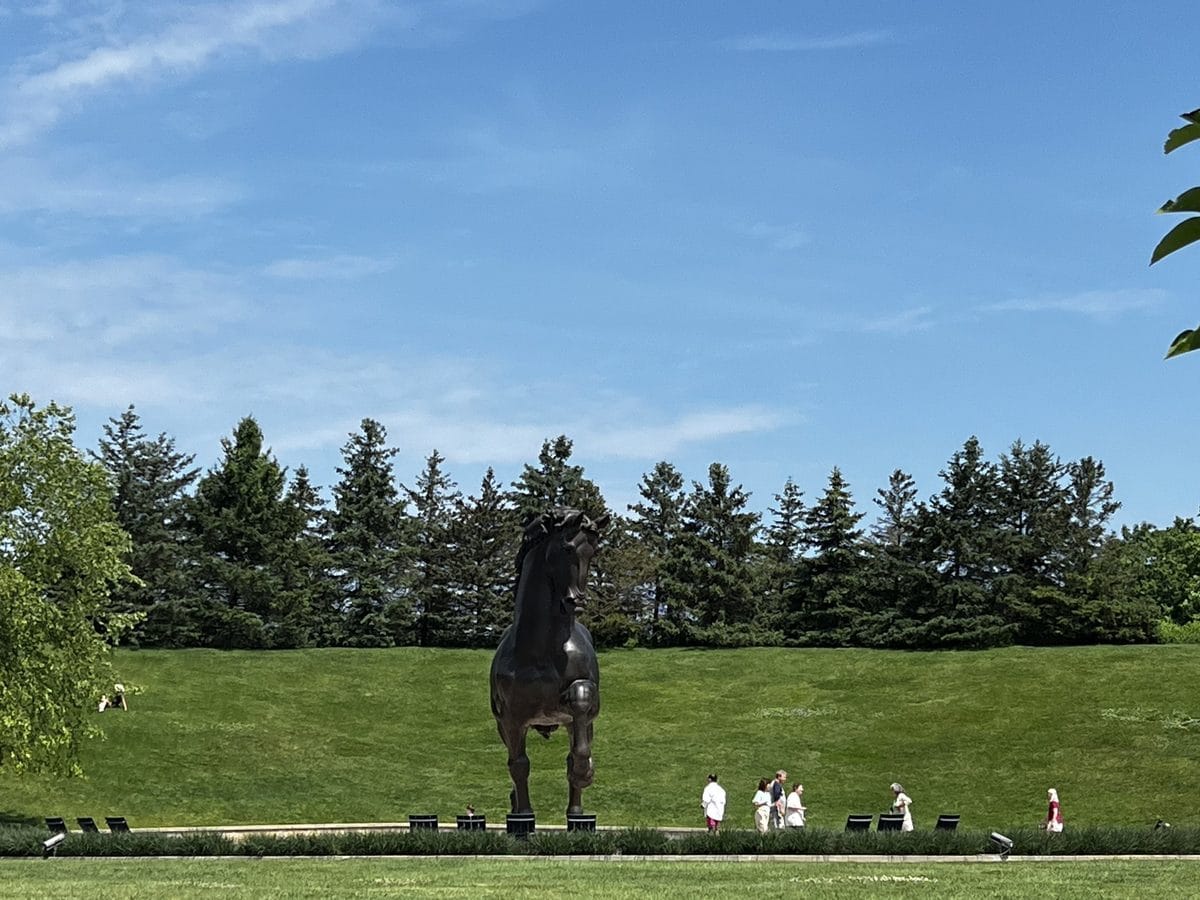
3. The American Horse, Grand Rapids, MI, 24 ft, Nina Akamu, 1999
What Nina Akamu chose not to do is the starting point for understanding The American Horse. She chose not to put a rider on it. In a form defined since antiquity by the relationship between horse and rider (the horse as extension of human authority, as vehicle for political power) she made a horse that carries no one. The pedestal is empty. The authority function of the form is simply absent.
The riderless horse refuses the political grammar of the equestrian form, and in doing so, puts the horse itself, for perhaps the first time in monumental history, at the center of the argument.
The choice connects directly to the work’s origin. The American Horse is Akamu’s realization of Leonardo da Vinci’s Gran Cavallo, the colossal equestrian monument Leonardo designed in 1482 for Ludovico Sforza, Duke of Milan, and never completed. Leonardo’s studies show a horse without a rider in many configurations. The rider was always the next problem, and it was never solved. Akamu took Leonardo’s horse-as-subject and made it the subject again, five centuries later. Two casts were produced: one installed October 7, 1999 at Frederik Meijer Gardens & Sculpture Park in Grand Rapids, and one for Milan, Italy, where Leonardo’s original commission was placed. For local search purposes, this Grand Rapids cast is the Cavallo most visitors mean.
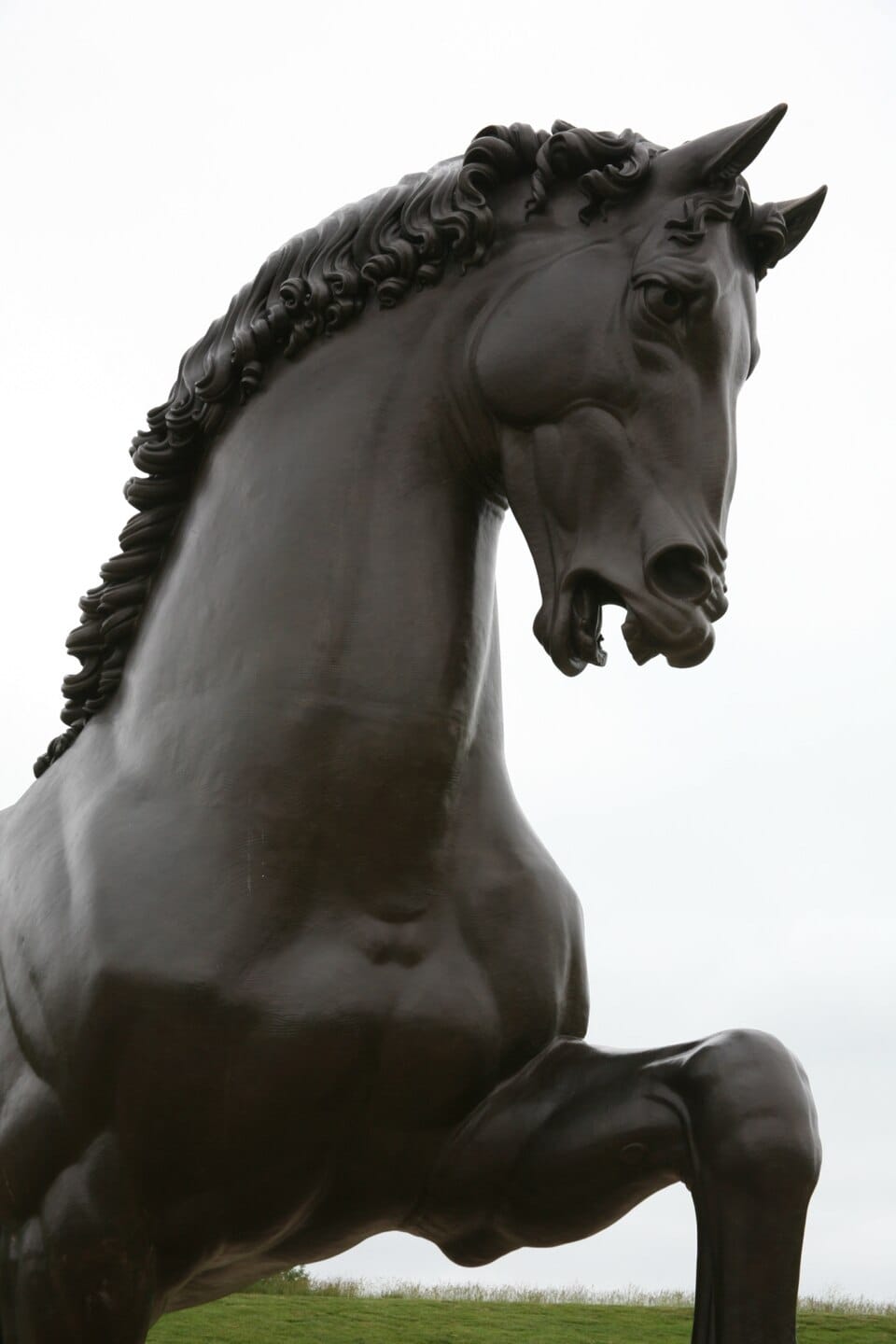
The engineering behind The American Horse deserves naming as an artistic decision. At 24 feet and 15 tons, balanced on two rear legs, built to withstand seismic loads on a 3-ton stainless steel armature, the structure required Akamu to solve the same problem Leonardo avoided: how does a massive bronze horse suspend 15 tons in a rearing posture without visible support? The answer is internal, invisible, and structural. The surface reads as pure form. For the full profile of this work and its connection to the new genre public art lineage, see the ADI cornerstone on The American Horse and the Frederik Meijer Gardens & Sculpture Park.
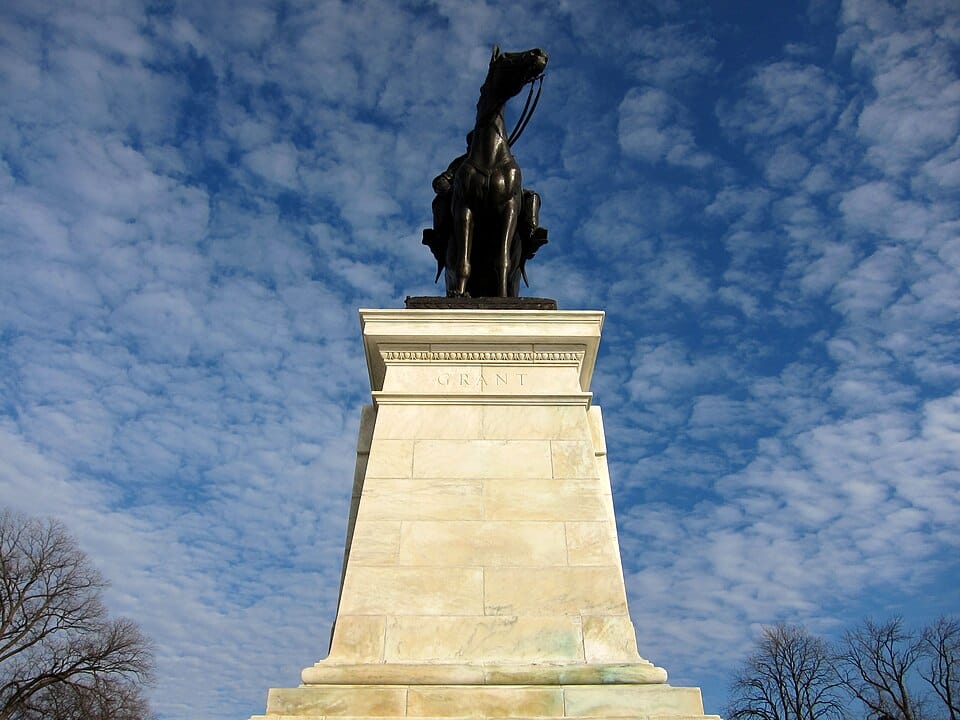
4. Ulysses S. Grant Memorial, Washington, DC, 17 ft 2 in, Henry Merwin Shrady, 1922
Henry Merwin Shrady won the commission for the Grant Memorial in 1902 at 29 years old, with no prior monumental work. He spent the next 20 years on it: the equestrian figure of Grant on his horse Cincinnati, the cavalry and artillery groups flanking the central platform, the 252-foot-by-71-foot Vermont marble base. He died in April 1922, two weeks before the May 30 dedication. The figure of Grant is 17 feet 2 inches and 10,700 pounds, mounted on a 22.5-foot marble pedestal at the base of Capitol Hill.
What Shrady built was a refusal of the theatrical. Grant sits on Cincinnati with no drawn sword, no dramatic gesture, no sense of performance. The coat is rumpled. The seat is practical. Against the backdrop of Beaux-Arts monumental sculpture (Saint-Gaudens’s gilded Sherman, French’s bombastic Lincoln) Shrady’s Grant is almost anti-monumental: a man who happened to win the Civil War by being better at logistics than everyone else, rendered in bronze with the same quality of stillness that his contemporaries described in his actual bearing.
The Architect of the Capitol maintains the Grant Memorial, which remains the largest equestrian statue in the United States by the most commonly cited measure, though the Oñate statue in El Paso has the larger actual dimension.
5. General William Tecumseh Sherman Monument, New York City, 24 ft, Augustus Saint-Gaudens, 1903
Augustus Saint-Gaudens worked from a sketch he made in 1888 for 16 years before the Sherman Monument was dedicated at Grand Army Plaza, Manhattan, in 1903. Sherman on horseback is led by Nike (Victory), gilded bronze, the goddess modeled in part on Harriette “Hettie” Anderson, an African-American woman from Georgia whose face Saint-Gaudens considered the finest he had found for the figure.
The gilded surface was contentious. Against the green of Central Park, it read as theatrical. It was technically unprecedented in American monumental bronze: a full patinated bronze figure, then gilded, producing a surface that catches light differently across the day. Saint-Gaudens did not live to see its reception settle; he died in 1907. The Central Park Conservancy documents the monument as one of the most significant public sculptures in New York City, and the NYC Parks Department records the 1903 dedication date. The gilding was the last major formal decision Saint-Gaudens made, and it is the one that most unsettles the viewer who expects bronze to be brown.
6. Appeal to the Great Spirit, Boston, MA, Cyrus Edwin Dallin, 1912
Cyrus Edwin Dallin (1861–1944) made four equestrian sculptures of Native American figures between 1890 and 1912, a series he called the “Epic of the Indian”: A Signal of Peace (1890), The Medicine Man (1899), Protest of the Sioux (1904), and Appeal to the Great Spirit (1912). The last was cast in bronze in Paris and placed in front of the Museum of Fine Arts, Boston.
The placement is the argument. The MFA holds significant collections of Native American material culture, objects removed from the communities whose members Dallin was representing in bronze. The figure faces the street: arms spread, facing skyward, on a horse whose stillness contrasts with the open posture of the rider. It is an image of petition. Whether the MFA’s placement of this figure as a kind of entrance greeting is a gesture of acknowledgment or a continuation of the same appropriative logic the museum otherwise embodies is a question the institution has been asked explicitly, and has answered only in the vaguest terms. The work is genuinely moving as sculpture. Its location raises questions the sculpture itself cannot answer.
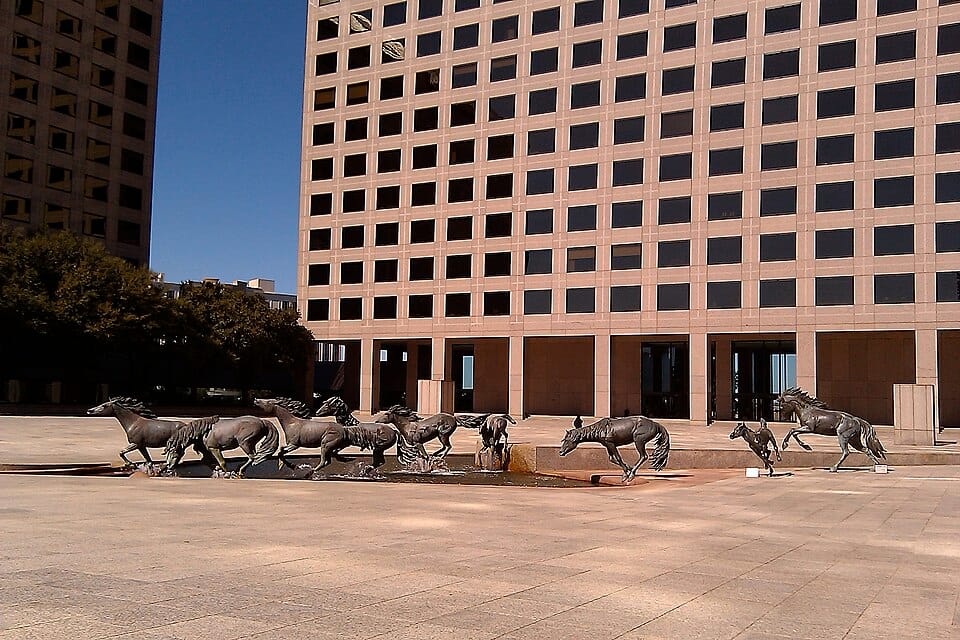
7. Mustangs of Las Colinas, Irving, TX, nine horses at 1.5x life size, Robert Glen, 1984
Robert Glen, born in Kenya in 1940, received the commission for the Mustangs of Las Colinas in 1976 and cast the nine horses in his studio in Nairobi, completing the installation at Williams Square in 1984. Each horse is approximately 1.5 times life size, roughly 56 to 60 inches at the shoulder, which means none of them qualifies as a large-scale equestrian monument by the measures used for the rest of this list. They appear here because the work refuses the entire grammar of the form in a way that deserves attention.
There is no rider. There is no pedestal. There is no single horse: there are nine, in full gallop across a 1.3-acre granite plaza with working fountain jets simulating a river crossing. The viewer does not stand before the work; the viewer stands inside it. The horses cross in every direction, and the scale (not monumental but immediate) creates the sensation of being in the middle of a crossing rather than observing one from a safe distance. The piece is the spatial antithesis of the single-rider-on-pedestal monument, and its public popularity (it remains one of the most visited public sculptures in Texas) suggests that the public finds something more compelling in that spatial model than in the commemorative grammar it replaced.
Shop the Collection
These two pieces work at domestic scale, which is the only way to live with the equestrian form at home. The contrast with the statues above is part of the point: a 36-foot bronze and a 10-inch resin piece are both arguments about the horse as object, separated by four orders of magnitude.
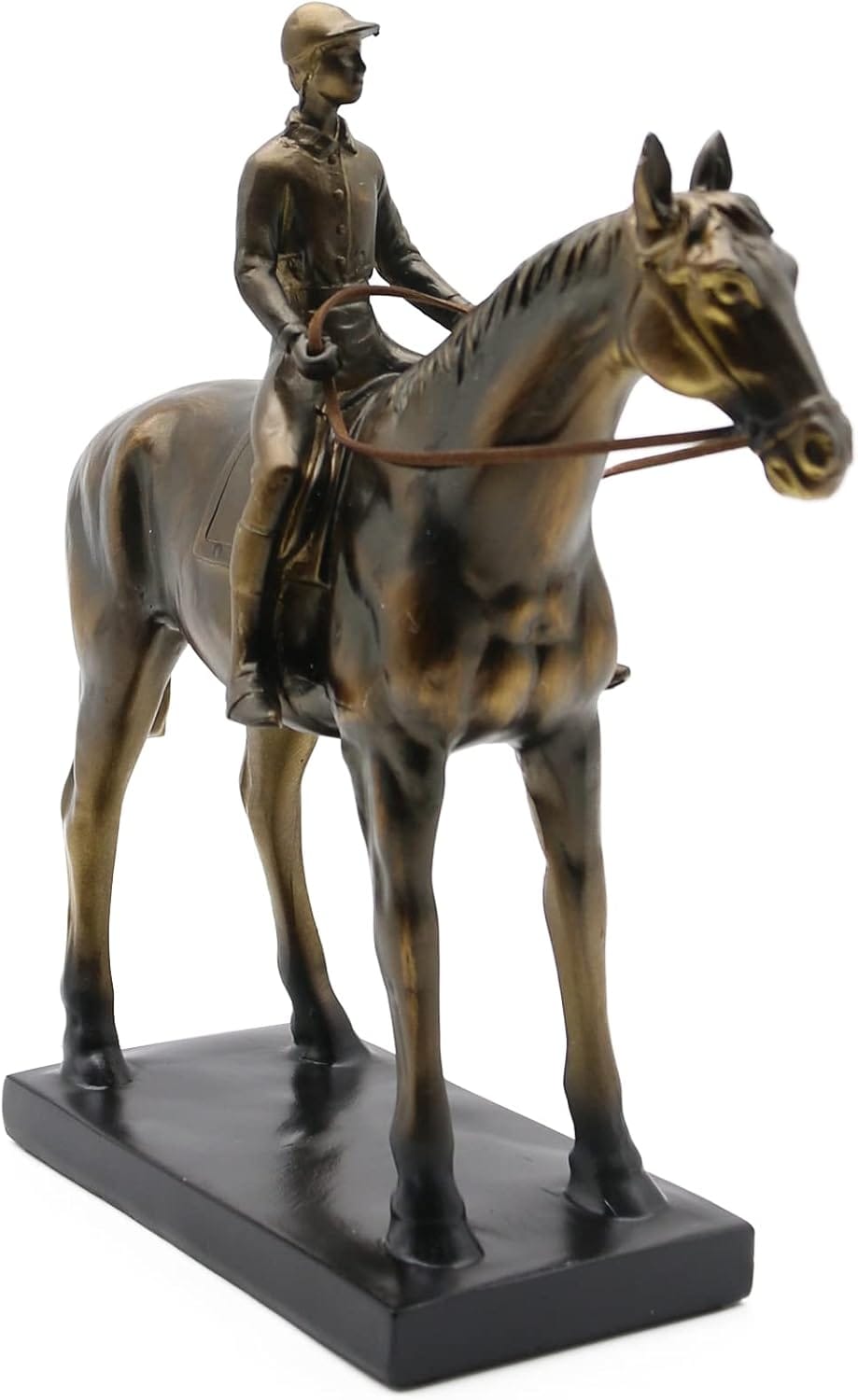
Lukitas Equestrian Horse Rider Figurine (10.5 in, resin)
A tabletop-scale equestrian piece for readers who want the form in domestic space; the contrast between a 36-foot Oñate and a 10-inch desk piece is not trivial. It is a different argument about what the form does at human scale.
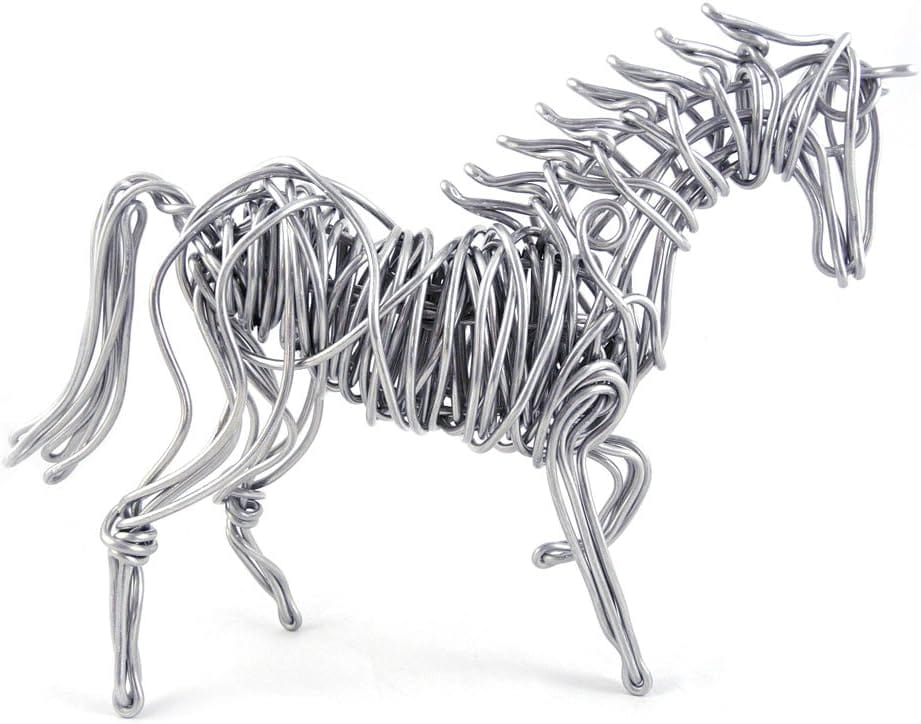
Contemporary Aluminum Wire Horse Sculpture (Modern Artisans, 18–20 in)
The open wire form inverts everything a bronze monument does: mass replaced by line, permanence by lightness, opacity by transparency. A useful counterpoint for readers who want the equestrian subject without the monumental vocabulary.
Further Reading
These three books take the subject seriously as scholarship, not as coffee-table browsing. Owning them is different from reading them once.
- Donald Martin Reynolds, Masters of American Sculpture: The Figurative Tradition from the American Renaissance to the Millennium (Abbeville Press, 1993): The only comprehensive survey of the tradition that produced most of the statues in this article; Reynolds covers equestrian monuments, the Beaux-Arts inheritance, and Native American subjects in sculpture with academic rigor and contextual specificity. This is the backbone.
- Walton Rawls, ed., A Century of American Sculpture: Treasures from Brookgreen Gardens (Abbeville Press, 1988): Brookgreen Gardens in South Carolina is the largest outdoor sculpture garden in the United States, and this catalog documents sculptors who overlap directly with the subjects of this article, including Anna Hyatt Huntington and Paul Manship. The book is a living collection’s argument for what American figurative sculpture was doing.
- Tamsin Pickeral, The Horse: 30,000 Years of the Horse in Art (Merrell, 2006): The broadest possible context, from prehistoric cave paintings through Stubbs, war horses, and contemporary sculpture. For readers who want to understand the equestrian form’s full genealogy, not just the American chapter of it.
Frequently Asked Questions
What is the largest equestrian statue in the United States?
The most commonly cited answer is the Ulysses S. Grant Memorial equestrian figure in Washington, DC: 17 feet 2 inches, sculpted by Henry Merwin Shrady and dedicated in 1922. The Oñate statue in El Paso, Texas (36 feet, completed 2006) is technically larger, but the Grant answer dominates existing documentation because it predates the El Paso claim by 84 years.
What is the biggest equestrian statue in the world?
The Genghis Khan equestrian statue at Boldog, Mongolia, currently holds the record among completed equestrian monuments at 40 meters (approximately 131 feet). The Oñate statue in El Paso, Texas, is the world’s largest equestrian bronze specifically, at 36 feet. The Crazy Horse Memorial in the Black Hills, South Dakota, planned at 563 feet tall, will surpass both by an enormous margin when completed, but as of 2022 carries no completion timeline.
Who sculpted the Grant Memorial in Washington DC?
Henry Merwin Shrady, with architect Edward Pearce Casey. Shrady won the commission in 1902 at 29 years old, with no prior monumental sculpture on his record, and spent the next 20 years on the project. He died in April 1922, two weeks before the May 30 dedication ceremony.
Why does The American Horse at Meijer Gardens have no rider?
Nina Akamu’s decision was deliberate and connects directly to the work’s origins. The American Horse is her realization of Leonardo da Vinci’s Gran Cavallo, the colossal equestrian monument Leonardo designed in 1482 for the Duke of Milan and never completed. Leonardo’s studies consistently show a horse without a rider; the rider was always the unresolved next problem. Akamu took Leonardo’s premise and completed it on its own terms: the horse as subject, not as vehicle. The riderless form strips the equestrian monument of its political function, removing the authority being commemorated and the hierarchy being encoded, and returns the animal to its own presence.
Is the hoof position on a horse statue a code for how the rider died?
No. This is a persistent myth with no historical basis. Snopes rates it FALSE, PolitiFact concurs, and surveys of Washington, DC equestrian statues show only roughly one-third follow any pattern at all. Sculptor Gary Casteel addressed it directly: ‘Gettysburg artists didn’t employ any secret symbolism when they created their works. They just wanted the technical challenge of getting two feet off the ground, or the aesthetic impression of a single raised hoof’ (quoted in Nations Classroom Tours). The appeal of the myth is real, but the sculptors were solving engineering and aesthetic problems, not encoding death-mode metadata.
Where can I see the Mustangs of Las Colinas?
Williams Square, Las Colinas Urban Center, Irving, Texas. The sculpture occupies a 1.3-acre granite plaza and is accessible as part of a public space. The adjacent Mustangs of Las Colinas Museum provides interpretive context. The horses are a live fountain installation; the water jets that simulate a river crossing are operational during regular public hours.

About Joe Post
Joe Post holds an MFA in Art from California Institute of the Arts (CalArts) and has done additional graduate work at the School of the Art Institute of Chicago. He founded Art Design Ideas to write about design as cultural argument — the decisions, contradictions, and assumptions built into the objects we live with.