
The Panton Chair is the world’s first single-piece cantilevered plastic chair, designed by Danish designer Verner Panton in 1960 and manufactured by Vitra since 1968. Conceived in the late 1950s as a challenge to furniture’s reliance on four legs, it became a touchstone of postwar design optimism and is still in production today.
What Verner Panton was arguing against when he designed the Panton Chair
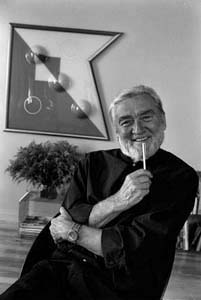
Verner Panton trained at Arne Jacobsen’s firm from 1950 to 1952. The timing matters. He arrived at an office that was refining what Danish design had made itself: careful joinery, organic forms derived from the body, wood and steel combined with uncommon grace. Jacobsen was producing the Ant Chair during those years: a stacking plywood shell on slender steel legs, as close to weightlessness as the available materials allowed. Panton watched and learned and then departed to build something that Jacobsen had no interest in building.
In 1955, Panton founded his own studio in Basel. He was twenty-nine and had a specific argument to make. The four-legged chair, in every idiom it had taken, from the Windsor chair to the tubular steel chairs of the Bauhaus to Jacobsen’s own bent-plywood pieces. All of them assumed that furniture required structure that was visible and separate from the seat itself. The legs held the seat up. The seat sat on the legs. The relationship was explicit. Panton thought this was a convention, not a necessity.
His first recorded step toward a single-form chair was a 1956 competition sketch submitted to WK-Möbel for a chair he called the S Chair — a single sinuous piece of plywood in S-form. The body of the chair did all the structural work by curving load through material rather than down through legs, as documented in Artsy’s editorial archive on the S Chair’s design lineage. The S Chair was a sketch, not a production object. But it established the direction.
By 1960, working with the Danish fabricators Dansk Akrylteknik, Panton had produced the first plaster-cast model of what would become the Panton Chair. The chair was designed for industrial mass-production in plastic, a material that didn’t exist in the necessary form until the post-war petrochemical expansion made it available at scale. He wasn’t adapting an existing chair-making tradition to a new material. He was waiting for a material that would let him make an argument.
He wasn’t adapting an existing chair-making tradition to a new material. He was waiting for a material that would let him make an argument.
The chair had a long road to production. Panton met Willi Fehlbaum of Vitra in the mid-1960s, and they began prototyping in cold-pressed fibreglass-reinforced polyester. The chair was publicly presented in August 1967 at an exhibition in Germany. Serial production began in 1968. It had taken twelve years from the S Chair sketch to a manufactured object.
Why removing the legs changed everything
The Panton Chair belongs to the same postwar conversation that produced the Barcelona Chair and the Wassily Chair. What those chairs share is a material argument: Mies asked steel and leather to define a modern throne; Marcel Breuer asked tubular steel to dissolve the weight of furniture into line. Panton’s move was more extreme. He didn’t reduce the material. He asked a single pour of plastic to carry the entire structural and aesthetic argument.
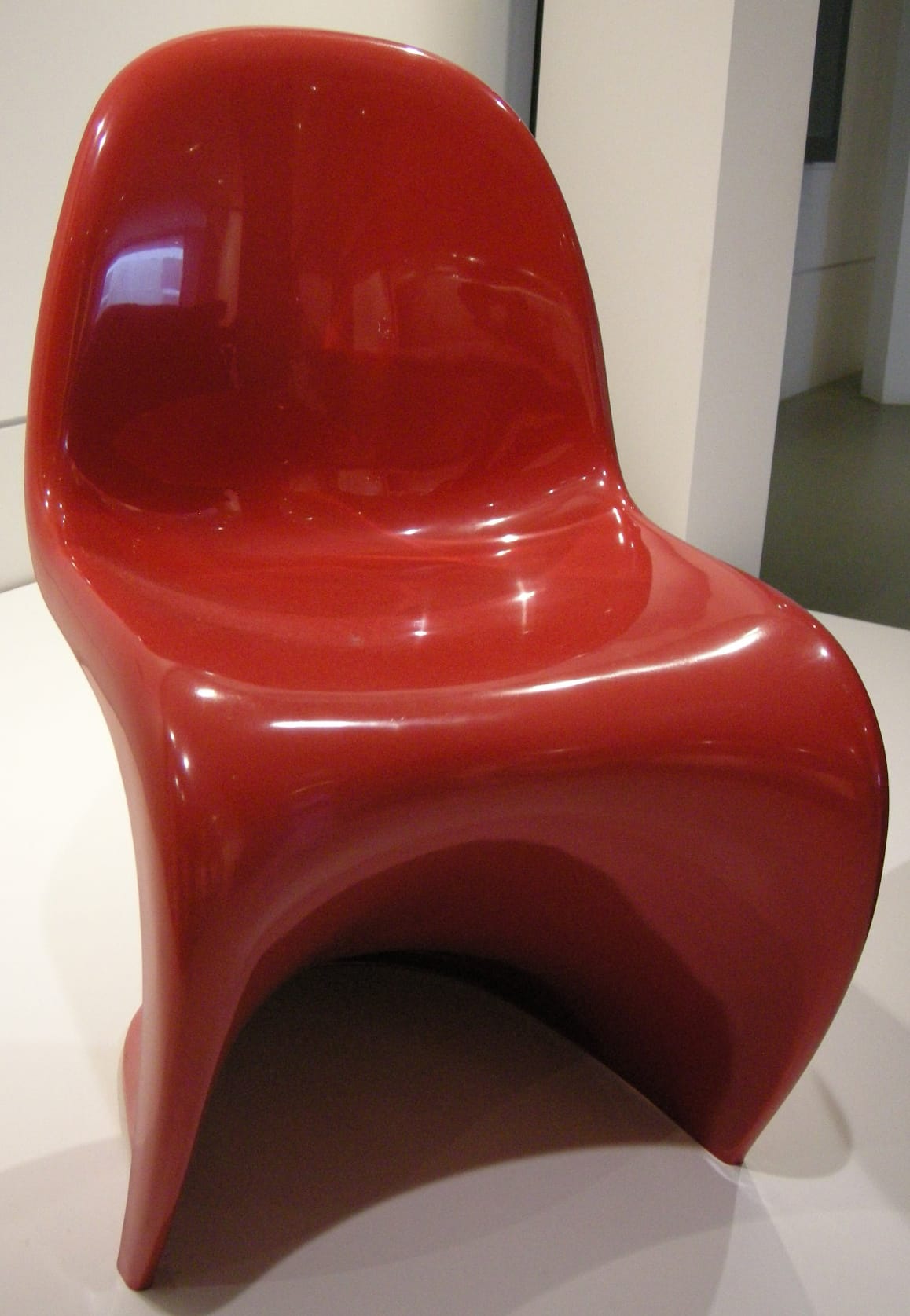
The chair is cantilevered: the seat extends forward without a front leg to support it. The structural load transfers through the curved body of the chair, which acts as a continuous spring. The chair slightly flexes under the sitter’s weight. This was not incidental. The flex was the proof that Panton was right about what plastic could do. As Vitra’s own product documentation notes, “The comfort of this chair results from the combination of a cantilever structure with an anthropomorphic shape and a slightly flexible material.” The shape and the structure are inseparable. That is precisely the point. Panton’s chair is the futurist version of the argument; Magistretti’s Selene chair, also a single-piece plastic seat from 1969 is the rationalist version — same material, opposite rhetoric.
The first production version, made from rigid polyurethane foam, launched in 1968. The material changed repeatedly over the following decades: cold foam from 1971 to 1979, hard foam from 1983 to 1986, then a gap until Vitra resumed production with Panton himself in 1990. The polypropylene version, which remains in production today, launched in 1999. Thirty years of material experimentation to find what the chair actually required is itself part of the argument. According to the Wikipedia article on the Panton Chair, the chair existed across multiple failed material iterations before polypropylene provided what all the earlier versions were approximating. That struggle is evidence that Panton was right about something structural, not just formal.
That struggle is evidence that Panton was right about something structural, not just formal.
The Museum of Modern Art holds the Panton Chair in its permanent collection, recognition that the chair made an argument significant enough to be preserved as art history. In 2024, Dezeen noted that Panton designed the chair to “provoke people into using their imagination.” The provocation was both formal and social. Panton’s insistence on the chair in saturated solid colors: red, orange, yellow, white. This was a philosophical position. The chair wasn’t designed to recede into an interior. It was designed to be the interior’s argument. Against the grey-beige conformity that Panton called out in interviews, the chair declared a position.
It belongs to the broader canon of modern seating as the most emphatic single-material statement that canon produced.
The objects that made Panton’s argument
Panton’s career extended well beyond the chair, and the other objects he produced were not decorative accessories to a furniture practice. They were the same argument at different scales.
The Panton Chair (1960, manufactured 1968)
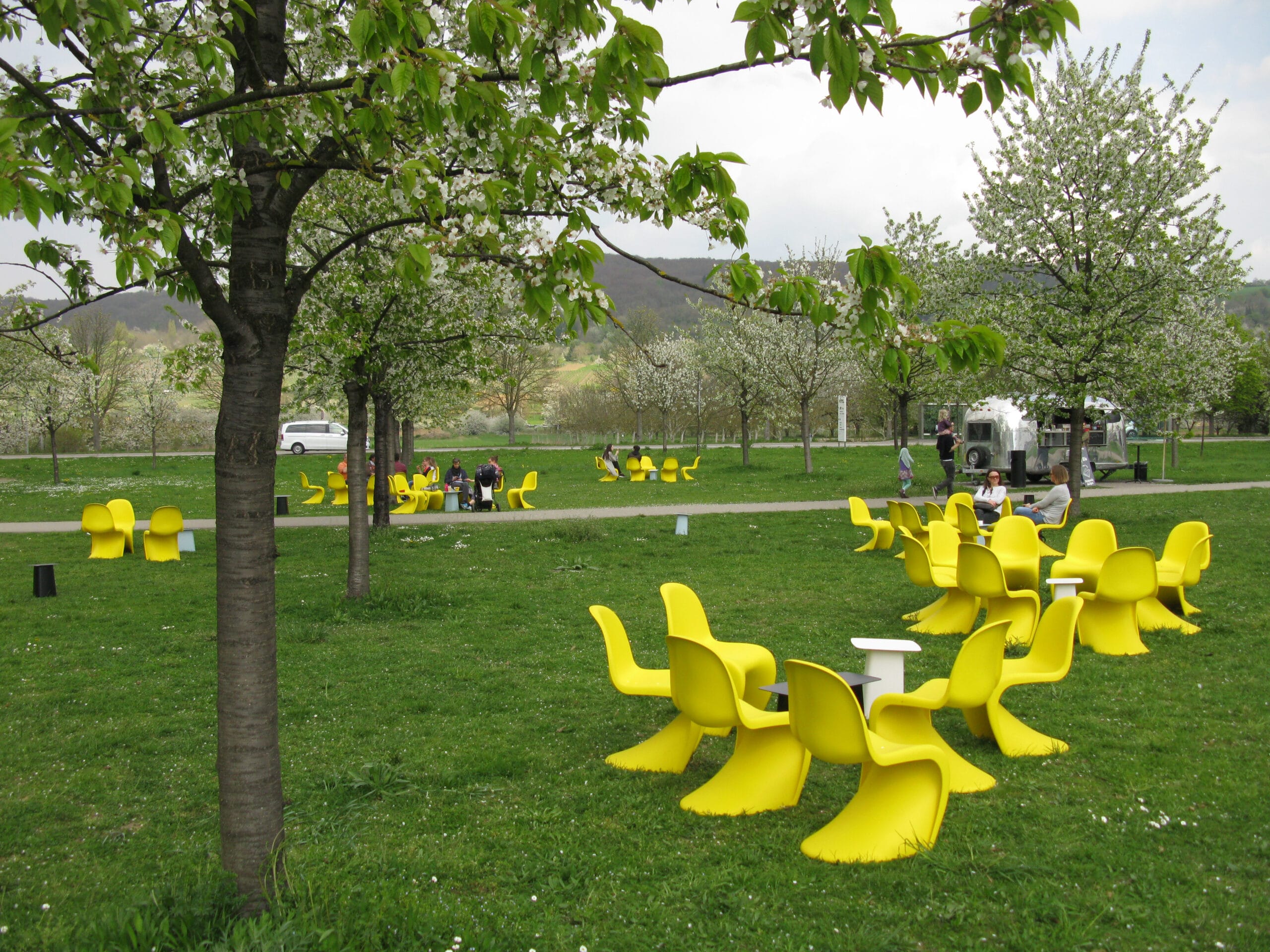
The chair itself: a single-piece injection-moulded plastic seat in cantilevered S-form. Currently produced by Vitra in polypropylene, stackable, available in multiple colors. The white version shows the form most clearly: without color pulling attention, the shape reads as pure geometry. The red version was the provocation Panton intended.
Flowerpot VP1 Pendant (1968)
Designed the same year as the chair’s production launch. Two opposing metal hemispheres, the upper sphere twice the diameter of the lower, lacquered in vivid solids. The Flowerpot became a visual shorthand for the Flower Power moment, not because Panton was designing for that moment, but because the object fit it perfectly. Now produced by &Tradition. The vocabulary of bold, simple, color-first geometry ran from his furniture to his lighting without interruption.
Visiona II (1970)
Not a product. A thesis. Commissioned by Bayer AG for their annual exhibition at the Cologne Furniture Fair, Visiona II was a total-environment installation built inside a chartered excursion boat. Panton called it “Fantasy Landscape” — a continuous interior of upholstered forms moving through blue-to-red gradients, the body-shaped seat merging with the floor and ceiling, no distinguishable boundary between furniture and room. The official Verner Panton archive describes it as “one of the major spatial designs of the second half of the twentieth century.” It is the logical extension of the chair’s argument: if a chair can be a single form, a room can be a single form. The chair’s logic extended into architecture.
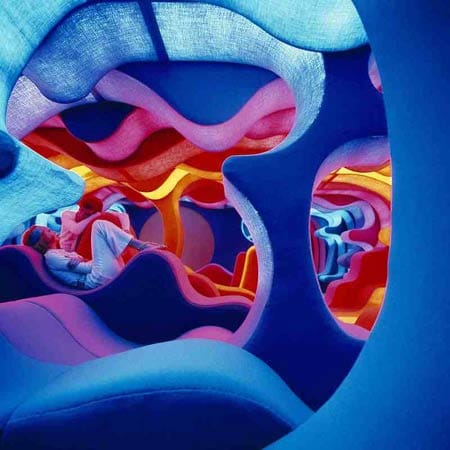
Visiona II, 1970. Panton’s total-environment installation for Bayer AG at the Cologne Furniture Fair remains one of the defining spatial designs of the 20th century. The 450×450px Wikimedia image is the best available documentation of this work.
Panton System 1-2-3 (1973)
A modular foam seating system that extended the single-form logic into a room arrangement. Elements combine as seating, tables, and dividers. Where Visiona II was an installation, System 1-2-3 was a product. It was the same argument available for purchase and arrangement at home.
Geometri Ballpoint Pen (ACME Studios)
The vocabulary ran to desk objects. Available via ACME Studios Geometri Ballpoint Pen, a geometric form in miniature. A reminder that Panton’s visual language operated at every scale.
Shop the Collection
These two objects are where to start with Panton. The chair defines his argument; the pendant extends it at a price point most rooms can absorb.
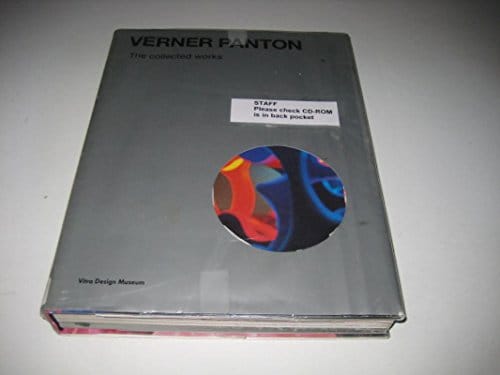
Verner Panton: The Collected Works
The definitive monograph from the Vitra Design Museum, documenting every chair, lamp, and immersive environment Panton designed across his career. The clearest single source for seeing how the Panton Chair fits the larger arc of his work.
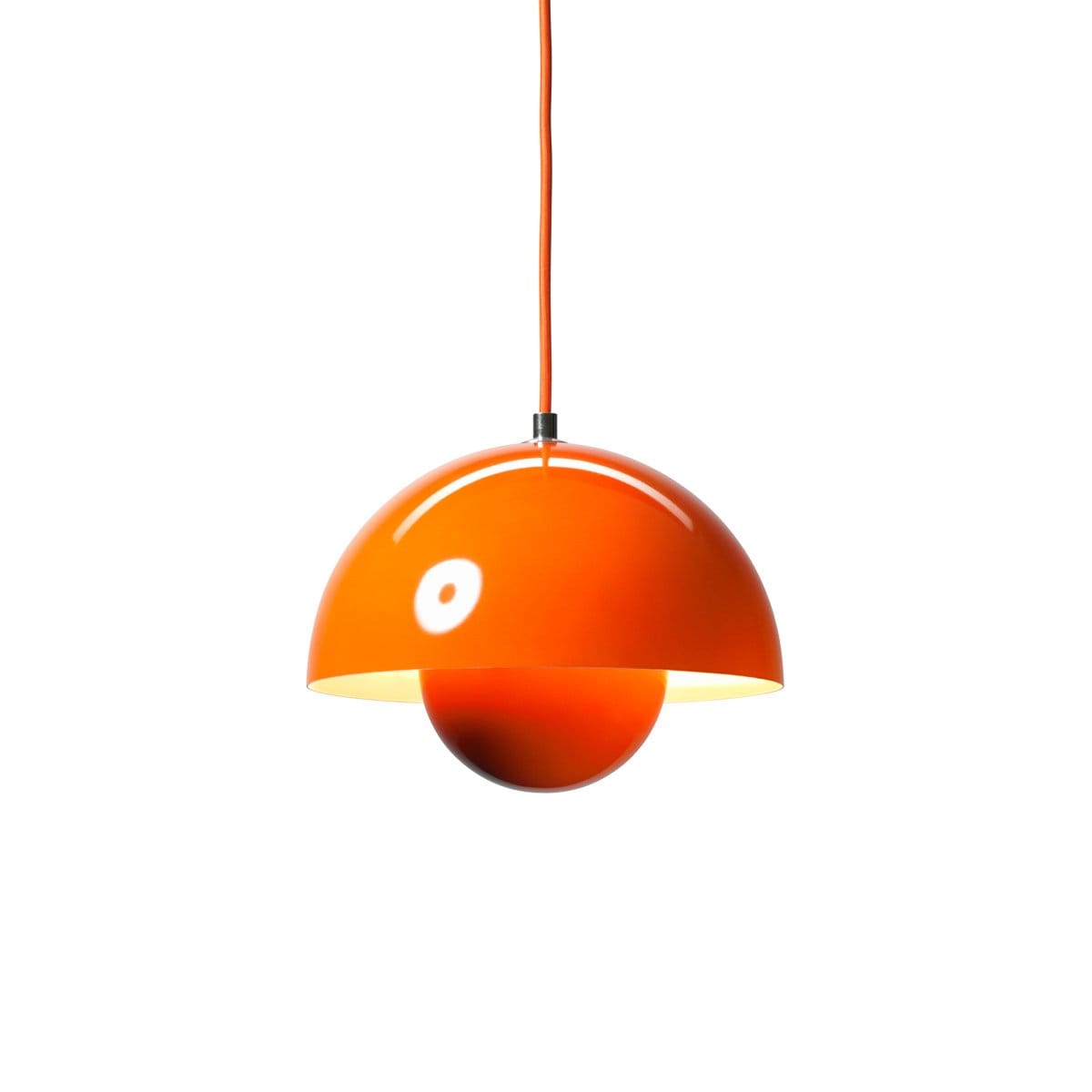
Verner Panton VP1 Orange Flowerpot Pendant
The 1968 pendant is the most accessible entry into Panton’s visual vocabulary for readers who won’t commit to a statement chair. Orange is the canonical colorway; the form is immediately readable at any room scale.
Further Reading
There are two books worth owning on Panton. Not three.
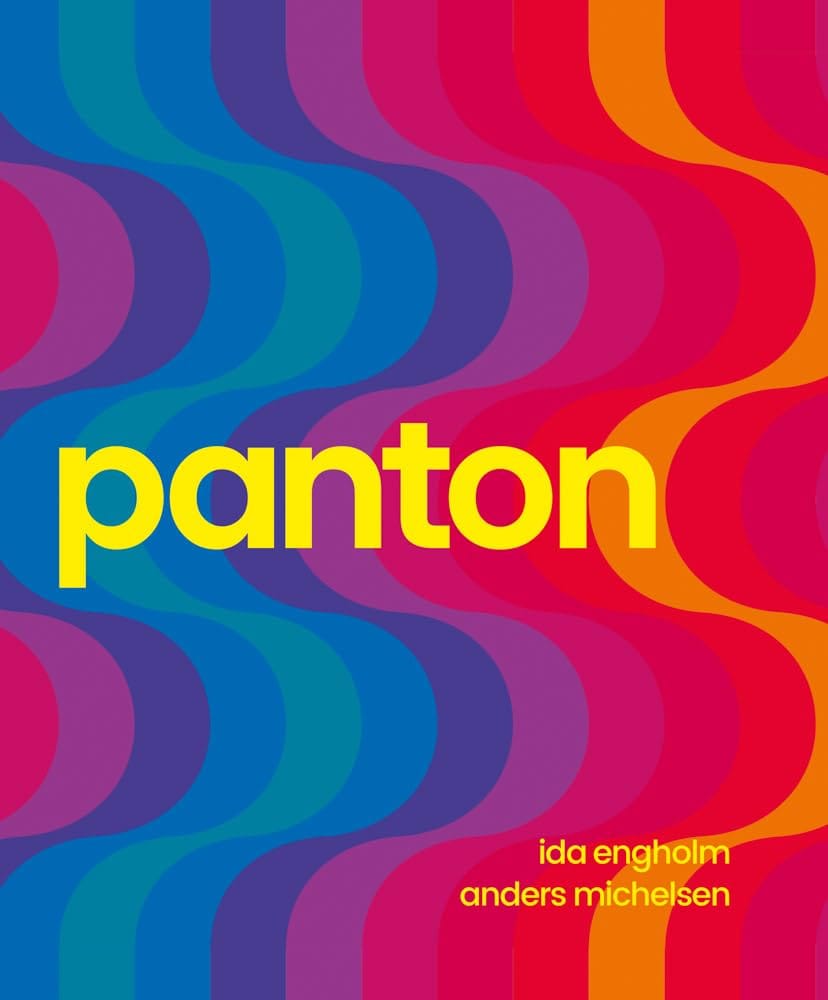
Ida Engholm and Anders Michelsen, Panton: Environments, Colors, Systems, Patterns (Strandberg Publishing, 2024)
The most comprehensive recent monograph: 352 pages, 350 color images, organized around Panton’s four obsessions. It is the book to own if you want to understand the full range of his work rather than just the chair.
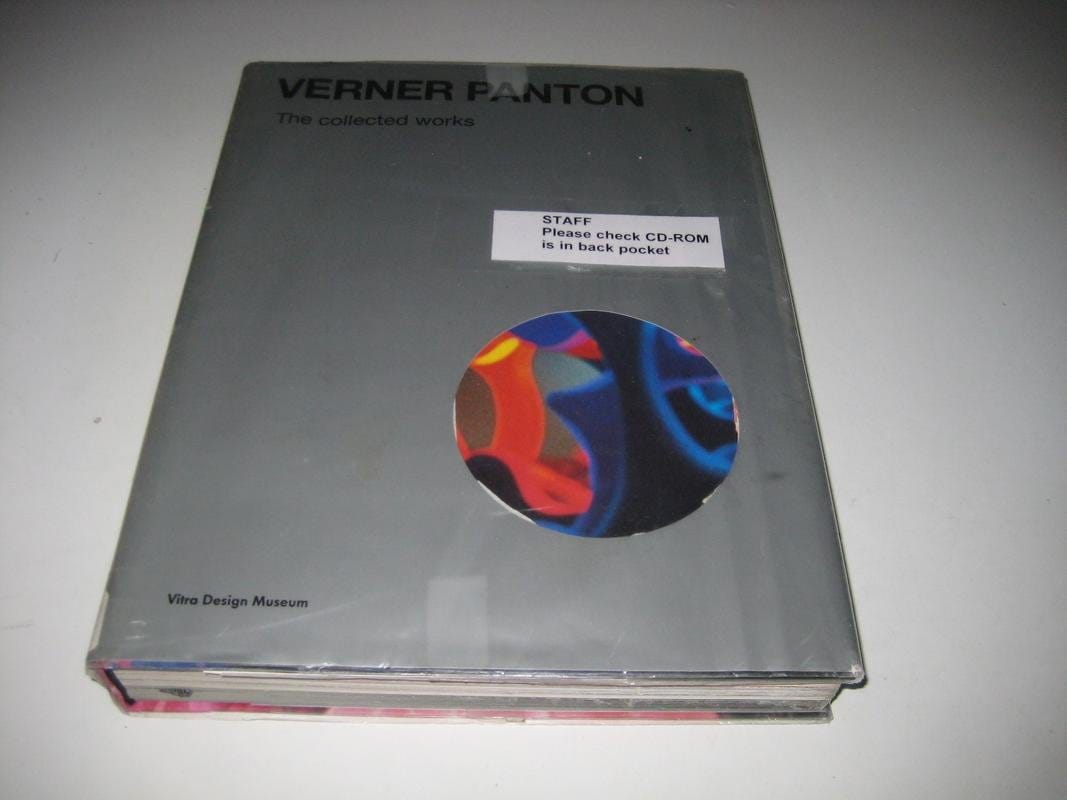
Mathias Remmele and Vitra Design Museum, Verner Panton: The Collected Works (Vitra Design Museum, 2001)
The catalogue from the 2000 Vitra Design Museum retrospective. Primary source material compiled while the museum had direct access to Panton’s archives. Harder to find than the Engholm monograph but more authoritative on the production histories.
Frequently Asked Questions
Who designed the Panton Chair and when was it made?
The Panton Chair was designed by Danish designer Verner Panton (1926–1998). Panton developed the concept from 1956 onward, completed the first plaster-cast model in 1960, and saw the chair publicly presented in August 1967. Serial production by Vitra began in 1968.
What is the Panton Chair made of?
The current production version, manufactured by Vitra since 1999, is made from polypropylene, a single-piece injection-moulded plastic. Earlier versions used different materials: rigid polyurethane foam from 1968 to 1971, cold foam from 1971 to 1979, and hard foam from 1983 to 1986. The polypropylene version is the most durable and is the one in production today.
Is the Panton Chair comfortable to sit in?
It is designed to be comfortable. The cantilevered structure and the slight flex of the polypropylene material distribute the sitter’s weight through the curve of the chair rather than through a rigid base. Vitra’s documentation describes the comfort as resulting from ‘the combination of a cantilever structure with an anthropomorphic shape and a slightly flexible material.’ That said, it is not a lounging chair. It is designed for upright sitting.
How is the Panton Chair different from other mid-century modern chairs?
Most mid-century modern chairs (the Eames shell chair, the Tulip Chair, the Egg Chair) are assemblies. They combine a seat, a base, and connecting hardware in materials that complement each other. The Panton Chair is a single object. No assembly. No separate base. The form is the structure. That distinction is what Panton spent twelve years trying to make in production.
Where can I buy an authentic Panton Chair?
Authentic Panton Chairs are produced exclusively by Vitra and carry the Vitra label on the underside of the seat. They are available from Vitra and authorized dealers, with secondhand examples turning up at auction. For the full design context, Verner Panton: The Collected Works documents the chair alongside his complete body of work.
How is the Vitra Panton Chair different from lookalikes?
Vitra is the licensed manufacturer, and its polypropylene formulation was developed through decades of material iteration. Unlicensed lookalikes use cheaper plastic compounds that lack the specific flex Panton designed for; they feel harder and heavier and do not distribute load the same way. If the goal is to own the argument and not just the shape, Vitra is the only manufacturer that carries the full production history.

About Joe Post
Joe Post holds an MFA in Art from California Institute of the Arts (CalArts) and has done additional graduate work at the School of the Art Institute of Chicago. He founded Art Design Ideas to write about design as cultural argument — the decisions, contradictions, and assumptions built into the objects we live with.