
The Memphis Design Movement is a postmodern design collective founded by Italian designer Ettore Sottsass in Milan in December 1980. The Memphis Group rejected Modernism’s “form follows function” doctrine, producing furniture, ceramics, and objects defined by bold color, geometric pattern, and deliberately clashing materials — and disbanded in 1987 after six years of intentional provocation.
What Was the Memphis Design Movement Actually Arguing Against?
Sottsass was 63 years old when he convened a group of young designers at his Milan apartment in December 1980. Bob Dylan’s “Stuck Inside of Mobile with the Memphis Blues Again” was playing on repeat. The group took its name from that evening. At 63, after decades inside the Italian design establishment and a long career at Olivetti designing business machines, Sottsass had earned the right to blow something up. Memphis was that act.
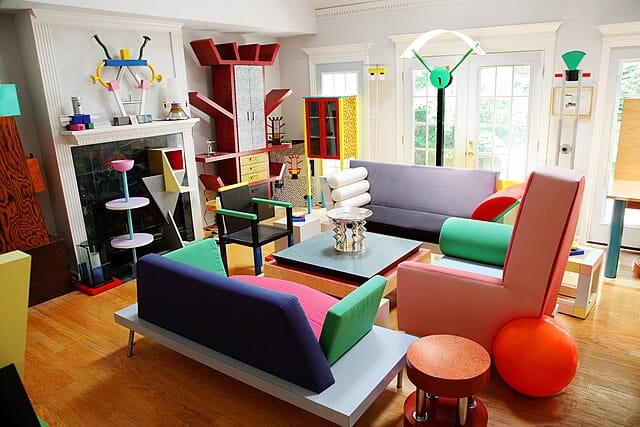
The target was specific. Late-1970s Italian design was ruled by Rationalism and the long shadow of Bauhaus Modernism. The doctrine “form follows function” had hardened from principle into moral prohibition: ornament was not just unnecessary, it was dishonest. Color was kitsch. Decoration was for people who didn’t know better. This was the design culture’s class position, dressed up as aesthetic theory, and Memphis went after it directly.
Memphis did not emerge from nowhere. It grew from the earlier Italian radical design movement of the late 1960s (Archizoom, Superstudio) and from Sottsass’s own long practice at the edges of design orthodoxy. But where the radicals produced manifestos, Memphis produced objects. Barbara Radice, the critic who became Sottsass’s partner and the movement’s primary intellectual interpreter, documented this transition in her primary account, Memphis: Research, Experiences, Failures and Successes of New Design (Thames & Hudson, 1995). Manifestos don’t end up in collections. Objects do. The Vitra Design Museum’s account of Sottsass’s career traces how his decades at Olivetti — designing typewriters and early computers as functional objects — charged the Memphis project: he understood exactly what a serious functional object looked like, which is what made ignoring that standard so pointed (design-museum.de/en/collection/sottsass).
Manifestos don’t end up in collections. Objects do.
The first public exhibition was at the Milan Furniture Fair (Salone del Mobile) in September 1981. Fifty-five pieces by twenty designers. The international roster (Michele De Lucchi, George Sowden, Nathalie Du Pasquier, Matteo Thun, Marco Zanini, Martine Bedin, along with Michael Graves from the United States, Hans Hollein from Austria, Shiro Kuramata from Japan, and Javier Mariscal from Spain) made the argument visual and immediate. This was not a local provocation. It was a coordinated attack on a shared orthodoxy.
Why Plastic Laminate Was a Political Choice
The choice of plastic laminate as Memphis’s signature material was not random. Abet Laminati, the Italian laminate manufacturer, partnered with Memphis specifically to produce custom-printed surface patterns, including Sottsass’s Bacterio design, the squiggling black-on-white biomorphic pattern that became the movement’s visual signature. That partnership meant the provocation was also a product. Memphis was arguing with the design establishment while also selling things to it.

But the laminate choice carried a pointed argument. Plastic laminate was the material of low-end kitchens, diner countertops, suburban furniture: the cheapest, most aggressively unprestigious surface available. Applying it to objects that would be reviewed in design publications and exhibited at international fairs forced a question: were critics objecting to the aesthetic, or to the class associations of the material? The Design Museum in London, whose assessment of Memphis’s legacy is deliberately framed as “awful or awesome?”, captures exactly this unresolved quality. The contestation is the point.
The patterns and colors Memphis chose came from popular culture: beach wear, skateboard graphics, television sets, fast food graphics. This was a deliberate refusal of “good taste” as a design criterion, or more precisely, a refusal of the social function that “good taste” was performing. Good taste, in this reading, was a mechanism for keeping certain people and certain references out of serious design discourse. Memphis let them in. Pop Art had pressed a similar case in the 1950s and 1960s, treating the line between high and low culture as a matter of class; see Pop Art and design culture.
Good taste was a mechanism for keeping certain people and certain references out of serious design discourse.
The reception confirmed the provocation worked. Critical response at launch was hostile. Over time, Karl Lagerfeld furnished his Monte Carlo apartment entirely in Memphis pieces, a collector’s act that complicated the narrative about who the movement was for. David Bowie reportedly described the physical experience of entering a Memphis-furnished room as a jolt. By the mid-1980s, Memphis aesthetics had migrated into Miami Vice set design, Nickelodeon’s production graphics, skateboard and BMX culture, and mall architecture. Whether that counts as cultural diffusion or co-optation depends on your position.
The rehabilitation in serious fashion came later. Raf Simons explicitly cited the Memphis Group in his 2005 menswear collection, according to accounts in Wallpaper and gestalten publications. That was the moment that signaled Memphis had survived long enough to be serious again. MoMA’s permanent collection includes several Memphis pieces — among them Sottsass’s Carlton and Casablanca objects — which is one institutional answer to the question of whether the movement belongs in design history or in the category of interesting mistakes (moma.org/collection/works/memphis).
Five Memphis Objects That Made the Argument
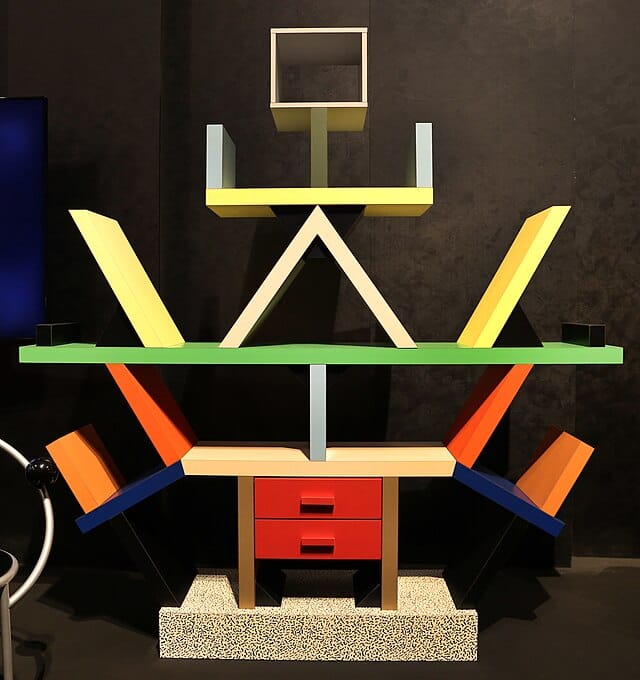
The Carlton Room Divider, which Sottsass designed in 1981, is the piece most photographs use to stand in for the whole movement: asymmetrical, totemic, built from plastic laminate in competing geometric patterns, its five sloping shelves organized by no visible logic of storage. It looks like a figure, not a piece of furniture. That is the point. It refuses to be subordinated to function while occupying the exact category (the room divider) that function should define.
The Casablanca Sideboard, also Sottsass in 1981, assembles competing geometric volumes in red, yellow, and black laminate. It is named after the Humphrey Bogart film, which is a wink: classical references are fair game for Memphis, but they arrive with distance, as quotation rather than inheritance. The name says the object knows it is playing a game.
Peter Shire’s Bel Air Armchair from 1982 brought a specific geographic argument into Memphis. Shire was a Los Angeles designer, and the Bel Air (tubular steel painted in pink, blue, and yellow, with geometric foam upholstery) named after the LA neighborhood. It inserted American pop culture into what might otherwise have read as an Italian-European argument about Italian-European design culture.
The Tahiti Table Lamp, Sottsass 1981, is bird-shaped, enamel-painted, and deliberately illustrative in a way that postwar Italian design had worked hard to leave behind. Birds were a motif in mid-century Italian ceramics. The Tahiti reclaims the motif as knowing quotation. It is kitsch that knows it is kitsch, which is either a sophisticated move or an evasion, depending on how much credit you give the knowing gesture.
The Bacterio textile pattern predates Memphis formally. Sottsass developed it in 1978, but it became the movement’s surface skin, applied to laminate across the first collection. Squiggling black lines on white, resembling bacteria under magnification. It named itself after something that contaminates. This was not an accident.
Shop the Collection
Authentic Memphis Group pieces trade at prices that reflect their status as documented design history. Originals start in the thousands, and significant pieces command five figures at specialized dealers. What Amazon carries is the movement’s aesthetic, not its objects. That is not a compromise if what you want is the argument on your wall, not the artifact in your insurance policy.
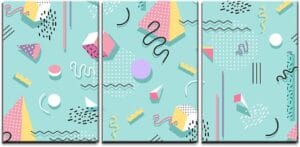
wall26 Memphis Pattern Canvas Wall Art (3-Panel)
A three-panel canvas in the Memphis geometric vocabulary, a low-commitment way to bring the movement’s visual argument into a living space without sourcing vintage.
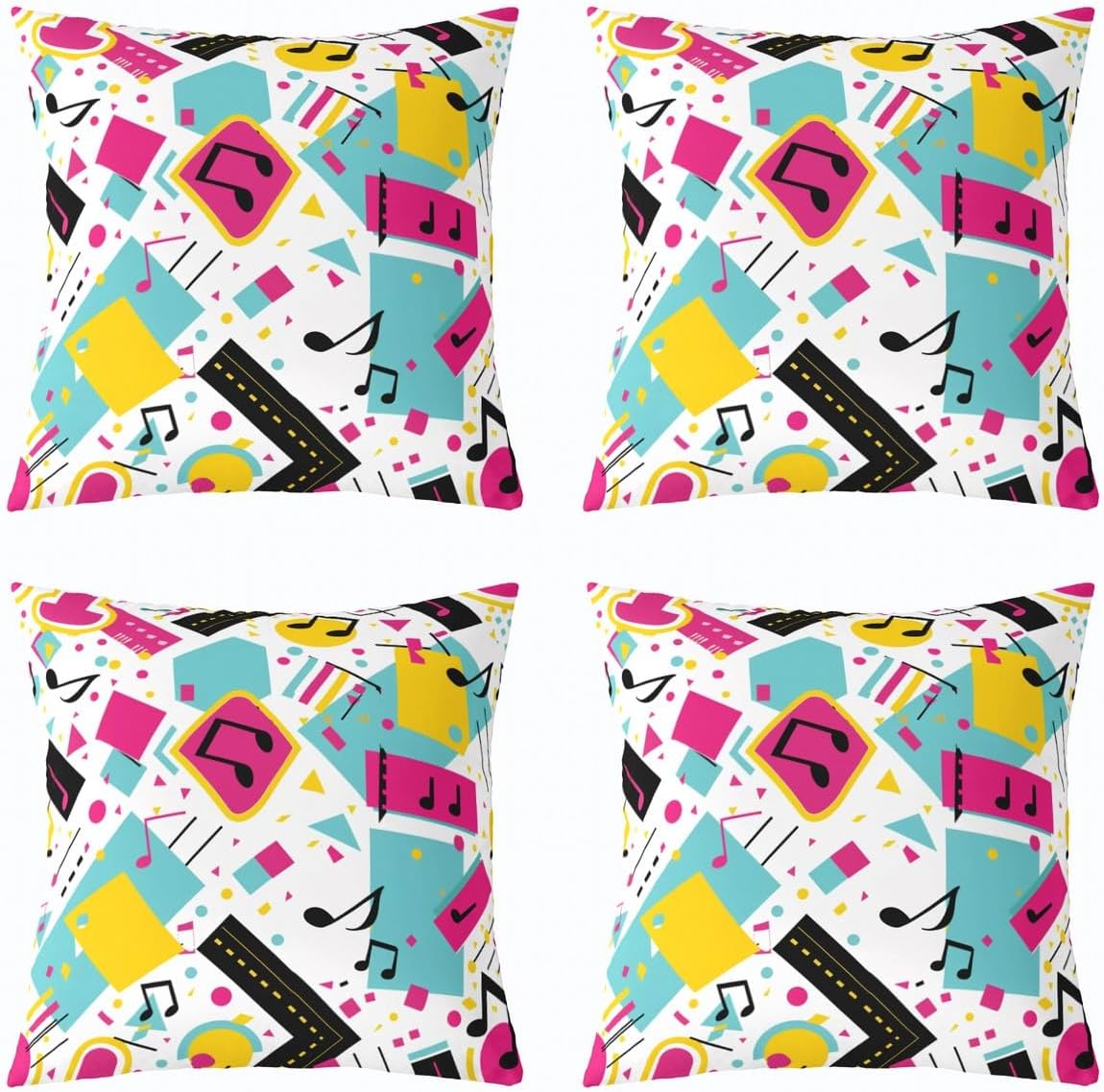
Feelyou Memphis Geometric Throw Pillow Covers (Pack of 2)
Memphis-patterned cushion covers in the movement’s signature palette, an accessible entry point for readers who want the aesthetic without a furniture acquisition.
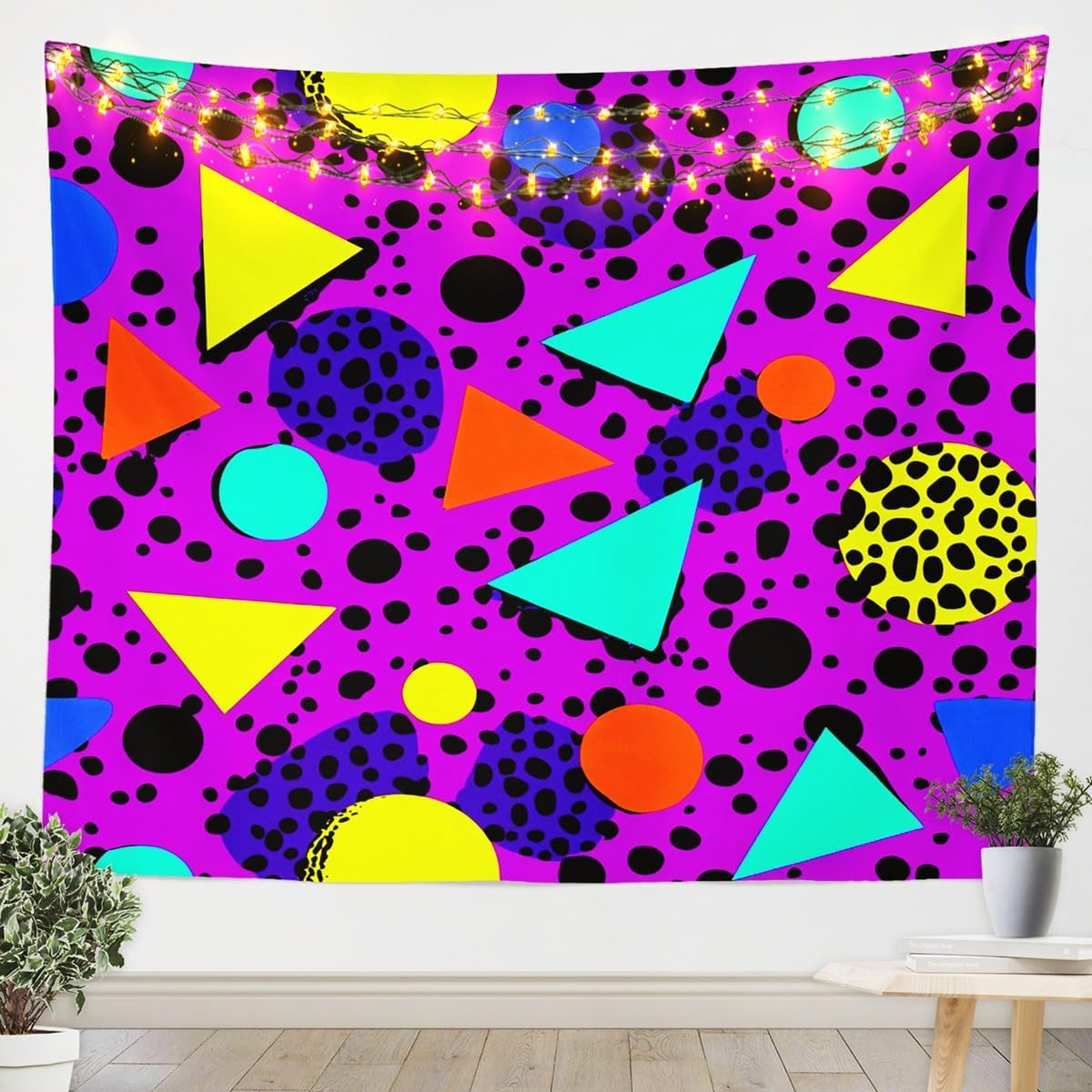
Memphis Geometric Framed Wall Art Print (Halftone, Yellow/Blue)
A small-format framed print in the geometric halftone language of 1980s Memphis, scaled for a desk or shelf rather than a wall installation.
Further Reading
Three books cover the Memphis territory without redundancy. Each comes from a different angle, and together they give you the insider account, the authoritative monograph, and the contemporary critical survey.
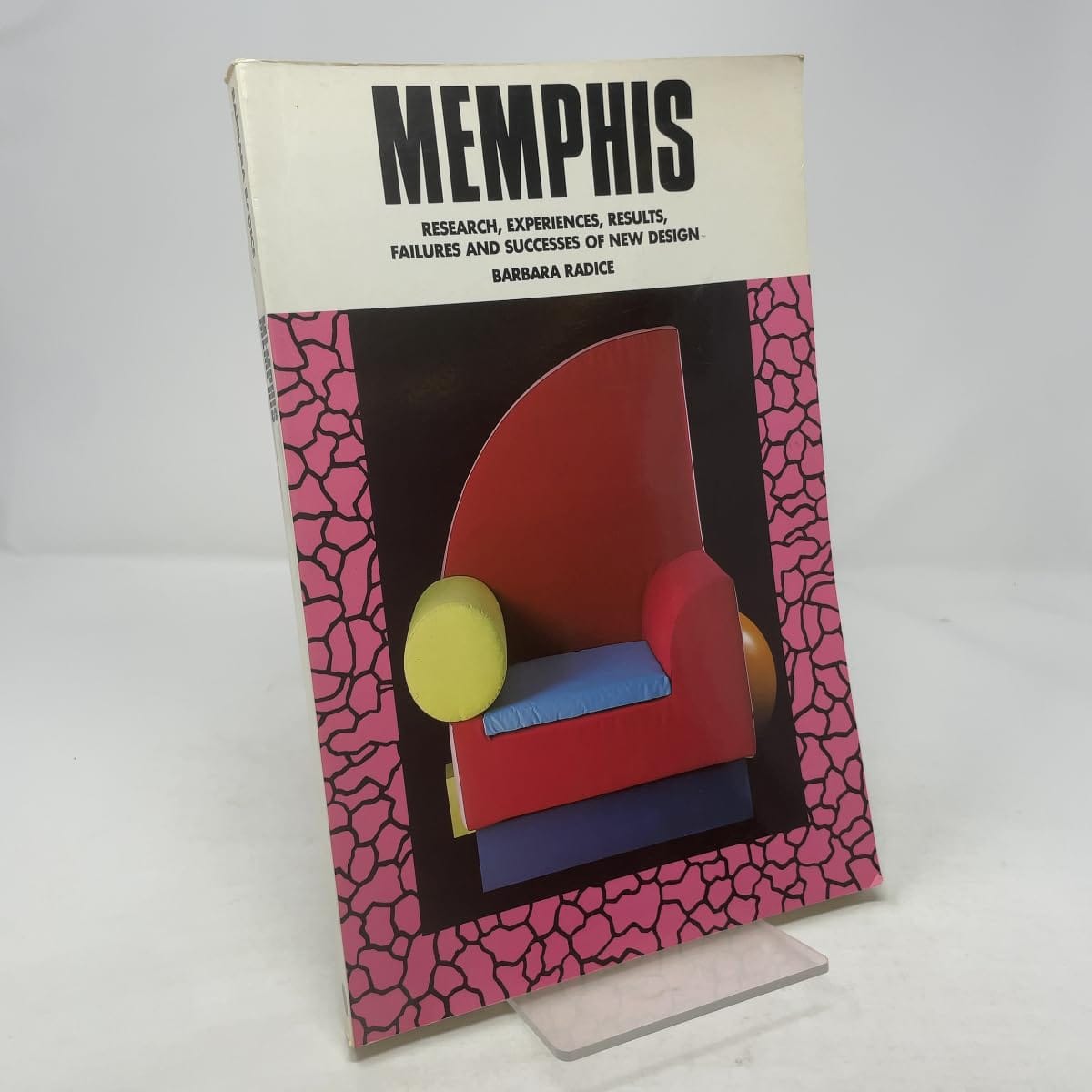
Barbara Radice, Memphis: Research, Experiences, Failures and Successes of New Design (Thames & Hudson, 1995)
Radice was inside the group, Sottsass’s partner and the movement’s primary intellectual interpreter. This is the primary source, not commentary on it. Everything else is derivative of what she documents here.
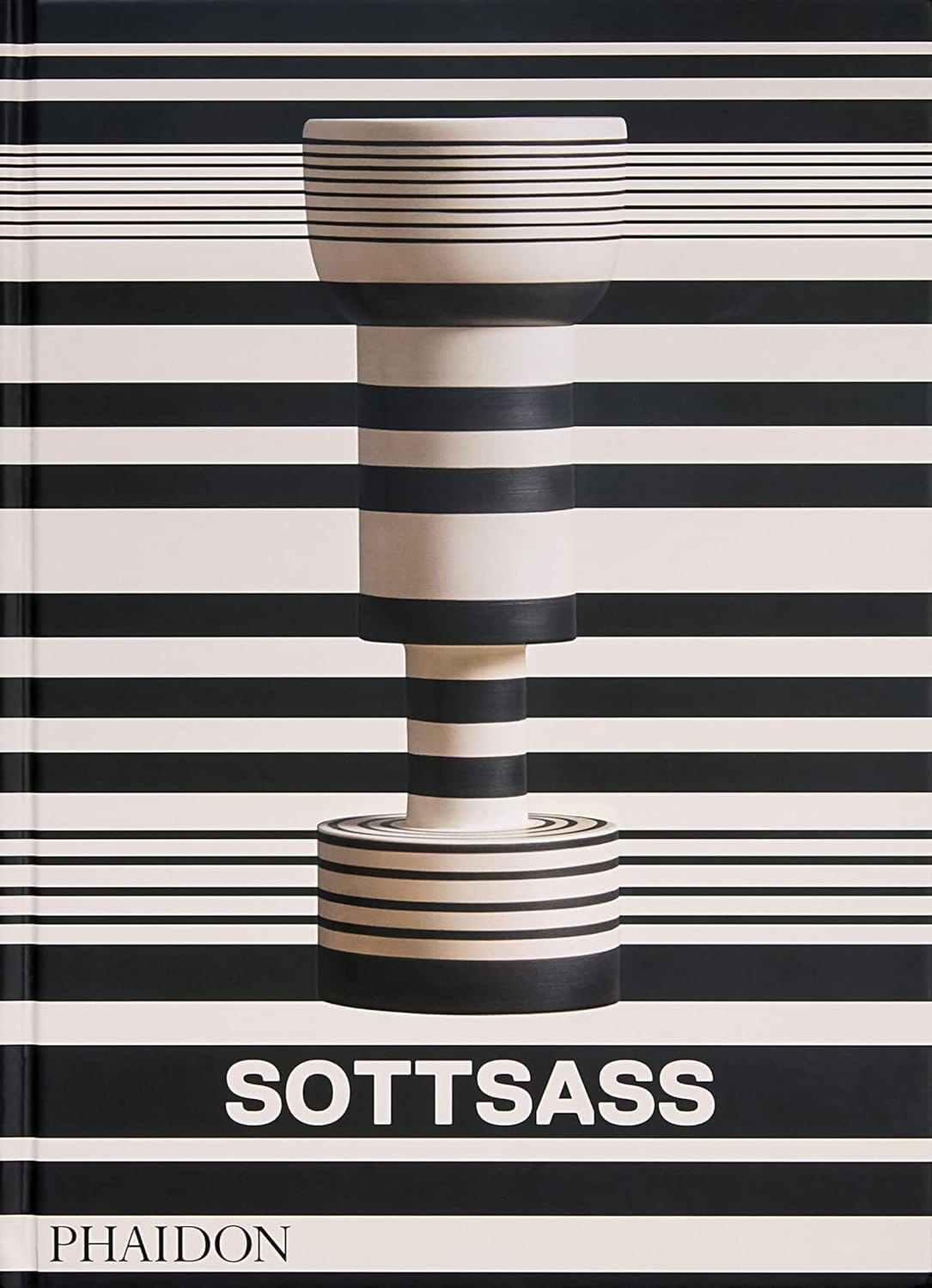
Philippe Thomé, Ettore Sottsass (Phaidon, 2022)
The definitive monograph on Sottsass at 492 pages, drawing on the full archive. It covers the Olivetti years, the Memphis years, and the late practice. It is the only book that shows how Memphis connects to everything else Sottsass made.
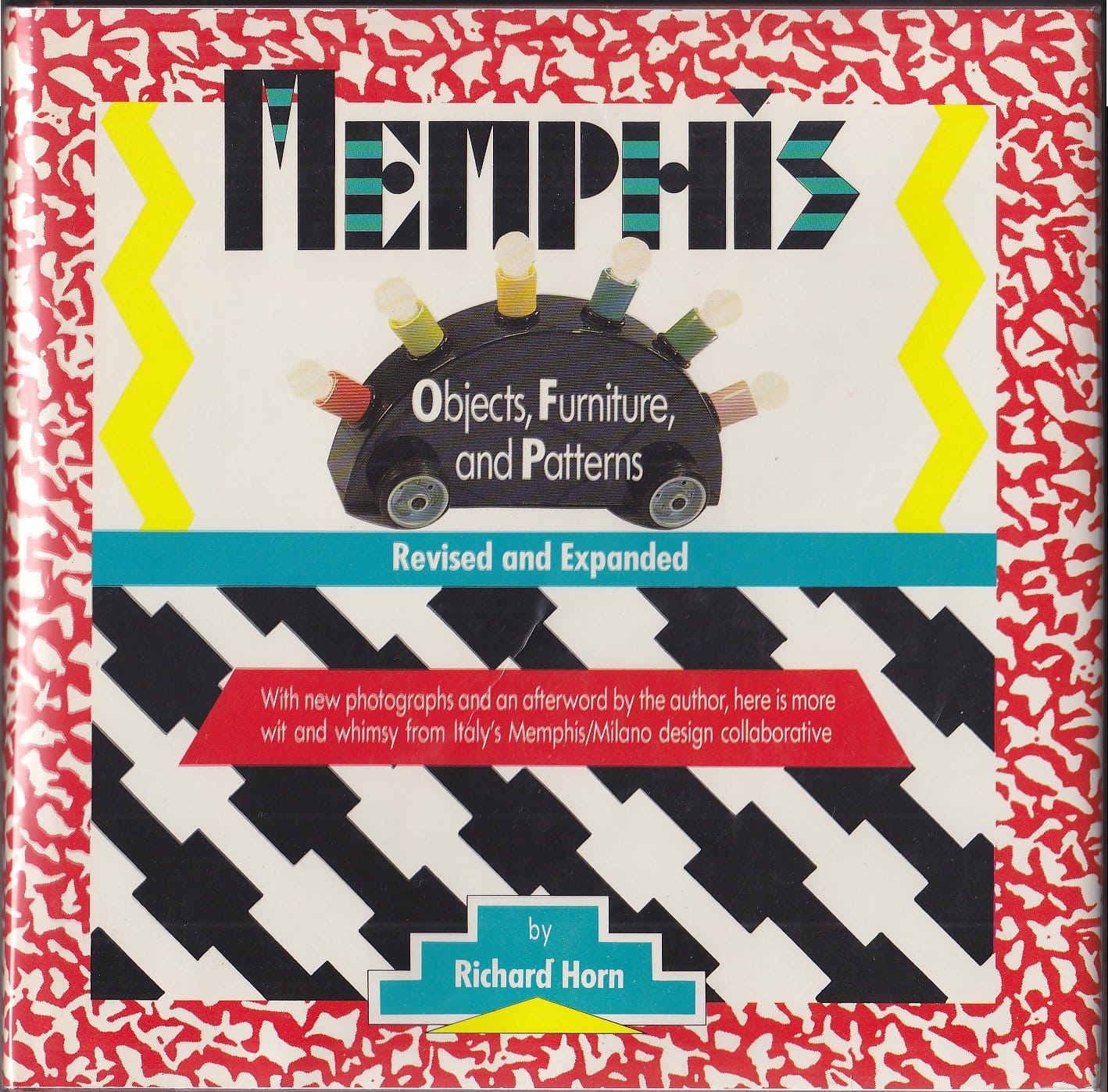
Richard Horn, Memphis: Objects, Furniture, and Patterns (Running Press, 1985)
Horn’s survey documents the 1981–85 output with photographs and critical text written while the movement was still active, a different angle than Radice’s insider account, and useful precisely because it captures the contemporary reception rather than the retrospective assessment.
Frequently Asked Questions
What is the Memphis Design Movement?
Memphis Design is a postmodern design movement founded by Ettore Sottsass and a group of young international designers in Milan in December 1980. The group rejected the Modernist principle that form should follow function, and instead produced furniture, ceramics, textiles, and objects defined by bold color, geometric surface patterns, and deliberately clashing materials. The group exhibited annually at the Milan Furniture Fair until Sottsass withdrew in 1987.
Why is it called Memphis design if it started in Italy?
The name came from a single evening. At the founding meeting in December 1980 at Sottsass’s Milan apartment, Bob Dylan’s “Stuck Inside of Mobile with the Memphis Blues Again” was playing on continuous loop. The group adopted the name Memphis from that session — it was an accident of what was on the record player, not a reference to the city or to Memphis music culture.
Who were the key designers in the Memphis Group?
The founding members included Ettore Sottsass, Michele De Lucchi, George Sowden, Nathalie Du Pasquier, Matteo Thun, Marco Zanini, and Martine Bedin. The international roster that contributed to Memphis exhibitions included Michael Graves (USA), Hans Hollein (Austria), Shiro Kuramata (Japan), and Javier Mariscal (Spain). Sottsass was the group’s founder and central figure; Barbara Radice, the critic and his partner, served as its primary intellectual voice.
When did the Memphis Group disband and why?
Sottsass withdrew from Memphis in 1987; the group formally wound up in 1988. The reason was not conflict within the group but the logic of what Memphis was: a provocation aimed at a specific moment in design culture. Once the argument had been made and the cultural conditions had shifted, continuing to produce Memphis objects would have transformed provocation into style. Sottsass understood the difference.
Is Memphis design the same as postmodern design?
Memphis is a specific postmodern design movement, not a synonym for postmodern design generally. Postmodern design encompasses a wide range of approaches that rejected Modernist orthodoxy — including the work of Michael Graves in architecture, the Alchimia group in Italy, and various national movements in the 1980s. Memphis is the most concentrated and internationally visible of these, but it represents one argument within a broader contested field, not the whole of it.
How can I incorporate Memphis design into my home?
The Memphis aesthetic translates most readily through surface pattern and color rather than through furniture acquisition (authentic pieces are expensive; reproductions vary widely in quality). Geometric textiles, printed wallpaper in the Memphis palette, and small decorative objects with bold pattern work are the accessible routes. The movement’s visual language (squiggles, triangles, bold color blocking, black-and-white surface pattern) is legible enough that even one element registers as a deliberate choice.
Memphis arose in direct reaction to Bauhaus and Modernist restraint — the direct confrontation between those traditions is the subject of our Memphis vs Bauhaus comparison. Art Deco made a structurally similar argument fifty years earlier: that ornament carries meaning, and that stripping it entirely is a cultural claim masquerading as an aesthetic one. Whether Memphis knew it was repeating that argument is one of the more interesting questions in twentieth-century design history. For the broader design history that Memphis fits into, see Design Legends. And for Memphis-inspired objects at accessible prices, see our curated guide to best Memphis design products.

About Joe Post
Joe Post holds an MFA in Art from California Institute of the Arts (CalArts) and has done additional graduate work at the School of the Art Institute of Chicago. He founded Art Design Ideas to write about design as cultural argument — the decisions, contradictions, and assumptions built into the objects we live with.