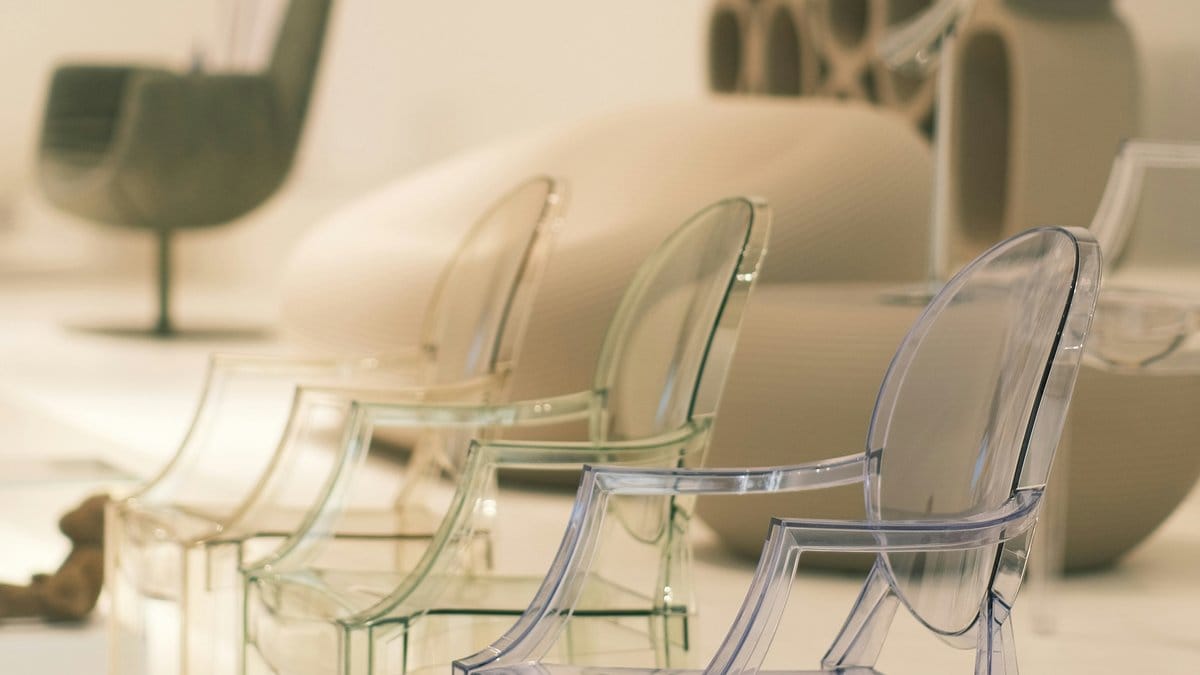
The Kartell Louis Ghost Chair is a transparent armchair designed by Philippe Starck and made in Italy by Kartell since 2002. It recasts a Louis XVI armchair in clear polycarbonate injected in a single mold, and more than two million have sold, which makes it one of the most commercially successful designer chairs ever produced. A pair cost $1,290 at Design Within Reach in September 2026. Authentic chairs carry the Kartell and Starck names molded into the plastic.
This Kartell Ghost Chair review covers the Louis Ghost armchair specifically: what it does well, where it fails, and how to spot a counterfeit.
The Problem the Ghost Chair Was Actually Solving
Before the Ghost Chair, there was no transparent armchair in production at scale. That sounds like a narrow problem, but it isn’t. Every chair you place in a room is visually present: it takes up space, it has color, it competes with everything else. In a small dining room, in a studio apartment, in any room where visual space is already constrained, that presence is a real problem. Starck’s question was: what if the chair could disappear?
The material solution was polycarbonate injection-molded in a single mold. Kartell describes it as “the world’s bravest example of injection of polycarbonate in a single mould” (brand language, but accurate). No manufacturer had produced a transparent armchair at this scale before. The process required Kartell’s specific manufacturing infrastructure; Starck had been working with the company since the early 1990s, and the Ghost Chair was the product of that relationship at its most technically ambitious.
The commercial result is documented: over two million units sold (Wikipedia; Kartell’s own figures). The form is a neoclassical Louis XVI armchair silhouette translated into a material that denies period weight. It borrows history and then makes it disappear. That is, arguably, the point.
This matters because the Ghost Chair is not primarily a celebrity product. Starck’s name helps it sell, but the chair sold because it solved a specific spatial problem. Put one in a corner and watch it disappear. That is not marketing language. The transparent polycarbonate genuinely reads as almost absent against most backgrounds. The two million sales are evidence of product-market fit, not brand recognition alone.
It sits alongside the Masters Chair (2009) as Kartell’s most significant Starck collaboration. Where the Ghost Chair solves a spatial problem, the Masters Chair makes a historical argument. They are different objects making different claims.
What the Ghost Chair Gets Right and Where It Disappoints
What it gets right
The transparency works. Put the Ghost Chair in a small room and it genuinely does not compete with the space the way a solid chair would. The polycarbonate reads as almost absent (particularly in the crystal/clear version), and that is the chair’s core proposition, delivered.
Structurally, it holds up. Single-mold polycarbonate is impact-resistant. The chair is stackable to six, which makes it practical for events or anyone who needs to store chairs when not in use. The original polycarbonate is UV-stabilized and weather-capable, making it suitable for covered outdoor dining areas, a genuine advantage over most indoor-only design chairs.
The form is neoclassical (the Louis XVI armchair silhouette) but the material makes it read as contemporary. It works in a mid-century modern room, a minimalist room, a maximalist room. That visual flexibility is real.
Where it disappoints
Comfort. The Ghost Chair is not comfortable for extended sitting. Multiple owners note that you become aware of the polycarbonate quickly. There is no give, the contact points are hard, and after an hour most people want a cushion. This is not an oversight; it is a trade-off inherent in the design. The chair was not optimized for ergonomic comfort. It was optimized for visual impact. Those are different goals, and buyers who prioritize comfort should know this before spending $645 a chair.
Scratching. Polycarbonate scratches. The crystal/transparent version shows this most readily. Every scratch is visible. This is a documented and consistent complaint about the chair. If you place Ghost Chairs in a dining room where they will be moved regularly, scratching is a real consideration.
Counterfeits. This matters. Online marketplaces carry many transparent chairs sold on the Ghost Chair’s reputation, and some are presented as the real thing. Buying from Kartell or an authorized dealer (see Where to Buy below) avoids the problem entirely. If you buy secondhand, authentication matters.
Here is how to tell an authentic chair:
Authentic Kartell chairs have the Kartell name, the product name, and Philippe Starck’s name embossed directly into the polycarbonate. This is molded into the material: not a sticker, not a hang tag, not a paper label. If you open the box and the branding is on any kind of label rather than molded into the chair itself, it is not a Kartell chair.
Counterfeits are typically made from ABS plastic or recycled polycarbonate blends rather than the virgin polycarbonate Kartell uses. The difference shows up over time: they tend to yellow within about 18 months of indoor exposure, while authentic polycarbonate holds its clarity for years. Some use acrylic, which looks similar but has a different durability profile and cracks differently under thermal stress.
The practical instruction: check the embossing before you accept delivery, before you assemble anything. If the branding is on a label, refuse the shipment or initiate a return immediately.
Warranty. Kartell offers a 10-year structural warranty on its chairs, but only through authorized retailers. Marketplace purchases from third-party sellers do not carry it. If you want the warranty, buy from kartell.com or an authorized dealer such as Design Within Reach.
Kartell Ghost Chair Review: Is It Worth the Price?
Rating: 4 out of 5.
It earns the 4 because it does what it claims. The transparency is real. The disappearing-chair effect works in actual rooms. The single-mold polycarbonate construction is structurally sound, stackable, and weather-capable. The two million sales are not purely a marketing outcome. They are evidence that the chair solved a real problem at scale.
The missing point comes from two genuine failures: comfort for sustained sitting, and the counterfeit problem. Polycarbonate has no give; an hour in a Ghost Chair reminds you the design was not built for ergonomics. More significantly, a buyer who shops a marketplace without knowing the embossing test can pay full price for an ABS counterfeit that yellows within 18 months. That is a real risk, and it costs the chair a point because the purchase environment introduces uncertainty a design object at this price should not carry.
Buy if: You are decorating a room where visual lightness is the constraint: dining rooms, accent seating, small apartments where every piece of furniture competes for space. The Ghost Chair is also appropriate for covered outdoor dining, for events, or anywhere that seating needs to stack and store. Accept that comfort for extended sitting is limited.
Do not buy if: You need a chair you can sit in for hours, or you are shopping on price alone through marketplace search results. If comfort is the priority, this is the wrong chair regardless of price.
For US buyers, buying from kartell.com or an authorized dealer guarantees authenticity and includes the manufacturer warranty. Any price difference over third-party listings is worth it for those reasons.
Where to Buy
Recommended: kartell.com or Design Within Reach. Both are authorized, both carry the full 10-year structural warranty, and neither carries counterfeit risk. Kartell sells its chairs in pairs. Prices below were checked at Design Within Reach in September 2026.
Amazon.com is not a practical source for this chair right now. When we checked on 20 September 2026, every genuine Kartell listing there shipped from Amazon Germany with a quoted delivery of April 2027 and $140 to $500 in freight on top of the price.
Louis Ghost Chair, set of 2: $1,290
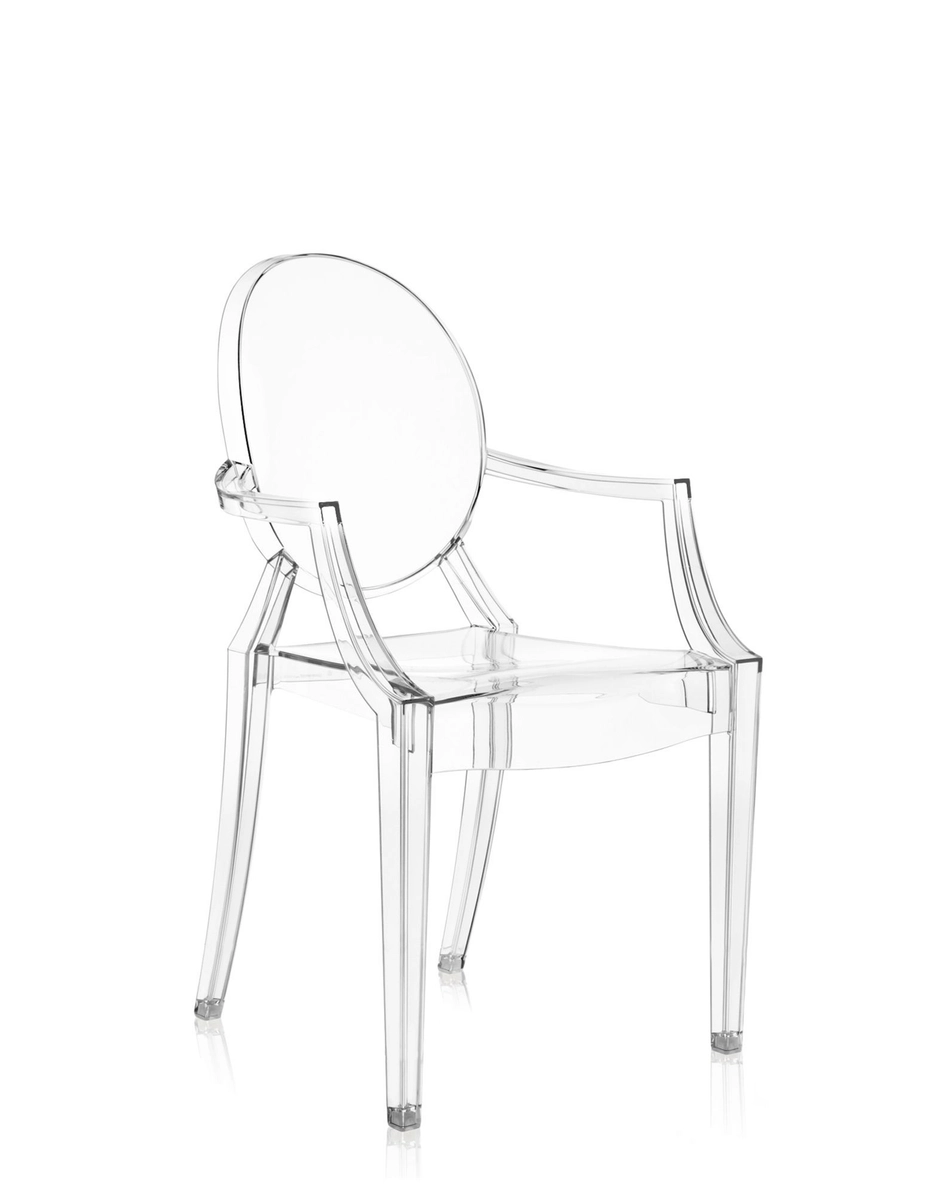
The armchair this review is about, in crystal and a range of transparent and opaque colors. Verify the embossed Kartell branding when it arrives, whatever channel you use.
Louis Ghost Chair in black
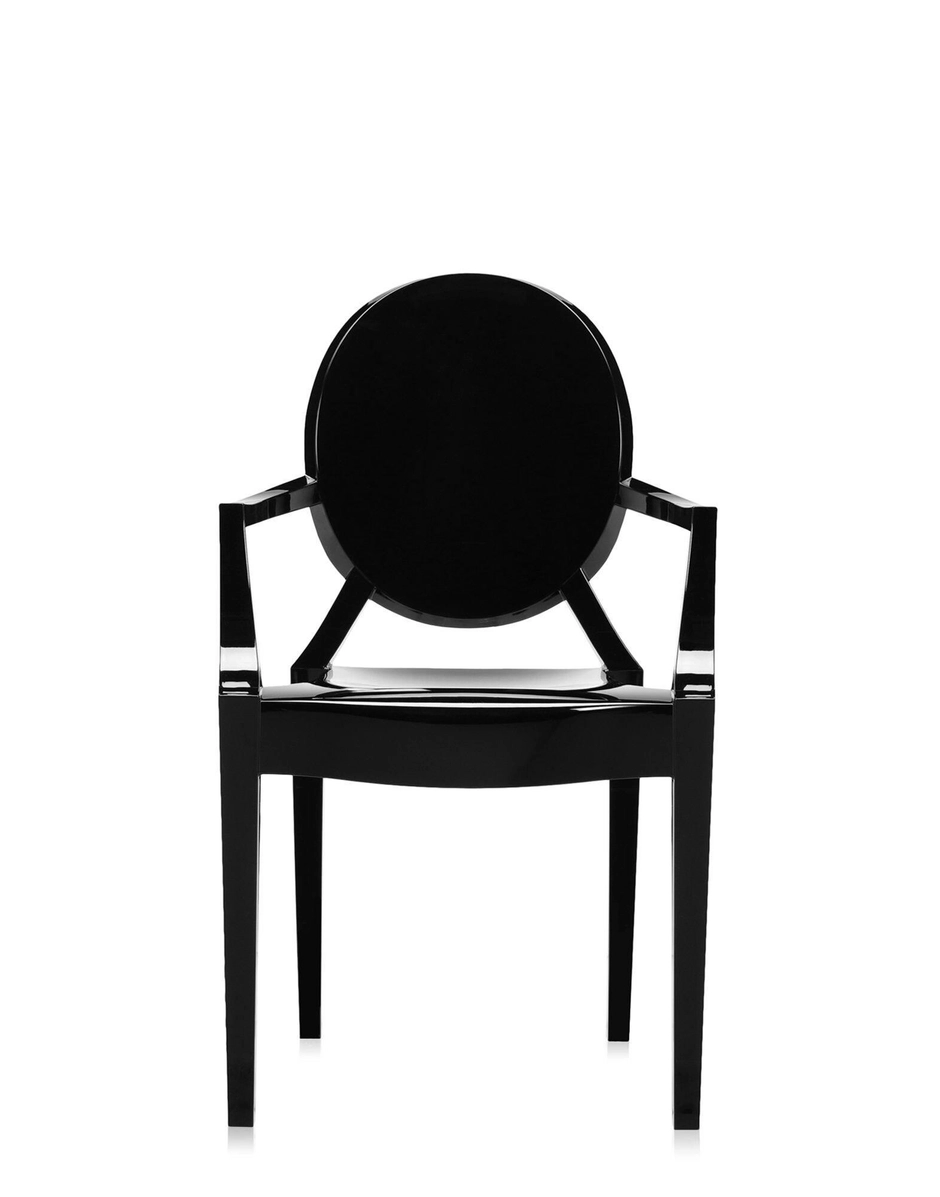
The black polycarbonate version reads as a sculptural object rather than a disappearing one. It is a different effect with the same construction, sold through the same listing.
Victoria Ghost, the armless companion, set of 2: $970
The Kartell Victoria Ghost is the armless side-chair version of the Ghost family: same polycarbonate construction, same stackable design, lower price. It is the better option for dining chairs where arm clearance is a constraint, and it pushes all the way under a table.
Masters Chair, set of 2: $910
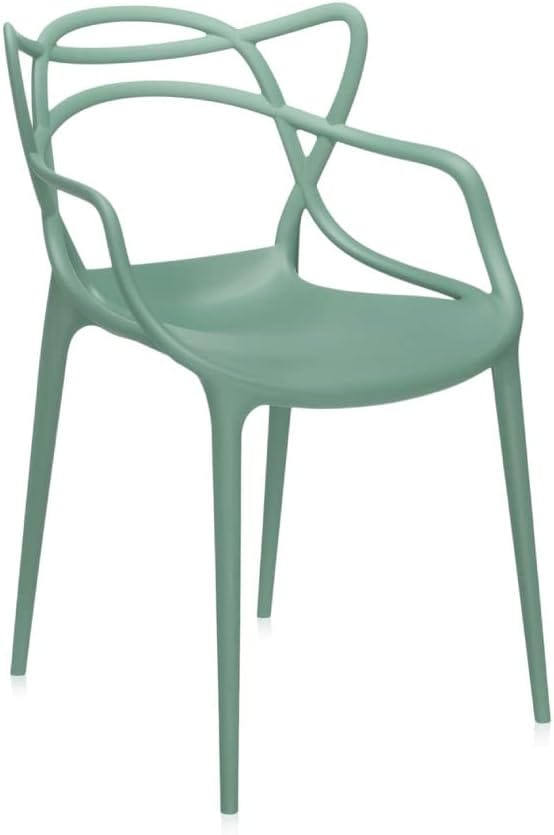
The Masters Chair is the other major Starck and Kartell collaboration, referenced earlier in this review. Where the Ghost Chair solves a spatial problem through transparency, the Masters Chair makes a design history argument through form. It is polypropylene rather than polycarbonate: opaque, available in a wide color range, and less expensive than the Ghost.
On a budget? Look secondhand. Ghost Chairs were sold by the million and turn up regularly on resale sites; the embossing test above tells you what you are buying. ADI does not recommend transparent chairs sold on the Ghost Chair’s look under another name.
For more affordable Starck objects under $100, see the companion guide. For the full range of Starck furniture including the Masters Chair and stool, see best Philippe Starck furniture.
Further Reading
- Judith Carmel-Arthur, Design Monograph: Starck (Phaidon, 2019): The most rigorous single-volume critical treatment of Starck’s work. Establishes the design argument the Ghost Chair is part of: what Starck was trying to prove with Kartell, and why the polycarbonate choice was not arbitrary.
- Ed Mae Cooper & Pierre Doze, Starck (Taschen, 2010): Visual survey of Starck’s full output. Shows where the Ghost Chair sits in his larger body of work: the furniture, the interiors, the product design, the bathroom systems.
Frequently Asked Questions
What is the Kartell Louis Ghost Chair?
It is a transparent polycarbonate armchair designed by Philippe Starck and produced by the Italian company Kartell since 2002. The shape is a simplified Louis XVI armchair with an oval back, molded in one piece from polycarbonate in crystal, tinted and opaque colors. It stacks, it can go in covered outdoor spaces, and it is sold in pairs.
How can I tell if a Ghost Chair is authentic?
Check the embossing. Authentic Kartell Ghost Chairs have the Kartell name, the product name, and Philippe Starck’s name embossed directly into the polycarbonate: molded into the material, not printed on a label or hang tag. If the branding is on any kind of sticker, paper label, or separate tag, it is not a Kartell chair. Do this check before you accept delivery or assemble anything.
Is the Kartell Ghost Chair comfortable?
Not for extended sitting. The polycarbonate has no give, and the contact points are hard. Most owners note that an hour in the Ghost Chair is the limit before you want a cushion. This is a design trade-off, not a defect. The chair was optimized for visual impact, not ergonomic comfort. If extended comfortable sitting is the priority, this is not the right chair.
How much does a Kartell Louis Ghost Chair cost?
Kartell sells the Louis Ghost in pairs. At Design Within Reach in September 2026 a set of two cost $1,290, or $645 a chair. Kartell’s US store (kartell.com) and its authorized dealers include the 10-year structural warranty that third-party marketplace sellers do not provide.
What is the difference between the Louis Ghost and the Victoria Ghost?
The Louis Ghost has arms; the Victoria Ghost does not. Both are Starck designs for Kartell in the same single-mold polycarbonate, and both stack. The armless Victoria Ghost slides fully under a dining table and costs less: $970 for a set of two at Design Within Reach in September 2026, against $1,290 for a pair of Louis Ghosts.
Can the Ghost Chair be used outdoors?
Yes, in covered outdoor areas. The authentic polycarbonate is UV-stabilized and weather-capable. This is a genuine advantage of the original material over the ABS and acrylic used in counterfeits, which are not UV-stabilized and will degrade faster outdoors. Avoid leaving any polycarbonate chair in direct sun for extended periods.
Does the Ghost Chair scratch easily?
Yes. Polycarbonate scratches, and the crystal/transparent version shows scratches most readily. If the chairs will be moved frequently (slid on a hard floor, stacked regularly) expect scratching over time.
Why did the Ghost Chair sell so many copies?
Because it solved a real problem: an armchair that is visually absent in a room. The transparent polycarbonate delivers a disappearing-chair effect that no other production chair achieves. The two million sales figure reflects product-market fit: the chair does what it claims, in rooms where that claim matters. Starck’s name helped, but the function drove the sales.
Why is the Ghost Chair so famous?
It was the first time a recognizable historical chair, the Louis XVI armchair, was reproduced in a single piece of transparent polycarbonate. Philippe Starck designed it for Kartell in 2002, and pairing a courtly silhouette with an industrial see-through material made it instantly legible as both a design statement and a usable chair. More than two million have sold across forty countries, and it turns up in museum collections, hotel lobbies, and restaurants, which is what turned one product into a shorthand for accessible designer furniture. For the broader context, see Starck’s most famous designs.
For the broader context of this work, see the Iconic Furniture Design hub — a survey of the chairs and objects that defined twentieth-century design.

About Zoe Post
Zoe Post holds a BFA and a Master of Architecture from the School of the Art Institute of Chicago. She now works as a product marketing leader at an architectural product design firm, bringing hands-on industry perspective to everything she writes. At ADI she covers contemporary artists, textile and pattern design, and the design objects that sit at the boundary of art and function.