

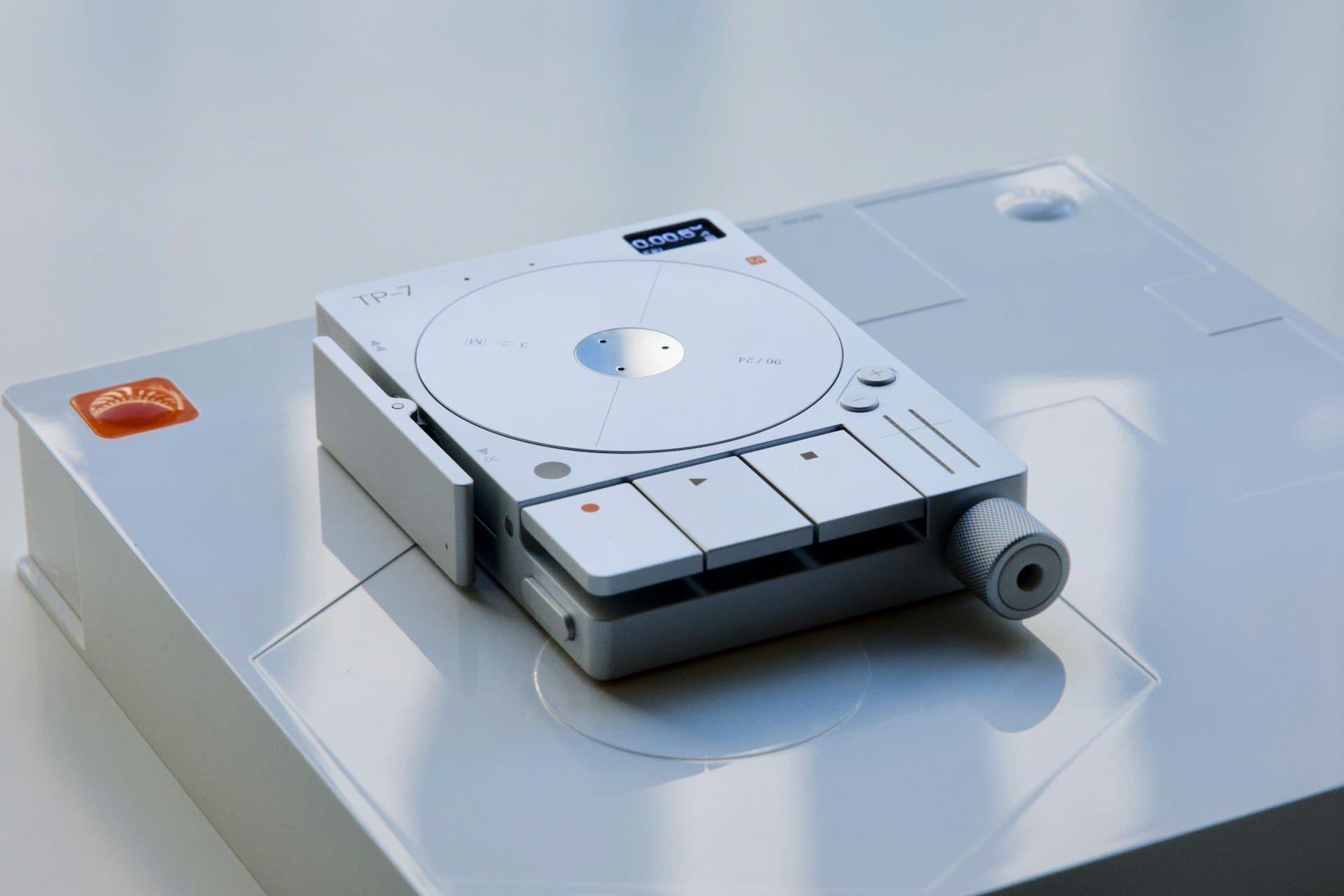
Around 2011, Teenage Engineering released the OP-1, a portable synthesizer about the size of a hardcover book. It contained multiple synthesis engines, a sampler, a sequencer, an FM radio, and a built-in microphone. All of this was operated through a row of physical encoders, a small color display, and a compact rubber keyboard. At a time when most synthesis had moved to software, the OP-1 was a deliberate argument: that music-making should be physical, that an instrument should push back, that the resistance of a well-machined dial is part of the creative act.
The argument held. The OP-1 became one of the most discussed design objects of the decade, not because it was the most powerful synthesizer available, but because it felt resolved. You could pick it up and understand it. The controls meant what they looked like they meant. Its design lineage runs directly to Dieter Rams — and understanding that lineage is the subject of this essay.
Where that quality comes from matters.
The tradition
Dieter Rams joined Braun as a designer in 1955 and spent three decades making objects that changed what products were allowed to look like. The SK-4 record player, the T3 pocket radio, the ET 66 calculator: each followed from a set of principles he articulated and returned to throughout his career. The most quoted is the simplest: “Good design is honest.”
What this means in practice is not decoration. The argument, as Rams articulated it, was for correspondence between appearance and function — for objects that do not misrepresent what they contain, what they can do, or what they cost to produce. The T3 radio looks like a radio because it is one. That correspondence is what his principles were designed to protect. Whether it fully held across Braun’s commercial output is a separate question. The principle itself was clear, and it became one of the most durable design ethics of the postwar period. Donald Norman translated the same principle into cognitive terms in The Design of Everyday Things: “affordances,” “mappings,” the relationship between an object’s visible properties and the user’s mental model. Whether that framework survives the shift to AI is the subject of The Design of Everyday Things Was Not Designed for This.
Jonathan Ive encountered this tradition directly. In Gary Hustwit’s documentary Objectified, Ive describes Apple’s design process as the pursuit of each product’s essential nature, the removal of everything that does not belong until only the object’s truth remains. Apple’s design team kept Braun’s product catalog as studio reference. The visual connection between the T3 and the first iPod is not coincidence. It is inheritance.
Where Ive extended the tradition, he did so by redefining what honesty meant for a different category of object. The iPhone is not honest about its circuits. There are none visible. It is honest about being a surface, a window through which software operates. The transparency moved inward, from material to interface. The object’s truth is not its components but its nature as a portal. The technology was mature enough to be described. The form was the admission.
Where Teenage Engineering diverged
Teenage Engineering is not an Apple spinoff, and describing it as part of the same design lineage requires some interpretation. The shared reference points are there: Rams’s principles, the discipline of subtraction, the conviction that form should not argue for more than an object actually does. However, where Ive moved to glass and the progressive disappearance of physical controls, TE went the other way — toward tactility, toward objects that respond, resist, and announce their mechanisms. The OP-1 Field synthesizer, released in 2022, is a slab of aluminum containing forty years of synthesis history. Its controls are deliberate. Its limitations are generative. The object’s constraints are part of its argument.
There is a design philosophy here that goes further than aesthetics. TE objects are built around the idea that the best-designed objects are not the most innovative-looking ones but the most resolved ones. The look follows from the resolution. When something is genuinely worked out, the form can afford to be quiet.
This is what makes TE an interesting collaborator for an AI product, and a revealing one. Their authority is earned. Their aesthetic is a record of that earning. When you borrow the aesthetic, you are borrowing the record without the history behind it.

The R1 as borrowed authority
The Rabbit R1 was designed in collaboration with Teenage Engineering and released in early 2024. Its aesthetic borrows directly from the tradition above: rounded corners, a matte surface, a scroll wheel with the satisfying weight of a well-made instrument, an orange casing that recalls the Pocket Operators. As an object, it is carefully considered.
The collaboration made sense as a strategy. If you are bringing a new AI device to market and you want to signal that it is serious, precise, and trustworthy, you recruit the company whose objects have earned that reputation. TE’s authority as an industrial design collaborator is earned through years of objects that do exactly what they claim. The R1 borrowed that standing.
The collaboration itself was not clumsy. The difficulty is structural. Design authority in the Rams tradition is not a visual property. It is an ethical claim. TE instruments look the way they do because they do what they appear to do. The relationship between form and function is a relationship of correspondence, of the object’s appearance being accountable to its behavior.
The R1’s form makes an implicit claim: that this object is resolved, built on the same correspondence between appearance and capability that its design lineage was built on. At launch, critics across design and technology press documented a consistent gap between what the device appeared to offer and what it could reliably deliver. In my reading, that gap is a design problem before it is a technology problem. It is a resolved design language applied to a capability that was not yet resolved.
This is not a criticism of Teenage Engineering. The visual language they brought was executed well. You cannot borrow the authority of the Rams tradition without the conditions that produced it. The aesthetics, separated from the resolved use they normally express, become a formal argument the object cannot back up.
A different lineage: the Humane AI Pin
The Humane AI Pin drew from a different design lineage. Where the R1 reached toward TE’s material craft, the Pin borrowed from a lineage of wearable technology and ultra-minimal product design: the ambitions of first-generation Apple Watch, the industrial design of medical devices, the clean surfaces of high-end European consumer electronics.
The Pin is a small rectangular device worn magnetically on the chest. It has no screen. It is designed to be invisible in use, an interface that disappears against clothing. Its design argument is that the best possible form for an AI assistant is no form at all: that the honest answer to the embodiment problem is to dissolve it.
The position is different from the R1’s, and it holds together on its own terms. Where the R1 argues that AI deserves a beautiful instrument, the Pin argues that AI deserves to be invisible. Both are responses to the same problem. Both borrowed design authority from traditions that had earned it through different means.
The Pin’s critics argued it failed on its own terms. The device was not invisible in use because it required too much deliberate attention: gestures, voice commands, a projected display that drew the eye. The argument for invisibility was not supported by the experience of using it. The form claimed a condition the technology could not produce. Furthermore, Humane collapsed as a company not long after launch; HP later acquired key assets, and the product ended before it had found its users. That outcome strengthens the design argument rather than complicating it.
What borrowed authority costs
These two products show different versions of the same underlying problem. The R1 borrowed the authority of material craft and produced an object that looked resolved but was not. The Pin borrowed the authority of invisible interface design and produced an object that demanded attention rather than disappearing.
In both cases, the design tradition being borrowed was sound on its own terms. The borrowing was the problem. The Rams design lineage produces its authority under a specific condition: the object answers questions that have been worked out. What is a radio? What should a calculator feel like? What does a turntable need to do? Form follows from resolution. When that form is applied to a product whose capabilities are still in motion, the same visual language signals something different — maturity the product has not earned.
That is not a moral claim about the companies involved. It is a claim about conditions. Resolved design language applied to unresolved capability produces a mismatch that users feel before they can name it.
This is the core difficulty for AI hardware, and it is primarily a sequence problem, not a design one. The Rams lineage requires something to be true before form can be honest about it. AI capability is not yet settled enough to be truthfully described in a physical object, at least not in the way the R1 and the Pin attempted.
What tradition AI objects actually need
The Rams lineage is a tradition of resolution. Form follows function once function is known. This is not a conservative argument. Rams’s work was genuinely new. But it is a sequential one. The technology has to stabilize before design can be honest about it.
What tradition would an honest AI object draw from?
One answer is the tradition of provisional design, the idea that form can honestly represent a thing in development. Prototype aesthetics, visible seams, the design language of objects that announce their own incompleteness. Some AI software has gestured toward this: the spinning cursor, the streaming output, the interface that makes its own processing visible. Hardware has not found its equivalent.
A different answer, and possibly a more useful one, is that AI hardware may need to stop borrowing and start building its own lineage. Every major technological form eventually produces objects that look like themselves. The automobile, the telephone, the laptop: none borrowed their forms permanently. The furniture phase is always temporary. At some point the technology matures into a form that belongs to it alone.
The design intelligence working on this question is serious. In May 2025, io Products, Inc. merged with OpenAI, with Jony Ive and his design collective LoveFrom assuming deep design and creative responsibilities across the company. Ive understands both sides of the problem: the Rams-to-Apple design lineage he built on for decades, and the particular demands of software-first, cloud-dependent products. No product has been announced.
That the project remains unrevealed is consistent with the argument here. In the Rams sense, you cannot design honestly for something whose nature has not been settled. The answer is still being worked out.
What the OP-1 knows
Teenage Engineering’s instruments are trustworthy because the questions they answer are settled. What is a synthesizer? What should a sequencer feel like? How much resistance should an encoder have? These are solvable problems, and TE solved them carefully. The objects earn their authority because the authority is grounded in behavior.
The R1 was an attempt to transfer that authority to a different category of problem. The design was capable. The transfer did not hold, and that is not TE’s failure. The tradition that produces honest form is being asked to give form to something that has not yet decided what it is.
What the R1 looks like, at some distance, is a well-made argument for a question that has not been answered. That is what the furniture phase looks like from inside it. Not a mistake. A placeholder, built from borrowed material, waiting for the real thing to arrive.
Joe Post is a writer. He holds an MFA from CalArts and writes about design as cultural argument at artdesignideas.com.

About Joe Post
Joe Post holds an MFA in Art from California Institute of the Arts (CalArts) and has done additional graduate work at the School of the Art Institute of Chicago. He founded Art Design Ideas to write about design as cultural argument — the decisions, contradictions, and assumptions built into the objects we live with.