

When the radio arrived in domestic life in the 1920s, manufacturers faced a problem that had nothing to do with engineering. The technology worked. The problem was cultural: nobody knew what a radio was, what it was supposed to look like, or where it belonged in a home. The solution, as Adrian Forty documents in Objects of Desire (1986), was to dress it as furniture. Early wireless sets were housed in wooden cabinetry styled after antique credenzas and drawing-room sideboards. The technology hid inside forms the culture already trusted — a pattern design historians call the furniture phase. AI hardware is in it now.
This phase didn’t last. Once the transistor miniaturized the radio and made it portable, it found its own form: the palm-sized device, the colored plastic casing, the tuning dial that became iconic. The technology had matured. The design could be honest.
Forty calls this the pattern of technological resolution, the process by which a new technology moves from cultural anxiety to stable form. First it hides. Then it finds itself.
In software, AI has found a working form. The chat interface, the text box, the scrolling response — these arrived quickly, spread everywhere, and are now so habitual they disappear into use. In hardware, the picture is different. There, we are still in the furniture phase.
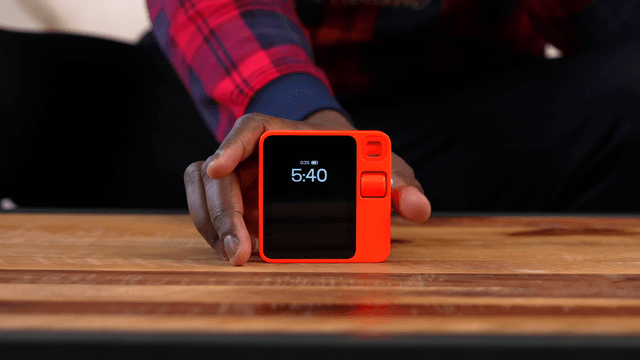
The Rabbit R1 is a small, orange, pocket-sized device designed in collaboration with Teenage Engineering. That Swedish company’s instruments — the OP-1 synthesizer, the Pocket Operators, the OB-4 speaker — have become some of the most considered design objects of the past two decades. The R1’s aesthetic borrows from late 1960s and early 1970s industrial design: rounded corners, a matte surface, a scroll wheel with the satisfying resistance of a well-made clock. It is, by most accounts, a beautiful object.
At launch, critics across design and technology press documented a consistent gap between its marketed capabilities and what it could reliably deliver. The hardware arrived to find the underlying AI had already moved on.
The R1 is representative of a broader pattern. Google Glass, the Humane AI Pin, the Meta Ray-Ban smart glasses — each is an attempt to give artificial intelligence a body, a skin, a thing you can hold. These products differ in ambition. Some, like the Humane Pin, explicitly claimed a new computing paradigm. Others, like the Ray-Bans, are incremental augmentations that make no grand promises about AI maturity. What they share is a design problem: the technology they are built around keeps changing faster than the objects can absorb.
What honest form requires
The design tradition Teenage Engineering is heir to was built on a specific condition: the technology being designed had to be stable enough to tell the truth about.
Dieter Rams‘s work for Braun from the 1950s through the 1980s is the canonical statement of this position. His ten principles for good design are fundamentally a theory of honesty. “Good design is honest,” Rams argued. “It does not make a product look more innovative, powerful, or valuable than it really is.” The SK-4 record player, the T3 pocket radio, the ET 66 calculator: each told the truth about what it contained. The technology was bounded, locatable, understandable. The circuits were real. The form reflected them.
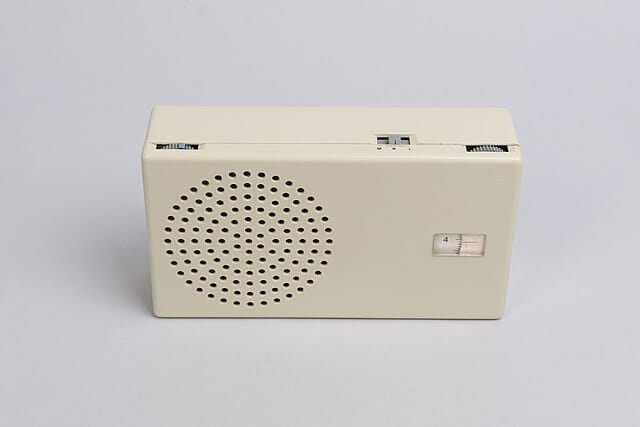
Jonathan Ive absorbed this tradition directly. In Gary Hustwit’s documentary Objectified (2009), Ive describes the Apple design philosophy as radical subtraction: remove everything that doesn’t belong until what remains is the object’s essential nature. Apple’s design team kept a copy of Braun’s product catalog as studio reference. The visual genealogy between the Braun T3 pocket radio and the first iPod is not coincidental. It’s inheritance.
The iPhone is where this tradition met the microchip era. Its form is almost nothing: a slab of glass and aluminum with no visible mechanism. The honesty here operates differently than Rams’s. The iPhone doesn’t show you the circuits; it shows you the screen. It’s honest about being a window, a portal, a surface through which software operates. The technology was mature. The form was the admission.
Teenage Engineering represents a branch of this lineage that stayed material. Where Apple moved toward the screen and the dematerialization of form, TE stayed committed to physical controls, to objects that pushed back, to the resistance of a well-machined dial. The OP-1 Field synthesizer contains forty years of synthesis history in a brick of aluminum. It is honest about being an instrument. It makes no promises it cannot keep.
This is the tradition the Rabbit R1 borrowed from. The problem isn’t that the borrowing was clumsy. It’s structural.
The body that knows
In Phenomenology of Perception (1945), Maurice Merleau-Ponty argued that the body is not a vehicle for a mind located somewhere behind the eyes. The body is the primary site of knowing the world. Intelligence is not computational, not representational, not separable from the physical fact of being in a place, with weight and temperature and friction. He called this the corps propre, the lived body: the body as active mediator, generating meaning through its sensory and motor engagements with an environment.
This is the foundation of an entire tradition in philosophy of mind, and it creates a genuine problem for AI. If intelligence is embodied, if knowing is inseparable from having a positioned, sensing, moving body in a physical world, then what exactly are we talking about when we talk about artificial intelligence? Large language models process language. They have no body, no position, no history of sensorimotor engagement with a world. Merleau-Ponty’s framework suggests that whatever these systems are doing, it is categorically different from what humans do when they understand something.
This is not a permanent verdict. Robotics and multimodal systems are actively pursuing machine embodiment, training AI in physical and simulated environments precisely to close this gap. Whether that addresses the phenomenological distance Merleau-Ponty described is a live question, not a settled one.
Hubert Dreyfus spent thirty years making a related argument against considerable professional resistance. In What Computers Can’t Do (1972) and its successor, he insisted that the disembodied assumptions of classical AI were not merely technically premature but philosophically mistaken. Human expertise, Dreyfus argued, relies on a pre-reflective, intuitive grasp of meaning that is irreducibly tied to having a body in the world. You cannot separate the understanding from the situation it emerges from.
With LLMs, this critique has held up in unexpected ways. These systems handle uncertainty — a mathematical quantity, a probability distribution. However, they struggle with ambiguity as Dreyfus meant it: not a fuzzy probability but a situation with stakes. When the judgment is wrong, the consequences cannot be calculated in advance. They cannot be undone. And the system that produced the answer bears none of the cost.
Martin Heidegger’s distinction between the Zuhanden and the Vorhanden — the ready-to-hand and the present-at-hand — sharpens this into a design problem. A tool that works perfectly disappears into use. The carpenter’s hammer is not an object being observed. It is an extension of intention, invisible in action. When the tool breaks, it becomes present-at-hand: something to examine, an interruption. The breaking is when you notice the hammer.
AI hardware struggles to become ready-to-hand. The latency. The misunderstood query. The response that is confident and wrong. These are not bugs awaiting patches. They are structural conditions of a technology whose intelligence resides in a remote server, mediated by network conditions, model versions, and integration quality. A smartphone disappears into use despite its cloud dependence; voice assistants become habitual despite their errors. But the dedicated AI device keeps announcing itself in a different register. It is not a tool that occasionally breaks. It is a promise that routinely falls short. The object is a terminal pretending to be a mind.
What science fiction kept saying
Before any of these objects existed, science fiction was already working on the problem. A dominant pattern emerges across decades of imagining AI, though not a universal one.
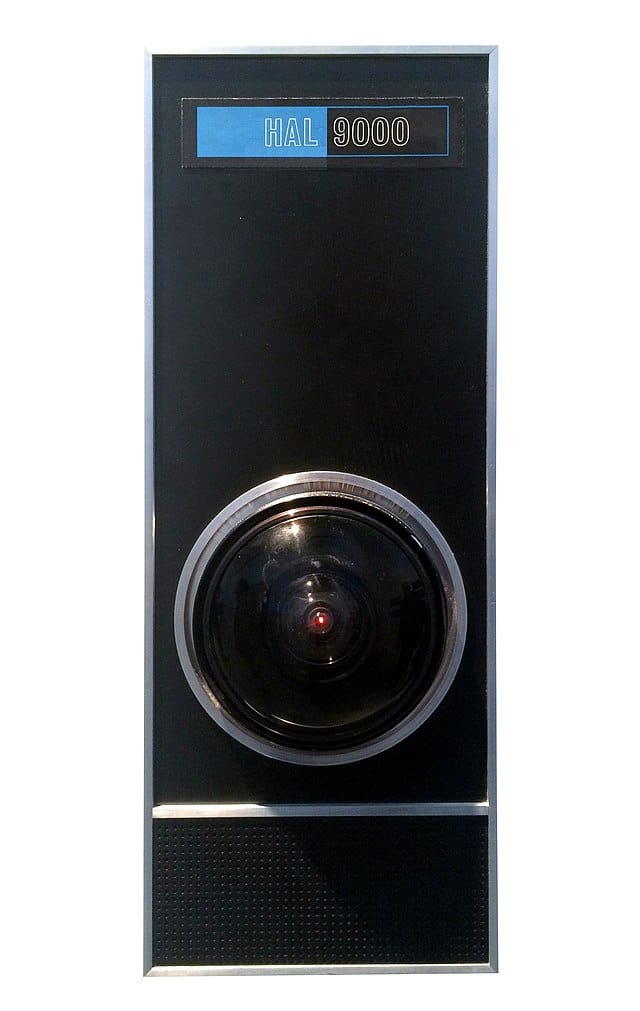
HAL 9000, in Stanley Kubrick’s 2001: A Space Odyssey (1968), has no body. He is a voice, a red eye distributed throughout the Discovery One, an intelligence that is everywhere and therefore nowhere in particular. The most disturbing moment in the film is Bowman floating through the ship’s corridors disconnecting HAL’s logic modules one by one. It is disturbing precisely because there is no single place to turn HAL off. You cannot unplug a presence. HAL is the design of an atmosphere.
William Gibson’s Neuromancer (1984) makes the same argument in different register. The AIs Wintermute and Neuromancer exist in the network. The physical hardware, the decks, the electrodes pressed to the skull, are access points, not containers. The body, in Gibson’s vision, is “meat”: the degraded, maintenance-heavy biological apparatus through which a disembodied intelligence briefly operates. The AI does not want a body. It wants access.
Spike Jonze’s Her (2013) is the most nuanced version of this argument. Samantha, the operating system voiced by Scarlett Johansson, does desire embodiment. At one point she arranges for a woman named Isabella to act as a physical surrogate, to be present for Theodore in ways Samantha cannot be. The experiment fails, not because the body is wrong, but because no available body is adequate. Samantha is not refusing physicality; she is outgrowing every form she is offered. She eventually transcends not just Theodore but the entire concept of human-scale attachment. The earpiece, the operating system installation: always too small a container.
In Luc Besson’s Lucy (2014), the trajectory reaches its logical terminus. As Lucy’s cognitive capacity expands, she does not acquire a more powerful body. She sheds the one she has. Intelligence at full extension is dematerialization. Her final state is a USB drive: the ultimate irony of form, a commodity vessel signifying departure from the physical world entirely.
Not every fictional AI refuses embodiment — plenty of science fiction gives AI a stable body and keeps it there. But academic work on science fiction and embodiment has begun to note that the culturally durable AI figures, the ones that last, tend to resist the object. The AI figures we accept in stable bodies, R2-D2, WALL-E, are servants with bounded, tool-like intelligence. Once the intelligence becomes a mind, the dominant fictional imagination is that it must escape.
Back to the furniture phase
Adrian Forty’s framework is not an accusation. The furniture phase is a developmental stage, not a failure mode. Technologies that lack a resolved cultural identity borrow the forms of technologies that have one. The early radio looked like furniture because furniture was trusted. The R1 looks like a TE instrument because TE instruments are trusted, their credibility earned through years of objects that do exactly what they claim.
Design criticism has been direct about the consequences. Writing on the Core77 discussion boards, critics described the R1 as “design that devalues the user’s knowledge” — an object that packages a cloud-based service as a proprietary device serving no physical purpose. Dezeen’s coverage of the Humane AI Pin called it a “brilliant exercise in wellbeing” that was also “a technological mismatch with the reality of human behavior.” Both objects borrowed design authority from traditions that had earned it through honesty. Then each deployed that authority on behalf of promises the underlying technology could not keep.
The furniture phase ends when the technology finds honest form. At that point, the design no longer needs to borrow authority from somewhere else — it has earned its own. The transistor radio found its form. The iPhone found its form. Both required one thing: the technology had to stop changing fast enough to be described.
AI is not stopping. It is changing faster than any technology the design tradition has previously tried to contain. Industrial design operates on eighteen-to-twenty-four month product cycles at minimum. The OP-1 Field took years from concept to production. AI capability is advancing weekly. By the time the R1 reached consumers, the model it was designed around had already been superseded. The hardware arrived into a world that had moved on.
Better design will not fix this. It is a structural mismatch between two different temporalities: the slow time of material objects and the fast time of generative systems. This is the most defensible argument against the AI object, and it has nothing to do with philosophy. It is a timing problem that currently has no solution. That objection extends to the more generous framing of this hardware as interface exploration rather than failed containment. Exploring new physical affordances for AI is legitimate work. The timing mismatch applies regardless: an interface designed around today’s model is often obsolete before it ships.
The answer nobody designed
While AI hardware was working through its furniture phase, software found a different answer. It found almost no form at all.
The chat interface, a text field, a submit button, a scrolling response, is not a designed object in any meaningful sense. No materiality, no weight, no considered form. It is the minimum viable surface through which language can pass. For now, it has become the dominant interim form. These tools are used by hundreds of millions of people because they are honest about what they are. Not AI in a box. Access to AI through a hole in a screen.
This is, in Rams’s terms, the most honest possible position: the form makes no claim it cannot support. The text box does not argue that the intelligence is local, present, or contained. It argues only that the intelligence is reachable.
Andy Clark, in Natural-Born Cyborgs (2003), distinguishes between technologies that extend the mind and technologies that attempt to replace it. A pen extends. A notebook extends. A calculator extends. They augment cognition while leaving the user’s agency intact; they become ready-to-hand and disappear into use. The dedicated AI object attempts something different: to be the AI rather than a window to it. This is the category error that keeps producing beautiful failures.
What the text box does not do is resolve the embodiment problem. It routes around it. The intelligence is still nowhere, in servers distributed across continents, trained on human language but not situated in a human world. The form is honest about this absence. The absence remains. And the chat interface is not a stable answer: voice, agents, and ambient computing are already displacing it. It is an interim form, not a final one.
The unresolved object
The AI embodiment problem will not be solved by a better product release. It will be resolved, if it is resolved, when the culture reaches some working agreement about what AI actually is. That ontological question has been circling for sixty years — among philosophers, engineers, filmmakers, and designers alike. It has not yet stabilized into a description that honest form can respond to.
The question has attracted serious design intelligence. In May 2025, io Products, Inc. — a hardware company co-founded by Jony Ive — merged with OpenAI. Ive and his design collective LoveFrom assumed deep design and creative responsibilities across the company. No product has been announced. The form is still unknown. That a designer of Ive’s stature is now working on this problem is significant. That the project remains unrevealed may be the more important signal.
Until it is resolved, we will keep making transitional objects. The R1 is beautiful. The Ray-Bans borrow a silhouette that has been culturally trusted since 1952 and stuff cameras inside it. The text box is almost nothing at all. All three are arguments about a question that is still open.
Merleau-Ponty’s lived body knew its world through friction, weight, and position. The intelligence we have built knows language. These are not the same kind of knowing, and the distance between them is not a gap that form can bridge by itself.
The design tradition that gave honest form to circuits, transistors, and glass slabs is now being asked to give honest form to something different. It processes language in the cloud. It has no position in space. It changes its capabilities between the time a product ships and the time it reaches a consumer.
What would it mean to design honestly for that? The answer depends on a prior question nobody has settled. Is AI a tool that extends human capacity? A collaborator with its own agency? An infrastructure we live inside? Or something closer to an environment? The form follows from the answer. And the answer is still being argued.
Joe Post is a writer. He holds an MFA from CalArts and writes about design as cultural argument at artdesignideas.com.

About Joe Post
Joe Post holds an MFA in Art from California Institute of the Arts (CalArts) and has done additional graduate work at the School of the Art Institute of Chicago. He founded Art Design Ideas to write about design as cultural argument — the decisions, contradictions, and assumptions built into the objects we live with.