

Dieter Rams products are the more than 500 objects the German designer created or oversaw at Braun between 1955 and 1995, plus his furniture for Vitsœ. The best known are the SK 4 radio-phonograph (1956, with Hans Gugelot), the T3 pocket radio (1958) and the 606 Universal Shelving System (1960). You can still buy the 606 and the 620 Chair Programme new from Vitsœ, along with Braun’s 2019 LE speakers, developed from Rams’s 1959 LE1.
Dieter Rams inspired products apply his ten principles of good design — honest materials, functional clarity, and nothing superfluous — to everyday objects. The best Dieter Rams inspired products come from Braun, Vitsœ, and Muji, each carrying forward the less-but-better discipline Rams codified at Braun between 1955 and 1995.
The Problem Dieter Rams Was Trying to Solve
In the late 1970s, Rams surveyed the products his team had made and arrived at an uncomfortable conclusion: he was part of the problem. He described the designed world as “an impenetrable confusion of forms, colours and noises.” The ten principles were not a manifesto for the industry — they were a verdict he issued on himself.
Rams joined Braun in 1955 as a young architect-trained designer. He had studied under Wilhelm Wagenfeld’s influence and entered a company already committed to breaking from the decorative American styling that dominated postwar consumer goods. Braun’s owners, Erwin and Artur Braun (the founder’s sons), had partnered with designers from the HfG Ulm — the Hochschule für Gestaltung, the institution that carried Bauhaus thinking forward after the war. Hans Gugelot was already collaborating with Braun when Rams arrived. Rams inherited that framework and pushed it further than any of them had gone.
By the time he retired in 1995, Rams had designed or overseen more than 500 products at Braun. The ten principles — formulated in those late 1970s years of self-examination — codified what the best of those products had in common. Good design is honest. It is unobtrusive. It is long-lasting. It is, above all, “as little design as possible” — that phrase, translated from the German “Weniger, aber besser” (less, but better), is the one that follows him everywhere, and the one that most people misread.
Why “Minimalist” Is the Wrong Word for What Rams Did
The ten principles are not an aesthetic program. They are an ethical one. The look of a Braun product — white, matte, functionally legible — is a consequence of solving each principle, not a style applied on top of an object that might have been designed differently. This distinction matters when you’re deciding what counts as a Rams-inspired product and what’s just a thing with clean lines.
A genuinely Rams-inspired product is honest: it does not pretend to do what it cannot. It is unobtrusive: it does not demand your attention. It is long-lasting: it resists obsolescence by refusing to follow trends. Most products sold as “minimalist” satisfy one of these conditions. Very few satisfy all three.
The Apple comparison gets made constantly, and Rams himself acknowledged it — he told Gary Hustwit in the 2009 documentary Objectified that Apple is one of the few companies designing products according to his principles. Jony Ive has called Rams his primary influence, and the visual parallel between the Braun T3 pocket radio (1958) and the original iPod (2001) is the most documented design parallel in the last fifty years. But Rams was not entirely comfortable with the comparison, and the discomfort is instructive: a Braun clock from 1972 still works. The Vitsœ 606 shelving system has been in production since 1960 — unchanged, because there was nothing to change. Apple products are designed to be replaced. That is a different philosophy using some of the same grammar.
Rams Originals and What You Can Buy Today
Some Rams designs never left production, some came back, and some live only on the vintage market. This is where each of the famous ones stands now. For the full story of the Braun years, see our guide to Braun design objects by Dieter Rams.
| Rams original | Year | Buyable today |
|---|---|---|
| SK 4 radio-phonograph (with Hans Gugelot) | 1956 | Out of production; vintage and auction market only |
| T3 pocket radio | 1958 | Out of production; vintage market only |
| LE1 loudspeaker | 1959 | Braun Audio LE01, LE02 and LE03, launched in 2019 with Bluetooth and Wi-Fi inside the original form |
| 606 Universal Shelving System | 1960 | New from Vitsœ, in continuous production |
| 620 Chair Programme | 1962 | New from Vitsœ, re-engineered with Rams in 2013 |
| Braun clocks and watches | 1970s onward | Current Braun clock and watch lines such as the BC12 and BN0032 below |
Beyond Braun and Vitsœ, a few makers work in his tradition with their own designs. Teenage Engineering, the Stockholm studio behind the OP-1 synthesizer, is the one most often compared to Rams-era Braun. Muji and Naoto Fukasawa reach a similar restraint from a Japanese starting point, and Apple under Jony Ive took his principles into consumer electronics. For how his approach differs from American styling, see Raymond Loewy vs Dieter Rams.
Our Top Picks
Four of these five products are on Amazon. One is not, and that one is arguably the most important. The Vitsœ 606 has no Amazon listing because it is not that kind of product — you buy it directly from Vitsœ, and it ships in configurations. It earns its place here because no list of Rams-inspired objects is complete without the piece Rams himself called his most important work.
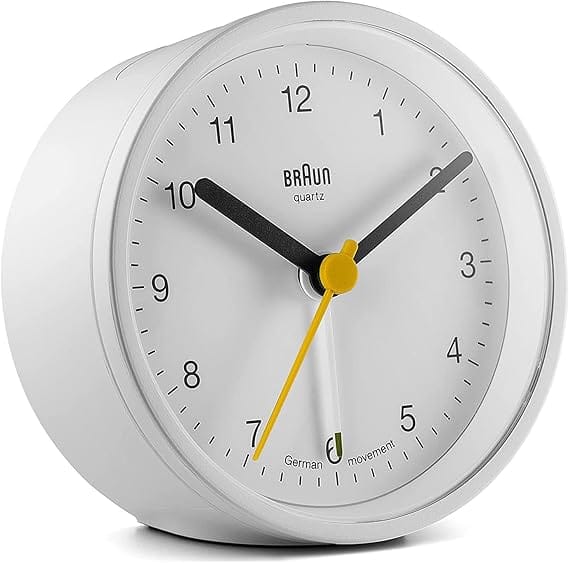
Braun BC12 Classic Alarm Clock
Budget · $30–50 · Bedroom / nightstand
The current-production descendant of the Braun clocks Rams designed in the 1970s — stripped face, no decorative elements, the same refusal to announce itself.
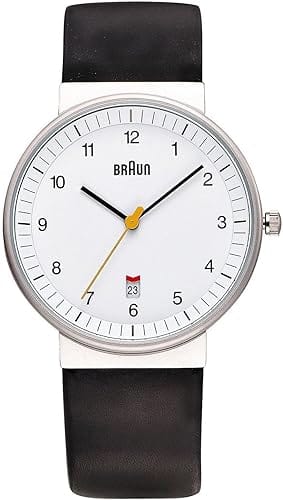
Braun BN0032WHBKG Watch
Mid-Range · $150–200 · Daily wear
The watch idiom translated from the Braun Phase 1 clock — white dial, minimal indices, the yellow second hand as the one concession to personality.
Braun Series 3 3040s Shaver
Mid-Range · $40–60 · Daily grooming
Direct successor to the Braun Sixtant series Rams oversaw in the 1960s — the form is determined by the function of the foil head, not by ergonomic theater.
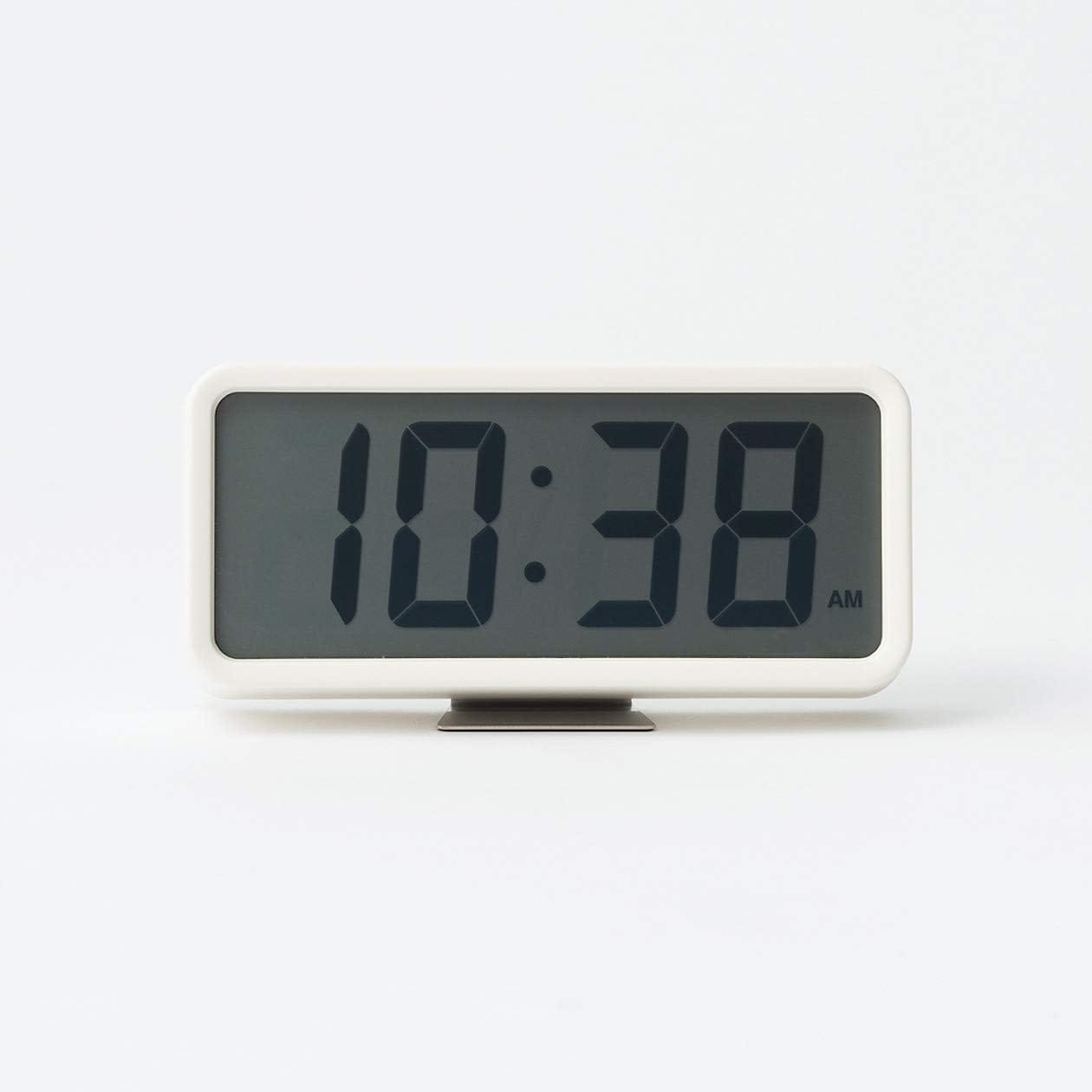
Muji Digital Clock Medium White
Budget · $25–40 · Desk / kitchen
No brand mark on the face, no decorative elements, nothing competing with the information it’s presenting — as close to Rams-grade restraint as a non-Braun product gets.
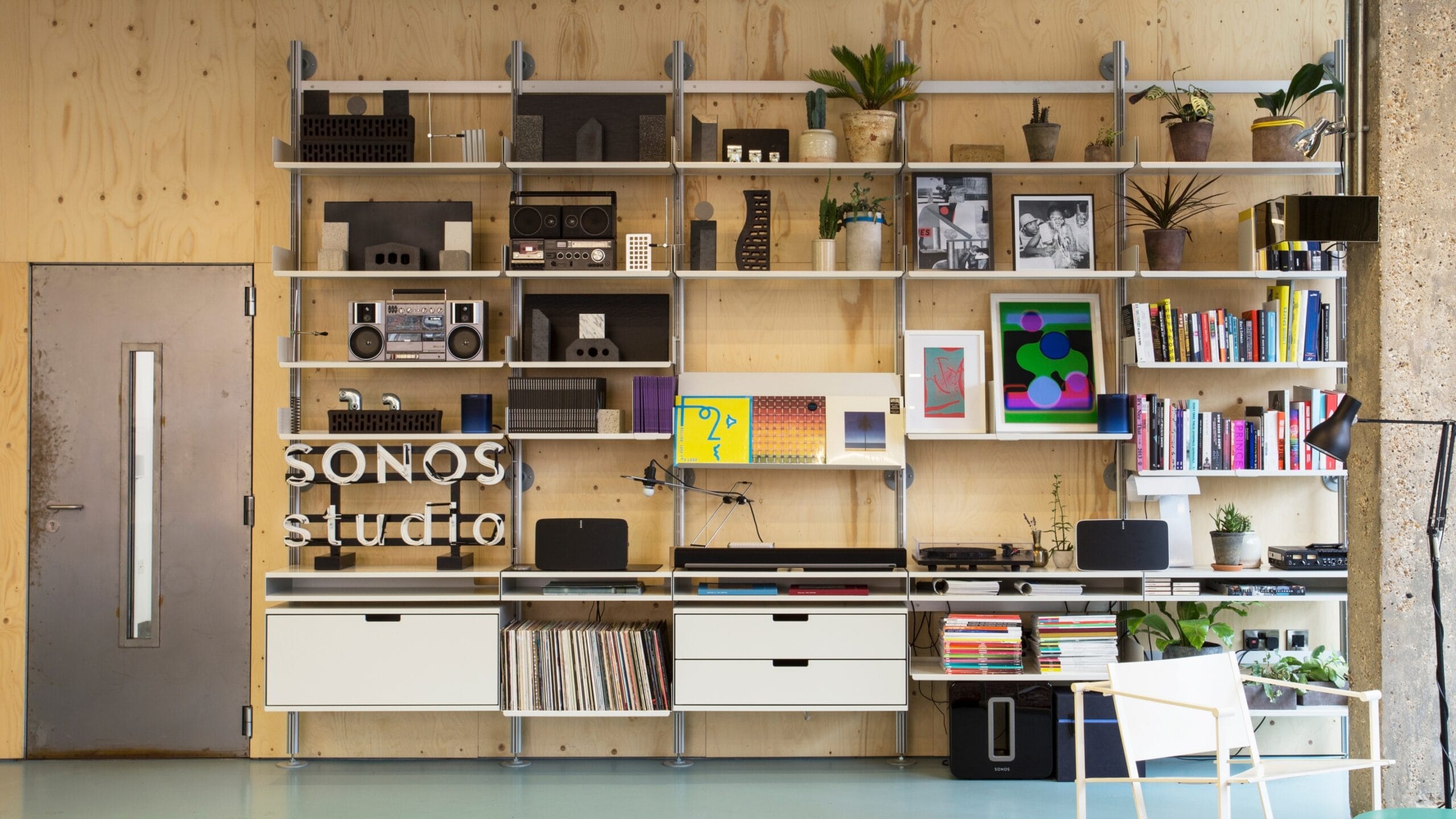
Vitsœ 606 Universal Shelving System
Premium · $500+ · Home / office
Not available on Amazon. Designed by Rams in 1960, still in production unchanged. The defining object of his career — configurable, expandable, and repairable, with every component available individually.
Quick Decision Guide
- Best overall: Braun BC12 Classic Alarm Clock — Low price relative to its design pedigree, still manufactured, and the most direct surviving link to the Braun clock vocabulary Rams established in the 1970s.
- Best for the desk: Muji Digital Clock Medium White — Blends rather than competes; the no-brand-mark face is the right object for a desk that already has enough going on.
- Best wearable: Braun BN0032WHBKG Watch — The Rams clock idiom on the wrist; the yellow second hand is the only move away from total restraint, and it earns that move.
- Best grooming tool: Braun Series 3 3040s Shaver — The form logic of the Sixtant series, updated for current foil technology; Braun’s grooming line has held the formal argument longer than any other product category.
- Best for the home or office: Vitsœ 606 Shelving System — Not on Amazon. The canonical Rams object; buy direct from Vitsœ and plan to use it for the rest of your life.
Full Comparison
| Product | Best For | Price Range | Key Rams Principle Embodied | Link |
|---|---|---|---|---|
| Braun BC12 Classic Alarm Clock | Bedroom / nightstand | Budget ($30–50) | Unobtrusive, honest | Buy on Amazon |
| Braun BN0032WHBKG Watch | Daily wear | Mid-Range ($150–200) | Long-lasting, thorough to the last detail | Buy on Amazon |
| Braun Series 3 3040s Shaver | Daily grooming | Mid-Range ($40–60) | Useful, understandable | Buy on Amazon |
| Muji Digital Clock Medium White | Desk / kitchen | Budget ($25–40) | As little design as possible | Buy on Amazon |
| Vitsœ 606 Shelving System | Home / office | Premium ($500+) | Long-lasting, environmentally friendly | See Vitsœ.com |
Why These Five Products Pass the Rams Test
Braun BC12 Classic Alarm Clock
Pros:
- Face design descends directly from the Braun clock vocabulary Rams formalized in the 1970s — the stripped dial is not an aesthetic choice, it’s the result of removing everything that doesn’t tell you the time
- Still manufactured and widely available — not a vintage piece requiring sourcing
- Price point is low for what it represents historically ($30–50)
- Legible at a glance in low light without needing a backlight
Cons:
- Build quality is not Braun’s postwar standard — the current production is made to a price point, and it shows in the plastic casing
- The alarm function is functional but not quiet; it won’t ease you awake
Who it’s for: Anyone who wants a Rams-lineage object on a nightstand without spending more than $50.
Why it stands out: It is the most direct surviving product link between what Braun was making under Rams and what you can order today. The formal argument is intact even if the materials have changed.
Braun BN0032WHBKG Watch
Pros:
- White dial, minimal indices, and the yellow second hand is the only element that could be called a design decision — everything else is the absence of one
- The watch runs on the same formal principles as the Braun clocks, which is exactly the kind of design consistency Rams built his career on
- Built to last; quartz movement is robust and the strap is replaceable
Cons:
- The price ($150–200) is mid-range but buys you a quartz movement, not Swiss-grade mechanics — the design is worth more than the engineering
- Not a dress watch; the white dial reads as casual in formal contexts
Who it’s for: Someone who wants to wear the Rams formal vocabulary daily without committing to a vintage Braun piece.
Why it stands out: The yellow second hand is the one concession to personality in an otherwise completely restrained design, and it works — it proves that “as little design as possible” doesn’t mean “no decisions at all.”
Braun Series 3 3040s Shaver
Pros:
- The form is determined by the engineering of the foil head, not by the desire to look like a premium object — this is Rams’ principle of honesty made literal
- The Sixtant series Rams oversaw in the 1960s established the visual language; the current Series 3 holds that logic
- Mid-range price for daily-use reliability ($40–60)
Cons:
- The grey and black color palette of current-production Braun shavers is less considered than the white and silver of the Rams-era originals
- Not the most powerful shaver in its price range — the design discipline comes at some cost to the spec sheet
Who it’s for: Someone who wants the Braun design lineage as a daily object that is also genuinely useful, not decorative.
Why it stands out: Of all the Rams-inspired products you can buy today, this is the one most directly doing the job it was designed to do — not displayed on a shelf, not worn as a signal, but used every morning.
Muji Digital Clock Medium White
Pros:
- No brand mark on the face — the face is the function and nothing else
- The white housing disappears into most environments, which is exactly what Rams meant by “unobtrusive”
- Budget price ($25–40) for a genuinely resolved design
Cons:
- The digital display means the formal vocabulary is different from the Braun analogue clock — this is the right object for different contexts (desk, kitchen) rather than a bedroom nightstand
- Build quality is budget-grade — it is not a heirloom object
Who it’s for: Someone who wants a Rams-grade restraint on a desk or kitchen counter and has no interest in the Braun brand specifically.
Why it stands out: Muji arrived at a similar visual conclusion from a completely different starting point, and the result is an object that makes the same argument without any reference to Rams at all — which is the strongest possible endorsement of the argument.
Vitsœ 606 Universal Shelving System
Pros:
- Designed by Rams in 1960 and still in production unchanged — this is what “long-lasting” means in practice
- Configurable, expandable, and repairable — every component is available individually
- Rams called this his most important work; that is not false modesty
Cons:
- Not available on Amazon — must be purchased directly from Vitsœ, which requires planning and lead time
- Premium price point ($500+) puts it out of range for casual purchase; this is a considered investment
Who it’s for: Anyone furnishing a home or office with a long time horizon — this is furniture you buy once.
Why it stands out: Every other product on this list is inspired by Rams. This one is Rams — the original, still made, available now.
The Tradition These Products Come From
Braun, under Rams, did not work in isolation. The intellectual framework came from the HfG Ulm — the design school that picked up where the Bauhaus stopped, emphasizing systematic thinking over individual expression. Hans Gugelot brought that framework into Braun before Rams became chief of design; Rams absorbed it and extended it across 40 years of product work.
Muji’s relationship to this tradition is more lateral than direct. The name itself points to the source: “mu” (nothing) and “ji” (sign or mark) — no brand mark, the product as function. Naoto Fukasawa, whose work shaped much of Muji’s product design in the early 2000s when he joined Muji’s design advisory board, operates from the Japanese concept of “ma” — negative space, the meaning carried by what is absent. That is a different philosophical tradition arriving at a similar formal conclusion. The Muji clock does not descend from Rams. It simply agrees with him, from the other side of the world, having reasoned its way there independently.
That convergence — Ulm rationalism and Japanese ma producing objects that look related but aren’t — is one of the more interesting facts in twentieth-century design. It suggests that Rams’ principles were not a style he invented but a set of observations he was the first to articulate clearly.
Shop the Collection
These four objects are the most accessible entry points to the Rams formal vocabulary — each available now, each holding the argument he spent 40 years making.
- Braun BC12 Classic Alarm Clock: The current-production descendant of the Braun clocks Rams designed in the 1970s — the same stripped-face logic, the same refusal to decorate.
- Braun BN0032WHBKG Watch: The Braun watch line runs on the same formal principles as its clocks — white dial, minimal indices, the yellow second hand as the only concession to personality.
- Braun Series 3 3040s Shaver: The Series 3 line descends from the Braun Sixtant shavers Rams oversaw in the 1960s — the form is still determined by the function of the foil head, not by ergonomic theater.
- Muji Digital Clock Medium White: Muji’s approach to clocks is as close to Rams-grade restraint as a non-Braun product gets — no brand mark on the face, no decorative elements, nothing that competes with what it’s telling you.
Further Reading
There are three books on Rams worth owning. Each does a different job.
- Dieter Rams, Less But Better (gestalten, 2014): The primary source — Rams writing about his own principles, with the object photography that makes the formal argument visible. If you read one book, this is it.
- Klaus Klemp, Dieter Rams: The Complete Works (Phaidon, 2021): The catalogue raisonné — every product Rams designed, chronologically documented. The only reference that lets you trace how the ten principles evolved across 500 objects over 40 years.
- Sophie Lovell, Dieter Rams: As Little Design as Possible (Phaidon, 2011), foreword by Jonathan Ive: The most contextualised biography available — Lovell situates Rams inside postwar German industrial culture and the HfG Ulm framework; Ive’s foreword makes the Apple connection explicit and Rams’ ambivalence about it legible.
Frequently Asked Questions
What is Dieter Rams known for?
Dieter Rams is the German industrial designer, born in Wiesbaden in 1932, who led design at Braun from 1961 to 1995. He is known for the ten principles of good design, the motto “Weniger, aber besser” (less, but better), Braun radios, record players and clocks, and the 606 Universal Shelving System he designed for Vitsœ in 1960.
What is Dieter Rams’ most famous product?
The Braun SK 4 radio-phonograph (1956), designed with Hans Gugelot and nicknamed “Snow White’s Coffin” for its clear lid, is usually named as his most famous product. The T3 pocket radio (1958) is a close second, and the Vitsœ 606 shelving system (1960) is the Rams design most people can still buy new.
What are Dieter Rams’ 10 principles?
Good design is innovative, makes a product useful, is aesthetic, makes a product understandable, is unobtrusive, is honest, is long-lasting, is thorough down to the last detail, is environmentally friendly, and is as little design as possible. Rams set them out from the late 1970s. Our Dieter Rams design principles guide takes each one in turn.
What products did Dieter Rams design for Braun?
Rams designed or oversaw more than 500 products at Braun between 1955 and 1995. The most frequently cited include the T3 pocket radio (1958), the Braun SK4 record player (1956, with Hans Gugelot), the phase 1 table clock, and the Sixtant foil shaver series. Outside Braun, his most important work is the Vitsœ 606 Universal Shelving System (1960), still in production today. The complete documented record is in Klaus Klemp’s Dieter Rams: The Complete Works (Phaidon, 2021).
Are Braun products still made using Rams’ design principles?
Current Braun products vary. The alarm clock and watch lines maintain close formal continuity with the Rams era — the BC12 alarm clock and the BN0032 watch both hold the original design vocabulary. The grooming line (Series shavers) retains the formal logic of the 1960s Sixtant series. Other product categories — Braun now licenses the brand to De’Longhi for some lines — have moved further from the original principles. The closer a current Braun product is to Rams’ own categories (clocks, shavers, audio), the more likely it is to hold the original argument.
What is the best Dieter Rams inspired product to buy today?
For most people: the Braun BC12 Classic Alarm Clock. It costs $30–50, still in production, and is the most direct surviving link between the Braun clock vocabulary Rams established and what you can put on a nightstand today. For a considered investment, the Vitsœ 606 Shelving System is the canonical Rams object — buy direct from Vitsœ, plan to use it for decades.
How did Dieter Rams influence Apple products?
Jony Ive has consistently named Rams as his primary influence. The most documented parallel is the Braun T3 pocket radio (1958) beside the original iPod (2001) — the form language, proportions, and control placement are nearly identical. Rams acknowledged the connection in Gary Hustwit’s documentary Objectified (2009), calling Apple one of the few companies designing to his principles, though he was not entirely comfortable with the comparison. The distinction Rams drew — implicit in his later statements — is that his objects were designed to last, not to be replaced.
What is the Vitsœ 606 and why is it considered the best shelving system?
The Vitsœ 606 Universal Shelving System was designed by Rams in 1960 and has been in continuous production since. It uses a system of wall-mounted uprights and horizontal shelves with no visible fasteners — the shelves clip into the uprights without screws. Rams called it his most important work because it is the principle he cared most about made physical: a product so well resolved that it requires no redesign. Every component made since 1960 is still compatible with current production. It is not available on Amazon; it is sold directly through Vitsœ.
Is Muji actually inspired by Dieter Rams?
Not directly. Muji’s design philosophy — the name means “no brand mark” — derives from a Japanese aesthetic tradition of restraint rooted in the concept of “ma” (negative space, the significance of absence). Naoto Fukasawa, whose work shaped much of Muji’s product design after he joined their design advisory board, arrived at similar formal conclusions through that tradition rather than through Rams. The convergence is real — a Muji clock and a Braun clock make similar arguments — but the genealogies are separate. Muji agrees with Rams; it did not learn from him.
The full profile of Rams’ design philosophy is in the Dieter Rams design principles guide. For the objects he made at Braun, see Braun design objects by Dieter Rams.

About Joe Post
Joe Post holds an MFA in Art from California Institute of the Arts (CalArts) and has done additional graduate work at the School of the Art Institute of Chicago. He founded Art Design Ideas to write about design as cultural argument — the decisions, contradictions, and assumptions built into the objects we live with.