

Dieter Rams’ ten principles for good design state that good design is innovative, makes a product useful, is aesthetic, makes a product understandable, is unobtrusive, is honest, is long-lasting, is thorough down to the last detail, is environmentally-friendly, and is as little design as possible. Rams, head of design at Braun from 1961 to 1995, wrote them in the late 1970s to test his own work. His shorthand for all ten: “Less, but better.”
Dieter Rams is a German industrial designer who spent nearly four decades at Braun, the Frankfurt consumer electronics company, and whose “Ten Principles for Good Design” remain the most cited framework in product design practice. His core argument: that good design should be as little design as possible — functional, honest, and invisible until you need it.
What Rams Was Actually Arguing
Dieter Rams joined Braun as an architect in 1955. By 1961 he was Chief Design Officer, a position he held until 1995. During those decades he designed or oversaw the design of products — shavers, radios, calculators, hi-fi systems — that became models for what understated, functional consumer design looked like. His relationship to the Bauhaus tradition was direct: the same commitment to function, the same distrust of ornament, the same argument that well-designed objects should be accessible to ordinary people. The Design Museum London credits him with “defining an elegant, legible, yet rigorous visual language in industrial design.” That assessment holds up in part because the Braun products have not aged in the way that fashionable design ages.
“You have to be confident to dare to be simple.”
— Dieter Rams
Jonathan Ive, who led Apple’s design from 1997 through 2019, has repeatedly credited Rams, and wrote the foreword to Sophie Lovell’s 2011 monograph Dieter Rams: As Little Design as Possible. The visual continuity between a 1960s Braun radio and an early generation iPhone is not incidental. It is the same argument about what a product owes its user: clarity, restraint, and surface that recedes so the function can speak. Rams sits in a line that runs from the Ulm School of Design, whose tutors advised Braun in the mid-1950s, to Silicon Valley. The shared argument is that functional discipline is the only honest position available to a designer in a world already saturated with objects. That argument was not self-evident in 1955. By 1995 it had become orthodoxy, and Rams is largely responsible for that shift.
Dieter Rams’ Ten Principles for Good Design
Rams wrote these principles in the late 1970s, after two decades of practice at Braun, when he began asking whether his own design was good design. They are published in their original form at Vitsoe, which produces his 606 Universal Shelving System and whose institutional relationship with Rams is the closest thing in design to an authorized record. They are not a design style — they are a set of standards against which to test a design decision.
Vitsoe pairs each principle with one object, and we follow its pairings below. Nine are Rams designs for Braun or Vitsoe. One, the ET 66 calculator, is by his Braun colleague Dietrich Lubs.
- Good design is innovative: Braun TP 1 radio/phono combination, 1959
- Good design makes a product useful: Braun MPZ 21 multipress citrus juicer, 1972 (with Jürgen Greubel)
- Good design is aesthetic: Braun RT 20 tischsuper radio, 1961
- Good design makes a product understandable: Braun T 1000 world receiver, 1963
- Good design is unobtrusive: Braun Cylindric T 2 lighter, 1968
- Good design is honest: Braun L 450 flat loudspeaker with TG 60 tape recorder and TS 45 control unit, 1962 to 1964
- Good design is long-lasting: Vitsoe 620 Chair Programme, 1962
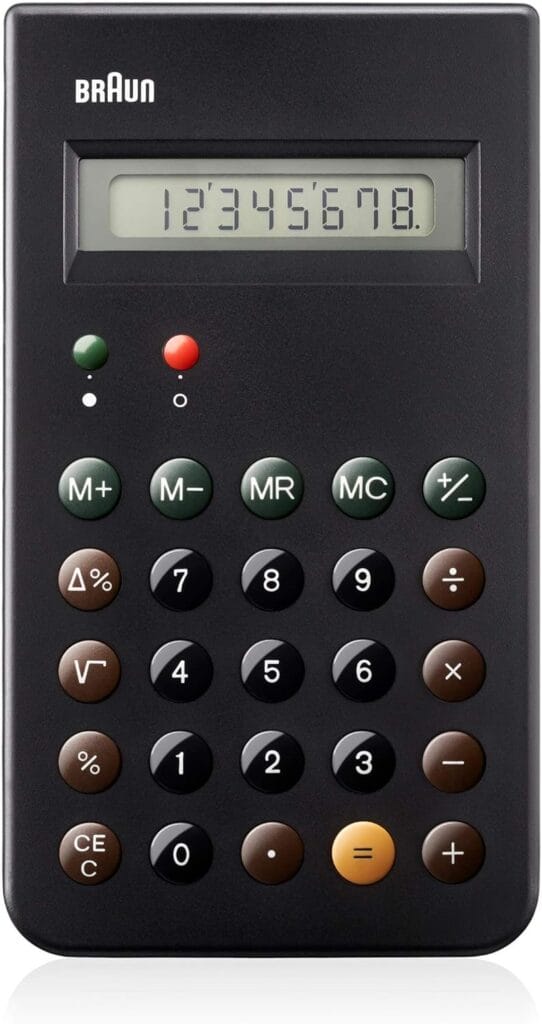
- Good design is thorough down to the last detail: Braun ET 66 calculator, 1987 (Dietrich Lubs)
- Good design is environmentally-friendly: Vitsoe 606 Universal Shelving System, 1960
- Good design is as little design as possible: Braun L 2 speaker, 1958
1. Good design is innovative
Innovation is not novelty for its own sake. The technological possibilities for design are always expanding, and good design explores those possibilities. But innovation is only valid when it serves the user. A new material or process is worth using when it makes the product better, not when it signals that something has changed.
Vitsoe’s example is the Braun TP 1 radio/phono combination (1959), which put a transistor radio and a portable record player into a single unit you could carry.
2. Good design makes a product useful
A product is bought to perform a function. Good design starts there. Aesthetic and psychological qualities matter, but usefulness is the baseline. Design that improves the appearance without improving the function has missed the point.
Vitsoe’s example is the Braun MPZ 21 multipress citrus juicer (1972), by Rams and Jürgen Greubel: a kitchen appliance with one job and nothing added to it.
3. Good design is aesthetic
The aesthetic quality of a product affects the user’s relationship to it. Objects used every day — a razor, a radio, a calculator — shape the visual environment of a life. They should be worth looking at. This does not mean decoration. It means that the forms, surfaces, and proportions of the object should be resolved to a point where nothing is accidental.
Vitsoe’s example is the Braun RT 20 tischsuper radio (1961), a table radio.
4. Good design makes a product understandable
The product should communicate its structure and function through its form. At best, it is self-explanatory. The user should not need a manual to understand how to operate it. This principle condemns interface complexity that requires training, hidden functions, and controls that do not indicate their purpose.
Vitsoe’s example is the Braun T 1000 world receiver (1963), a multi-band radio with many controls, where the layout itself has to explain what each one does.
5. Good design is unobtrusive
Products that fulfill a purpose are like tools. They are neither decorative nor works of art. Their design should be neutral and restrained, leaving room for the user’s self-expression. A product that demands visual attention is failing its user.
Vitsoe’s example is the Braun Cylindric T 2 table lighter (1968), a plain cylinder that does its job and otherwise stays out of the way.
“Good design emphasizes the usefulness of a product whilst disregarding anything that could possibly detract from it.”
– Dieter Rams
6. Good design is honest
A product should not pretend to be more innovative, powerful, or valuable than it is. It should not manipulate or deceive the buyer. Design that makes a cheap product look expensive, or a simple product look complex, is dishonest. The material should be what it says it is; the function should be what the form suggests.
Vitsoe’s example is the Braun L 450 flat loudspeaker, shown with the TG 60 reel-to-reel tape recorder and TS 45 control unit (1962 to 1964).
7. Good design is long-lasting
Good design avoids being fashionable, because fashion-dependent design becomes outdated quickly. A well-designed product should remain relevant for years or decades. This is also an environmental argument: objects designed to last do not need to be replaced. The 606 Universal Shelving System has been in continuous production since 1960.
Vitsoe’s example for this principle is the 620 Chair Programme (1962), which Vitsoe still makes.
8. Good design is thorough down to the last detail
Nothing in a design should be arbitrary or left to chance. Care and accuracy in the design process show respect for the user. The quality of the design is legible at the level of every detail: the radius of a corner, the weight of a button, the texture of a surface. Incompleteness at the detail level undermines the whole.
Vitsoe’s example is the Braun ET 66 calculator (1987), designed by Dietrich Lubs in the Braun design department Rams ran.
9. Good design is environmentally-friendly
Design makes an important contribution to the preservation of the environment. It conserves resources, minimizes physical and visual pollution throughout the lifecycle. This principle, articulated decades before sustainability became standard design language, is the natural consequence of the long-lasting principle: objects that are designed to endure use fewer resources over time.
Vitsoe’s example is the 606 Universal Shelving System (1960), built from interchangeable parts so it can be extended and rearranged instead of thrown out.
10. Good design is as little design as possible
Less, but better. Pure, simple design concentrates on the essential aspects. Back to purity, back to simplicity. This is not minimalism as aesthetic fashion. It is the logical conclusion of all nine preceding principles: if design is honest, functional, long-lasting, and unobtrusive, then the only design that remains is design that cannot be removed without loss.
In Vitsoe’s wording the principle reads: “Less, but better – because it concentrates on the essential aspects, and the products are not burdened with non-essentials. Back to purity, back to simplicity.” Vitsoe’s example is the Braun L 2 speaker (1958).
Rams and the Designers Who Followed
Rams’ principles set the terms for two generations of product designers. Philippe Starck arrived at a different answer to the same question — how do designed objects relate to their users — and the debate between the two positions (restrained functionalism vs. expressive democratic design) defines the main tension in post-Bauhaus design culture. The comparison with Raymond Loewy is equally revealing: where Loewy’s MAYA principle asked how much novelty an audience could absorb before discomfort, Rams refused the question entirely. The answer was always less.
For a practical guide to applying the principles — see How to Apply Dieter Rams’ Ten Principles. For the objects that best demonstrate the principles in physical form, see Braun design objects by Dieter Rams. For books that take his work seriously as criticism, see the best Dieter Rams design books. And for contemporary products that apply his framework without copying the Braun aesthetic, see the best Dieter Rams-inspired products. If you want to evaluate the objects you already own against these standards, see How to Identify Quality Industrial Design.
Why the Principles Have Not Aged
Dieter Rams’ principles continue to influence modern industrial design not because they are fashionable, but because they are correct. The test of a design principle is not whether it survives a trend cycle but whether it identifies something true about the relationship between people and objects. Rams’ ten principles have survived more than four decades and the full cycle of design movements — minimalism, postmodernism, Memphis, the excesses of the 1990s — without becoming dated. That durability is itself an argument for principle 7.
Among the studios that have carried this discipline forward, Teenage Engineering’s instruments offer the clearest contemporary translation of Rams’ formal vocabulary into electronic music.
Frequently Asked Questions: Dieter Rams’ Design Principles
What are Dieter Rams’ 10 principles of good design?
Rams’ ten principles state that good design is innovative, makes a product useful, is aesthetic, makes a product understandable, is unobtrusive, is honest, is long-lasting, is thorough down to the last detail, is environmentally-friendly, and, most concisely, is as little design as possible. These principles are not a style guide. They are a framework for evaluating whether a design decision serves the user or merely serves the designer’s agenda. Rams published them as a set of standards, not a manifesto.
How did Dieter Rams influence Apple’s design language?
Jonathan Ive, who led Apple’s design from 1997 through 2019, has repeatedly credited Rams and wrote the foreword to Sophie Lovell’s 2011 book Dieter Rams: As Little Design as Possible. The visual and functional continuity between Braun products of the Rams era, such as the T3 pocket radio, and early Apple hardware is not coincidental. Both apply the same argument: restrained surface, functional clarity, material honesty, and the removal of anything that cannot justify its presence. Ive’s Apple extended Rams’ industrial design ethics into consumer electronics at global scale.
Who did Dieter Rams design for?
Rams designed primarily for Braun from 1955 to 1995, serving as Chief Design Officer from 1961. He also designed furniture and storage systems for Vitsoe, including the 606 Universal Shelving System (1960) and the 620 Chair Programme (1962), both of which remain in production. His stated design audience was the ordinary person — not a luxury market or a collector, but someone who needed a product to work reliably and live in a home without demanding attention.
What makes Braun design different from other industrial design?
Braun design under Rams operated from a principled position of restraint at a time when most consumer electronics competed through visual complexity and novelty signaling. The surfaces were matte, the controls were minimal, and every element had a functional justification. The result was products that looked different from everything else on the market — not because they were styled to look different, but because they refused to be styled at all. That is a harder thing to achieve than decoration.
What is Dieter Rams’ most famous design?
The Braun SK 4 radio-phonograph (1956) is usually named as Rams’ most famous design. He developed it with Hans Gugelot of the Ulm School of Design, and its white body and clear acrylic lid earned it the nickname “Snow White’s Coffin.” The other contender is the 606 Universal Shelving System (1960), which Vitsoe still makes. For more of the Braun catalogue, see Braun design objects by Dieter Rams.
What is Dieter Rams’ most famous quote?
“Less, but better” (in German, “Weniger, aber besser”) is Rams’ best-known line. It is his summary of the tenth principle, good design is as little design as possible, and the title of his 1995 book.
What does Dieter Rams have to do with Teenage Engineering?
The connection is one of approach. Teenage Engineering, the Stockholm electronics company founded in 2005, gets compared to Rams-era Braun because products like its OP-1 synthesizer use the same compact forms, restrained surfaces and color-coded controls. Our Teenage Engineering design profile looks at that lineage in detail.
How can I apply Rams’ design principles at home?
Start with principle 10 — as little design as possible — applied as an editing standard. For each object in a space, ask whether it is there because it is needed or because it was acquired. For new purchases, apply principles 2, 4, and 6: does it do what it is supposed to do, can you figure out how to use it without a manual, and does it represent itself honestly? The full guide to applying the ten principles works through each standard with specific examples.
For the broader context of this work, see the Design Legends hub — profiles of the designers and movements that shaped modern design.

About Joe Post
Joe Post holds an MFA in Art from California Institute of the Arts (CalArts) and has done additional graduate work at the School of the Art Institute of Chicago. He founded Art Design Ideas to write about design as cultural argument — the decisions, contradictions, and assumptions built into the objects we live with.