

The MAYA principle design test (Most Advanced Yet Acceptable) is Raymond Loewy‘s formula for the right distance between familiar and new. It explains why some objects age well and others don’t. Apply it as a lens and you’ll make better decisions about furniture, kitchenware, and any object meant to last.
Why most design advice gets the question wrong
The Design Museum London profiles Loewy as one of the most commercially successful designers of the twentieth century, precisely because he never confused novelty with progress. His method — research, test, calibrate to the edge of acceptance — was systematic rather than intuitive. (Design Museum London, Raymond Loewy profile.)
The standard design question is “is it beautiful?” That question is unanswerable and, worse, unactionable. You can’t buy better by asking whether something is beautiful. Loewy replaced that question with one that has a test: is this the right distance from what people already accept? MAYA is not a style. It is a measurement. The same test applies to a Studebaker, a refrigerator, and a lounge chair. Distance from the familiar is something you can evaluate: in hindsight by whether people adopted the thing, and in real time by asking whether the object extends the vocabulary of the room or introduces a foreign one. Objects that pass the MAYA test tend to age without becoming caricatures of their era because they don’t overcorrect toward novelty. The principle was always commercial, and the commercial result was always the proof.
How to apply the MAYA principle design test to any object
The silhouette test: does the shape read at a glance?
MAYA objects have readable silhouettes. The Studebaker Avanti (1963) looks like a car — but not like any car that existed before it. The Shell logo, after Loewy’s 1971 redesign, looks like a shell — a more geometric, efficient shell than the original, with detail removed until only the recognizable form remained. Both pass the one-second test: look for a moment, look away, and you can reconstruct the outline from memory. Trend-driven objects require study. MAYA objects are legible.
For buyers, this is actionable. Hold your gaze for a second, then look away. Can you reconstruct the outline? If yes, you’re dealing with an object that has a stable formal identity, the kind that doesn’t require the current cultural context to make sense. If the object needs study to decode, it’s probably carrying more formal novelty than the MAYA point allows. For objects in this territory (streamlined barware, mid-century forms in current production), see our guide to Raymond Loewy inspired products.
The five-year test: will it look the same in five years?
Trend-driven design ages by definition. MAYA design doesn’t chase trends. It finds the nearest stable point to the culture’s current tolerance and stops there. Dieter Rams‘s 606 Universal Shelving System, designed in 1960, is still sold by Vitsoe with minor changes. The Memphis movement pieces from the 1980s look like the 1980s. Both were products of their moment; only one was calibrated to survive it.
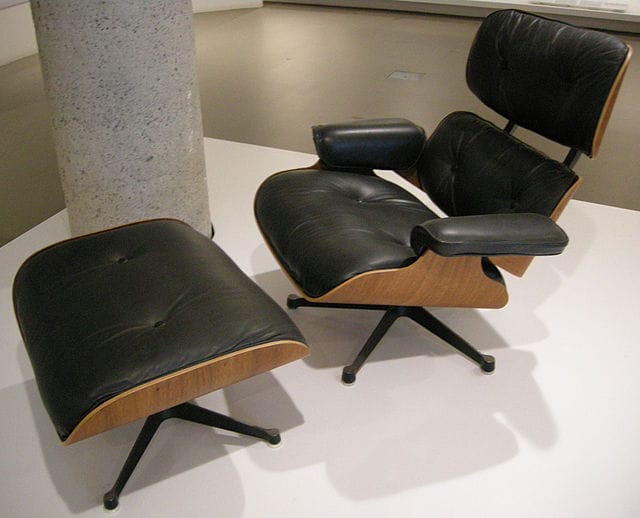
The question for buyers is whether the piece references something that existed before you noticed it, or whether it showed up as part of a current trend. MAYA objects have antecedents. They look like the next version of something that already made sense. Trend objects have peers. They look like everything else that appeared in the same six-month window. Lounge chairs are a clear case: the Eames Lounge Chair (1956, Herman Miller) passes because molded plywood and leather was genuinely new formal language applied to a familiar category. Many mid-century revival pieces don’t pass because they exaggerate the signals into caricature. See our guide to designer lounge chairs for examples at different price points.
The function surplus test: does it do more than it claims?
Loewy’s best work solved functional problems while also solving formal ones. The Greyhound Scenicruiser interior (1954) made long-distance bus travel feel less like transit and more like travel. The Coldspot redesign wasn’t just cleaner to look at; Loewy also made it easier to clean and load. Form and function improved together because Loewy’s research identified which functional complaints consumers actually had.
The buyer version of this test is direct: does the object’s form make its use easier, or does the form fight the use? A cocktail shaker with Art Deco geometry that’s also perfectly balanced and leakproof passes MAYA on both halves. One that looks correct but drips fails the acceptable side. The function undermines the advance. For barware and kitchen objects that pass both tests, see our Loewy-inspired product guide.
The context test: does it work in the room it’s going into?
MAYA is relational. “Acceptable” is defined by context, not absolutely. A streamline-era stainless steel kettle passes the MAYA test in a kitchen with mid-century leanings; the same kettle fails in a hyper-contemporary all-white kitchen where it reads as costume. The object hasn’t changed. The context has, and the context determines whether the distance from familiar is the right distance.
Loewy understood this commercially. He designed the Studebaker Avanti to feel like the next generation of a car people already knew. The implication for buyers is that you can’t evaluate a piece in a showroom. You need to evaluate it against the vocabulary already in the room. If the piece extends that vocabulary, it passes the context test. If it introduces a new vocabulary, even a good one, it requires the rest of the room to change with it. That’s a much larger commitment than the single object suggests. For thinking through room composition and furniture that extends rather than disrupts, see our guide to minimalist furniture for small spaces.
The longevity test: would you still want it in ten years?
The hardest version of the MAYA test is the forward projection. Objects at the novelty extreme become dated when novelty shifts. Objects at the familiar extreme become boring. MAYA objects sit in the productive middle: interesting now, without betting on future taste that nobody can predict.
The practical heuristic: if you can explain what makes the object interesting without referencing current trends, it probably passes. If the explanation requires “it’s very now” or “very of the moment,” it’s failing the Acceptable half of MAYA. The thing you’re buying is a bet that the object will still make sense when the context it arrived in has been replaced. Loewy’s most daring work (the Studebaker Avanti, the Air Force One livery) passed this test precisely because it moved to the edge of the acceptable, not to the middle. The principle is about calibrating risk, not avoiding it.
Where the MAYA principle breaks down, and where you break it
- Buying at the novelty extreme. When a design is the most advanced thing in the room, it has already failed the acceptable test. Avant-garde furniture that nobody sits in because it signals too hard is failing MAYA regardless of how good the design is in isolation. The principle operates at the room level, not the object level alone.
- Confusing MAYA with mediocrity. “Acceptable” does not mean safe. It means within the current tolerance for change. Loewy’s best work looked genuinely new. The Coldspot didn’t look like other refrigerators. The Avanti didn’t look like other cars. The difference between MAYA and mediocrity is that MAYA pushes to the actual edge of the tolerance. Mediocrity stops well short of it.
- Applying MAYA to the wrong scale. The principle works at the individual object level, not the interior level. A room designed end-to-end at MAYA tolerances will feel flat. The principle requires contrast between stable context and advancing object. MAYA works when individual pieces push against an otherwise settled room.
- Ignoring the context half of the test. A piece that passes MAYA in a showroom can fail in your apartment if the existing vocabulary is mismatched. The test is relational. The same object can be the right distance from familiar in one room and an alien intrusion in another.
- Treating MAYA as a taste test rather than an analytical tool. The goal is to understand why something will age well, not to identify the safest purchase. Loewy took risks. He calibrated them to what the market could absorb at that moment, but the calibration was active. The principle is a method for managing risk, not for avoiding it.
Frequently Asked Questions
What does MAYA stand for in design?
MAYA stands for Most Advanced Yet Acceptable. The principle was coined by Raymond Loewy and first formalized in his 1951 autobiography Never Leave Well Enough Alone. It holds that successful design finds the furthest point of innovation within the current cultural tolerance for change: advanced enough to be interesting, familiar enough to be accepted.
How did Raymond Loewy use the MAYA principle in his work?
Loewy applied MAYA by running consumer acceptance research before finalizing designs. For the Coldspot refrigerator (1935), he tested which formal changes consumers noticed and which they dismissed, then designed to the edge of what they could accept. The same logic applied to the Lucky Strike package redesign (1942), the Studebaker Avanti (1963), and the Air Force One livery (1962): each moved as far from the familiar as the market could follow, and no further.
Can the MAYA principle apply to furniture shopping?
Yes, and it’s more useful than most buying frameworks. Apply it in three steps: does the piece extend the vocabulary already in the room, or introduce a new one? Does the silhouette read at a glance, or does it require study? Can you explain what makes it interesting without referencing current trends? Furniture that passes all three is operating at the MAYA point, far enough from familiar to be worth buying, close enough that it won’t require the room to change around it.
What is the difference between good design and trendy design?
Good design in the MAYA sense is calibrated to the edge of the current tolerance for change and stops there: as advanced as the context can absorb without rejection. Trendy design chases the novelty end of the spectrum without the restraint that makes novelty last. The Memphis movement is the clearest counter-example: deliberately anti-MAYA, maximally novel, minimal acceptance. The pieces age as period artifacts because they bet on a future taste that didn’t sustain.
Which products best embody the MAYA principle today?
Objects that have already survived one cultural cycle without becoming dated are the clearest current examples. The Eames Lounge Chair (1956) is still in production at Herman Miller without formal changes. Dieter Rams’s 606 Universal Shelving System (1960) is still sold by Vitsoe. Georg Jensen’s Manhattan barware applies the same streamline vocabulary Loewy used on the GG1 locomotive: it reads as current without reading as of-the-moment. For specific product recommendations in this territory, see our guide to Raymond Loewy inspired products.
For the broader context of this work, see the Raymond Loewy profile — the career behind the MAYA principle. For book-length reading on Loewy’s method and career, see our best Raymond Loewy books guide. For objects that apply MAYA logic at current price points, see best Raymond Loewy inspired products.

About Joe Post
Joe Post holds an MFA in Art from California Institute of the Arts (CalArts) and has done additional graduate work at the School of the Art Institute of Chicago. He founded Art Design Ideas to write about design as cultural argument — the decisions, contradictions, and assumptions built into the objects we live with.