
A designer lounge chair is where the tension between comfort and visual argument becomes explicit. The best designer lounge chairs, the Eames Lounge, the Barcelona Chair and the Egg, earn their price by solving a problem ordinary chairs pretend doesn’t exist: how a chair should feel to look at as much as to sit in.
This guide links only to the licensed makers and their authorized dealers for those three chairs. Below them are two affordable lounge chairs that borrow nothing from anyone’s design. If you want to know how to tell a licensed chair from an unlicensed one, the Eames Lounge authentication guide and the Barcelona Chair authentication guide walk through the labels, materials and construction details.
The Originals, and Where to Buy Them
Three chairs, each still made by the company that holds the design. The selection criteria are not comfort scores or price-per-feature ratios. They are design coherence, material honesty, and whether the object still means what it was designed to mean when it arrives in a room that has nothing to do with its origin. Prices were checked at Design Within Reach in September 2026.
Eames Lounge Chair and Ottoman (Herman Miller)
Authorized · Charles and Ray Eames, 1956 · $7,745
Molded plywood shells, leather cushions, a cast aluminum swivel base. Herman Miller has made it continuously since the chair’s television debut in 1956, and it is the best recliner in this group by a wide margin.
Egg Chair (Fritz Hansen)
Authorized · Arne Jacobsen, 1958 · from $10,499 in fabric, $14,499 in leather
The shell geometry Jacobsen drew for the 1958 SAS Royal Hotel commission gives lateral containment that flat-back chairs structurally cannot. It has a smaller footprint than a chaise and reads as a defined object from any angle. Best for reading.
Barcelona Chair (Knoll)
Authorized · Ludwig Mies van der Rohe, 1929 · $8,327 in leather, $5,550 in fabric
Mies designed this in 1929 for a building meant to be demolished. The chair has outlasted every room it was made for. The X-frame is among the most analyzed structural decisions in furniture history. It was built for visual authority, and comfort came second.
Under $300, Imitating Nothing
Most cheap “mid-century” lounge chairs are copies of the three chairs above, and ADI does not link to them. These two are different. Both use a slatted solid-wood frame with loose cushions, a generic Danish-modern type that no single designer owns, and neither tries to look like an icon from across the room.
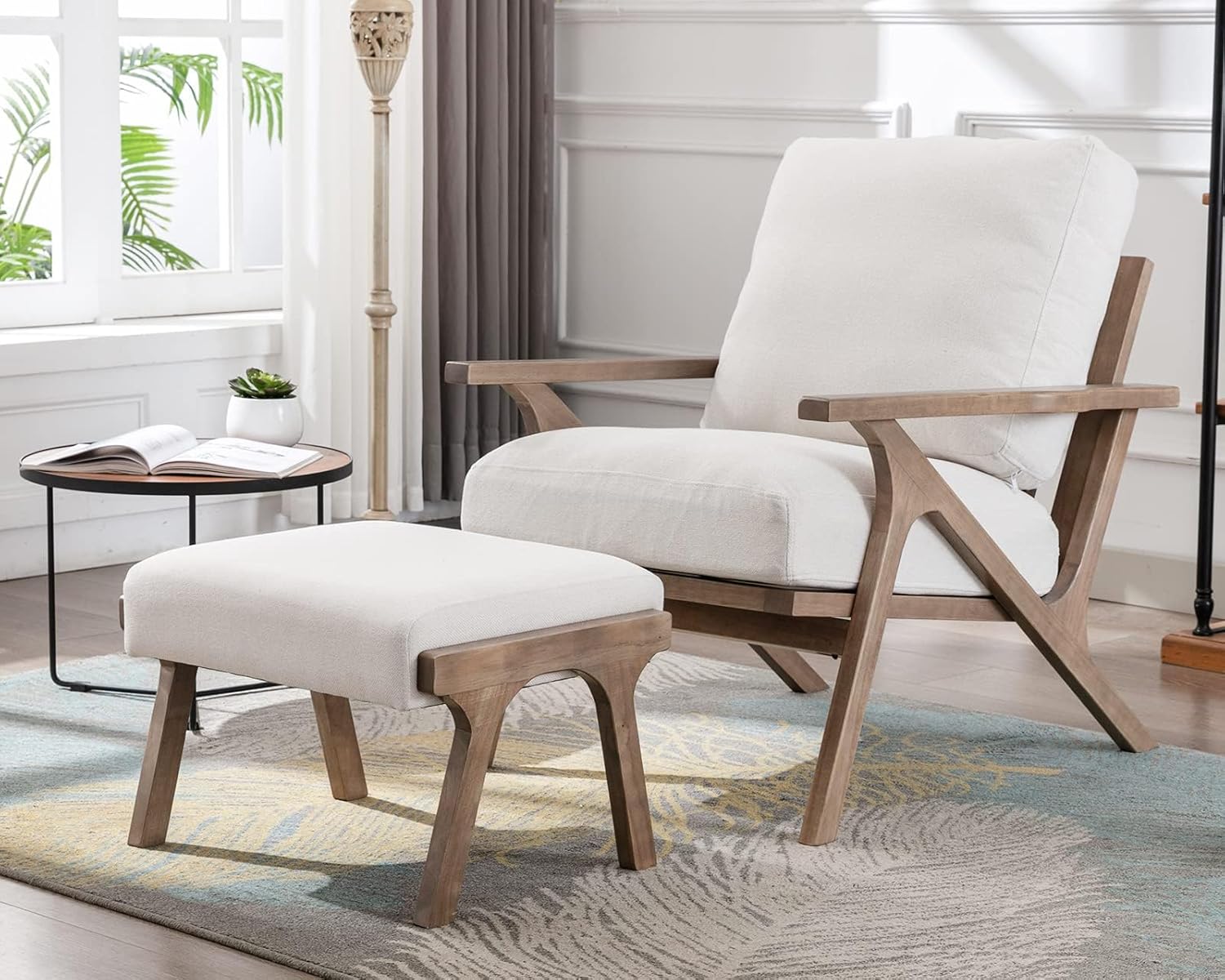
HNY Mid Century Arm Chair
Budget · Solid Wood Frame / Removable Cushions
Wood frame, removable cushions, and a matching ottoman sold as an option. It comes in several upholsteries, including a brown faux leather and a linen. It works in a bedroom or small apartment without making a spatial claim the room cannot support.
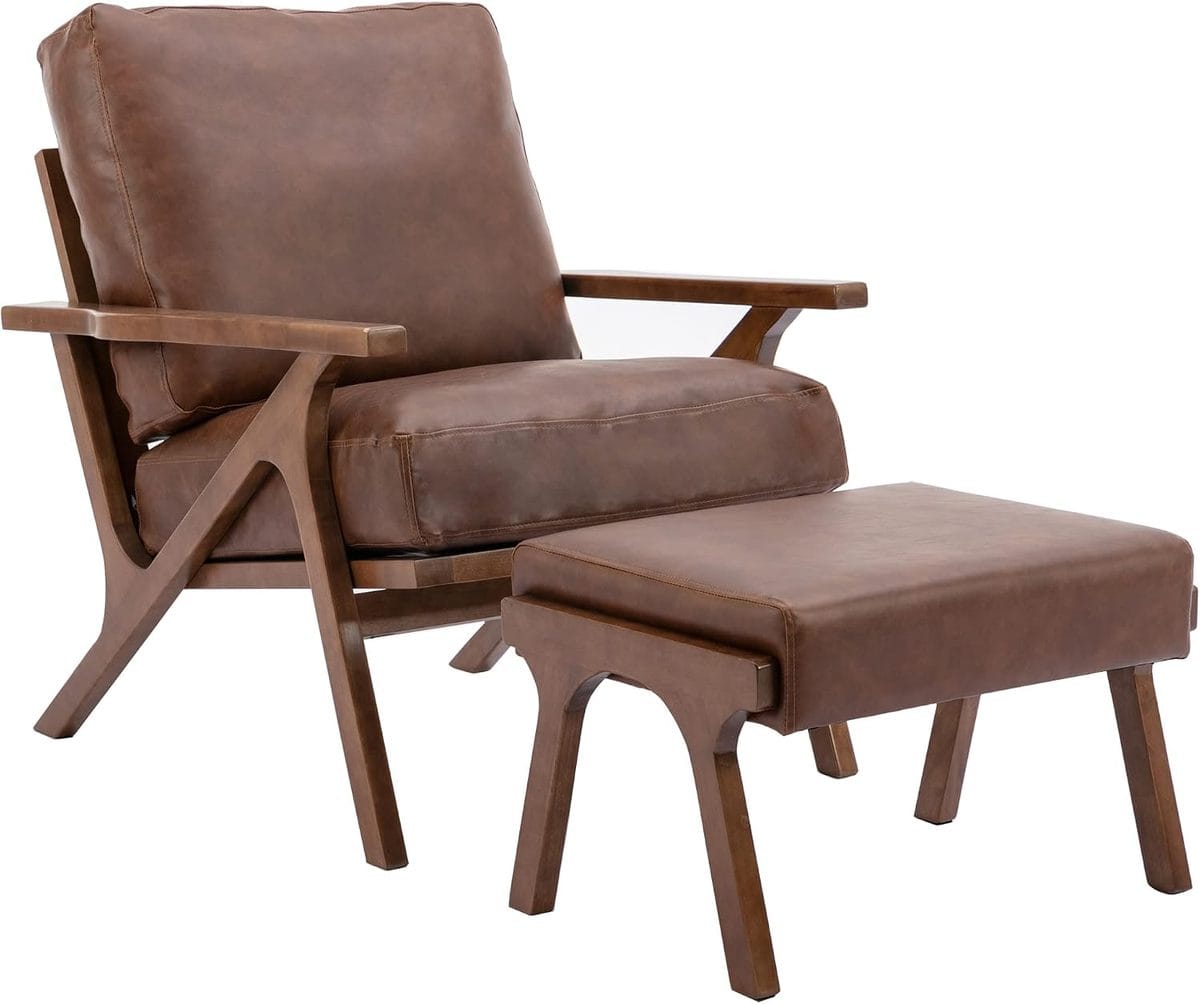
chairus Mid-Century Lounge Chair and Ottoman
Budget · Solid Wood Frame / Faux Leather
A deeper, more reclined seat than the HNY, with the ottoman included in the price. The slatted arms and angled back legs give it a lower, lounging posture. Pick this one if you plan to put your feet up.
Quick Decision Guide
- Best for reading: Fritz Hansen Egg Chair. Jacobsen’s shell holds posture passively; the lateral containment that makes it read as an enclosure in a room also supports your back and shoulders.
- Best for reclining: Herman Miller Eames Lounge Chair and Ottoman. The fixed 15-degree tilt and the ottoman were designed together, and it shows after an hour.
- Best for a statement piece: Knoll Barcelona Chair. Designed for a room built to make an argument; the visual weight is the point.
- Best budget option: HNY Mid Century Arm Chair. A solid wood frame at a price that does not require commitment to leather or to a design argument you may change your mind about.
- Best budget chair with an ottoman: chairus Lounge Chair and Ottoman. Lower and deeper than the HNY, with the footrest included.
Full Comparison
| Chair | Maker | Best For | Price (Sept 2026) | Link |
|---|---|---|---|---|
| Eames Lounge Chair and Ottoman | Herman Miller | Reclining, long sits | $7,745 | Design Within Reach |
| Egg Chair | Fritz Hansen | Reading, enclosure | from $10,499 | Design Within Reach |
| Barcelona Chair | Knoll | Formal rooms, visual statement | from $5,550 | Design Within Reach |
| HNY Mid Century Arm Chair | HNY | Small rooms, first purchase | Budget | Buy on Amazon |
| chairus Lounge Chair and Ottoman | chairus | Feet-up lounging on a budget | Budget | Buy on Amazon |
What each chair delivers, and where each falls short
The Eames Lounge Chair
Pros:
- Seven-ply molded veneer shells, which is the structural idea of the whole chair and not a surface finish
- Top-grain leather that ages rather than peeling
- Ottoman included; the chair was designed to be used with it
- Holds its resale value; secondhand Herman Miller examples are a real market
Cons:
- Heavy; moving it between rooms is not casual
- The proportions read large. Not suited to rooms under 200 square feet.
- The price. There is no way around it except the secondhand market.
Who it’s for: Someone who wants the specific combination of plywood shell, walnut and leather, and who will sit in it every day for decades.
The Egg Chair
Pros:
- The shell wraps around you, giving containment a flat-back chair cannot
- Works as an accent piece; the form reads as a defined object from any angle in a room
- Dozens of fabric and leather options, so it can read as neutral or as a statement
- Smaller footprint than a chaise
Cons:
- Not a recliner. The shell is fixed; you are either in the Jacobsen position or you are not.
- The most expensive chair here, and the leather version costs more again
Who it’s for: A reader who wants to sit enclosed rather than sprawled. For the full story of the Egg, the Swan and the Series 7, see the ADI profile of Arne Jacobsen.
The Barcelona Chair
Pros:
- The X-frame is visually authoritative in a room in a way upholstery alone cannot achieve
- Grid-stitched leather cushions are the design, not a covering over the design
- Specific historical weight: designed for the German Pavilion at the 1929 Barcelona International Exposition, one of the defining works of modern architecture
Cons:
- Not comfortable for extended sitting. It was made for formal reception; the cushion depth and seat angle are not tuned for hours.
- Wide and low, so it needs floor space around it to read properly
Who it’s for: A buyer furnishing a space where a chair is a position rather than a comfort instrument. Torn between the two icons? The Barcelona Chair vs Eames Lounge Chair comparison settles which argument fits your room.
The HNY and chairus Wood-Frame Chairs
Pros:
- Solid wood frames, not particle board or MDF, which affects both durability and the physical weight that makes furniture feel considered
- Removable cushions you can clean or replace
- They borrow a type, not a trademark. Slatted wood lounge chairs have been made by hundreds of workshops since the 1950s.
Cons:
- Faux leather will not age the way real leather does
- No design history attached. You are buying the object, not the provenance.
Who they’re for: A first-time buyer trying mid-century proportions in a real room, without the cost of a licensed chair or the visual commitment of a statement piece.
Why the mid-century lounge chair has not been replaced
The short version: the designers who made these chairs were not trying to make comfortable furniture. They were arguing about what a chair should be.
Charles Eames described the design intent for his Lounge Chair and Ottoman as wanting it to have “the warm receptive look of a well-used first baseman’s mitt.” He meant worn-in, specific and personal, not comfortable in the generic sense. The chair was first shown publicly in 1956 on NBC’s Home show, presented by Arlene Francis, and it went into MoMA’s permanent collection. Herman Miller has manufactured it continuously since then.
The post-war context matters here. The Eames, Jacobsen and Mies generation had access to materials that wartime production had made both available and technically refined: molded plywood, fiberglass, aluminum alloys. They used them to argue that well-designed objects could be manufactured at scale. Seventy years later the same companies are still making the same chairs, which is its own proof that the argument worked.
The Barcelona Chair is a different case. Mies designed it in 1929 for a building that was built to be demolished. The German Pavilion was dismantled after the exposition and only reconstructed in 1986. The chair was meant for a temporary room, and it has outlasted every architectural context it was ever placed in. That is not a comfort feature. It is a design argument that has aged better than the architecture around it.
For further context, see the ADI profiles on the Barcelona Chair and Philippe Starck.
Further Reading
Two books worth having if you are going past surface familiarity with this furniture.
- Eidelberg, Martin et al., The Eames Lounge Chair: An Icon of Modern Design (Merrell, 2006): The only monograph dedicated to the Lounge Chair specifically. It traces the development from prototype through to the MoMA collection, with production history and design documentation that a general Eames survey does not include.
- Bradbury, Dominic, Mid-Century Modern Furniture (Thames & Hudson, 2014): Covers the full material argument of the period: Eames, Jacobsen, Bertoia, Finn Juhl. Production history and manufacturing context rather than just aesthetic catalog entries.
Frequently Asked Questions
What is the difference between a designer lounge chair and a regular armchair?
A designer lounge chair is built around a specific structural or material argument: the Eames shell, the Jacobsen enclosure, or the Mies X-frame, rather than generic upholstery over a frame. The difference shows up in how the object reads in a room. Designer lounge chairs have a silhouette with meaning attached, which is either what you want or an argument you did not ask to make.
How can I tell an authentic Eames Lounge Chair?
Herman Miller is the licensed maker in North America and Vitra in Europe. An authentic chair carries the maker’s label under the seat, uses seven-ply molded veneer shells, and has rubber shock mounts joining the shells to the aluminum spines. The Eames Lounge authentication guide covers each detail.
How much does a real Barcelona Chair cost?
Knoll is the licensed manufacturer. At Design Within Reach in September 2026 the Barcelona Chair cost $8,327 in leather and $5,550 in fabric. The authentic chair uses a polished stainless steel frame and hand-tufted leather cushions. Secondhand Knoll examples sell for considerably less and keep their value.
What lounge chair is best for reading?
The Egg Chair is the most structurally suited to reading. Its shell provides passive lateral containment that supports the back and shoulders without active posture adjustment. The Eames is better for reclining; the Barcelona Chair is not designed for sustained seated use.
Can a designer lounge chair work in a small apartment?
Yes, with the right form. The Egg Chair and the wood-frame chairs from HNY and chairus have smaller footprints than the Eames and can occupy a corner or reading zone without requiring the room to recede around them. The Eames and the Barcelona Chair both carry visual weight that needs room to read as intended.
How do I know if a mid-century modern lounge chair is good quality?
Look at three things: the upholstery material (top-grain leather against PU, which is a structural difference and not just a price signal), the base material (solid wood or welded steel against particle board), and the seat mechanism if there is one (engineered recline with a fixed stop against a generic tilt). A chair that passes all three is worth the price differential.

About Joe Post
Joe Post holds an MFA in Art from California Institute of the Arts (CalArts) and has done additional graduate work at the School of the Art Institute of Chicago. He founded Art Design Ideas to write about design as cultural argument — the decisions, contradictions, and assumptions built into the objects we live with.