
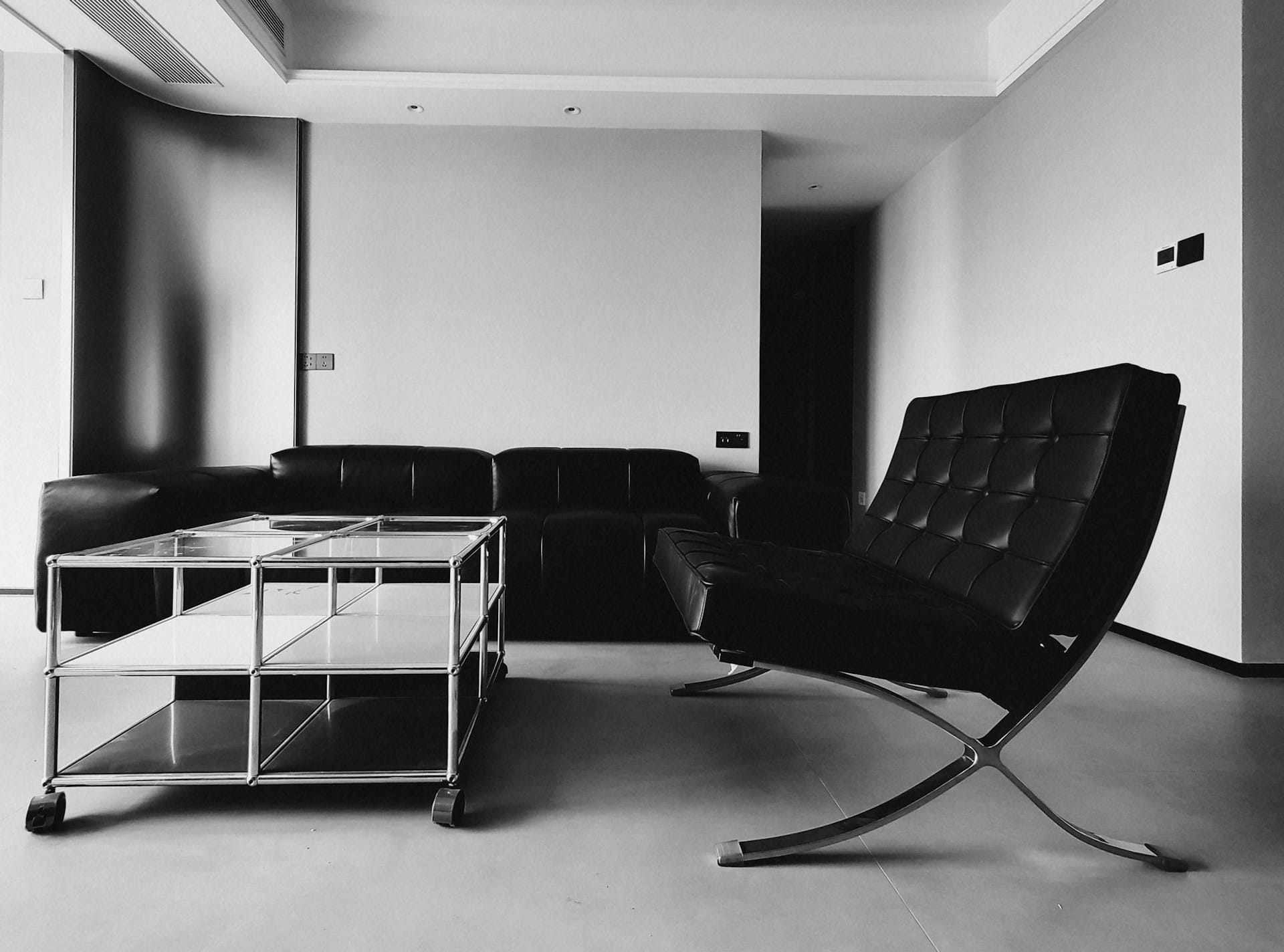
A Barcelona Chair reproduction is a copy of the 1929 Mies van der Rohe and Lilly Reich design made outside Knoll’s licensed production. Reproductions range from budget bonded-leather units to premium versions using full-grain leather and solid stainless steel that closely match the original’s 40-panel hand-tufted construction.
Our Top Picks
Two manufacturers have published enough specification detail to earn a serious recommendation. Both clear the structural basics that budget reproductions consistently fail: solid stainless steel frame, full-grain leather, hand-tufted cushions. Neither is the Knoll original. At roughly $1,000 to $1,200, they are the argument that the design is strong enough to survive replication, which is, in fact, the harshest test of any form.
- RoveConcepts Barcelona Chair — Black Italian Leather (Premium): Grade 304 stainless steel frame polished to mirror finish, 28-hour hand-stitched cushions with published specification matching original construction. The most documented premium option at this price point on Amazon.
- iFN Modern Reproduction Barcelona Chair (Mid-Range): 100% leather with genuine cowhide belting straps and polished stainless steel with seamless corners. A solid mid-tier entry that checks the structural basics without the premium price.
Quick Decision Guide
- Best premium option: RoveConcepts Barcelona Chair — most complete published specification, 28-hour hand-stitched cushions, Grade 304 frame with mirror polish.
- Best mid-range option: iFN Modern Reproduction — genuine cowhide belting, seamless stainless steel frame, lower price without sacrificing the structural essentials.
- Best budget option: Neither of these chairs. If the price drops below $600, you are looking at bonded leather and chrome-plated mild steel. That is not a Barcelona Chair. It is a chair shaped like one.
Full Comparison
| Product | Best For | Price Range | Key Feature | Link |
|---|---|---|---|---|
| RoveConcepts Barcelona Chair | Premium buyers who want documented specs | Premium ($1,000–$1,500) | 28-hour hand-stitched cushions, Grade 304 frame | Buy |
| iFN Modern Reproduction | Mid-range buyers who want structural integrity | Mid-Range ($600–$1,000) | Genuine cowhide belting straps, seamless frame | Buy |
What the best Barcelona chair reproductions get right, and where they fall short
RoveConcepts Barcelona Chair — Black Italian Leather
Pros:
- Grade 304 stainless steel frame, solid not hollow, hand-polished to mirror finish
- 28-hour hand-stitched cushion construction (a specification Rove Concepts publishes, which is rare)
- Full-grain leather with 40 hand-tufted panels per cushion, matching the original construction count
- The most complete published specification of any reproduction on Amazon
Cons:
- Premium price puts it near the lower range of the used Knoll market. The calculus is real.
- Black colorway only in this listing; the original Knoll comes in multiple leathers including cream
Who it’s for: Someone who wants the design to work properly, with the right steel, the right leather, and the right construction, and is willing to pay for the specification rather than just the silhouette.
Why it stands out: It publishes its numbers. In a market full of vague copy (“premium materials,” “high-quality steel”), Rove Concepts states 28 hours of hand-stitching, Grade 304 steel, 40 panels. You can hold those claims against the chair when it arrives.
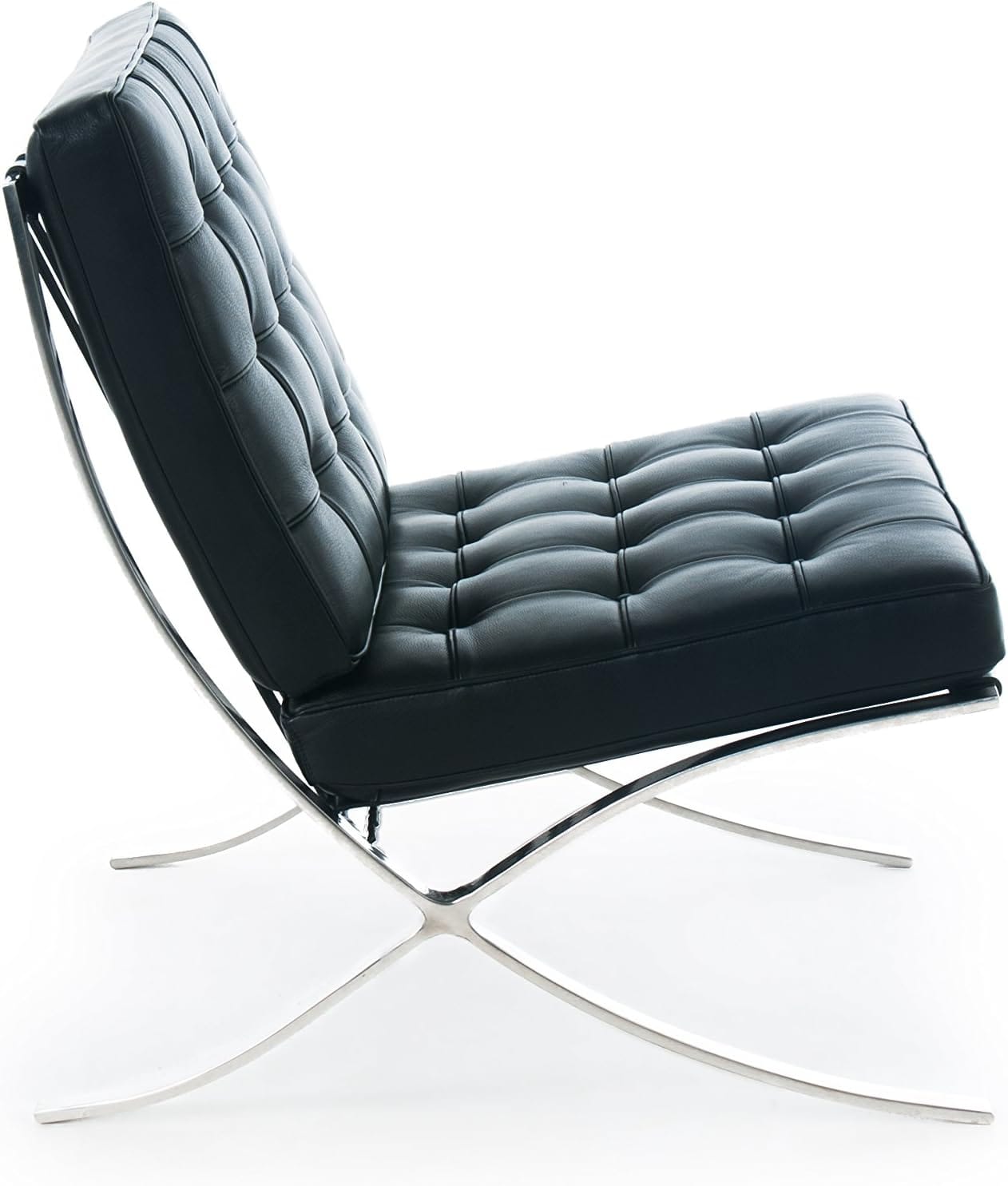
RoveConcepts Barcelona Chair — Black Italian Leather
Grade 304 stainless steel frame polished to mirror finish, 28-hour hand-stitched cushions with published specification matching original construction. The most documented premium option at this price point on Amazon.
iFN Modern Reproduction Barcelona Chair
Pros:
- 100% leather upholstery (not bonded, not PU)
- Genuine cowhide belting straps riveted to the frame (not glued, not zip-tied)
- Polished stainless steel frame with seamless corners. The weld problem addressed.
- Lower price than RoveConcepts while retaining the materials that matter
Cons:
- Less published specification detail than RoveConcepts, making it harder to verify cushion density and construction hours
- Mid-range pricing still represents a real investment; the used market for this tier is thin
Who it’s for: Someone who wants a structurally honest reproduction without paying premium prices, and who understands that honest means leather straps, solid steel, and real leather rather than a resemblance.
Why it stands out: The belting straps are the tell. Genuine cowhide straps riveted to the frame is the detail that budget reproductions skip first. Getting that detail right suggests the rest of the construction has been taken seriously.
Getting the belting straps right suggests the rest of the construction has been taken seriously.
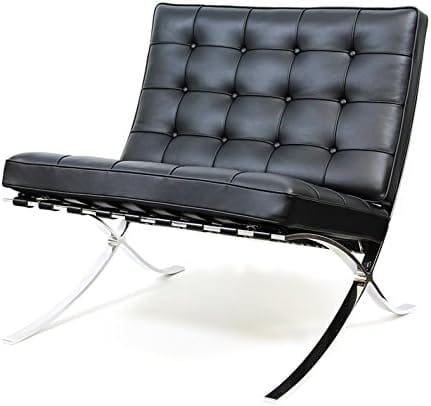
iFN Modern Reproduction Barcelona Chair
100% leather with genuine cowhide belting straps and polished stainless steel with seamless corners. A solid mid-tier entry that checks the structural basics without the premium price.
What Mies and Reich were actually building in 1929
The German Pavilion at the 1929 Barcelona International Exposition was not a trade show booth. It was an argument about modern space: glass, travertine, and steel arranged as a philosophical statement, with nothing displayed inside except the space itself. Mies van der Rohe and Lilly Reich designed the pavilion together. The chair came with it.
The commission was specific. The Spanish royal family, King Alfonso XIII and Queen Victoria Eugenia, needed somewhere to sit during the opening ceremony. Mies built a throne. The form derived from the Roman curule chair, the folding stool carried by the magistrate class as a sign of authority. Mies moved the axis to the sides and cantilevered the seat, a gesture that required modern stainless steel. This was not homage to Rome. It was a structural argument about what a new material allows.
Lilly Reich’s contribution to the chair is documented and consistently underattributed. She was Mies’s collaborator and the material specialist at the pavilion. The leather selection and cushion construction were her decisions, not footnotes to his. The chair is correctly credited to both of them. The archival record confirmed that her role in the project’s material and textile decisions was substantial, not subordinate.
The frame was originally bolted together. In 1950 Mies redesigned it with seamless stainless steel, the version that became the modern standard. Knoll obtained formal production rights from Mies directly in 1953. The name “Barcelona Chair” came later: Knoll applied it in 1987, according to company history, almost sixty years after the chair was made. For most of its life it was simply the chair made for the pavilion. The Museum of Modern Art holds a 1953 example (model MR 90) in its permanent collection.
The Knoll original currently retails at approximately $6,230 to $8,600 (2026 market pricing, per decomica.com and stylewithinreach.net). That price reflects licensed production, American manufacturing, hand-finishing, and institutional markup. It is not the only way to own the form.
The name “Barcelona Chair” came in 1987 — sixty years after the chair was made. For most of its life it was simply the chair made for the pavilion.
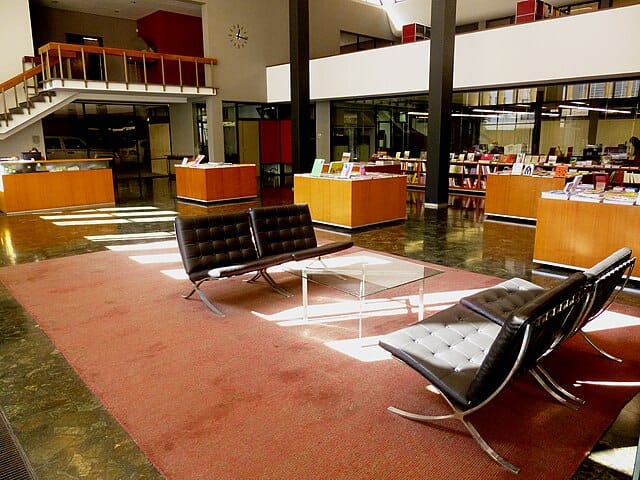
Why most reproductions fail at the same three details
The reproduction market exists because of a specific design-cultural argument: Mies built one of the most expensive chairs ever made, then handed production rights to the company most likely to keep it expensive. The design entered the culture as an image, seen in lobbies, photographed in interiors, reproduced on mood boards, while the object remained out of reach for most people who wanted to own it seriously. Reproductions are the market’s answer to that gap.
Most of them answer it badly.
Frame construction is the most decisive variable. The Knoll original uses 12mm solid stainless steel, Grade 304, with seamless hand-polished joints. No visible welds, no chrome plating over mild steel. Budget reproductions use hollow tube frames or chrome-plated steel. Chrome plating over mild steel corrodes at the joints within years. The test is simple: tap the frame. Solid steel rings differently than hollow tube.
Leather quality separates the price tiers more than any other factor. Premium reproductions use full-grain bovine leather with 40 hand-stitched and tufted panels per cushion. The leather straps (17 per seat, approximately 7 to 8 oz each) are dyed to match and riveted to the frame. Bonded leather or PU splits, fades, and peels, usually within 2 to 3 years of regular use. According to buyer guides at decomica.com, this is the single most common failure mode in the under-$600 tier.
Cushion density and construction close the gap between a reproduction that lasts and one that doesn’t. Original-grade reproductions specify foam density of 30 to 36 kg/m³. Budget chairs use lower-density foam that compresses flat within a year of regular use. The hand-stitching process on a premium reproduction takes up to 28 hours per chair. This is Rove Concepts’ published specification. That number matters because it is verifiable. Most manufacturers in this market do not publish it.
The reproduction market is not a failure of taste. It is proof that the design is strong enough to survive mass copying, which is, in fact, the harshest test of any form. A design that only works at $7,000 may be a masterpiece. A design that still reads correctly at $1,200 is something more durable.
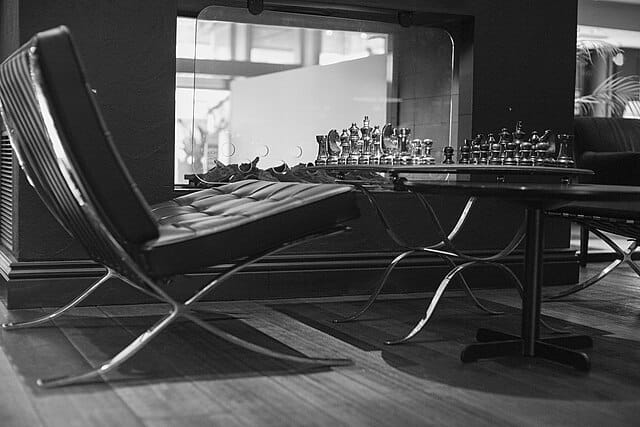
Why construction standards are the whole argument
The best Barcelona chair reproductions work because the original design has no margin for approximation. The X-frame geometry is precise. Alter the angle even slightly and the seat tilts, the visual tension collapses. The leather strap system carries structural load; if the straps are glued rather than riveted, the cushion shifts under use. The 40-panel hand-tufted surface is not decorative. It is what holds the cushion’s shape over time.
This is why the specification question is the only question worth asking. A reproduction that publishes its steel grade, its panel count, and its construction hours is making a verifiable claim. A reproduction that uses phrases like “premium materials” without numbers is not. The form that Mies and Reich designed in 1929 still reads correctly at $1,200 because its proportions are correct, its structure is correct, and its materials are correct. When any of those three fails, the whole thing fails. If you are still weighing the Barcelona form against its rivals, the ranked guide to the best designer lounge chairs puts it beside the Eames Lounge and the Egg.
Further Reading
Two books are worth owning before committing to any version of this chair, original or reproduction.
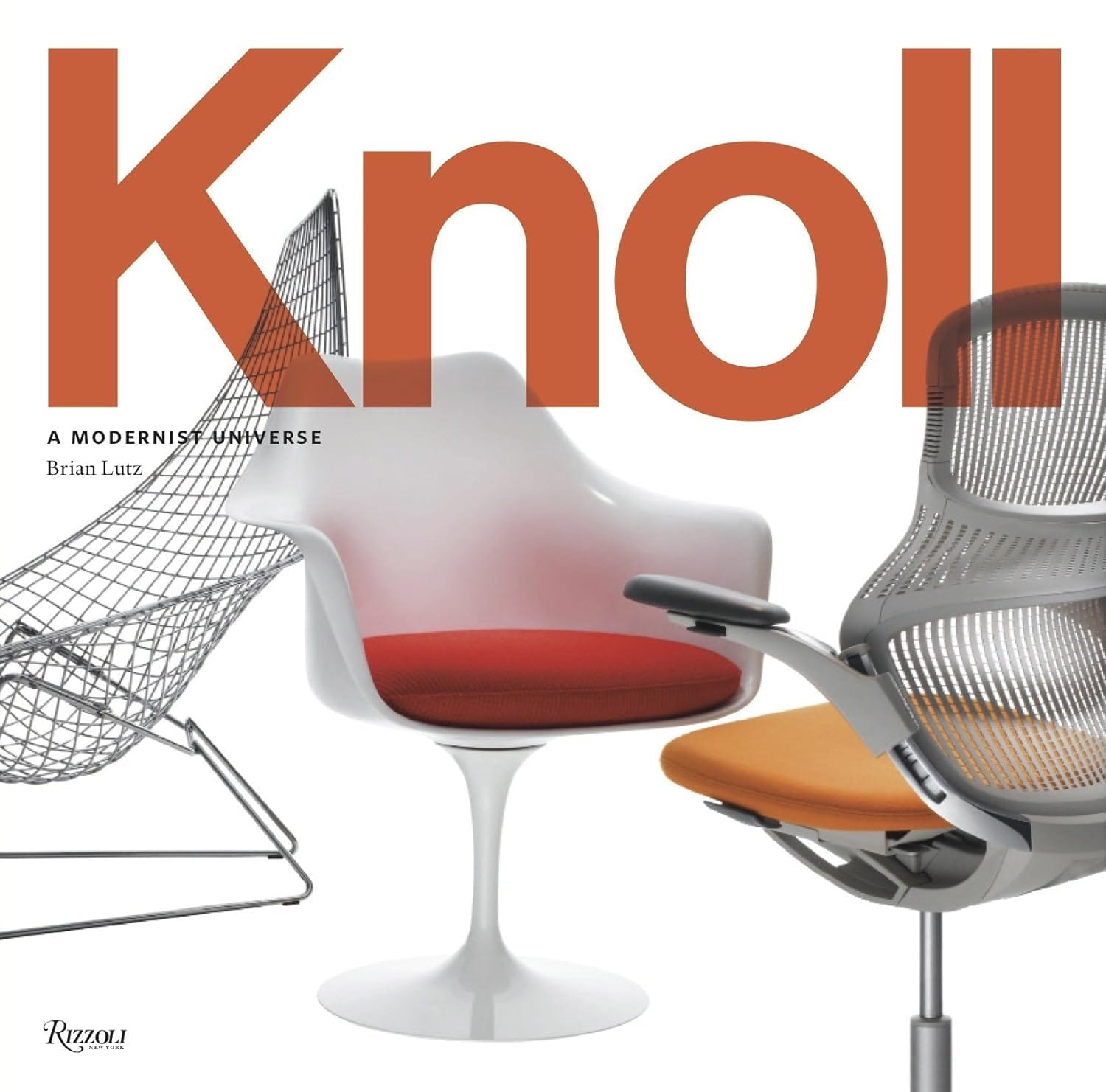
Knoll: A Modernist Universe
Knoll is the licensed manufacturer. Understanding the company’s design philosophy explains why the chair’s production standards are what they are, and why the price is what it is. The institutional history that frames the entire reproduction market.
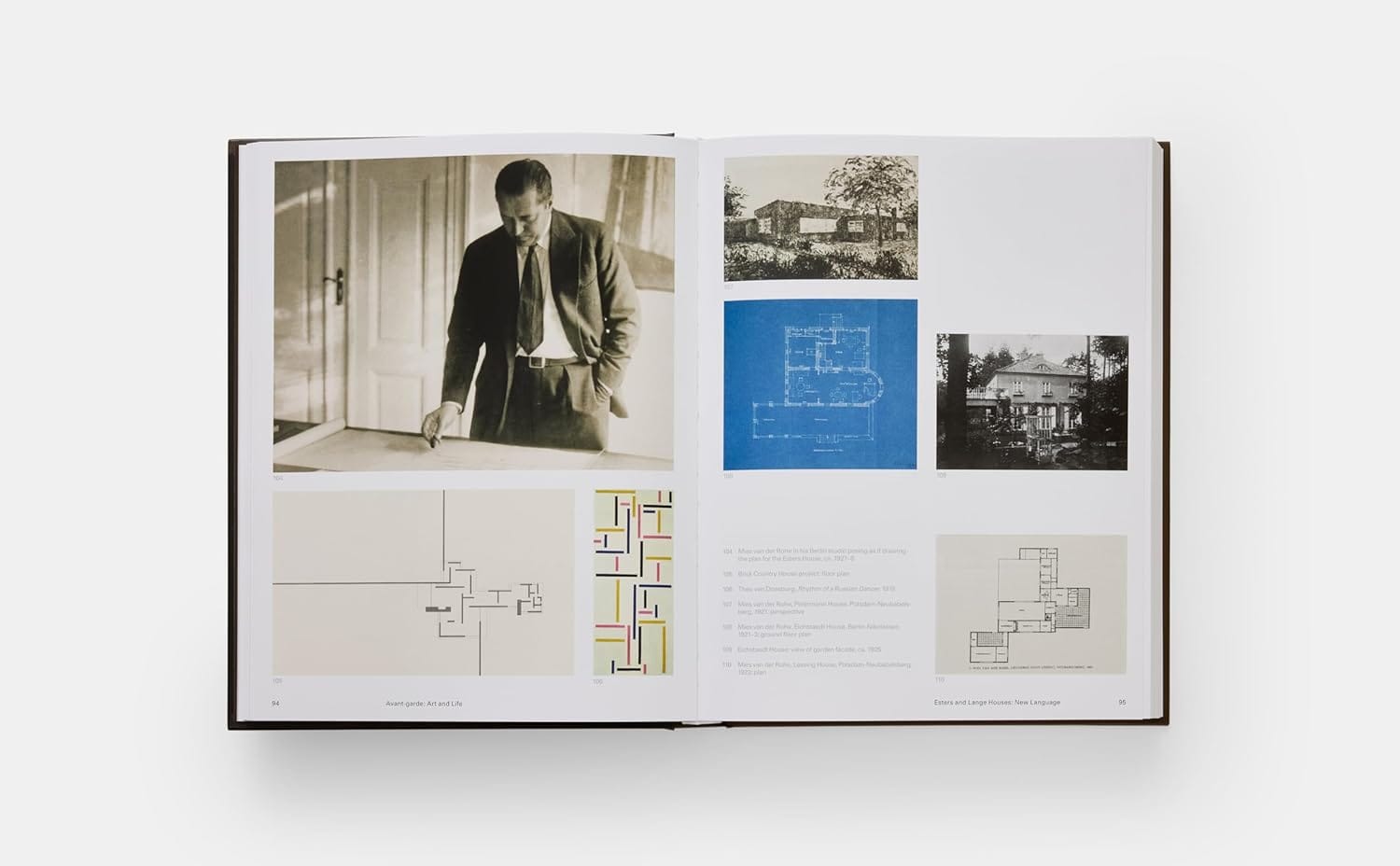
Mies van der Rohe: Objects and Furniture Design
The only dedicated study of Mies’s furniture output, with 180 color illustrations including original drawings and specifications for the Barcelona Chair. If you want to understand what a reproduction is reproducing, this is the reference.
Frequently Asked Questions
What is the difference between a Barcelona chair replica and a reproduction?
The terms are used interchangeably in the market, but the distinction matters. A reproduction attempts to replicate the original construction, the materials, the proportions, the fabrication method, to a standard that approximates the Knoll original. A replica often refers to a lookalike produced without regard for construction standards, using substitute materials (bonded leather, hollow steel) to achieve a similar silhouette at low cost. In practice, “reproduction” signals higher quality intent; “replica” often signals budget manufacture. Neither carries Knoll’s licensed production standards or Mies’s facsimile signature.
How can I tell if a Barcelona chair is good quality?
Tap the frame. Solid Grade 304 stainless steel rings differently than hollow tube or chrome-plated mild steel. Examine the leather strap connection under the cushions: straps should be riveted to the frame with visible hardware, not glued or zip-tied. Check the cushion panels. A quality reproduction shows 40 hand-tufted panels with visible stitching along the grid. Measure the seat height: it should be approximately 17 inches. If the manufacturer does not publish their steel specification and foam density, treat that as a red flag.
Are Barcelona chair reproductions legal to buy and sell?
Yes, in most jurisdictions. The original design dates from 1929, and design patent protections in the United States expired decades ago. Knoll holds trademark rights to the ‘Barcelona’ name and to the facsimile Mies van der Rohe signature stamped into its licensed chairs. Reproduction manufacturers cannot legally use either. What they can manufacture and sell is the physical form of the chair. What they cannot do is call it a ‘Barcelona Chair’ (Knoll’s trademark) or stamp it with Mies’s signature. If you see a facsimile Mies signature on a non-Knoll chair, that is a fraud indicator, not a quality signal.
What materials should a Barcelona chair reproduction be made from?
Frame: Grade 304 solid stainless steel, minimum 12mm diameter, with seamless joints. Not hollow tube. Not chrome-plated mild steel. Upholstery: full-grain bovine leather, minimum 40 hand-tufted panels per cushion. Belting straps: genuine leather, approximately 7 to 8 oz weight, riveted to the frame. Foam: minimum 30 kg/m³ density. These are the specifications that separate a reproduction that holds its form from one that degrades within a few years of regular use.
Why does the original Knoll Barcelona chair cost so much more than reproductions?
Several reasons, and they are worth separating. Knoll manufactures in the United States using hand-finishing processes that are labor-intensive. The licensed production carries overhead (royalties, brand maintenance, quality control infrastructure) that reproductions do not. The facsimile signature and the ‘Barcelona’ trademark are part of what you are buying. And the Knoll chair carries a resale market: a used Knoll Barcelona Chair retains significant value; a used reproduction does not. If you are buying the object for its design, a premium reproduction is a reasonable choice. If you are buying an asset with provenance, only the Knoll original makes sense.
Is a Barcelona chair reproduction comfortable for everyday use?
A premium reproduction (Grade 304 solid frame, full-grain leather, 30 to 36 kg/m³ foam density) can function as a regular seating piece. The original Knoll chair was designed for a ceremonial context, a king’s seat in a pavilion, not for eight hours of daily use. The seat height of approximately 17 inches and the reclined back angle are comfortable for reading or conversation, but are not optimized for desk work. Budget reproductions with low-density foam become uncomfortable quickly as the cushions compress. If everyday comfort is the primary goal, verify the foam density specification before buying.
For the full design history and what distinguishes licensed from unlicensed production, see the Barcelona Chair profile. For a head-to-head comparison with the Eames Lounge Chair, see Barcelona Chair vs Eames Lounge Chair. Both chairs sit within the broader canon covered in our Iconic Furniture Design hub.

About Joe Post
Joe Post holds an MFA in Art from California Institute of the Arts (CalArts) and has done additional graduate work at the School of the Art Institute of Chicago. He founded Art Design Ideas to write about design as cultural argument — the decisions, contradictions, and assumptions built into the objects we live with.