Building skins are the exterior envelopes that separate interior space from the outside world. They have become architecture’s most debated design surface. Christian Schittich’s Building Skins documents how architects now treat the facade as a system: simultaneously managing energy performance, structural load, material expression, and cultural meaning.
Why the building skin stopped being a wall
The curtain wall started as an argument. When Mies van der Rohe completed the Lake Shore Drive Apartments in Chicago in 1951 and the Seagram Building in New York in 1958, the glass-and-steel envelope was not a passive technical decision. It was a position: ornament is dishonest, material logic is everything, and the building skin should make no claim it cannot structurally justify. Kenneth Frampton called this “tectonic culture” — the argument that how something is built determines what it means — in Modern Architecture: A Critical History (Thames & Hudson, 5th ed., 2020). The same argument, applied to furniture, explains why the Barcelona Chair pavilion matters as much as the building itself. Modernism was a coordinated statement about surfaces.
That position held for roughly two decades. Then October 1973 arrived.
The OPEC embargo forced European architects to reckon with something the glass-box orthodoxy had ignored: a fully transparent envelope is a terrible thermal performer. Solar gain in summer, heat loss in winter. The Miesian skin treated climate as an inconvenience that mechanical systems could solve. Germany’s Wärmeschutzverordnung (Thermal Insulation Ordinance), enacted in 1977 directly in response to the energy crisis, made that assumption illegal. For architects working in German-speaking Europe (where DETAIL magazine is based), the facade was suddenly a regulated thermal system, not just a transparent surface. The design conversation shifted from what the envelope expressed to what it did.
Schittich joined DETAIL’s editorial staff in 1991, became Editor-in-Chief in 1998, and spent the next eighteen years documenting what happened next. Building Skins, first published by Birkhäuser in 2001 and then expanded to 198 pages in 2006, emerged from that documentation. The book’s scope reflects the moment: the decorative surface traditions that Modernism had explicitly rejected, explored in Art Deco and Art Nouveau, were replaced not by a return to ornament but by a new layer of technical complexity that no single designer could hold alone.
What Schittich’s Building Skins gets right that other facade books miss
Most architecture books about building envelopes organize themselves one of two ways: chronological survey (here is a history of facades) or portfolio (here are beautiful facades). Schittich did neither.
Building Skins divides into two distinct registers. The first third is an essay on the historical, technological, aesthetic, and environmental forces driving the facade’s transformation. The last two thirds are case studies with construction section drawings: horizontal sections, vertical sections, material specification tables. This structure is not decorative. It is the book’s argument: that you cannot understand what a building skin is doing aesthetically without understanding how it is constructed, and that construction details without conceptual framing are just engineering documents.
Why the book has three authors
The 2006 edition credits Christian Schittich as editor, Werner Lang as technical contributor, and Roland Krippner as co-author. That attribution reflects a real division of labor. Schittich provides the historical and conceptual framing. Lang handles the thermal performance specifications and glazing system analysis. Krippner contributes the material assembly details. The book models its own argument: that facade design now requires collaboration between architect, engineer, and materials scientist. The era of the sole-author building skin is over.
This is a practitioner’s book. The section drawings are drawn to actual construction tolerances; they show how layers meet, how waterproofing integrates with structure, how a ventilated rain screen cavity is dimensioned. These are not illustrative diagrams. They are reference documents for architects detailing real buildings. Reading them fluently requires command of architectural section drawing conventions — the vocabulary Francis D.K. Ching’s A Visual Dictionary of Architecture codified as the standard reference in architectural education.
The Birkhäuser “In Detail” series, of which Building Skins is a part, built its reputation on exactly this: the construction section drawing as primary evidence. The series covered Building in Existing Fabric, Building Simply, Small Structures, and others, each organized around the same principle. The “Building in Existing Fabric” framing connects to a related argument at the extreme of constrained building: when available land runs out entirely, buildings must negotiate their skins at millimeter precision. For that case, see Pet Architecture: Tokyo’s Infill and the Logic of the Leftover. Schittich’s book is the most cited in the series, and the facade is the most debated element in contemporary building, which is why that remains true.
The intellectual frame that makes Building Skins more than a technical manual is the one Frampton articulated and Schittich applied: the argument that how something is made determines what it means. This is the same argument that Dieter Rams’s ten principles translate into product design language. A double-skin glass facade and a Rams-era Braun radio are both making claims through construction. The building skin is just the scale where that argument has the most consequences.
Five facades that prove the envelope has become a system
The case studies in Building Skins document a set of facade strategies that had emerged by the early 2000s as responses to specific constraints: regulatory, environmental, economic. These are not stylistic choices. Each is a designed response to a pressure.
The double-skin facade
Two layers of glazing separated by an air cavity, ranging from twenty centimeters to several meters deep, are the double-skin facade’s basic anatomy. The cavity functions as a thermal buffer: in winter, trapped air reduces heat loss; in summer, the cavity ventilates to prevent solar gain from becoming a cooling load. The outer skin takes the weather; the inner skin provides the room-facing finish. As the double-skin facade system developed across European commercial projects in the 1990s and early 2000s, it became the primary technical answer to energy-performance requirements that glass-only envelopes could not meet. Schittich documents multiple European examples in both editions of the book.
Photovoltaic-integrated cladding
By the 2006 edition, crystalline silicon panels integrated directly into facade cladding panels had moved from experiment to documented practice. The building skin generates electricity rather than just managing it. The thermal mass argument (the skin as climate buffer) becomes an energy argument (the skin as power source). The 2006 expansion of Building Skins added projects in Germany and Switzerland where photovoltaic integration had reached the level of construction documentation, which is the threshold Schittich and DETAIL required before treating a technique as resolved.
Operable screening and kinetic facades

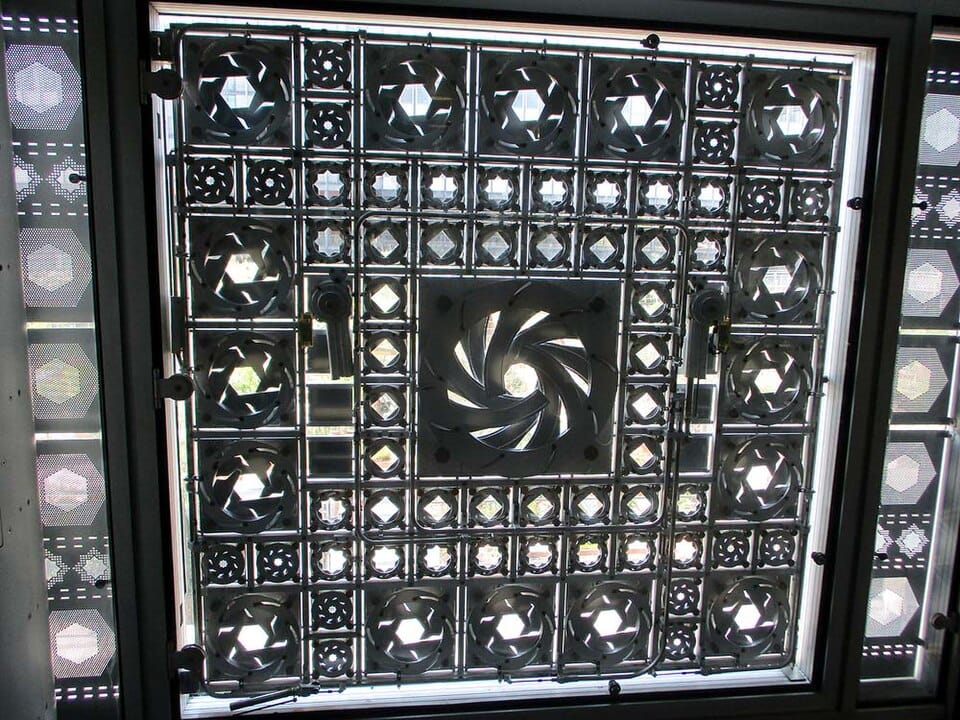
Louvres, perforated sliding panels, and rotating fins that respond to solar position represent the furthest development of the active-skin argument. The building envelope moves. Jean Nouvel’s Institut du Monde Arabe in Paris (1987) established this typology’s design language before Schittich’s book was written: its south facade uses a mechanical diaphragm system drawn from Arabic geometric tradition to modulate light entry through apertures that open and close with solar intensity. Schittich’s book documents the German and Swiss commercial cases that followed — less dramatic, more technically resolved, and actually replicable at conventional project budgets.
Material mass as climate strategy
Herzog & de Meuron’s Dominus Winery in Napa Valley (1998) runs the opposite argument from transparency: gabion baskets of local volcanic stone form the building skin, filtering light and heat through material mass rather than through a designed layer. The stone is neither transparent nor opaque; it is porous in a way that glass cannot be. This is the same period as Schittich’s first edition, and it represents the extreme case of the material-as-climate argument. The skin is not a system of layers; it is a single material performing multiple functions simultaneously.
Rem Koolhaas and the academic validation of Schittich’s territory
Koolhaas’s Elements of Architecture, produced for the 2014 Venice Architecture Biennale and published by Taschen in 2018, dedicated an entire catalogue to the facade and envelope as discrete architectural elements. By 2014, the territory Schittich had documented for practitioners in 2001 had become the subject of academic and curatorial analysis. The Biennale’s engagement with the facade was, in part, a validation that the building skin had become architecture’s primary site of formal and cultural argument.
Shop the collection
Two books earn a place here: one for the practitioner who needs construction detail and historical framing together, one for the reader who wants the engineering layer without the essay.

In Detail: Building Skins by Christian Schittich, Werner Lang, Roland Krippner (Birkhäuser, 2006): The 2006 enlarged edition is the right one — 198 pages, expanded case studies on climate-responsive and photovoltaic skins, and construction section drawings throughout; the 2001 original is thinner in both senses.
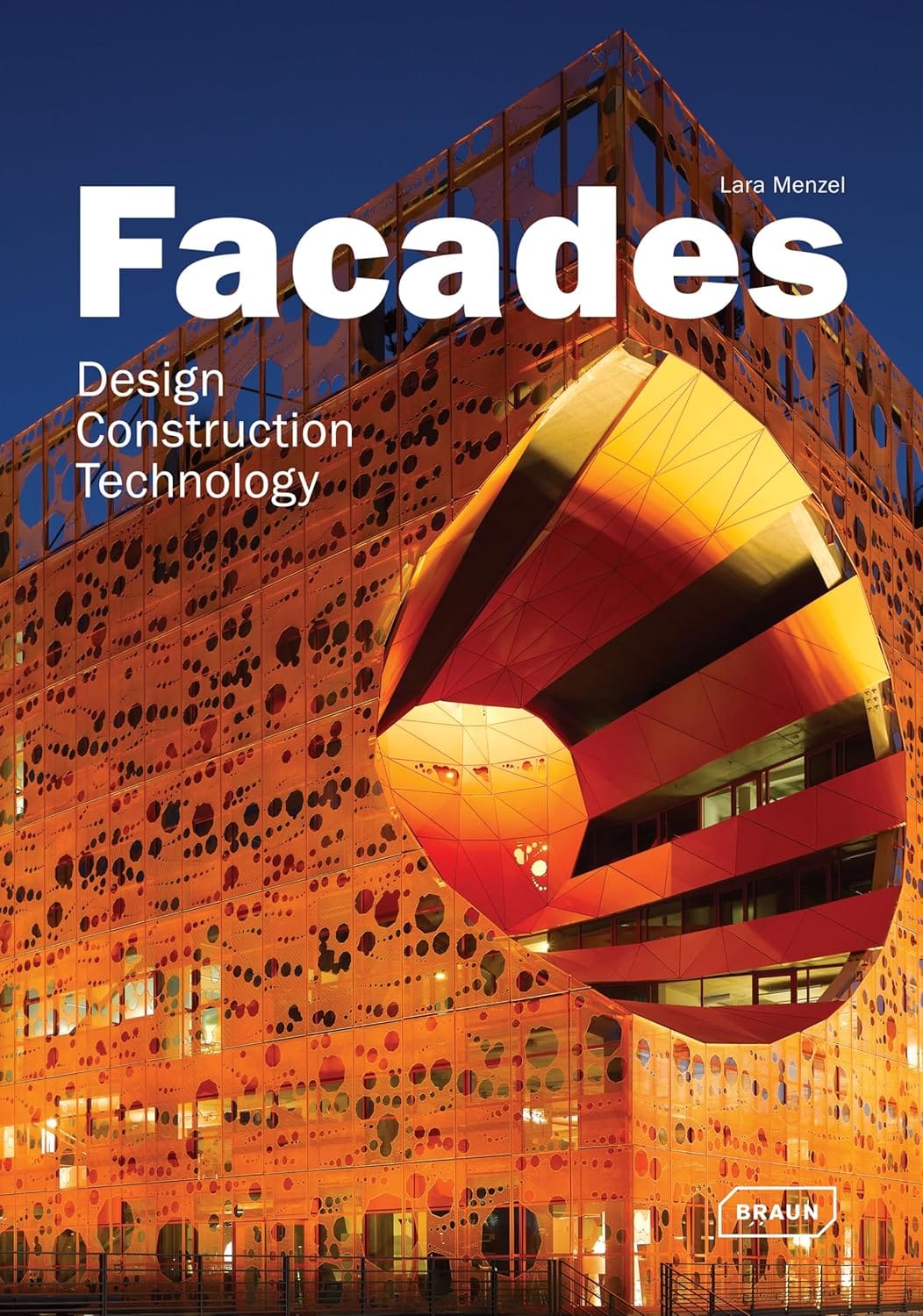
Facades: Design, Construction & Technology by Lara Menzel (Braun, Architecture in Focus series): A technically grounded complement to Schittich — covers cladding systems, unitized curtain walls, and rainscreen principles using the same section-drawing methodology; useful when the need is engineering specificity without the historical framing.
Further reading
These two books bracket the building skin argument: one establishes what Schittich is responding to, the other asks the cultural question his book leaves aside.

Kenneth Frampton, Modern Architecture: A Critical History (Thames & Hudson, 5th ed., 2020): The chapter on Mies and the curtain wall is the essential context for understanding what Building Skins is pushing against; Frampton’s concept of tectonic culture, that how a building is made is how it means, is the intellectual framework the facade debate has always occupied, even when practitioners weren’t naming it.
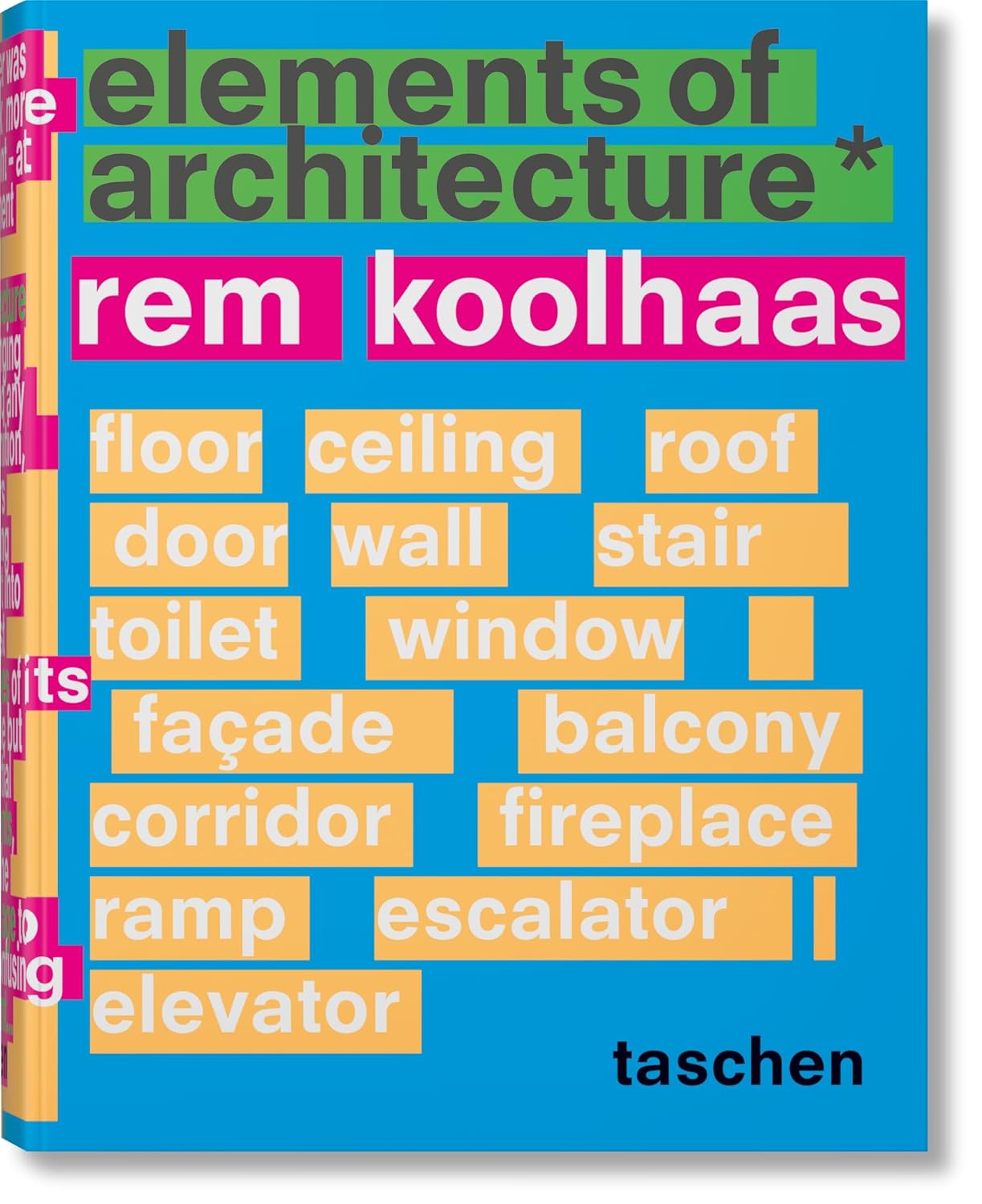
Rem Koolhaas, Elements of Architecture (Taschen, 2018): Where Schittich documents how facades are built, Koolhaas asks what they mean; together these two books hold the full argument, technical evidence and cultural interpretation, that neither alone provides.
Frequently Asked Questions
What is a building skin in architecture?
A building skin is the exterior envelope of a structure: the layers of material, systems, and surfaces that separate interior space from the outside environment. The term entered architectural discourse in the 1990s as a synthesis of “facade” (which emphasizes design) and “envelope” (which emphasizes technical performance), acknowledging that contemporary exterior walls do both simultaneously.
How does a double-skin facade work?
A double-skin facade places two layers of glazing with an air cavity between them, typically ranging from twenty centimeters to several meters deep. The cavity acts as a thermal buffer, reducing heat loss in winter and preventing solar gain from becoming a cooling load in summer. Natural ventilation through the cavity is a common additional feature. The system allows architects to meet energy-performance regulations while maintaining glass facades that earlier single-skin designs could not deliver thermally.
Why do architects care so much about building envelopes?
Because the envelope is where nearly every significant architectural argument plays out simultaneously: energy performance, structural expression, material honesty, climate response, and cultural meaning. The facade is also the part of a building that the public experiences most directly. It is the building’s public statement, and it is regulated more heavily than any other building element in most jurisdictions. Those pressures, aesthetic, structural, and regulatory, converging on a single surface is what makes it the most debated element in contemporary architecture.
What is the difference between a facade, an envelope, and a building skin?
“Facade” is the design-focused term; it refers to the visible exterior face, with attention to composition and material expression. “Envelope” is the engineering term; it refers to the building’s thermal and weather boundary as a performance system. “Building skin” emerged in the 1990s as a synthesis: it acknowledges that the exterior is both a designed surface and a technical system, and that separating those two functions is no longer useful or accurate.
Is Christian Schittich’s Building Skins still relevant today?
Yes, for two reasons. First, the construction section drawings document facade strategies, including double-skin systems, photovoltaic integration, and ventilated rain screens, that remain in active use and are not superseded by later publications. Second, the book’s argument about facade design as a collaborative discipline (architect, engineer, materials scientist) has become more true over the twenty years since publication, not less. The 2006 edition is the one to own.
What makes a building facade high-performance?
A high-performance facade manages thermal transmission, solar gain, daylighting, moisture, and structural load as an integrated system rather than addressing each separately. In practice, this means layered assemblies: insulation, air barriers, cladding materials, shading systems that work together rather than sequentially. Energy codes in most European countries and increasingly in North American jurisdictions specify minimum performance requirements; high-performance facades exceed those minimums by treating the skin as an active climate-management tool rather than a passive boundary.
See also: Points + Lines: Stan Allen

About Zoe Post
Zoe Post holds a BFA and a Master of Architecture from the School of the Art Institute of Chicago. She now works as a product marketing leader at an architectural product design firm, bringing hands-on industry perspective to everything she writes. At ADI she covers contemporary artists, textile and pattern design, and the design objects that sit at the boundary of art and function.