
Art Deco vs Art Nouveau: two dominant ornamental movements of the early twentieth century, divided by a world war and an argument about what modernity owed design. Art Nouveau (c. 1890–1914) drew from organic nature: sinuous curves, botanical motifs, the female form. Art Deco (c. 1920–1940) answered with geometry, machine precision, and luxury materials.
What each movement was actually arguing
The question people rarely ask about Art Nouveau and Art Deco is what each movement thought it was doing. Not what it looked like, but what position it was staking out. Both arose in reaction to something specific, and understanding what they were reacting against is the only way to understand why they look the way they look.
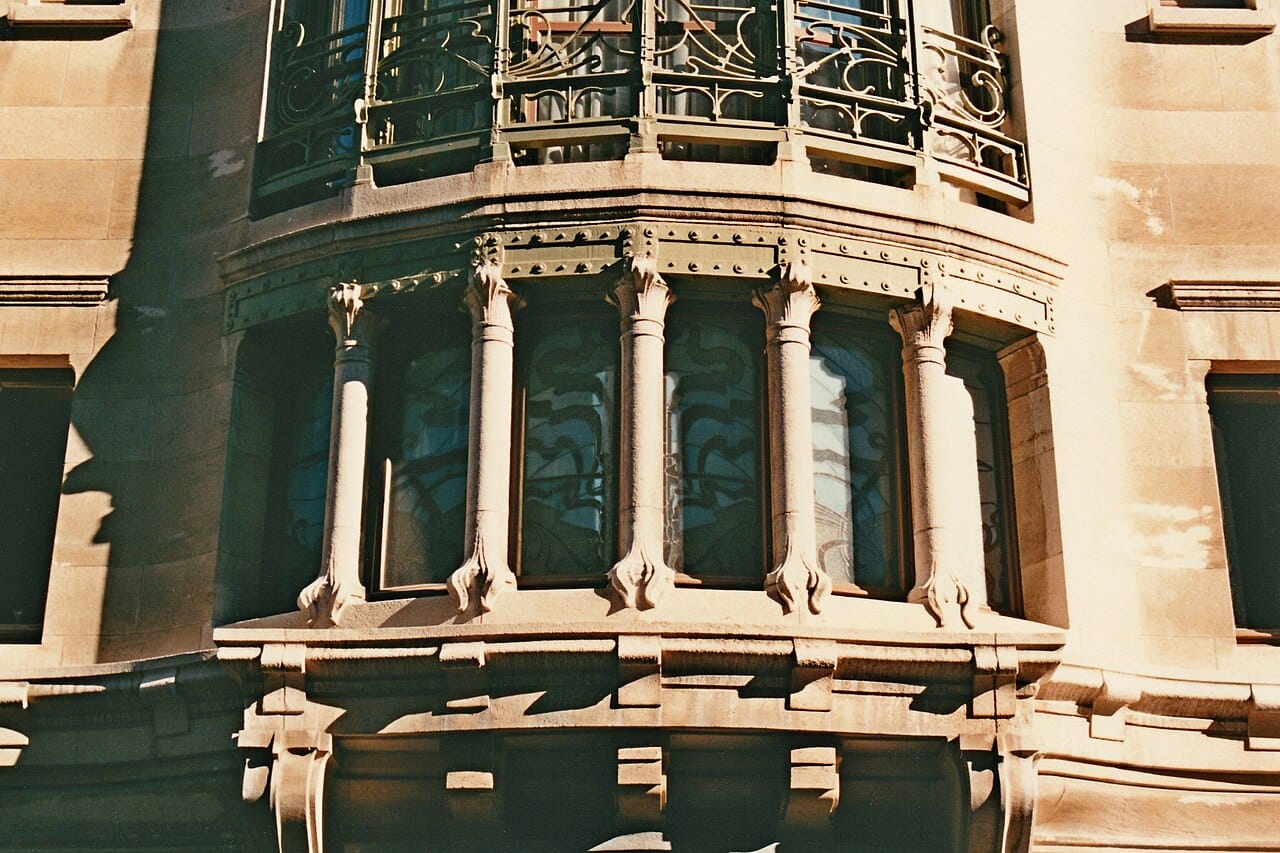
Art Nouveau emerged in Brussels in the early 1890s as a deliberate rejection of Victorian historicism. The dominant design culture of the mid-nineteenth century recycled historical styles, neo-Gothic, neo-Renaissance, Baroque revival, because it had no confidence in the present as a source of form. Paul Hankar, Henry van de Velde, and Victor Horta found this intolerable. Horta’s Hôtel Tassel, completed in 1893, was the argument made visible: organic structural ironwork, no period reference, every surface derived from botanical and geological form rather than historical precedent. The building said that the present could generate its own aesthetic language without borrowing from the past.
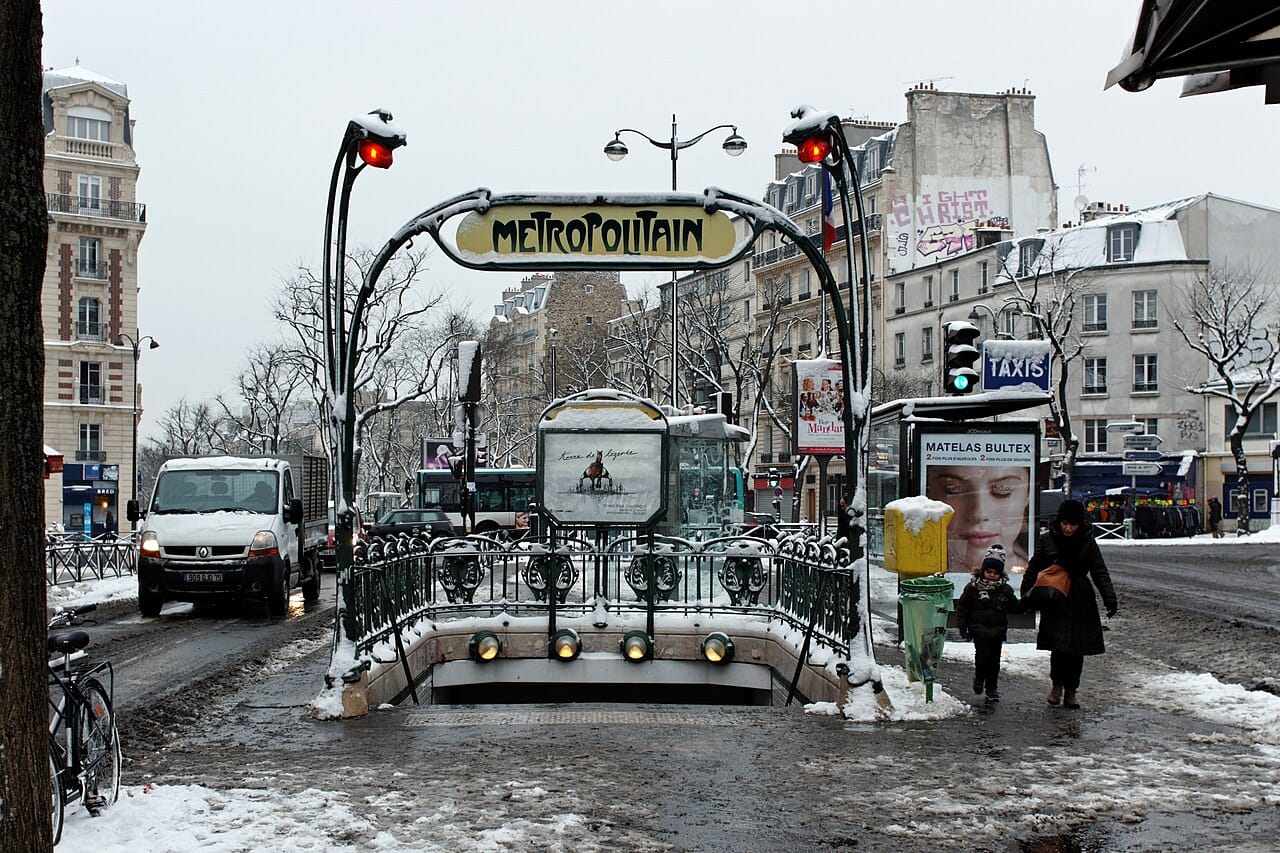
Art Nouveau reached its cultural apex at the 1900 Paris International Exposition. Hector Guimard’s Métro entrances, the first of which opened the same year, became the movement’s most durable public signature. The undulating cast-iron canopies are still standing. But by 1914, the movement had exhausted itself. It was expensive to execute well. The hand-craft it demanded — the carving, the joinery, the hand-blown glass — could not survive the labor disruption of WWI.
Art Deco was different in character from the start. It didn’t name itself until 1966, when the art historian Bevis Hillier coined the term retroactively. The movement was codified at the 1925 Exposition Internationale des Arts Décoratifs et Industriels Modernes in Paris. The industrial in that title is significant. Art Deco embraced what Art Nouveau had resisted: geometric forms, machine production, luxury materials that could be fabricated at scale. The movements didn’t overlap by accident. Art Deco was, in part, a response to Art Nouveau’s collapse — the recognition, after WWI had destroyed the artisan economy, that beauty could not survive on hand-craft alone.
Art Deco didn’t just look different from Art Nouveau. It was making the opposite argument about what modernity owed design.
Art Deco didn’t just look different from Art Nouveau. It was making the opposite argument about what modernity owed design.
The deeper divide is philosophical. Art Nouveau was anti-industrial in spirit, close to the Arts and Crafts movement, which held that the machine was degrading something irreplaceable in human making, though where Arts and Crafts distrusted ornament, Art Nouveau treated it as the point. Art Deco had no such position. It treated the machine as an aesthetic partner. That shift is the whole story.
Where they part ways: four categories
Line and form
Art Nouveau’s defining formal move is the whiplash curve: asymmetrical, flowing, derived from the movement of vines, waves, insects, and hair. The line never resolves into geometry. It continues, bends, and doubles back. Horta’s ironwork in the Hôtel Tassel is the clearest example. The structural columns branch at the top into organic tendrils, as though the building had grown rather than been built.
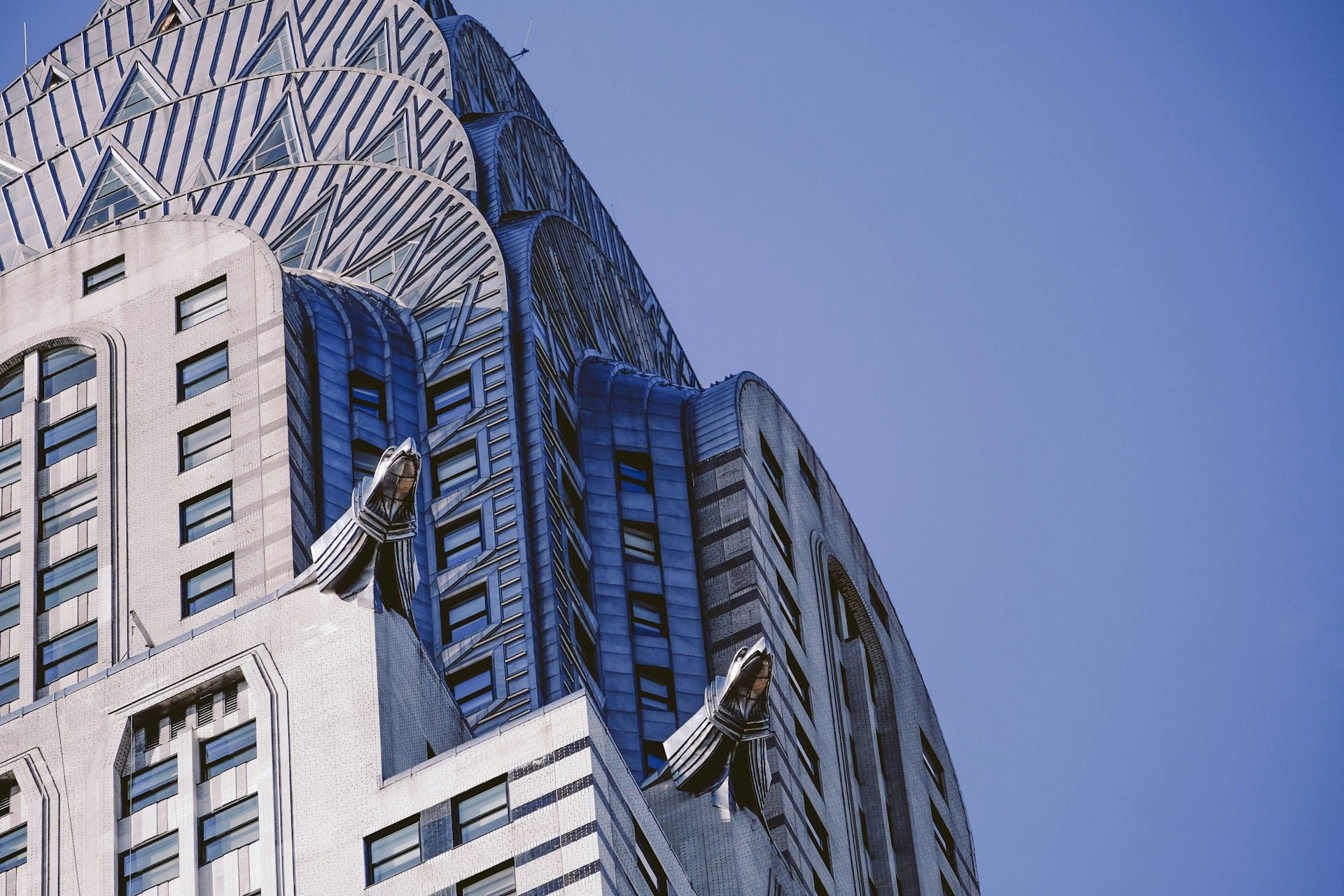
Art Deco replaced the whiplash with the zigzag, the chevron, the stepped form, the sunburst. These are geometric shapes derived from machine production, Cubism, and the archaeological finds that transfixed the 1920s. The discovery of Tutankhamun’s tomb in 1922 sent Egyptian geometry through European design. The Chrysler Building (1930, architect William Van Alen), with its stainless steel eagle gargoyles and tiered crown, is the most visible monument to this convergence.
For contemporary design applications, Art Deco’s geometry carries more directly. The clarity of the angle scales to architecture and typography in a way the organic curve does not. This is not an aesthetic judgment. It is a practical observation about how each vocabulary performs at different scales and in different media.
Color and materials
Art Nouveau worked with the materials of craft: wrought iron, stained glass, hand-carved wood, hand-blown glass, ceramic tile. The palette was naturalistic, drawing on the greens, amber tones, and blues that appear in plant forms and the iridescent wing of a dragonfly. Émile Gallé’s cameo glass vases and Louis Tiffany’s leaded lamps are the collector’s objects from this period precisely because machines cannot make them. Their value is the hand.
Art Deco introduced a different material vocabulary. Chrome, lacquer, Bakelite, rare exotic woods, stepped black-and-gold color schemes, moody jewel tones. These were luxury materials that could be precision-manufactured. The designer Jacques-Émile Ruhlmann worked in lacquered amboyna burl and ivory — expensive, but repeatable. His cabinets are showpieces for an age that wanted luxury to feel modern, not nostalgic. The color logic shifted too. Art Deco’s palette was about contrast and electric light: black against gold, cream against chrome. Art Nouveau’s palette was about organic harmony, nothing too sharp.
Subject matter and motifs
The Art Nouveau repertoire is consistent across national variants: the female figure with flowing hair, botanical forms (irises, water lilies, wisteria), insects (dragonflies, beetles), animals in sinuous profile. These motifs appear in Alphonse Mucha’s advertising lithographs, in Horta’s architectural ironwork, in Tiffany’s glass, in Lalique’s early jewelry. The imagery is nature observed closely enough to become abstract.
Art Deco’s motifs were modern by design. Sunbursts and speed lines evoked velocity and electricity. Egyptian and Aztec geometry, available to Western designers through archaeological exhibitions, provided a non-European alternative to both Classical revival and Art Nouveau’s botanicals. The stylized human figure, not Mucha’s naturalistic curves but geometric and angular, became the Art Deco image in fashion illustration. Erté’s Harper’s Bazaar covers from 1915 to 1936 are the standard.
Mucha looked at nature until it became abstract. Art Deco designers looked at geometry until it became glamour.
Mucha looked at nature until it became abstract. Art Deco designers looked at geometry until it became glamour.
The difference in subject matter follows the difference in position. Art Nouveau believed the natural world was the source of form. Art Deco believed the modern world, the machine, the skyscraper, the speed of travel, was equally generative. Both were right. They were drawing from different reservoirs.
Philosophy and production
This is where the aesthetic differences become ideological. Art Nouveau was, at its core, anti-industrial. William Morris and the Arts and Crafts movement, which ran parallel in England, stated the position plainly: mass production was degrading both the worker and the object. Art Nouveau inherited this conviction. The movement valued the hand, the unique object, the irreproducible gesture. This is why Art Nouveau furniture is nearly impossible to reproduce without losing what makes it worth having.
Art Deco reversed this. Machine production was not the enemy but the method. The goal was beautiful objects that industry could make and make at scale. The geometry that defines Art Deco is partly a response to this constraint: angular forms are easier to machine than organic curves. The aesthetic and the economics converged.
This is why WWI effectively ended Art Nouveau and didn’t slow Art Deco. The war destroyed the artisan economy that hand-craft depended on. Art Deco was built for the world that followed: new industrial wealth, new consumer markets, and no patience for anything that couldn’t be manufactured.
Art Deco vs Art Nouveau: what each style gets right
Art Nouveau
The movement built total design environments with an ambition that design has rarely matched. Horta’s Hôtel Solvay and Hôtel Tassel are not decorated buildings. Every surface, fitting, and structural element participates in a single formal argument. For sensory richness and warmth in a designed environment, nothing Art Deco produced competes. The best Art Nouveau objects, a Gallé vase, a Tiffany window, a Lalique brooch from the 1890s, are irreplaceable by definition.
The limitations are real. Art Nouveau was expensive to execute well and became pastiche when executed cheaply. The organic vocabulary is harder to control than Deco’s geometry. In lesser hands, it reads as overwrought. The anti-industrial position was, in the end, a losing argument: the world industrialized, and Art Nouveau had no answer for what design looked like in that world.
Art Deco
The geometric vocabulary carries across media: architecture, typography, fashion, product design, and interior design, with a clarity that Art Nouveau’s organic forms don’t always achieve. Art Deco objects hold their own in contemporary settings without requiring a period context. A piece of Deco furniture or a Deco graphic doesn’t need a Jazz Age room around it to read clearly. The style has also produced a lasting popular culture presence: the Chrysler Building, Tamara de Lempicka’s paintings, the MGM musical. It photographs well.
The limitations: at its worst, Art Deco is opulent without warmth, gold and chrome in service of nothing in particular. The style is also unusually susceptible to kitsch. Cheap gold spray and geometric patterns occupy a long distance from Ruhlmann or the Chrysler Building, but they all get called Art Deco. The gap between the best and worst Art Deco work is wider than the equivalent range in Art Nouveau.
Which Should You Choose?
René Lalique designed Art Nouveau jewelry in the 1890s and Art Deco glass in the 1920s. He is the rare figure who moved successfully between the two worlds, which suggests, correctly, that the division is not absolute. In jewelry and decorative objects especially, the movements overlap: organic forms in geometric settings, natural motifs arranged with bilateral symmetry.
For practical decisions about what to collect, display, or use as design reference, however, the choice maps onto a real difference in how you want objects to work in a room.
Choose Art Nouveau if you want designed environments with emotional warmth, organic irregularity, and craft that remains visible in the object. A Mucha print, a Tiffany-style lamp, Horta’s ironwork — these objects ask to be looked at slowly. They reward close attention. The irreproducibility that made Art Nouveau commercially fragile also made its surviving objects historically significant. A verified Gallé vase or a period Tiffany piece is not going to be reproduced at scale.
The best entry point for Art Nouveau study is Mucha’s poster work. The four-panel series The Seasons (1896) and the Sarah Bernhardt advertising lithographs are the canonical images, widely reproduced in museum-quality prints. For the vocabulary at full scale, Victor Horta’s surviving Brussels buildings, now UNESCO World Heritage Sites, are the primary reference.
Choose Art Deco if you want graphic strength, geometric precision, and objects that hold their own in a contemporary setting without requiring a period context. Deco vocabulary transfers to architecture, typography, and product design in ways that Art Nouveau’s organic forms don’t always manage. If you’re drawn to the Chrysler Building’s silhouette, Erté’s fashion figures, or Lalique’s geometric glasswork of the 1920s, you’re in Art Deco territory. The style also has a more accessible entry point for collectors: surviving Deco objects, ceramics, glassware, prints, Art Deco jewelry, are widely available, and the geometric vocabulary holds coherence from the Chrysler Building down to a ceramic ashtray.
For a deeper look at the movement that won the argument, the Art Deco design guide covers the key figures, the defining objects, and where to find them today.
Shop the Collection
Art Nouveau and Art Deco prints are the most practical entry point into either vocabulary: a way to study the visual language closely before committing to the cost of original objects or furniture.
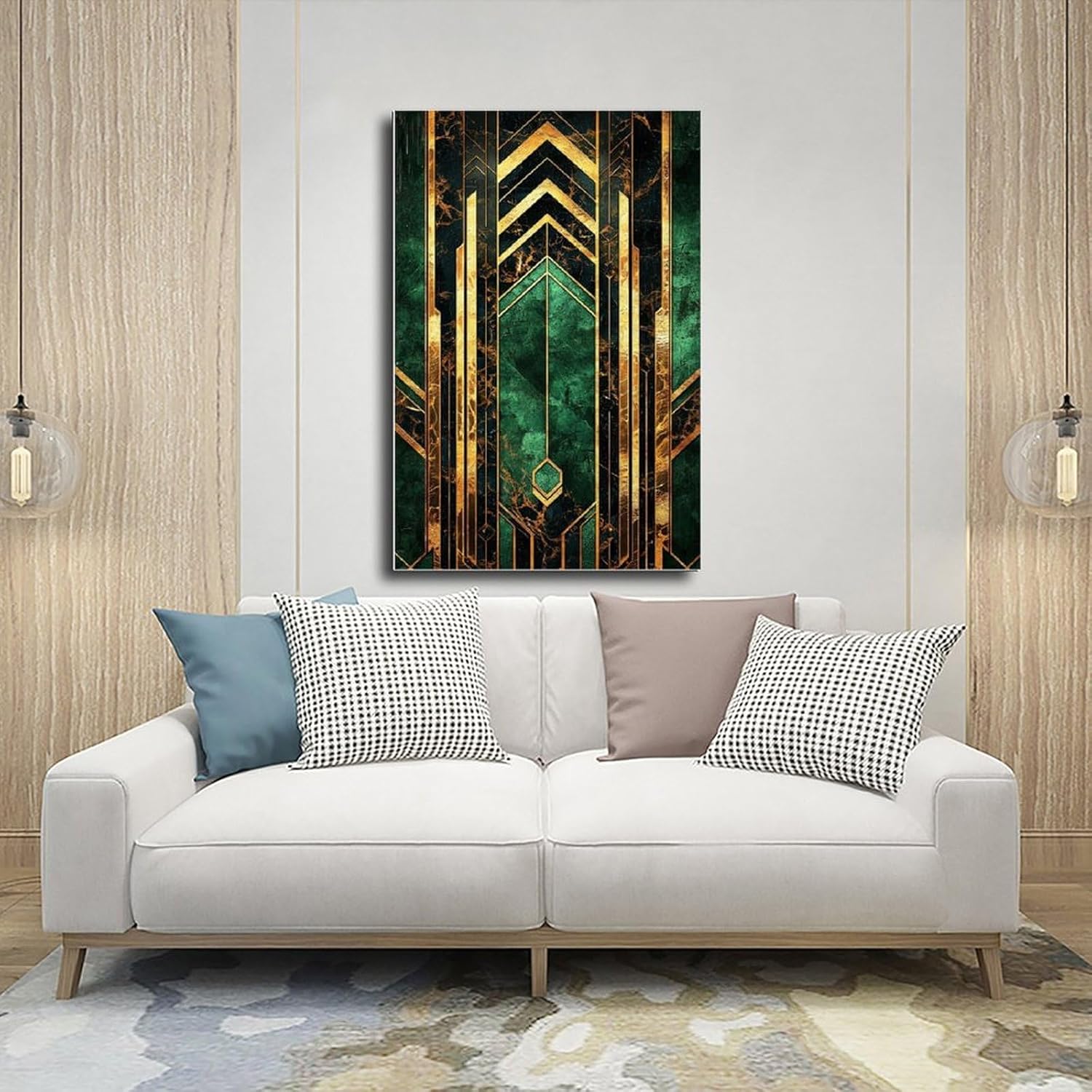
Art Deco Geometric Wall Print
The geometric poster print is the most direct way to study the Art Deco vocabulary in a domestic setting. The angular forms and high-contrast palette that define the movement read clearly at poster scale.
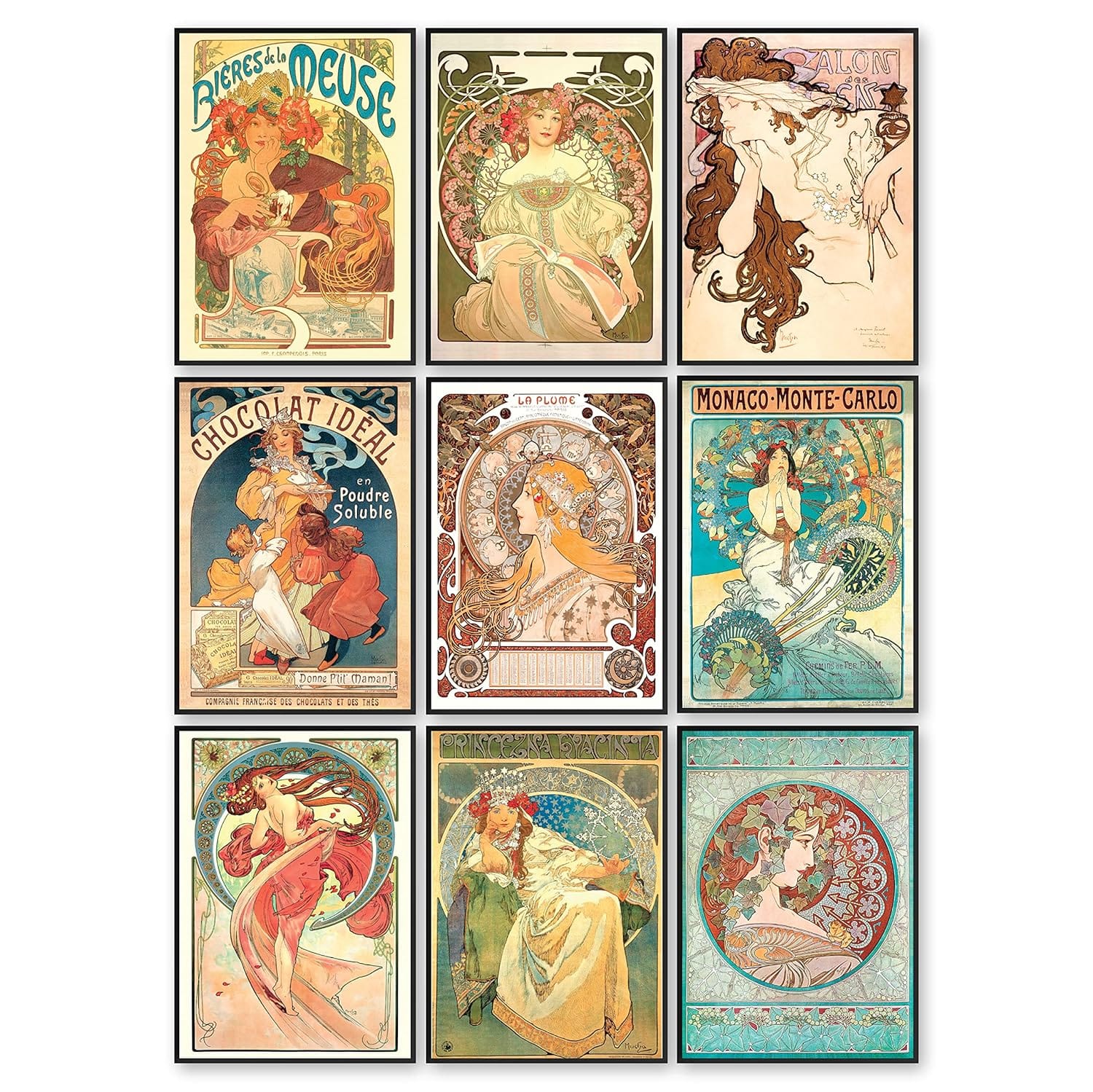
Alphonse Mucha Art Nouveau Print
Mucha’s lithographs are the most reproduced Art Nouveau images in print. The botanical flatness, the flowing female figure, the ornamental borders are the Art Nouveau vocabulary in concentrated form. A reproduction on the wall teaches the eye faster than most surveys.
Further Reading
Two books and one museum catalogue cover the ground between them.
- Alastair Duncan, Art Deco Complete (Abrams, 2009): The standard reference, 544 pages and over 1,000 color images spanning architecture, furniture, jewelry, and graphic arts. Duncan is rigorous on attribution and dating. If you own one Art Deco book, it should be this one.
- Alastair Duncan, Art Nouveau (Thames & Hudson, 1994): The compact counterpart in the World of Art series, an accessible starting point rather than a scholarly survey. Reading Duncan’s two volumes side by side is the clearest way to see the break between the movements: same author, same rigor, completely different world.
- Charlotte Benton, Tim Benton, and Ghislaine Wood, Art Deco: 1910–1939 (Bulfinch Press, 2003): The catalogue from the Victoria and Albert Museum’s 2003 exhibition. Primary source essays, period photographs, and critical analysis that the survey books can’t match. The section on Art Deco’s relationship to Cubism and the 1925 Paris exposition is worth the price of the book on its own.
Frequently Asked Questions
What is the main difference between Art Nouveau and Art Deco?
Art Nouveau (c. 1890–1914) used organic, flowing curves derived from natural forms: plants, insects, the female figure. Art Deco (c. 1920–1940) replaced those curves with geometric angles, zigzags, and stepped forms drawn from Cubism, Egyptian archaeology, and industrial production. The difference is philosophical as well as visual: Art Nouveau resisted industrialization; Art Deco embraced it.
Which came first, Art Nouveau or Art Deco?
Art Nouveau came first. It emerged in Brussels in the early 1890s and reached its cultural peak at the 1900 Paris International Exposition. Art Deco followed after WWI, with the 1925 Paris exposition as its defining public event. The two movements don’t overlap. The War is the break between them.
Can Art Deco and Art Nouveau be used together in interior design?
They can coexist, but the combination requires judgment. The movements work from opposing positions: organic versus geometric, warm versus cool. Where they meet most naturally is in decorative objects, jewelry, glassware, and prints where organic and geometric vocabulary appear in the same piece. A Mucha print on the wall of a room with clean Deco furniture reads as deliberate contrast, not as incoherence.
Who are the most famous artists associated with Art Nouveau?
Alphonse Mucha (lithography and poster design), Victor Horta (architecture, Belgium), Hector Guimard (architecture and interior design, France), Émile Gallé (glass), Louis Comfort Tiffany (stained glass and decorative objects), and the early jewelry work of René Lalique. Mucha’s advertising lithographs and Guimard’s Paris Métro entrances are the most widely reproduced works from the movement.
Who are the most famous artists associated with Art Deco?
Erté (Romain de Tirtoff), whose Harper’s Bazaar covers from 1915 to 1936 define the Art Deco human figure; Tamara de Lempicka, whose painted portraits of glamorous women in geometric settings are the defining Art Deco paintings; Jacques-Émile Ruhlmann (furniture); René Lalique in his later glass period; and architect William Van Alen (Chrysler Building, 1930).
Is Art Nouveau or Art Deco more popular today?
Art Deco has a wider contemporary presence. Its geometric vocabulary scales to modern design applications in architecture, typography, and fashion in ways that Art Nouveau’s organic forms don’t always transfer. Art Nouveau commands higher prices for original objects precisely because the hand-craft that produced them cannot be replicated at scale.

About Joe Post
Joe Post holds an MFA in Art from California Institute of the Arts (CalArts) and has done additional graduate work at the School of the Art Institute of Chicago. He founded Art Design Ideas to write about design as cultural argument — the decisions, contradictions, and assumptions built into the objects we live with.