
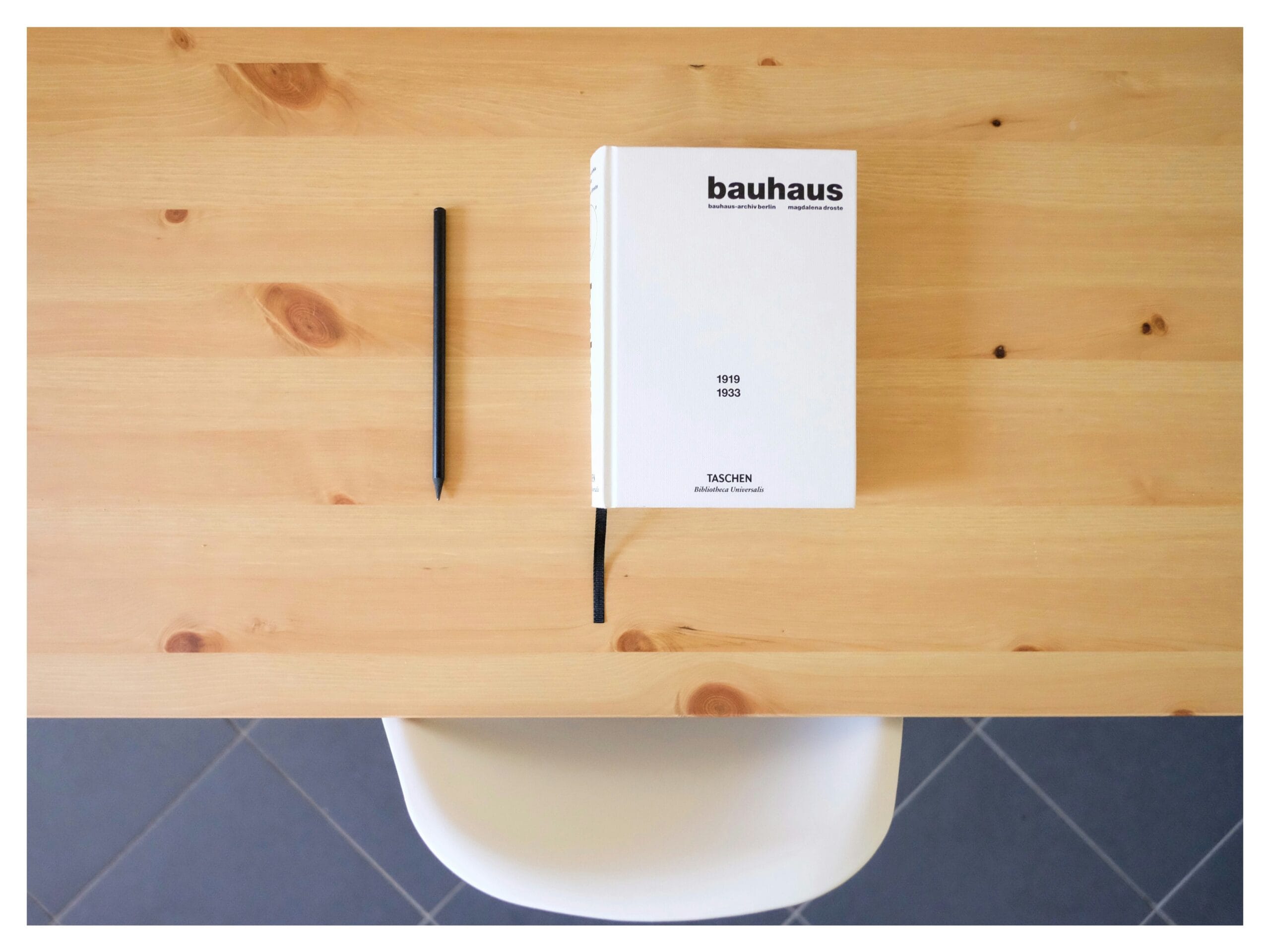
The best book on the Bauhaus is Magdalena Droste’s Bauhaus. Updated Edition (Taschen), a 400-page survey with 550 illustrations made with the Bauhaus-Archiv in Berlin, where Droste worked from 1980. For a short narrative history, read Frank Whitford’s Bauhaus (Thames & Hudson, 1984). For the Vorkurs, read Johannes Itten’s Design and Form. For primary documents, use Hans M. Wingler’s Bauhaus (MIT Press, in English since 1969). The school itself ran from 1919 to 1933.

Our Top Picks
Four books about the Bauhaus cover what most readers need, with a fifth on the school’s women in the guide below. The Droste is the one to buy first. After that, it depends on what you want: narrative history, primary pedagogy, or the documentary record. Here is what each one actually does.
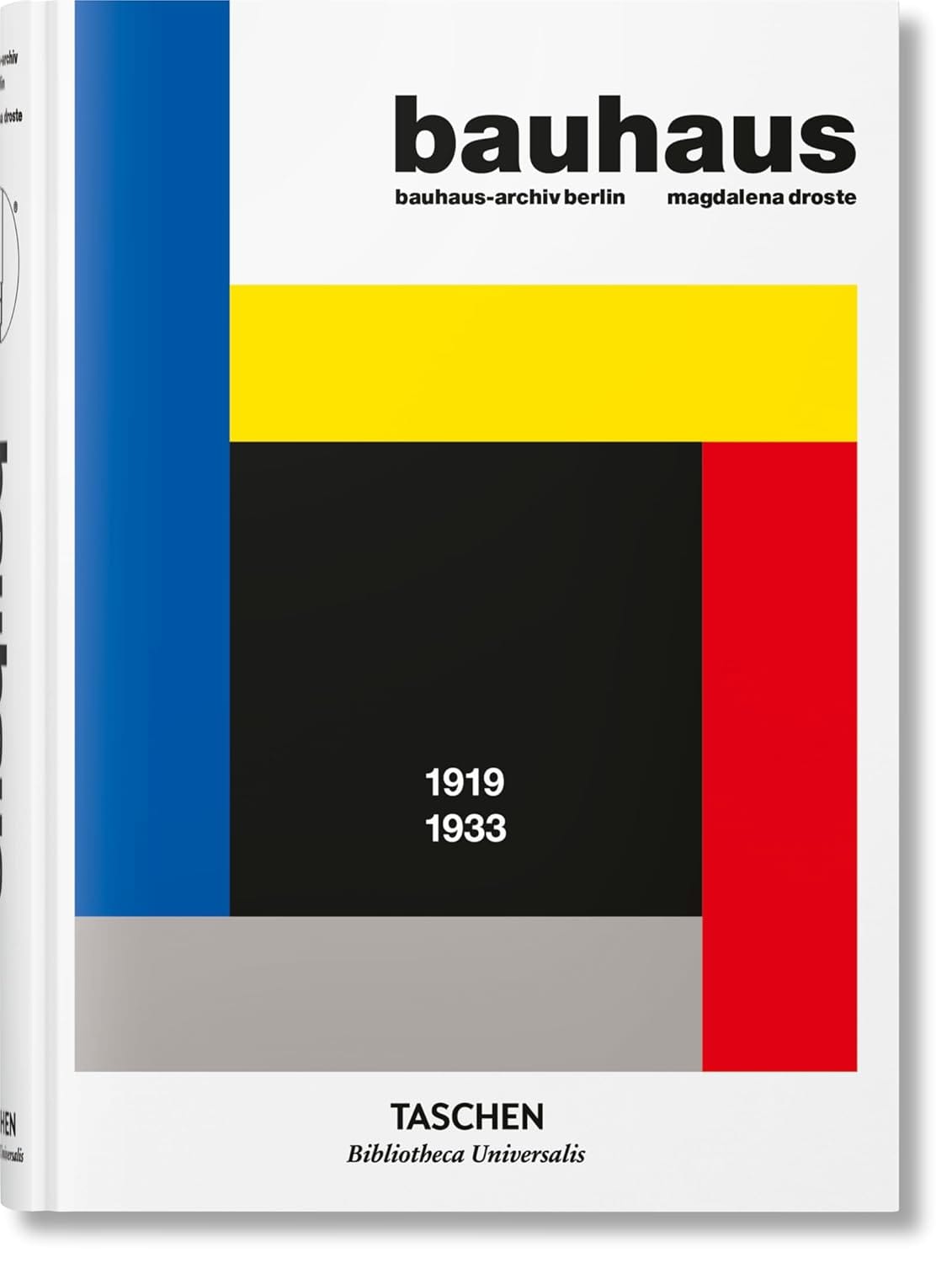
Best Overall — Magdalena Droste, Bauhaus. Updated Edition (Taschen, 2019)
Mid-Range (~$50–60)
Droste spent years working at the Bauhaus-Archiv Berlin before writing this book. That matters. The Bauhaus-Archiv holds the largest collection of Bauhaus documents and works in the world, and the 550+ illustrations in this edition are drawn directly from that collection. They are not secondary reproductions. The updated 2019 edition covers all three eras (Weimar, Dessau, Berlin) and runs to 400 pages. There is no other single volume that gives you this access to the primary material in this format.
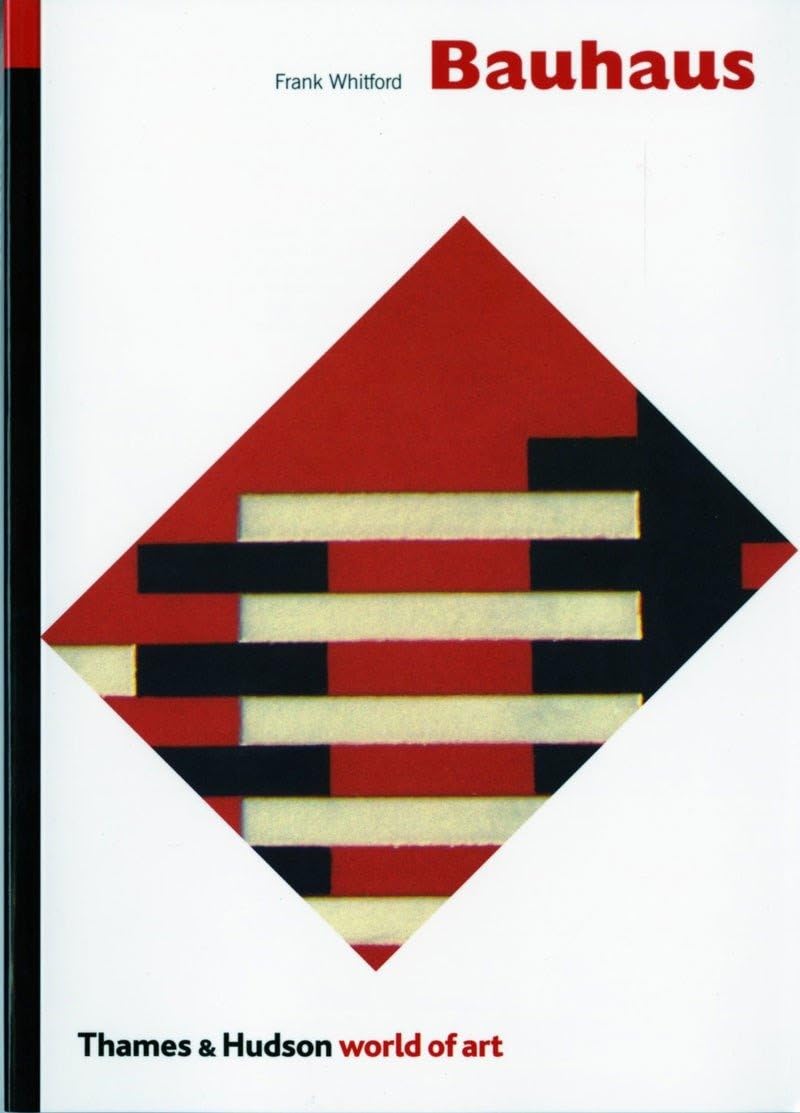
Best Concise Introduction — Frank Whitford, Bauhaus (Thames & Hudson World of Art, 1984)
Budget (~$20–25)
The World of Art series has a specific discipline: it forces writers to build an argument in limited space. Whitford’s 216 pages are probably the most efficient account of why the school kept moving cities. Weimar, Dessau, Berlin — and what changed each time. He covers Klee, Albers, Kandinsky, Gropius, and the curriculum in sequence, and does it without turning into a reference book. If you want a book you will actually read rather than consult, this is the one.
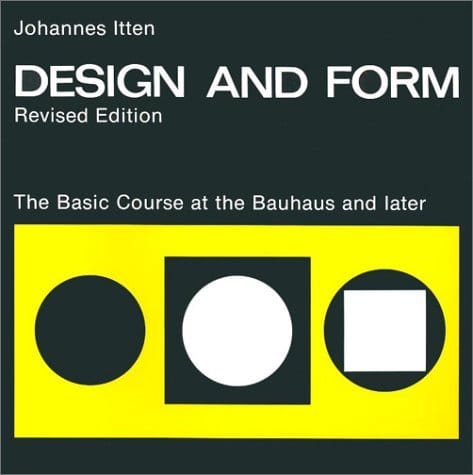
Best for Pedagogy — Johannes Itten, Design and Form: The Basic Course at the Bauhaus and Later (Wiley, revised ed.)
Mid-Range (~$35–45)
Itten ran the Vorkurs from 1919 to 1923. His goals, stated plainly: free the creative powers of students, help them identify career directions, and teach the fundamental principles of design. The book is illustrated with photographs and drawings from the student exercises themselves. No other book shows you how the pedagogy actually worked at the level of the individual exercise. This is useful if you teach, if you want to understand the teaching, or if you want to run Foundation Course exercises yourself.
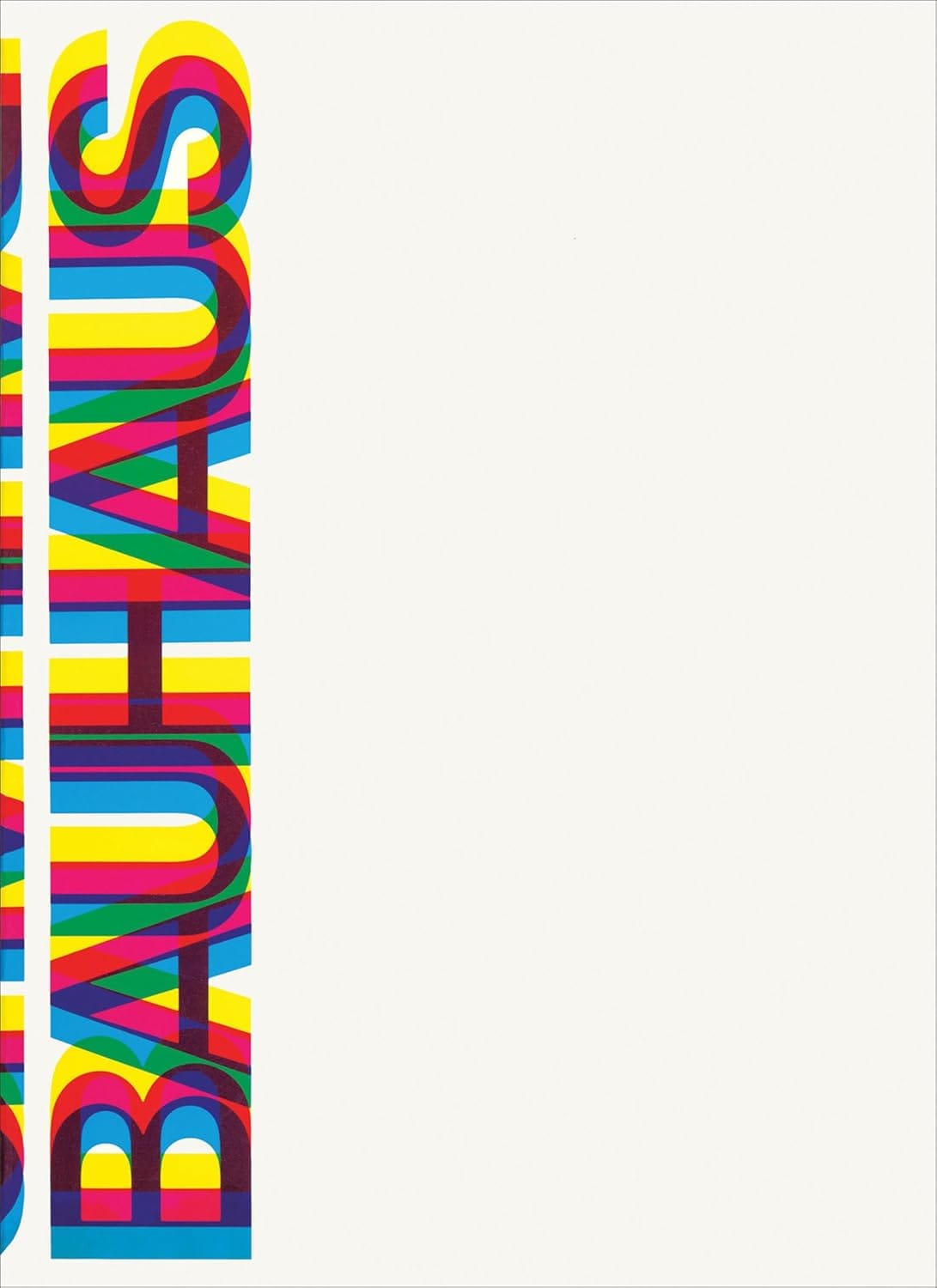
Best Primary Document Archive — Hans M. Wingler, Bauhaus: Weimar, Dessau, Berlin, Chicago (MIT Press, 1978)
Premium (~$80–100+)
This is not a book you read front to back. It is a reference of more than 650 pages built around primary documents: manifestos, German government records, private letters, architectural drawings, all translated into English. Wingler founded the Bauhaus-Archiv, and the MIT Press has published his book in English since 1969 (the paperback followed in 1978). It is the standard documentary source in Bauhaus scholarship. If you are writing about the Bauhaus, doing studio research into it, or building an institutional library, this is the volume you need. The price reflects its status as a reference work, not a trade title.
The Droste is the book where you can see the primary archive material without flying to Berlin.
Quick Decision Guide
- Best for design students new to the Bauhaus: Whitford (Thames & Hudson). Short, structured, reads as history rather than reference. Gets you through the three eras and the key figures without overwhelming the first encounter.
- Best for architecture and design professionals: Wingler (MIT Press). Primary documents in English translation. The standard citation. If you need to cite something, it will be in Wingler.
- Best gift for a design-interested person: Droste (Taschen). The images make the argument before you read a word. At the price point it costs less than most design objects it documents.
- Best for teaching or running studio exercises: Itten (Wiley). The Foundation Course is reproducible from this book. It is the only one of these four that a design instructor can open and work from directly.
- Best for understanding the Bauhaus’s women: Müller, Bauhaus Women: Art, Handicraft, Design (Flammarion, 2009). Profiles twenty women who worked across the school’s teaching, workshop and production branches, practice omitted from most early histories. Anni Albers, Marianne Brandt, Gunta Stölzl — and many more whose names you likely do not know. The standard account of the school was written by and about its male directors. This book corrects that.
Search for Müller’s Bauhaus Women on Amazon
Which Bauhaus book to read for which purpose
The four picks above are books about the Bauhaus. Some of the most useful books are by it: the teachers’ own texts, several of them first issued in the school’s Bauhausbücher series. Match the book to the question you are asking.
- History: Whitford for the story in 216 pages, then Droste for the images and the full chronology of Weimar, Dessau and Berlin.
- Teaching and the Vorkurs: Itten’s Design and Form for the course he started, and Paul Klee’s Pedagogical Sketchbook (Bauhausbücher no. 2, 1925), the lecture notes from his classes on visual form, edited by Gropius and designed by László Moholy-Nagy.
- Primary sources: Wingler, then the Bauhausbücher themselves, several of which exist in facsimile or English translation.
- Color: Josef Albers’s Interaction of Color (Yale University Press, 1963). Albers took Itten’s preliminary course in 1920 and taught it from 1923; the book records the way of teaching color he developed later in the United States. More on it in our guide to Josef Albers and color.
- Graphic design and photography: Moholy-Nagy’s Painting, Photography, Film (Bauhausbücher no. 8, 1925), where he set out his idea of the “New Vision,” the camera as a new way of seeing.
- Architecture: Walter Gropius’s The New Architecture and the Bauhaus (Faber and Faber, 1935; MIT Press paperback, 1965), his own short statement of the ideas he developed as director.
- Interiors and furniture: Droste, whose 550 illustrations include architectural plans, photographs and models. For the objects themselves, see our guides to Bauhaus furniture and the Wassily chair.
Full Comparison
| Book | Author / Publisher | Best For | Price Range | Link |
|---|---|---|---|---|
| Bauhaus. Updated Edition (2019) | Droste / Taschen | First purchase; visual survey | Mid-Range (~$50–60) | Amazon |
| Bauhaus (World of Art, 1984) | Whitford / Thames & Hudson | Readable narrative account | Budget (~$20–25) | Amazon |
| Design and Form (revised ed.) | Itten / Wiley | Pedagogy; Foundation Course | Mid-Range (~$35–45) | Amazon |
| Bauhaus: Weimar, Dessau, Berlin, Chicago (1978) | Wingler / MIT Press | Primary sources; research | Premium (~$80–100+) | Amazon |
| Bauhaus Women (2009) | Müller / Flammarion | Women’s practice; corrective history | Mid-Range (~$30–40) | Amazon |
What each book actually does
Droste: the archive in your hands
Pros:
- 550+ illustrations sourced directly from Bauhaus-Archiv Berlin
- Covers all three eras (Weimar, Dessau, Berlin) with equal weight
- Updated 2019 edition incorporates recent scholarship
Cons:
- 400 pages is dense — not a casual read
- Taschen price fluctuates; check current listing before purchase
Who it’s for: Anyone who wants one authoritative book on the shelf.
Why it stands out: The Bauhaus-Archiv provenance is not a marketing note. The book was made with the archive, so the illustrations come from its own holdings of original documents. That matters when you are looking at workshop drawings and prototype photographs.
Whitford: the argument compressed
Pros:
- 216 pages built for reading, not consulting
- World of Art series enforces argumentative discipline
- Best narrative account of why the school kept relocating
Cons:
- Fewer illustrations than Droste — text-forward
- Some recent scholarship not reflected (1984 publication)
Who it’s for: Design students, teachers, and anyone who wants to read about the Bauhaus rather than look at it.
Why it stands out: Whitford explains each of the three Bauhaus eras as a shift in intellectual position, not just a change of address. The Weimar school was different from the Dessau school in argument, not just in building. That distinction is missing from most surveys.
Itten: the pedagogy made visible
Pros:
- Illustrated with photographs and drawings of original student exercises
- The only book that documents the Foundation Course in Itten’s own account
- Exercises are reproducible — useful for teaching
Cons:
- Availability varies by edition; the 1975 Wiley revised edition is the standard
- The pedagogical format (exercises, diagrams) is not for browsing
Who it’s for: Design educators, design students wanting to understand how Bauhaus training worked, and anyone who teaches a Foundation Course in any context.
Why it stands out: Itten’s three goals for the Vorkurs — free creative powers, help students find career paths, teach fundamental design principles — were the framework the entire post-war design education system built on. You cannot understand the origin of that framework without this book.
Wingler: the documentary standard
Pros:
- Primary documents in English translation — manifestos, government records, private correspondence
- More than 650 pages; the standard documentary source in Bauhaus scholarship, in English since 1969
- Includes architectural drawings and model documentation not available elsewhere in English
Cons:
- Not a reading book — a reference book; chapter-by-chapter reading is not the intended use
- Price point reflects institutional reference status, not trade accessibility
Who it’s for: Researchers, academics, design professionals building a working library, and anyone who will need to cite primary Bauhaus sources in English.
Why it stands out: English-language books that cite primary Bauhaus documents lean on Wingler, because it gathers that documentary record in translation in one volume. If you are going to read those books carefully, you need the primary sources they are drawing from.
English-language books that cite primary Bauhaus documents lean on Wingler, because it gathers that record in translation in one volume.
What the Bauhaus was actually arguing
Gropius founded the Bauhaus in Weimar on April 1, 1919, by merging the Grand-Ducal Saxon School of Arts and Crafts with the Weimar Academy of Fine Art. The thesis was simple and difficult: art and craft are the same activity, split apart only by academic convention, and the split is damaging. The school tried to undo it.
That argument ran into political reality three times. In Weimar (1919–1925), in Dessau (1925–1932), and in Berlin (1932–1933), where the school was closed under Nazi pressure. Each move was a response to that pressure, and each move changed the school’s position. The Weimar school under Gropius was different from the Dessau school under Meyer (1928–1930), which was different again from the Berlin school under Mies van der Rohe (1930–1933). The books worth owning understand this. They do not present the Bauhaus as a single coherent aesthetic. They show you an argument under pressure, moving and changing as the pressure changed.
Frequently Asked Questions
What is the best book on the Bauhaus?
Magdalena Droste’s Bauhaus. Updated Edition (Taschen) is the best single book: 400 pages and 550 illustrations, made with the Bauhaus-Archiv in Berlin. Pair it with Whitford’s short history if you want to read rather than look, with Itten’s Design and Form for the teaching, and with Wingler’s MIT Press volume for the primary documents.
What is the best book on Bauhaus architecture?
Start with Walter Gropius’s The New Architecture and the Bauhaus (Faber and Faber, 1935; MIT Press paperback, 1965), the founder’s own account of the ideas he developed as director from 1919 to 1928. For drawings and documents of the buildings, go to Wingler, and for photographs and plans, to Droste.
What is the most famous piece of Bauhaus?
The most famous Bauhaus work is the Bauhaus building in Dessau, designed by Walter Gropius and built in 1925 and 1926 as the school’s home; it has been part of a UNESCO World Heritage Site since 1996. Among objects, the best known is Marcel Breuer’s tubular steel Wassily chair, designed in 1925 and 1926 while he ran the Bauhaus cabinet-making workshop.
Was the Bauhaus leftist?
Partly, and it depends on the director. Gropius insisted the school was apolitical. His successor Hannes Meyer (1928 to 1930) moved it further left, and Dessau’s mayor dismissed him in 1930 over alleged communist activity at the school. Conservatives and then the Nazis painted the Bauhaus as a center of communist intellectualism, and it closed under Nazi pressure in 1933.
Is IKEA considered Bauhaus?
No. IKEA is a Swedish company founded by Ingvar Kamprad in 1943, ten years after the Bauhaus closed, and its design comes out of Scandinavian modernism. The two share an aim, simple furniture made for mass production at prices ordinary people can pay, which is why they get compared. We set out the differences in Bauhaus vs Scandinavian design.
What is the best Bauhaus book for beginners?
Whitford’s Bauhaus (Thames & Hudson World of Art) is the right first book. At 216 pages it gives you the narrative — why the school was founded, what it taught, how it moved between cities, who the key figures were — without requiring the reader to already know the history. The Droste Taschen is the better reference once you have that foundation.
What did the Bauhaus school actually teach?
The Bauhaus ran a two-track curriculum. Every student completed the Vorkurs (Foundation Course), which taught fundamental design principles through exercises developed by Itten and later Albers and Moholy-Nagy. After the Vorkurs, students entered workshops: weaving, furniture, typography, ceramics, metalwork. They trained alongside both a master craftsman and a master of form, typically a fine artist. The goal was to train people who could work at the intersection of art and industrial production.
How many books did the Bauhaus publish itself?
The Bauhaus issued the Bauhausbücher series — 14 books published between 1925 and 1930, written by teachers and associates of the school. These covered the school’s core positions on art, design, architecture, and pedagogy. They are historical documents as much as design books; some are available in facsimile reprints.
Who were the most important teachers at the Bauhaus?
Gropius recruited from the German artistic avant-garde. The Weimar faculty included Itten (Foundation Course), Lyonel Feininger (graphics), and Gerhard Marcks (ceramics). Paul Klee joined at Weimar in 1921 and Wassily Kandinsky in 1922; both continued at Dessau. László Moholy-Nagy replaced Itten in 1923. Josef Albers taught at Dessau and Berlin before emigrating to the United States. The answer depends on which workshop and which era you mean — the school was never a single unified faculty.
Is the Wingler Bauhaus book still in print?
The MIT Press paperback edition is still listed on Amazon, though availability and price fluctuate. It is worth checking current availability before purchase. The hardcover boxed edition commands higher prices and is frequently found through used-book sellers. For research purposes, either edition contains the same primary documents.
For the broader movement context, see the full guide to Bauhaus design ideas. For products in the Bauhaus tradition, see best Bauhaus design products and the guide to Bauhaus design for the home.

About Joe Post
Joe Post holds an MFA in Art from California Institute of the Arts (CalArts) and has done additional graduate work at the School of the Art Institute of Chicago. He founded Art Design Ideas to write about design as cultural argument — the decisions, contradictions, and assumptions built into the objects we live with.