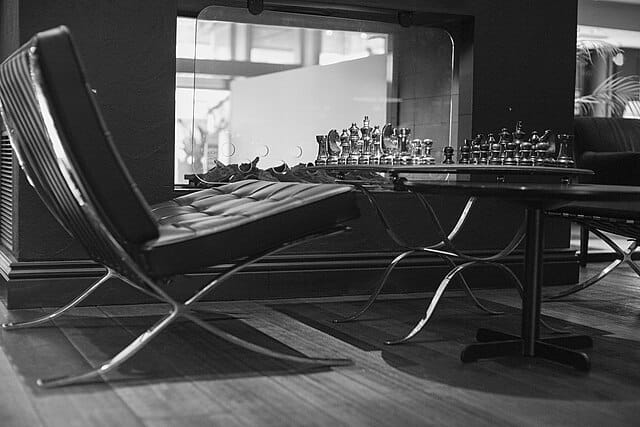

Bauhaus furniture means designs produced by or descended from the German Bauhaus school (1919–1933), built on tubular steel, geometric form, and materials-honest construction. The best Bauhaus furniture today comes from the companies that hold the licenses, Knoll and Thonet, and from contemporary brands that work in the same tradition without copying it. ADI links only to those sources.
Our Top Picks
These picks cover the range: the chair that started the tubular steel conversation, two versions of the cantilever form that changed how chairs are built, and two contemporary brands for buyers who want Bauhaus principles in something designed today. Prices were checked at the makers’ own US stores in September 2026.
- Knoll Wassily Chair (Premium, $4,373): Marcel Breuer’s 1925 Model B3, made under license by Knoll. Chrome-plated tubular steel and leather slings in the proportions Breuer specified.
- Knoll Cesca Caned Side Chair (Mid-Range, $1,380): Breuer’s 1928 cantilever with a bentwood seat and back and hand-woven cane. The most livable Bauhaus chair ever made, and the easiest to use every day at a dining table.
- Thonet S 33 (Mid-Range): Mart Stam’s 1926 cantilever, still made by Thonet, the company that produced the first tubular steel furniture at scale. The structural idea: no rear legs are needed if the steel itself provides spring. Sold through Thonet’s dealers.
- HAY and Muuto (Mid-Range): Danish brands that carry the Bauhaus logic (material honesty, no ornament, functional form) into current production without reproducing specific originals. The right choice if you want the principles at a lower price.
Quick Decision Guide
- Best statement chair: Knoll Wassily Chair. The first tubular steel chair, and still the clearest demonstration of what the material could do.
- Best dining or desk chair: Knoll Cesca. Comfortable for a full meal, light enough to move, and the most affordable licensed Breuer design.
- Best for purists: Thonet S 33. The cantilever at its most reduced, from the manufacturer that built the Bauhaus-era originals.
- Best contemporary Bauhaus-inspired: HAY or Muuto. Not reproductions, but designed objects that take the same position on materials and form.
- Best value: a secondhand Knoll or Thonet piece. These chairs were made in large numbers for decades; check for the maker’s label or stamp under the seat.
- Barcelona Chair: We’ve covered the Barcelona Chair, designed by Mies van der Rohe and Lilly Reich in 1929, in a separate profile. See our Barcelona Chair guide for the full story and where to buy the licensed Knoll version.
Full Comparison
| Chair | Design | Price (Sept 2026) | Best For | Link |
|---|---|---|---|---|
| Knoll Wassily Chair | Marcel Breuer, Model B3, 1925 | $4,373 | Statement seating, reading rooms | Knoll |
| Knoll Cesca Caned Side Chair | Marcel Breuer, 1928 | $1,380 | Dining, desk | Knoll |
| Thonet S 33 | Mart Stam, 1926 | Through dealers | Dining, compact spaces | Thonet |
| HAY / Muuto | Contemporary, Bauhaus-inspired | Varies | New homes, everyday living | HAY / Muuto |
What the best Bauhaus furniture pieces are actually doing
Knoll Wassily Chair
Pros:
- The tube is structural, not decorative. The whole chair is a skeleton, and the leather slings are held in tension across it.
- Black leather against chrome is part of what the chair is; the color contrast makes the structure readable
- Licensed production to documented specifications, with a resale market that holds value
Cons:
- The price
- An occasional chair, not a working one; comfortable for an hour, not a day
Who it’s for: Someone who wants the object that started modern tubular steel furniture, and has a reading corner to put it in.
Knoll Cesca Chair
Pros:
- The cantilever flex is present and intentional; the chair gives slightly as you sit
- Cane seat and back breathe, which matters over a long dinner
- Available as a side chair, armchair, stool and fully upholstered version
Cons:
- Cane can be damaged by sharp objects and pets; upholstered versions avoid this
- A set of six is a significant purchase
Who it’s for: Dining room or desk buyers who want Bauhaus structure in a chair they will actually use every day.
Thonet S 33
Pros:
- Made by Thonet, which manufactured tubular steel furniture for the Bauhaus generation and still does
- The most reduced version of the cantilever idea: a single bent tube and a seat
- Compact enough for dining or desk use without dominating the space
Cons:
- Harder to buy in the US than a Knoll piece; you order through a Thonet dealer
- No armrests on the S 33; the S 34 is the armchair version
Why it stands out: The cantilever principle is the most structurally interesting idea to come out of the Bauhaus-era furniture workshops, and this is its first and plainest statement.
HAY and Muuto: Bauhaus logic, new designs
Pros:
- These are designed objects, not versions of old ones. The design decisions are current and intentional.
- Material honesty is built into the design language: what you see is what it’s made of
- Priced well below the licensed classics
Cons:
- Not Bauhaus designs. If the historical form is what you want, these won’t satisfy it.
Who it’s for: Buyers who want the Bauhaus design sensibility (functional, material-honest, no ornament) in a daily-use chair they don’t have to handle carefully. HAY, founded in 2002 by Rolf and Mette Hay, and Muuto, founded in 2006, work in the tradition the Bauhaus established: good objects at scale, without pastiche.
What the Bauhaus was actually arguing about furniture
The Bauhaus opened in Weimar in April 1919, relocated to Dessau in 1925, moved to Berlin in 1932, and was shut down under Nazi pressure in 1933. Fourteen years. The furniture associated with it (the Wassily Chair, the Cesca Chair, the S 33 cantilever, the Barcelona Chair) has been in production ever since.
The argument was specific: industrial materials are not inferior to traditional ones. Tubular steel, the kind used in bicycle frames and scaffolding, was considered a manufacturing material, not a furniture material. Marcel Breuer looked at his new bicycle in 1925 and saw something else. The steel tube’s strength relative to its weight meant a chair could be a skeleton, a structural gesture, instead of a padded box. For the full story of that work, see Marcel Breuer’s tubular steel chairs; the Wassily and Cesca remain in licensed production today.
This was as much a political claim as an aesthetic one. Walter Gropius founded the school on the premise that good design should be producible at scale and available to people who couldn’t afford handcrafted wood furniture. The tubular steel chairs were proof of concept. They could be made in a factory. They were meant to be.
Every chair on this page is still made by the company that produced it, close to a century later, because people keep buying them. That’s the argument’s verdict. For more on the movement and what it produced beyond furniture, see our guide to Bauhaus design ideas.
Frequently Asked Questions
How do I know if a Wassily or Cesca chair is authentic?
In the US, Knoll makes both under license and holds the trademarks to the Wassily and Cesca names. Authentic chairs carry a Knoll label or stamp, and Knoll documents their specifications. A new chair sold under either name by anyone other than Knoll or an authorized Knoll dealer is not the licensed product.
Where can I buy authentic Knoll Bauhaus furniture?
Knoll sells directly at knoll.com, and Design Within Reach is an authorized US dealer. At knoll.com in September 2026, the caned Cesca side chair listed at $1,380 and the Wassily Chair at $4,373. Thonet sells the S 33 and S 34 cantilevers through its own dealer network.
Is the Wassily Chair comfortable for everyday use?
Not for most people. The Wassily Chair was designed as a reading or occasional chair. The leather slings provide support for seated rest, not for long working sessions. The seat depth and back angle work well for 30 to 60 minutes of relaxed sitting. Its strength is presence and structural clarity, not ergonomic support.
What furniture brands are inspired by the Bauhaus but make new designs?
HAY (founded 2002, Denmark) and Muuto (founded 2006, Denmark) design new objects within the same principles: functional form, honest materials, no applied ornament. They are working in the tradition rather than reissuing it. String Furniture (Sweden) takes a similar position.
How do I judge the quality of tubular steel furniture?
Three indicators: tube wall thickness (thin tubes flex and dent), chrome finish (even coverage, no orange-peel texture), and the seat material (full-grain leather or cane against bonded leather, which is a composite that cracks). On a secondhand piece, check the welds and the maker’s label.
Is the Barcelona Chair the most famous Bauhaus furniture piece?
The Barcelona Chair, designed by Ludwig Mies van der Rohe and Lilly Reich for the German Pavilion at the 1929 Barcelona International Exposition, is arguably the most recognized single piece. Mies was the Bauhaus’s last director. It has been in licensed production through Knoll since 1953. See our Barcelona Chair guide for its history and where to buy it.
Further Reading
Two books: one for orientation, one for looking.
- Frank Whitford, Bauhaus (Thames & Hudson, 1984): The standard English-language introduction to the movement. Covers furniture alongside architecture, graphics, and theater without over-weighting any one discipline; the right starting point if you want to understand what the school was actually doing.
- Magdalena Droste, Bauhaus Updated Edition (Taschen): The visual reference. Furniture sketches, production photographs, and period documentation from the Bauhaus-Archiv; the one to own if the furniture is what you’re here for.

About Zoe Post
Zoe Post holds a BFA and a Master of Architecture from the School of the Art Institute of Chicago. She now works as a product marketing leader at an architectural product design firm, bringing hands-on industry perspective to everything she writes. At ADI she covers contemporary artists, textile and pattern design, and the design objects that sit at the boundary of art and function.