
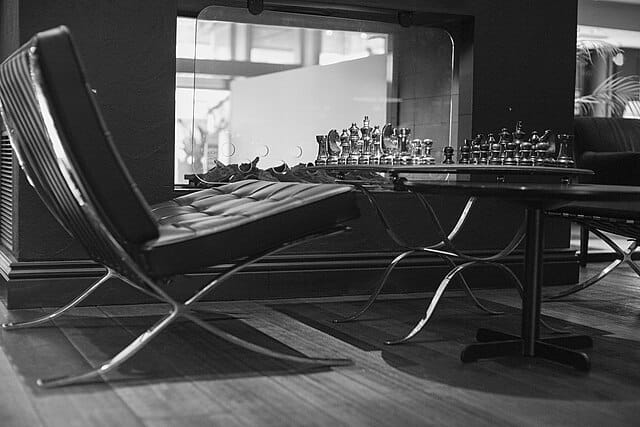
The Barcelona Chair, designed by Ludwig Mies van der Rohe and Lilly Reich for the 1929 German Pavilion in Barcelona, is the clearest single object argument for what modernism believed about architecture, materials, and the relationship between furniture and space. Its X-frame steel base and hand-stitched leather cushions were not decorative choices. They were structural and philosophical positions — and they have held for nearly a century.
Genesis of a Design Masterpiece
The 1929 International Exposition: A Stage for Innovation
The Barcelona Chair was conceived for the German Pavilion at the 1929 International Exposition in Barcelona. Mies van der Rohe, appointed to design the pavilion, sought to create a space that embodied the progressive spirit of the Weimar Republic. This ambition extended to the furniture within, leading to the creation of the Barcelona Chair — a piece intended not just as seating but as a statement of modernity and elegance. The Design Museum London documents Mies as an architect who believed that structure itself was the ornament.
Collaboration of Mies van der Rohe and Lilly Reich
While Mies van der Rohe is often solely credited for the Barcelona Chair, Lilly Reich’s contribution was significant. Reich was a designer and Mies’s close collaborator who brought expertise in textiles, materials, and spatial arrangement. Her role in the pavilion — and in the chair’s development — was substantive, not supporting.
Design Aesthetics and Construction
A Fusion of Form and Function
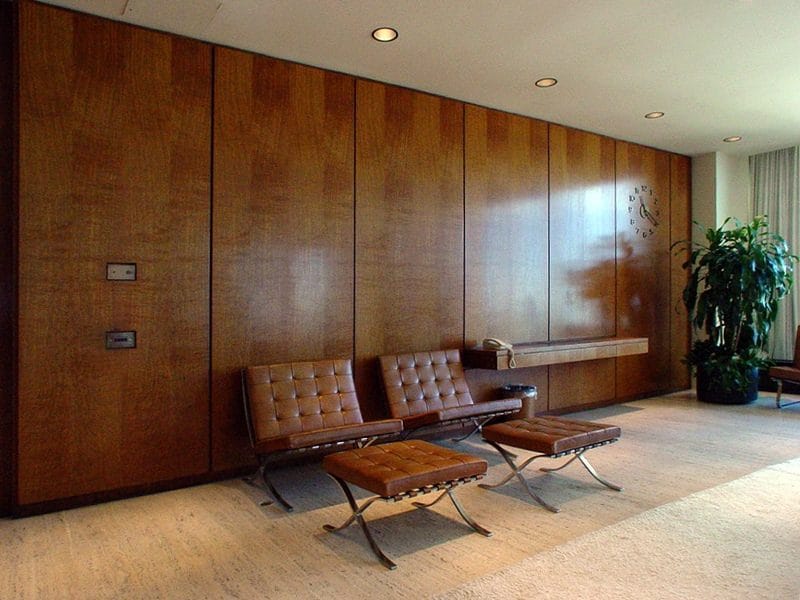
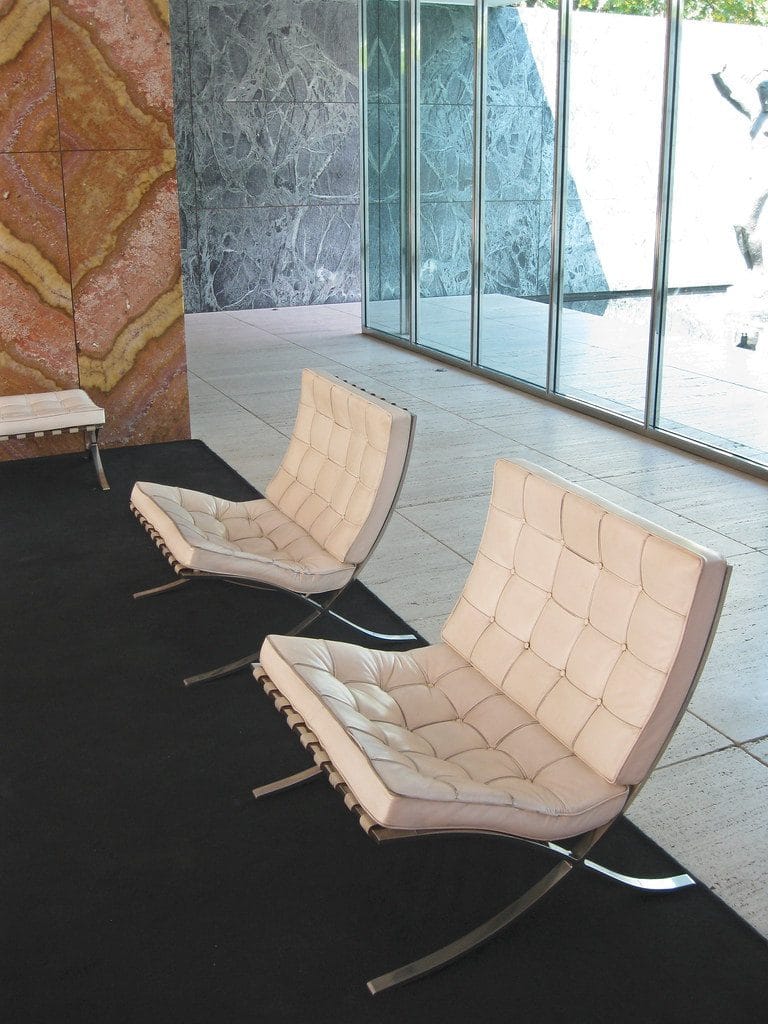
The Barcelona Chair’s structure comprises two intersecting chrome-plated flat steel bars forming a distinctive X-shape. This design provides structural stability while creating a sense of visual lightness. The cantilevered seat floats above the base — a technical achievement that required precise engineering to achieve the spring and flex that make the chair comfortable without visible mechanical support.
Materials and Craftsmanship
Originally, the chair used white pigskin leather, featuring 40 individual hand-cut and hand-stitched panels. That panel count was not arbitrary. It was dictated by the geometry of wrapping compound curves without folds or bunching. In later versions, bovine leather replaced pigskin, maintaining the chair’s quality while adapting to material availability. Knoll, the authorized manufacturer, documents the current production process as requiring over 40 hours of hand labor per chair.
The Barcelona Chair in Context
The Barcelona Pavilion: A Harmonious Ensemble
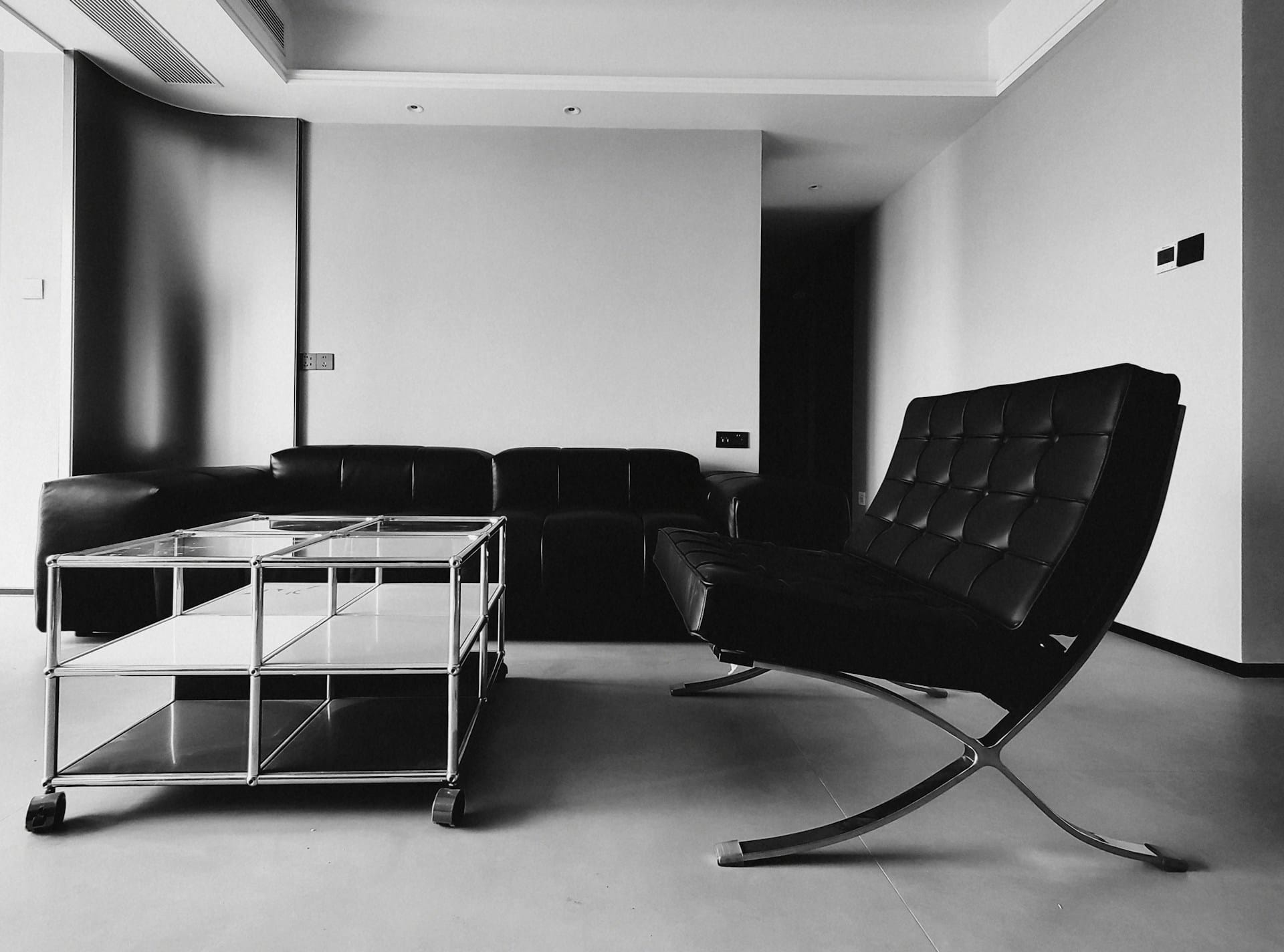
The Barcelona Chair was more than seating in the pavilion; it was integral to a larger spatial argument. The pavilion’s open plan, travertine floors, and glass walls treated materials as the primary architectural event. The chair extended that argument into the domestic object: the same attention to material properties, the same refusal of applied ornament, the same insistence that the structure itself was the design.
Symbolism and Reception
The chair was originally designed for the Spanish Royal Family to use during the exposition’s opening ceremony. That ceremonial origin gave the chair an immediate associative weight — it was furniture designed for a specific moment of state — which quickly became part of its cultural meaning. The chair’s authority comes partly from that origin and partly from the design itself: both are inseparable.
Early Impact and Production
Limited Production and Exclusive Appeal
The original production comprised only two chairs for the pavilion. That exclusivity added to the chair’s early mystique. Its subsequent appearance in Villa Tugendhat — a private residence designed by Mies in Brno — further established the chair as a Mies signature, an object that belonged in the same spatial argument as his architecture.
Transition to Mass Production
Knoll began producing the Barcelona Chair in the late 1940s after acquiring the rights from Mies. That transition brought the chair into wider circulation — offices, reception areas, residences, museums — without changing the production method meaningfully. The chair remained expensive to make. Knoll maintained the hand-stitched leather construction rather than adapting it to cheaper manufacturing. The chair’s price reflects that decision.
The Chair as a Cultural Icon

Inclusion in Art and Popular Culture
The Barcelona Chair has appeared in literature, film, and television as a reliable shorthand for a particular kind of authority: institutional, modernist, expensive without being flashy. Tom Wolfe, in From Bauhaus to Our House, called it “the Platonic ideal of the chair” — meaning the object toward which all chair-making aspires. The MoMA collection includes the Barcelona Chair as a permanent fixture of twentieth-century design history.
A Timeless Design Icon
The Barcelona Chair’s lasting appeal reflects a design that resolved its brief completely. Mies and Reich set out to make a piece that could sit in the Barcelona Pavilion without apology — something that matched the architecture in material ambition and spatial intelligence. Nearly a century later, no revision has improved on the original solution.
Influence on Modern Furniture Design
The chair’s design principles have shaped modern furniture’s relationship to structure and material. Its insistence on visible steel construction — at a time when most high-end furniture concealed its structure in upholstery — established a formal vocabulary that later designers from Eames to Breuer used as a starting point. The tubular steel argument was being made simultaneously by Mies van der Rohe and the Bauhaus precedent for tubular steel seating — two designers who arrived at the cantilever from different directions. For a parallel argument made in a different material vocabulary, see Charles and Ray Eames — who pursued the same modernist thesis through mass manufacturing rather than bespoke craft. Where the Barcelona Chair asked steel and leather to perform comfort, the Panton Chair’s single-form plastic logic asked a single pour of plastic to carry the entire structural and aesthetic argument. A generation later, Arne Jacobsen’s Egg chair answered the same lounge-seating question with sculpted foam instead of an exposed frame, proof that the debate the Barcelona Chair started never closed.
Reproductions and Authenticity
Legal Issues and Unlicensed Versions
The popularity of the Barcelona Chair produced a large unlicensed market. Knoll has pursued legal action in several jurisdictions to protect the design. The legal landscape varies by country — intellectual property protection for industrial design differs significantly between the US, EU, and Asia — which is why unlicensed versions remain widely available in some markets and not others.
The Chair’s Authenticity and Value
Authentic Barcelona Chairs produced by Knoll are considered collectible items valued for their historical significance and production quality. The difference between a Knoll original and an unlicensed version is measurable: the leather panel construction, the steel finish, and the seat spring tension are all held to documented tolerances in the authorized version. For a guide to the best reproduction options currently available, see how to identify an authentic Barcelona Chair.
If you are evaluating a chair in person or in a listing, four checks separate a Knoll original from a copy:
- The stamp. Authentic chairs carry the KnollStudio logo and Mies van der Rohe’s incised signature on the frame. No stamp, no provenance.
- The frame. Since the 1950 redesign, the authorized frame is a single seamless piece of hand-polished stainless steel. Unlicensed versions typically bolt chrome-plated sections together; look for joins where the X crosses.
- The upholstery. Knoll cushions use individual leather squares cut from a single hide, hand-welted and hand-tufted. Machine-stitched panels with uniform seams signal a reproduction.
- The suspension. Originals hang the cushions on leather straps; many unlicensed versions substitute rubber or fabric webbing under foam.
For a direct comparison of the Barcelona Chair against its main rival in the design canon, see Barcelona Chair vs Eames Lounge Chair. To see how it ranks against the whole field, from the Eames Lounge to the Egg, see our guide to the best designer lounge chairs. For the broader context of this work, see the Iconic Furniture Design hub — a survey of the chairs and objects that defined twentieth-century design.
Frequently Asked Questions
Who designed the Barcelona Chair?
Ludwig Mies van der Rohe and Lilly Reich designed the Barcelona Chair in 1929 for the German Pavilion at the International Exposition in Barcelona. Mies is the more widely credited designer, but Reich’s contribution — particularly in materials, textiles, and spatial arrangement — was central to the pavilion’s design program and to the chair itself.
What is the Barcelona Chair made of?
The Barcelona Chair’s frame consists of two flat bars of chrome-plated or stainless steel, crossing in an X-shape to form the base and back support. The cushions are leather — originally white pigskin, later bovine leather — cut into 40 individual panels and hand-stitched with welted seams. The seat and back cushions rest on a network of leather straps rather than a solid platform, providing flex without mechanical springs.
How much does a Barcelona Chair cost?
A Knoll-authorized Barcelona Chair retails between $5,000 and $9,000 depending on leather selection and finish. That price reflects over 40 hours of hand labor per chair. Unlicensed versions sell for $300 to $1,500. The production gap explains the price gap: unlicensed versions use machine-stitched panels and lighter steel, which changes the seat behavior and finish quality.
Is the Barcelona Chair still in production?
Yes. Knoll has manufactured the Barcelona Chair continuously since the late 1940s under license from the Mies van der Rohe estate. It remains one of Knoll’s flagship products and is produced to the same hand-labor standards established in the original production run. The chair has never been discontinued.
What is the difference between an authentic and an unlicensed Barcelona Chair?
Authentic Knoll Barcelona Chairs use hand-cut and hand-stitched leather panels, solid stainless or chrome-plated flat-bar steel, and precisely tensioned leather seat straps. Unlicensed versions use machine-stitched panels, lighter steel profiles, and often substitute foam for the strap-suspended cushion system. The visual difference from a distance can be minimal. The tactile and structural difference — how the chair sits, how the leather ages, how the frame holds under long-term use — is significant.
How can you tell if a Barcelona chair is real?
Check four things: the KnollStudio logo and Mies van der Rohe signature stamped on the frame, a seamless one-piece stainless steel frame with no bolted joins, hand-welted leather squares cut from a single hide, and leather strap suspension under the cushions. A missing stamp or a bolted X-frame settles the question immediately.
Who manufactures the Barcelona chair today?
Knoll, which has held the production rights since acquiring them from Mies van der Rohe in the late 1940s, still manufactures the authorized chair under its KnollStudio line. Knoll has been part of MillerKnoll since 2021. Every other version on the market, whatever its quality, is a reproduction.

About Joe Post
Joe Post holds an MFA in Art from California Institute of the Arts (CalArts) and has done additional graduate work at the School of the Art Institute of Chicago. He founded Art Design Ideas to write about design as cultural argument — the decisions, contradictions, and assumptions built into the objects we live with.