
Ludwig Mies van der Rohe (1886–1969) was a German-American architect and furniture designer whose work reduced modern building to steel, glass, and the unapologetic suppression of ornament. His Barcelona Chair, Farnsworth House, and Seagram Building remain the most widely cited arguments for why “less is more” is a design position, not a preference. He belongs to any serious account of the design legends of the 20th century.
What Mies Was Actually Arguing — and Why Germany in the 1920s Made That Argument Necessary
The classical revival styles that dominated European architecture before World War I were not merely aesthetic. They were political. Beaux-Arts buildings and Gothic revivalism were the visual language of empire, of institutional authority, of a social order that four years of industrialized slaughter had discredited. After 1918, building in that language meant endorsing what had just failed. Mies understood this. His stripped-down modernism was not minimalism as a sensibility. It was an argument about what architecture owed the present.
His stripped-down modernism was not minimalism as a sensibility — it was an argument about what architecture owed the present.
He came up in a tradition that had already been working through this question. From 1908 to 1912, he worked in Peter Behrens’s office, which was simultaneously employing Walter Gropius and Le Corbusier. Three of the architects who would define 20th-century modernism occupied the same drafting room. Behrens was then designing the AEG Turbine Factory in Berlin, the first major industrial building to be treated as architecture rather than engineering, and the arguments Mies absorbed there about structure, material honesty, and the suppression of applied decoration shaped everything that followed.
His appointment as director of the Bauhaus in 1930 placed him at the center of a fight that went beyond pedagogy. Hannes Meyer, the previous director, had been forced out under pressure because his Communist politics had made the school politically untenable in Dessau. Mies took over a school that the political right wanted closed, moved it to Berlin in a last attempt to preserve it, and held it together until the Nazis shut it in July 1933. He was not a crusader. He would later collaborate with the Nazi state on exhibition design in 1934. But what he did at the Bauhaus matters: he ran the school as a design institution, not a political one, and that restraint, however morally ambiguous in retrospect, gave modernism four more years of institutional existence in Germany. Franz Schulze and Edward Windhorst address this political record directly in Mies van der Rohe: A Critical Biography (University of Chicago Press, 2014), which is the standard source.
He emigrated to Chicago in 1938. As director of architecture at the Illinois Institute of Technology from 1938 to 1958, he redesigned the IIT campus and the discipline of architectural education simultaneously. Crown Hall is the most visible example. That work changed what American architecture students thought buildings were for.
Why the Barcelona Chair Is Not Minimalist Furniture — It Is a Throne
The occasion was specific. The German Pavilion at the 1929 Barcelona International Exposition was built to receive King Alfonso XIII and Queen Victoria Eugenia of Spain in an official ceremony. The building itself had no permanent collection, no instructional purpose, no commercial function. It was built to stand for Germany, and then, after the Exposition closed, it was taken down.
The Barcelona Chair was designed for a specific ritual: a German king receiving a Spanish king in a building that had no permanent function.
Mies needed furniture for a ceremony in an empty building. He designed a chair that reads as a throne without using any of the visual language of a throne. The Barcelona Chair, designed with his collaborator Lilly Reich, has an X-frame in chrome-plated steel. The cantilever eliminates the rear leg entirely, distributing weight through the curve of the steel. Seat and back cushions are cut from 40 individual leather panels, hand-welted and hand-tufted. The production precision is not luxury for its own sake. It is what the chair’s argument requires: you cannot make this object look cheap. The chair refuses to be informal.
Every reproduction gets this wrong. Not because they fail to look like the original, but because they are built for people who want to own a chair that looks like a Barcelona Chair, which is a different project from what Mies was doing. The Knoll edition, for which Mies granted production rights in 1953, is built to the original tolerances because Knoll understood that the tolerances are the design. What makes the Barcelona Chair what it is, the behavior of the leather under use, the specific weight distribution of the chrome frame, cannot survive cost reduction. This is why it belongs to the mid-century furniture canon not as an aesthetic achievement but as a design argument that the structure itself makes.
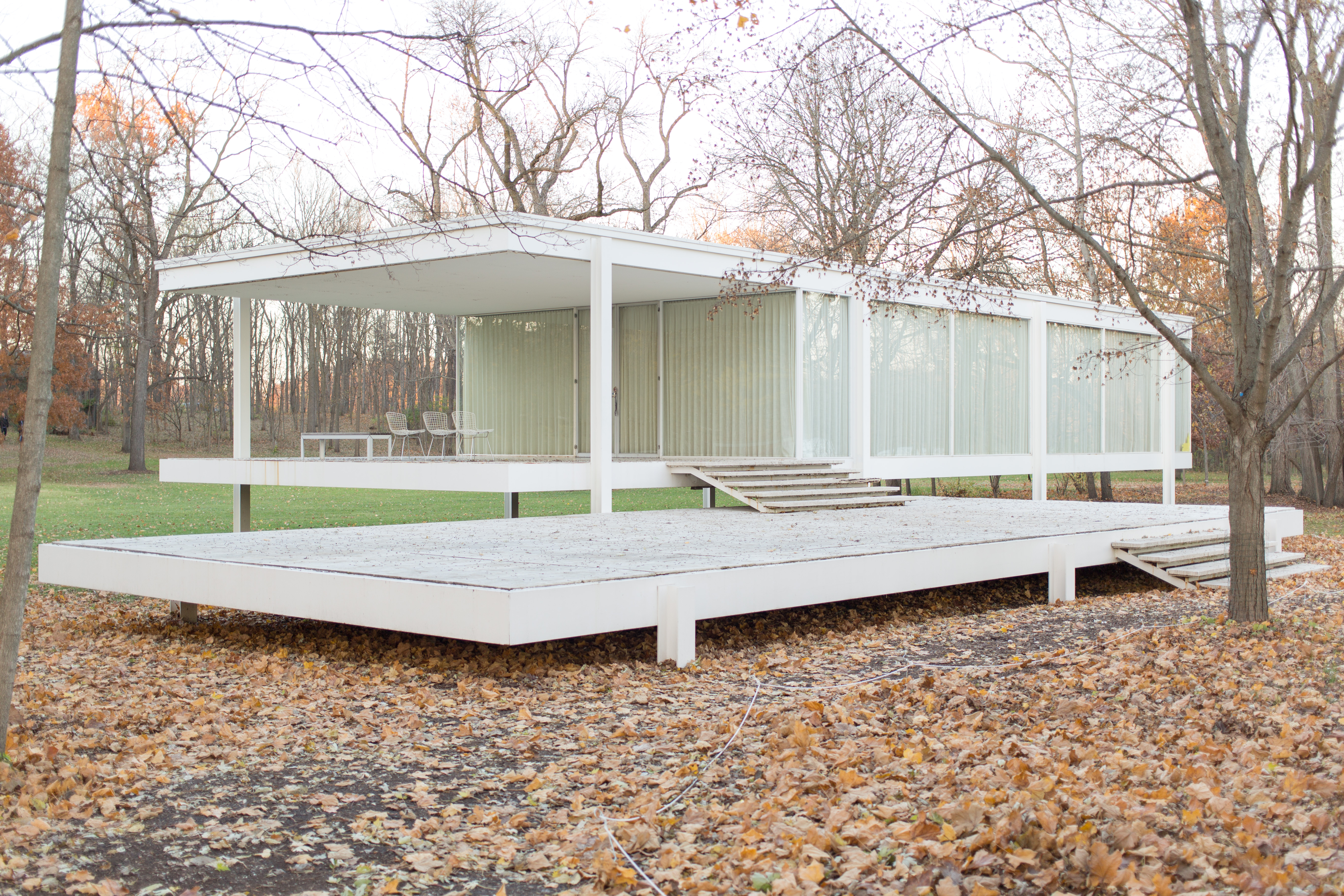
The Farnsworth House (1946–1951) shows the same logic applied to a building the client would actually occupy. Dr. Edith Farnsworth commissioned a weekend house on a flood-prone site near Plano, Illinois. What Mies gave her was a glass box raised on steel stilts, enclosed in floor-to-ceiling glass on all four sides, with no visual separation between the interior and the surrounding landscape. The client sued him over construction cost overruns. The suit was dismissed. But the legal dispute documents something more important than the bill: when “less is more” is not a preference but an imposition, someone has to pay for it. The person paying was Farnsworth. She lived in a house that was, by Mies’s own account, a statement about what a house could be. Whether she wanted to make that statement was not part of the brief.
The Seagram Building in New York, completed in 1958 and co-designed with Philip Johnson, introduced another version of this argument. Mies used bronze I-beams on the exterior curtain wall, structurally redundant, placed there to show where the steel inside actually was. The ornament is the structure. The building tells you what it is doing in the language of what it is doing. He also set the building back from the street line, creating a public plaza at a time when no one else in Midtown Manhattan was giving up that square footage. The result is documented at the Museum of Modern Art, which organized the first major Mies retrospective in 1947, initiated by Philip Johnson.
The argument across all these projects is not that less is aesthetically superior to more. It is that the structure itself, when it is honest, is already enough. Decoration is not neutral. It obscures the argument the building is making about how it stands up. And obscuring that argument is a kind of dishonesty that Mies found intolerable.
Five Objects That Show What Mies Was Doing
Barcelona Chair (1929) — With Lilly Reich. Cantilevered X-frame in chrome-plated steel, hand-welted leather cushions in 40 panels. Designed for a ceremony. Still in production at Knoll under the terms Mies set in 1953. What separates the Knoll from every other version: the specification has not been revised downward. Every other leather chair manufacturer eventually finds somewhere to save money. Knoll has not.
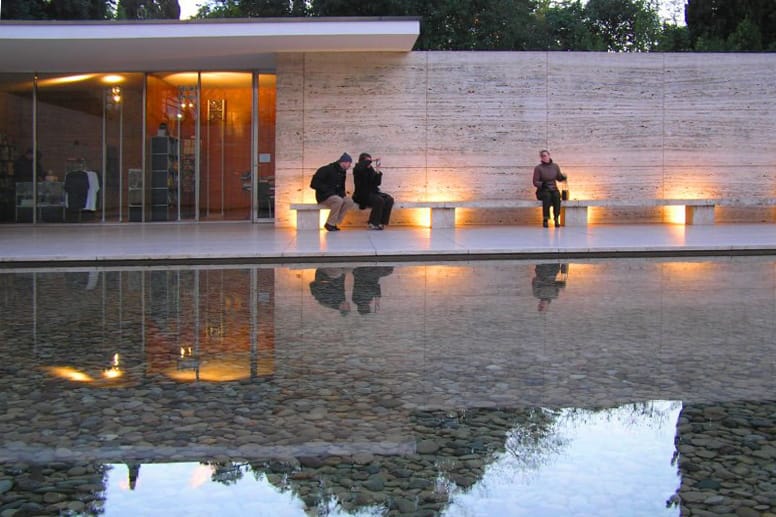
Barcelona Pavilion (1929) — The German national pavilion for the Barcelona International Exposition, designed with Lilly Reich. Eight cruciform chrome columns carry the flat roof. The walls carry nothing; they define space without holding it up. Stan Allen’s field conditions theory in Points + Lines (1999) works from the same kind of evenly spaced column grid, with the Great Mosque of Córdoba as its main example. Onyx, Roman travertine, glass, a reflecting pool. The materials were the exhibit. Demolished after the Exposition, reconstructed in 1986 by the Fundació Mies van der Rohe. Still standing in Barcelona.
Tugendhat House (1929–1930) — Built in Brno, Czechoslovakia (now Czech Republic), for Grete and Fritz Tugendhat. One of the first private houses to use an open-plan living space defined by free-standing walls of onyx and ebony macassar. The clients later reported feeling both liberated and unsettled by the transparency. The building has been a UNESCO World Heritage Site since 2001.
Farnsworth House (1946–1951) — Near Plano, Illinois. A single glass room elevated on steel stilts. Edith Farnsworth sued Mies. She sold the house in 1972, noting she found it impossible to maintain on a nephrologist’s schedule. It is now owned and operated by Landmarks Illinois as an architectural landmark.
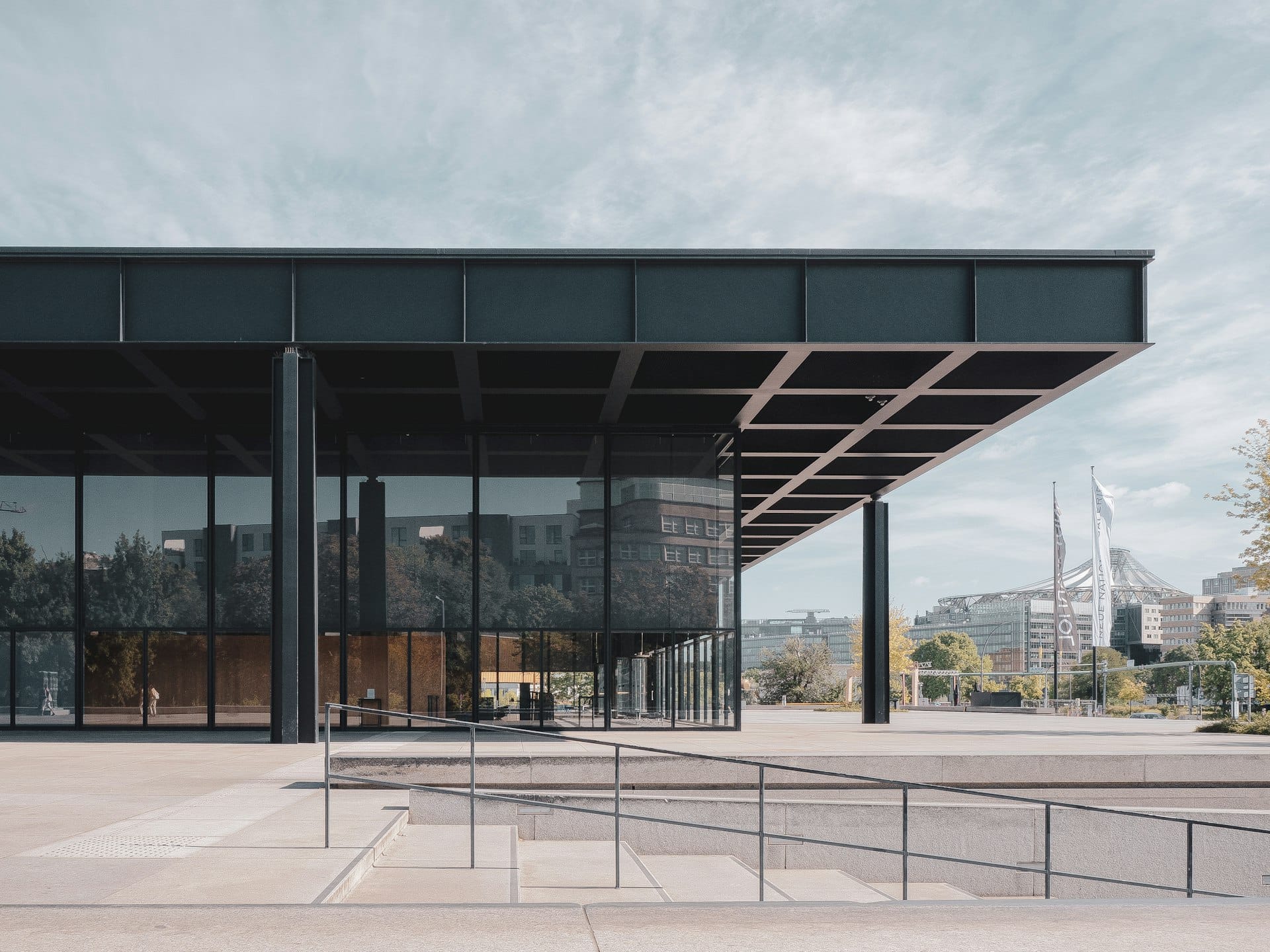
Crown Hall, IIT (1956) — The architecture building at the Illinois Institute of Technology, Chicago. One undivided space, no interior columns, roof suspended from above by steel girders. The structure is outside the enclosure. Every decision in Crown Hall demonstrates what steel can do when the architect refuses to conceal it.
Shop the Collection
Two items. One is the reason most people come to this page. The other is the reason to keep reading after the chair.
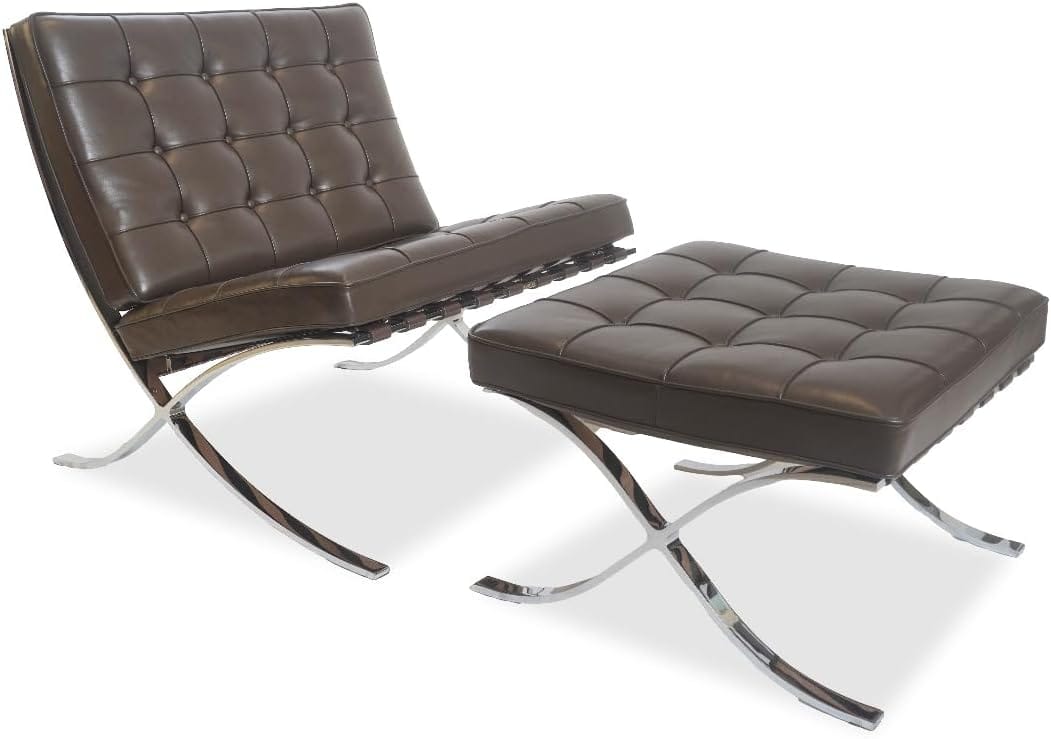
Knoll Barcelona Chair
The licensed production. Mies granted Knoll the rights in 1953. If you are going to own this chair, this is the one. Not because the others don’t look right, but because Knoll maintains the specification that makes the chair what it is. The 40 hand-cut leather panels, the chrome tolerances, the behavior of the frame over time. No other manufacturer is obligated to those standards. Knoll is.
Buy it from Knoll or an authorized dealer, and nowhere else. A Barcelona Chair in leather runs several thousand dollars new. Third-party marketplace listings that carry the Knoll name at a fraction of that price are not bargains on the licensed chair; at best they are unverified secondhand, and the chair’s trade dress is registered, which is why Knoll pursues sellers who use the name without the license. Knoll and Design Within Reach are the two US channels where the provenance is not in question.
Further Reading
The furniture is documented. The architecture is documented. What is less documented, or was, until these two books, is the design logic that connects them.
- Franz Schulze and Edward Windhorst, Mies van der Rohe: A Critical Biography (University of Chicago Press, revised edition): The standard scholarly biography. Schulze is unsparing about Mies’s political situation in the 1930s, his collaboration with Lilly Reich (which is treated as the central creative relationship it was, not a footnote), and his transformation of American architectural education at IIT. This revised edition, three times the length of the 1985 original, has access to archival material that changes how you read the work.
- Sandra Dachs, Laura Garcia Hintze, and Patricia de Muga, Mies van der Rohe: Objects and Furniture Design (Editorial Gustavo Gili): The furniture work is underrated relative to the architecture, and this is the only book that gives the Barcelona Chair, Brno chair, Tugendhat chair, and daybed the full treatment they deserve: production drawings, specifications, and the design decisions behind each piece. The Barcelona Chair takes 30 pages. That is about right.
Frequently Asked Questions
What is Mies van der Rohe most famous for?
Mies van der Rohe is most associated with the aphorism “less is more” and with three buildings: the Barcelona Pavilion (1929), the Farnsworth House (1951), and the Seagram Building (1958). He also designed the Barcelona Chair, which has been in continuous licensed production at Knoll since 1953. He directed the Bauhaus from 1930 until its closure in 1933, and the architecture program at the Illinois Institute of Technology from 1938 to 1958.
What does “less is more” mean in architecture?
In Mies’s usage, “less is more” means that structure, when expressed honestly, does not require decoration. It is an argument about material truth, not aesthetic preference. A steel frame that expresses its own construction is doing more than an ornate facade that conceals it. Mies saw decorative architecture as dishonest: it hides the argument the building is making about how it stands. The phrase is often attributed to Robert Browning, but Mies made it a design principle.
Who did Mies van der Rohe design the Barcelona Chair for?
The Barcelona Chair was designed in 1929 for the official reception ceremony at the German Pavilion at the Barcelona International Exposition, where King Alfonso XIII and Queen Victoria Eugenia of Spain were to meet with German officials. The building had no permanent collection and no commercial purpose. Mies needed seating for a ceremony in an empty space built for the occasion, and designed furniture that read as ceremonial without using the visual language of historical thrones.
Why is the Farnsworth House considered controversial?
Dr. Edith Farnsworth, who commissioned the house as a weekend retreat, sued Mies over construction costs that far exceeded the original estimate. The suit was dismissed. She lived in the house for years but found it difficult to maintain: its complete transparency offered no privacy from visitors, and she sold it in 1972. The controversy is architectural as much as legal: the Farnsworth House is the clearest case study in what happens when an architect’s argument is imposed on a client rather than built with one. It is also, by most accounts, one of the most precisely realized buildings of the 20th century.
How did Mies van der Rohe influence modern architecture?
Mies established the steel-and-glass curtain wall as the dominant language of commercial architecture in the second half of the 20th century. His IIT campus work set the template for American institutional modernism. His influence on Philip Johnson was direct and long-term. More significantly, his argument that structure honestly expressed is sufficient, that a building need not be decorated to be architecture, became the default position of modernist practice worldwide, for better and for worse.
What is the difference between an authentic Barcelona Chair and a reproduction?
The Knoll edition is the only legally licensed production of the Barcelona Chair. Mies granted Knoll the production rights in 1953. The difference between the Knoll and any reproduction is not primarily visual. It is the specification: 40 hand-cut, hand-welted leather panels per chair; chrome tolerances held to the original standard; the cantilever geometry of the X-frame built to the load distribution Mies specified. Reproductions approximate the appearance. The Knoll maintains the standard. Over time, under use, in light, against wear, those differences become visible.

About Joe Post
Joe Post holds an MFA in Art from California Institute of the Arts (CalArts) and has done additional graduate work at the School of the Art Institute of Chicago. He founded Art Design Ideas to write about design as cultural argument — the decisions, contradictions, and assumptions built into the objects we live with.