Alessi is an Italian housewares manufacturer founded in 1921 that commissions architects and designers — Philippe Starck, Michael Graves, Alessandro Mendini — to make objects for everyday domestic use. Knowing how to choose Alessi products means understanding which tier, which designer’s work, and which category fits the way you actually live.
Why Alessi is harder to buy than it looks
Over 2,000 products. Four product categories. Three sub-brands operating at different price points and with different purchase intentions. Alessi started in 1921 as FAO (Fratelli Alessi Omegna), a metalwork workshop in Piedmont. For sixty years, it was a competent Italian manufacturer. Then Alberto Alessi took leadership and in 1983 commissioned eleven architects (Robert Venturi, Michael Graves, Aldo Rossi, Alessandro Mendini among them) to create miniature tea and coffee services as “architecture in miniature.” That project, the Tea and Coffee Piazza, was the moment Alessi became something different: a design platform that happened to make objects you use in your kitchen.
The consequence is a catalog that ranges from a five-dollar egg timer to a limited-edition espresso set. That breadth is real: in 2006 the company restructured into three tiers spanning pop plastic to hand-finished collectible. Without knowing which tier you’re in, the catalog is genuinely confusing.
How to choose Alessi products: four decisions
Functional or decorative: pick your use case first
The clearest dividing line in the Alessi catalog is not price or designer. It is what the object is supposed to do. The Graves 9093 kettle boils water and sings when it’s ready. The Dry cutlery set by Achille Castiglioni goes in the dishwasher and comes out looking exactly the same. These are tools that happen to be well-designed.
Then there is the Alessi Juicy Salif Citrus Juicer by Philippe Starck. Starck sketched it on a pizzeria napkin during an Italian holiday. It extracts juice less efficiently than a twelve-dollar reamer from a supermarket. He described it as designed to trigger conversation, not citrus. It stands on three spider legs and looks like a piece of concept architecture. In the Officina Alessi tier, limited production, high price, it is primarily an argument about what a kitchen object can be.
The functional-first buyer should look at Alessi’s kitchen tools and tableware lines: kettles, espresso makers, cutlery, serving pieces. The decorative or collectible buyer should look at Officina Alessi and limited-edition runs. Trying to use a Juicy Salif as a daily juicer is a category error. So is dismissing the Juicy Salif because it juices poorly. That was never the point. For a broader look at how Alessi kitchen tools perform as everyday objects, the best Alessi kettles guide covers the functional end of the catalog in detail.
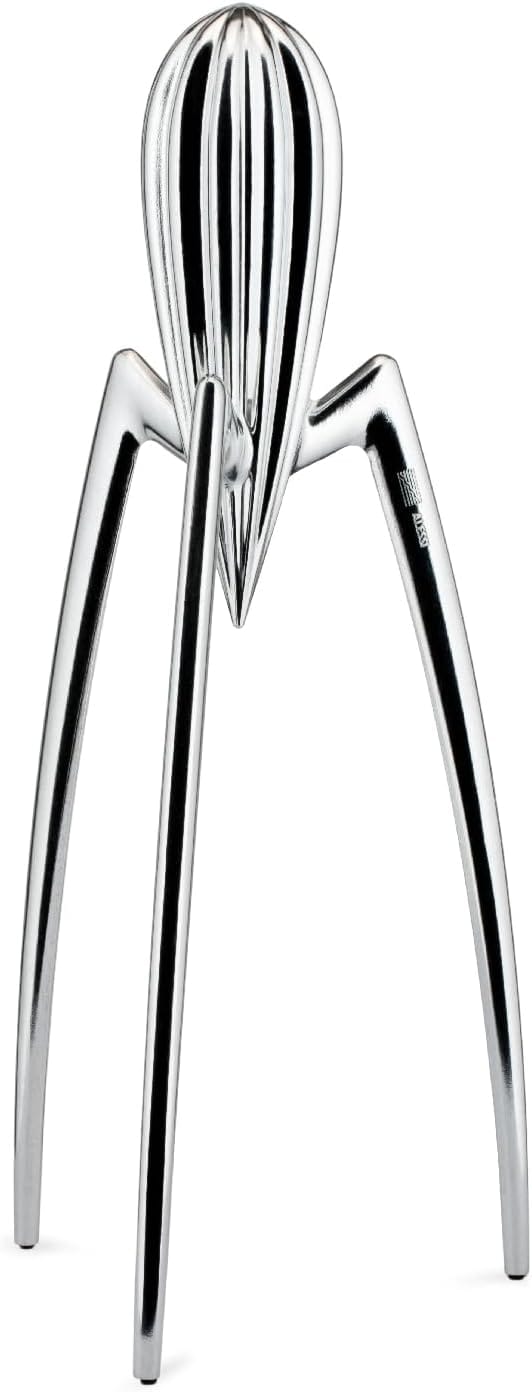
Alessi Juicy Salif by Philippe Starck
The defining Officina Alessi object — designed as spatial argument, not citrus tool. Sketched on a pizzeria napkin during an Italian holiday. It extracts less juice than a twelve-dollar reamer, and does something the reamer cannot.
Which designer’s work to start with
Alessi has worked with over 300 designers. The catalog has recognizable registers, and matching your sensibility to a designer’s register is more reliable than picking by product category.
Alessandro Mendini’s work is figurative and ironic. The Alessi Anna G Corkscrew, designed in 1994 and modeled on Anna Gili (Mendini’s girlfriend and fellow designer), is a smiling woman whose arms open into a corkscrew. It became one of Alessi’s bestsellers. Mendini’s objects are colorful, personality-forward, and accessible in price. They are an entry point for people who want a designed object with character.
Michael Graves works in a Post-Modern register: warm, narrative, comfortable with ornament. His 9093 kettle has a bird that sings when the water boils. It became the highest-selling product in Alessi’s history precisely because it tells a story — the object has a behavior, not just a form.
Starck’s objects argue. The Juicy Salif is the well-known case. His work is for people who understand that the object is making a proposition, and who want to live with that proposition on their counter.
Wiel Arets, who contributed to the catalog in the 2000s, works in a cooler, more architectural register. Less narrative than Graves, less provocative than Starck. His pieces are for buyers with a more restrained spatial sensibility.
For context on how these designers fit into Alessi’s broader cultural project, see our Alessi design history overview.
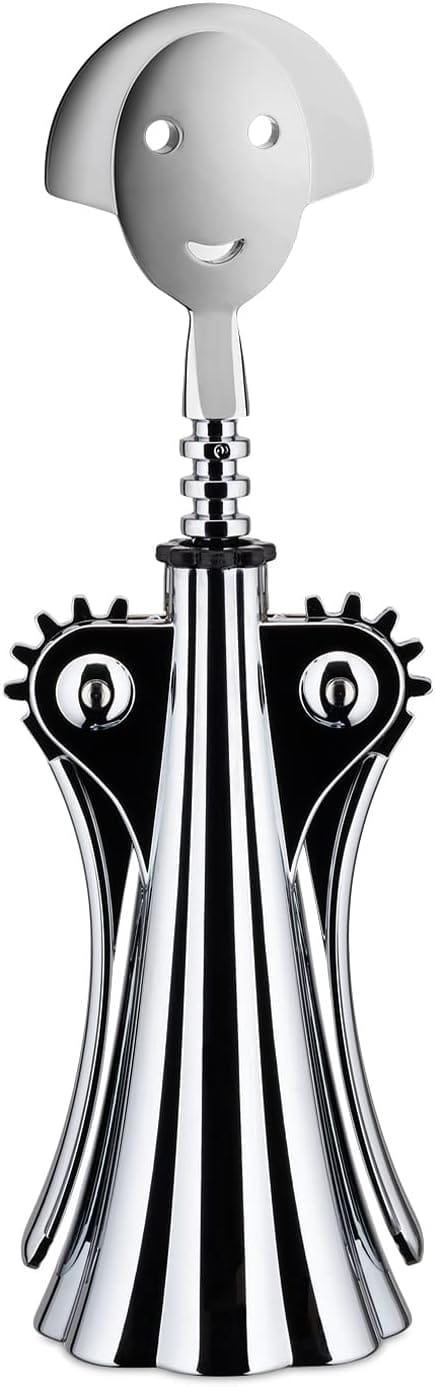
Alessi Anna G Corkscrew by Alessandro Mendini
Designed in 1994, modeled on Mendini’s girlfriend and fellow designer Anna Gili. The smiling figure whose arms open into a corkscrew became one of Alessi’s bestsellers — figurative, ironic, and the most accessible entry point in the catalog.
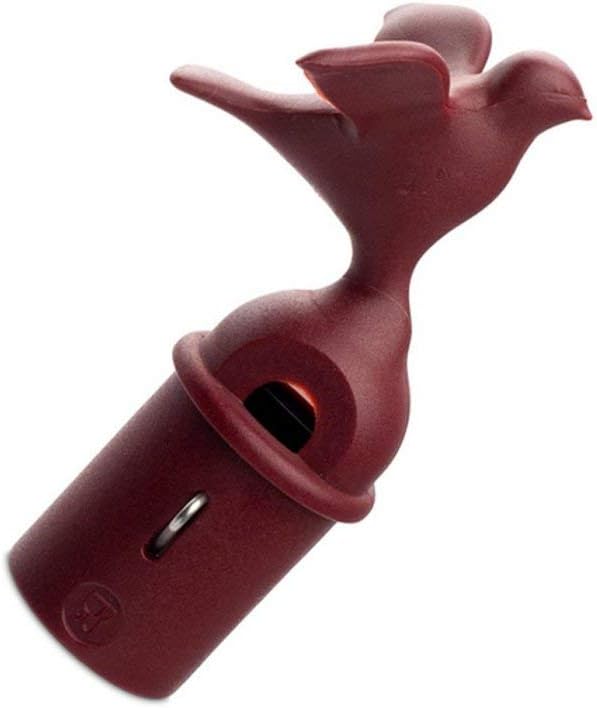
Alessi 9093 Kettle by Michael Graves
The highest-selling product in Alessi’s history. A Post-Modern kettle with a singing bird whistle that turns a functional act — boiling water — into a small domestic event. In MoMA’s permanent collection.
Understanding the three price tiers
The 2006 restructure divided Alessi’s output into three distinct sub-brands, each signaling a different production method and purchase intention.
A di Alessi is the affordable entry point. Plastic and steel mixes, pop aesthetics, the democratic end of the catalog. The company’s own materials describe it as “democratic and pop.” This is where you buy for a student kitchen or as a casual gift. The objects are designed (not mass-market generic) but the production method is volume serial production, and the price reflects that.
The main Alessi line is where most of the 2,000-plus products live. Stainless steel predominates. Mid-to-high price range. Serial production, but with the material calibration and R&D investment that distinguishes an Alessi tool from a mass-produced equivalent. The 9093 kettle lives here.
Officina Alessi is small-batch, experimental, and collectible. Limited editions. Premium materials. Hand-finishing. Higher prices. These are the pieces most likely to appreciate. The Juicy Salif, in its original limited runs, was Officina territory. Buying an Officina piece expecting a workhorse kitchen tool is the same category error as buying any collectible expecting daily utility.
The tier also tells you about the buyer relationship. A di Alessi is for someone trying Alessi for the first time at a manageable price. Officina Alessi is for someone who already understands the catalog and wants the piece that won’t be reproduced. For a deeper look at how this three-tier structure developed, see our Alessi design history.
Category: matching object to occasion
Alessi’s four categories (kitchen tools, tableware, home accessories, and clocks) map onto different buying occasions and different household needs.
Kitchen tools are the most functional category. Kettles, espresso makers, citrus squeezers, can openers. The Alessi 9093 Kettle by Michael Graves is the best-known example: a functioning kettle with a behavioral detail (the singing bird whistle) that makes the design logic concrete. This is where Alessi competes directly on utility, and where the price premium requires the most justification.
Tableware is where Alessi’s design pedigree shows in handle geometry and finish. The Alessi Dry Cutlery Set by Achille Castiglioni is the most referenced example: daily-use flatware where the design rigor extends to every piece that goes in a person’s hand. Castiglioni’s cutlery demonstrates that Alessi’s approach is not limited to shelf objects. It applies equally to tools people use at every meal.
Home accessories and clocks are Alessi’s gift category. Practically, the gift market is a substantial share of Alessi’s volume. MoMA New York, the Metropolitan Museum of Art, the V&A London, and the Pompidou Paris all hold Alessi pieces. A piece in a permanent museum collection is a factual claim that earns the premium on a gift.
The category decision focuses the search. Someone equipping a kitchen for daily cooking chooses differently than someone looking for a housewarming gift. Starting with category narrows 2,000 products to a manageable set.
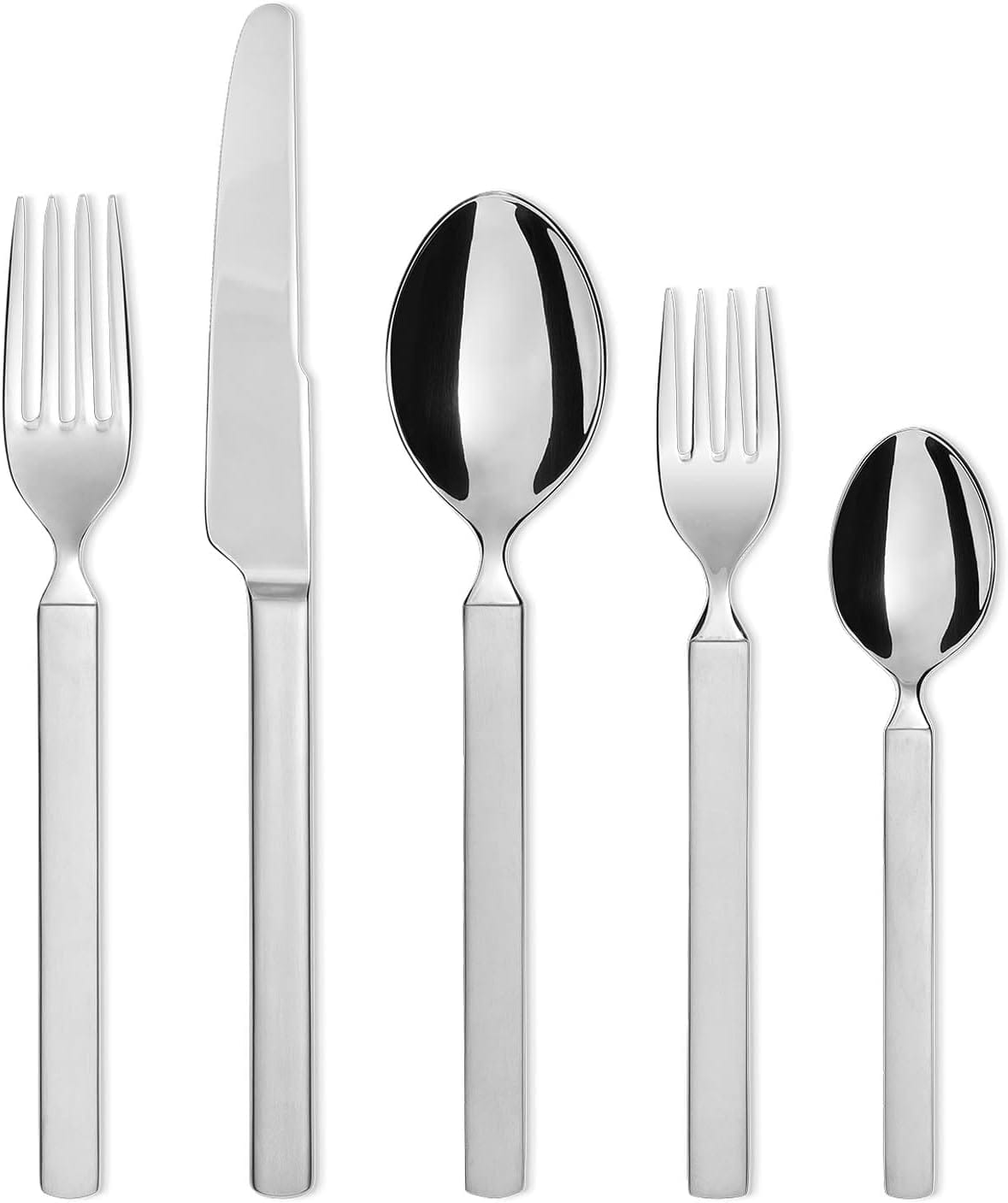
Alessi Dry Cutlery Set by Achille Castiglioni
Daily-use flatware where the design rigor extends to every piece that goes in a person’s hand. Dishwasher safe. The clearest proof that Alessi’s approach works as well on the table as it does on the shelf.
What gets Alessi buyers in trouble
- Counterfeits on third-party marketplaces: Authentic Alessi has a laser-etched logo, production year, and factory code on every piece. Authentic pieces feel dense and cool; the steel has weight and sits flat on a surface. A hollow object, a piece that wobbles on a flat surface, or a piece with a printed rather than laser-etched mark is not authentic. The difference is physical and immediate once you know what to feel for.
- Buying decorative pieces expecting workhorse performance: The Juicy Salif is the clearest case. It is an Officina piece designed as a spatial argument. Expecting it to out-perform a functional juicer is a buyer error, not a product failure. Officina pieces that are explicitly designed to function (the Graves kettle, Castiglioni’s cutlery) do function. Officina pieces designed to make an object-argument do not compete on utility metrics.
- Treating price as a quality proxy within the main line: A $299 kettle and a $40 corkscrew can both be first-rate design objects. Tier signals production method and scarcity, not necessarily design merit. Some of Alessi’s most referenced pieces are in the mid-range. Over-indexing on price within the same tier often leads to buying the most expensive item in a category that was designed for a different buyer profile.
- Ignoring the designer: Buying an Alessi piece without knowing which designer made it means missing the reason the object looks the way it does. The Graves kettle and a Starck piece are not interchangeable just because they are both in the main Alessi line. The designer is the specification.
- Buying for a room rather than a practice: Alessi objects work best when they fit how a household actually functions. A decorative citrus squeezer in a household that squeezes citrus every morning is a poor match. Not because the object is inferior, but because the buyer’s use case required a tool, not an argument.
Frequently Asked Questions
How do I know if an Alessi product is authentic?
Authentic Alessi pieces carry a laser-etched logo, production year, and factory code. Not printed. Etched. The piece feels dense and cool; the steel has weight and sits flat on a surface without rocking. A hollow feel, a printed mark, or a loose assembly are signs of an unlicensed version. Buy from authorized retailers rather than third-party marketplace listings to eliminate the risk entirely.
What is the difference between Alessi and A di Alessi?
A di Alessi is Alessi’s entry-level sub-brand, introduced in the 2006 restructure. It uses plastic and steel mixes, targets a lower price point, and uses the company’s description of “democratic and pop.” The main Alessi line is mid-to-high serial production in predominantly stainless steel. Officina Alessi is small-batch, collectible, and experimental. The three tiers share designers but differ in production method, materials, and purchase intention.
Are Alessi products worth the price?
For the main line and Officina pieces: yes, when the buyer’s use case matches the object’s design intention. A Graves kettle costs roughly three times a mass-produced equivalent; the premium buys material calibration, a behavioral detail (the singing bird), and the R&D behind it. Where the premium is not justified: when a buyer wants a functional tool and chooses a decorative piece because it is more expensive. The tier and the designer together tell you what the object is actually for.
What is the best Alessi product for a gift?
The Anna G corkscrew by Mendini is the most accessible gift in the catalog. Moderate price, clear figurative personality, available in multiple colorways, and recognizable to anyone who follows design. For a larger gift budget, the Graves 9093 kettle works for anyone who uses a kettle daily. Both are in MoMA’s collection, which is a factual credential that holds up in a gift context.
Is the Juicy Salif actually useful as a citrus juicer?
No — and this was known from the beginning. Starck designed it as a spatial and conversational object, sketched on a napkin during an Italian holiday. It extracts juice less efficiently than a twelve-dollar reamer. The question is whether “useful as a citrus juicer” is the right standard. For someone buying a functional juicer: no, do not buy the Juicy Salif. For someone who wants an object that makes a proposition about what a kitchen tool can be: yes, it does exactly what it was designed to do.
For the broader context of this work, see the Design Brands & Ateliers hub — a guide to the brands and studios driving contemporary design.

About Zoe Post
Zoe Post holds a BFA and a Master of Architecture from the School of the Art Institute of Chicago. She now works as a product marketing leader at an architectural product design firm, bringing hands-on industry perspective to everything she writes. At ADI she covers contemporary artists, textile and pattern design, and the design objects that sit at the boundary of art and function.