
Muji — Mujirushi Ryohin, “no-brand quality goods” — is a Japanese retailer founded in 1980 whose Muji design philosophy rejects the premise of branding itself. Kenya Hara, art director since 2001, calls this emptiness: not the absence of things, but a state open enough that users determine what an object means.
What Japan’s economic miracle had to do with inventing Muji
The name is a contraction: mujirushi means “no brand,” ryohin means “quality goods.” Muji launched in December 1980 not as a standalone company but as a product line inside The Seiyu supermarket chain. The timing was not incidental. Japan’s post-war economic growth had peaked; consumers were beginning to ask whether they were paying for objects or for the packaging and advertising that surrounded them. Muji’s answer was a founding position: strip out the packaging, strip out the brand premium, keep the material quality.
The brand started with 40 products. By the end of the 2000s, it had more than 7,000. That scale is itself the argument. Restraint, applied consistently and commercially, works.
Muji transferred from Seiyu to Ryohin Keikaku Co. in 1990 and began operating as its own entity. The art direction in those early years was handled by Ikko Tanaka, the graphic designer who helped establish the brand’s visual identity: plain typography, no ornamentation, white space as a design decision rather than an absence of one. When Tanaka passed the baton to Kenya Hara in 2001, the philosophical continuity held. Hara was not correcting what Tanaka had done. He was deepening it.
Hara’s contribution was a conceptual frame: emptiness (mu). The brand, he argued, was not built on minimalism, a Western design program for eliminating elements, but on something more fundamental. Emptiness is not a style. It is a condition of openness, a state that invites completion rather than presenting a finished argument. “Without anything, there are the most possibilities,” Hara said in a Medium interview on Muji design. That is the operating logic of the entire product line.
The brand Muji’s founders built stood in direct opposition to what they called “habits of extreme consumer society”: the logic that the brand on the label adds value to the object inside the package. Muji’s position was that it does not.
Why Muji design philosophy is not the same as minimalism
Kenya Hara has been explicit about this distinction in multiple interviews. In a December 2017 conversation with Dezeen and in a Quartzy feature the same year, he drew the line clearly: minimalism is a system for reducing elements to their essential form. Emptiness is not reduction. It is a prior state, one that does not predetermine what something is for.
The polypropylene storage boxes demonstrate this in physical form. Semi-transparent, stackable, available in multiple sizes, no branding on the surface. The transparency is the argument: the box does not hide its contents behind a surface treatment or a label. It shows what is inside. The object’s visual neutrality is not blank. It is open. It works in a Tokyo apartment, a London kitchen, or a New York studio without visual conflict because it does not impose its own reading on the room.
Hara has described Muji’s goal as “trying to be the background to everybody’s life,” reported in Globis Europe coverage, and elsewhere said “Muji is enough,” quoted in Design Principles FTW. Neither statement is a claim about aesthetics. Both are claims about the relationship between a product and the person using it. The product does not make a demand on the user. The user completes the product.
This is not the same as minimalism’s claim, which is that reduction is itself an achievement. Minimalism produces objects that make an argument about their own restraint. Muji produces objects that do not make an argument at all. The mattress-as-sofa, a configuration Muji’s own materials describe as an example of emptiness enabling multiple uses, is not designed to look like anything. Its function changes depending on what the person who owns it decides to do with it. That is the emptiness principle applied to furniture.
The distinction matters commercially. Muji’s emptiness argument is why a Muji pen sells in design-conscious offices in Tokyo and in school supply stores in suburban New Jersey without feeling out of place in either. The pen is not performing a design identity. It is just a pen. That universality is not accidental. It is the result of a sustained design position applied across 7,000 products for more than four decades.
Objects that perform the argument
The Polypropylene Storage Case (c. 1980s, continuously refined) is Muji’s oldest surviving product category, introduced at founding and still in production. Semi-transparent stackable drawers in white polypropylene: no branding, no color, no surface treatment beyond the material itself. The transparency shows contents rather than concealing them, which is the emptiness argument applied to storage.
The Gel Ink Pen (0.5mm, c. 1990s) comes in approximately 15 colors at prices ranging from $0.80 to $1.90 per pen. No logo on the barrel. Smooth function, consistent across decades of production. Used by architects, students, and editors worldwide. The commercial success without brand performance is exactly what the brand’s founding argument predicted.
The Aroma Diffuser (ultrasonic, multiple generations since the 2010s) has a white cylindrical body, soft LED, and ultrasonic mist. Designed to integrate into a room rather than announce itself. The form does not call attention to the technology inside it. The technology serves; the object recedes.
The Body Fit Cushion has microbead filling and can be used as a chair or, laid flat, as a floor lounger. The object’s use is not determined by its form. The user decides. This is Hara’s emptiness principle in physical form: the object is incomplete until the person using it determines what it is.
The Notebook (A5, grid) has grid-printed pages, no lined colors, no logo on the cover. Used across design professions as a tool that does not impose its own visual language on the work inside it. The grid is the minimum necessary structure. Everything else is left to the person holding the pen.
Shop the Collection
These are the two Muji products with verified Amazon availability and the clearest expression of the brand’s material argument.

- MUJI Polypropylene 2-Drawer Storage Box (A4 Size): Muji’s oldest product category, semi-transparent, stackable, no branding; the physical argument for why emptiness is commercially viable, in a size that works on a desk or kitchen counter.
- MUJI Polypropylene 2-Drawer Storage Box (A4 Wide, Thin): The shallow-drawer variant, same white polypropylene, calibrated for documents or stationery; two together make the storage decision visible rather than arbitrary.
Further Reading
Two books by Kenya Hara explain the philosophy behind Muji’s direction. Both are worth owning; they are not the same book.
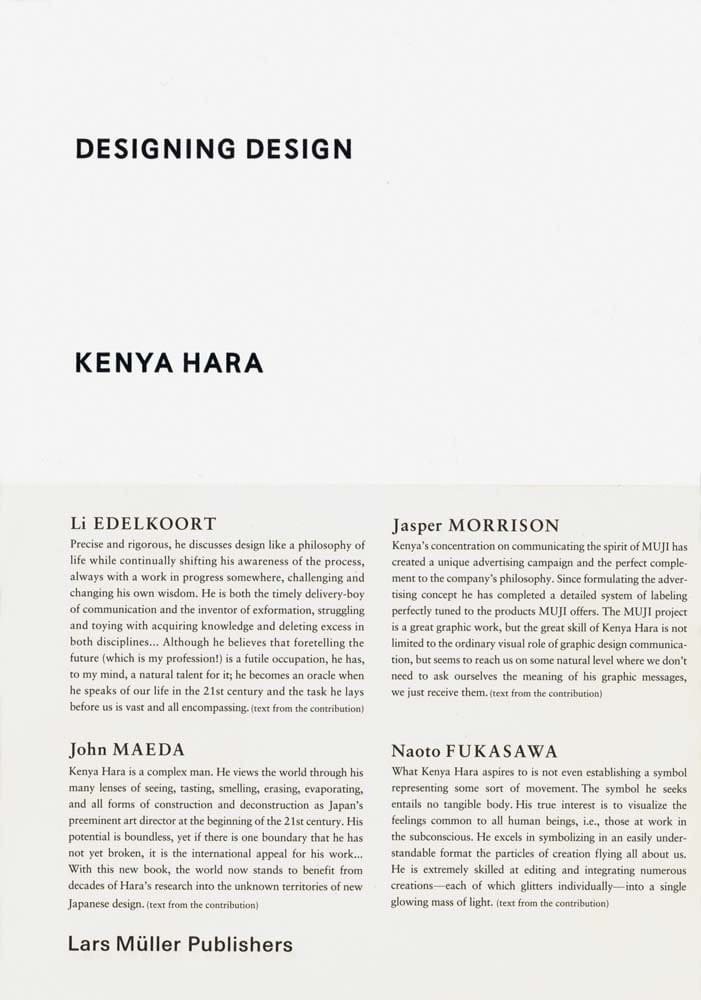
- Kenya Hara, Designing Design (Lars Müller Publishers, 2007): Hara’s own account of the philosophy underlying his Muji direction — this is not a brand book; it is a theory of design as a practice of emptying rather than filling, and it is the only text that explains why Muji’s restraint is a design position rather than a budget constraint.
- Kenya Hara, White (Lars Müller Publishers, 2009): Hara’s essay on white as Japanese aesthetic practice — the deepest explanation of what “emptiness” means in the Muji context; shorter than Designing Design and often the better entry point for readers new to Hara’s argument.
Frequently Asked Questions
What does Muji mean?
Muji is a contraction of Mujirushi Ryohin, which translates from Japanese as “no-brand quality goods.” The name encodes the brand’s founding argument: that product value comes from material quality and functional design, not from the brand name attached to it. The company launched as a product line inside the Seiyu supermarket chain in December 1980.
Who is Kenya Hara and what did he do for Muji?
Kenya Hara is a Japanese graphic designer and art director who has led Muji’s visual and product direction since 2001. He succeeded Ikko Tanaka, who helped establish the brand’s original identity. Hara’s contribution was a conceptual deepening of the brand’s position — his concept of emptiness (mu) distinguishes Muji’s design logic from Western minimalism and explains why the brand’s products work across cultural contexts without modification.
Is Muji available in the US?
Yes. Muji operates retail stores in the United States, primarily in major cities, and maintains an official storefront on Amazon. The polypropylene storage boxes have verified Amazon ASINs. Stationery items including gel pens and aroma diffusers are available through Muji’s Amazon storefront and the official US website at muji.us.
Why does Muji have no logo?
Muji’s founding argument was that brand markings on products add cost without adding value to the object itself. Removing the logo from the product surface is not an aesthetic choice — it is a commercial and philosophical position. The brand name Mujirushi Ryohin means “no-brand quality goods.” The absence of a visible logo is the brand’s most legible statement.
How is Muji different from minimalist design brands?
Kenya Hara has drawn this distinction explicitly. Minimalism is a design program that eliminates elements to arrive at an essential form — it presents a finished reduction. Muji’s design logic is built on emptiness, a state of openness that invites the user to determine what an object is for. A minimalist object makes an argument about its own restraint. A Muji object does not make an argument. The difference is evident in how Muji products work across different cultural contexts without visual conflict.
What are Muji’s best-selling products?
Muji’s most commercially successful product category is the polypropylene storage system — the stackable, semi-transparent drawers introduced at the brand’s founding in 1980 and continuously refined since. The gel ink pen (0.5mm) is the brand’s most widely used stationery item. The Body Fit Cushion and aroma diffuser are among the consistently listed bestsellers on muji.us. Muji’s official Amazon storefront provides current product availability for the US market.
Muji sits within the broader landscape of design brands that have made a position from restraint — covered in the Design Brands & Ateliers hub. For specific product picks, see our guide to best Muji home products. For a practical guide to applying the Muji approach to a home interior, see how to build a Muji aesthetic.

About Joe Post
Joe Post holds an MFA in Art from California Institute of the Arts (CalArts) and has done additional graduate work at the School of the Art Institute of Chicago. He founded Art Design Ideas to write about design as cultural argument — the decisions, contradictions, and assumptions built into the objects we live with.