
A lounge chair and an office chair answer different questions. The lounge chair asks: what does rest look like? The office chair asks: how do I keep a body functional for eight hours? If you’re weighing lounge chair vs office chair for a home space, the right answer turns on how you actually use the chair.
What a lounge chair and an office chair are actually arguing for
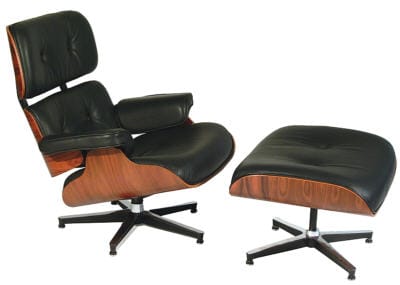
The lounge chair carries a long lineage. The chaise longue appeared in the 18th century, descended from the late 17th-century daybed and the bergère armchair — furniture that was always more about horizontal rest and visible comfort than about working posture. By 1956, Charles and Ray Eames had distilled this tradition into the Eames Lounge Chair and Ottoman for Herman Miller: molded walnut veneer, leather upholstery, a 15-degree recline that the designers described as “a special refuge from the strains of modern living.” The chair has been in continuous production for nearly 70 years. That is not because it is ergonomically superior to anything. It is because it looks the way luxury rest is supposed to look.
The Barcelona Chair makes the same argument more starkly. Ludwig Mies van der Rohe designed it in 1929 for the German Pavilion at the Barcelona International Exposition. Its first occupants were intended to be King Alfonso XIII and Queen Victoria Eugenia of Spain. Knoll currently sells it for $5,763. Nobody who buys a Barcelona Chair is doing it because they need back support for a work session. They are buying an object with compositional authority.
The office chair tells a different story entirely. The modern swivel chair is frequently traced to modifications made by Charles Darwin in the 1840s to a captain’s chair in his study. He added casters so he could roll between specimens. The ergonomic office chair as we recognize it emerged from workplace research of the 1970s and 1990s, culminating in the Herman Miller Aeron in 1994. Bill Stumpf and Don Chadwick designed the Aeron around a mesh suspension system they called 8Z Pellicle, a surface that distributes weight across the body rather than concentrating it at two pressure points. The chair comes in three sizes (A, B, C) to fit the first through 99th percentile of adult bodies. It is engineered for six to eight hours of sustained use, and it makes no visual argument at all. The Aeron is designed to disappear.
That is the split: lounge chairs are objects of visual weight and physical rest; office chairs are systems for managing bodies over long duration. If you are choosing between them for a home space, everything else follows from understanding which one you actually need.
Where they differ: a category-by-category comparison
Ergonomics and long-session support
Office chair wins. A lounge chair positions the body at roughly 20 to 30 degrees beyond upright seated posture, which does reduce spinal loading during rest, but creates a problem during sustained screen work: the neck and shoulders crane forward to compensate for the reclined torso. Ninety minutes in an Eames Lounge Chair while staring at a monitor will tell you this. The Aeron’s adjustable lumbar support (PostureFit SL), seat depth, tilt tension, and armrest pivot are engineered specifically for the way bodies move during long concentration sessions. A lounge chair is not.
Visual weight and room composition
Lounge chair wins. An office chair, even a well-designed one like the Eames Aluminum Group (Charles and Ray Eames, 1958, designed originally for the Time-Life Building lobby), is built to read as neutral. It follows the worker; it does not claim the room. A Barcelona Chair or Eames Lounge Chair operates differently: it is an anchor. In a living space, a reading corner, or any room that is a home first and workspace second, a lounge chair has a visual authority that no office chair achieves. The Aeron doesn’t ask to be noticed. That is either its virtue or its failure, depending on the room. For a closer look at which designer lounge chairs actually deliver on that visual weight at different price points, that category is worth reviewing before you buy.
Adjustability
Office chair wins. Herman Miller’s Aeron offers height adjustment, tilt tension, seat depth, forward tilt, armrest width, height, depth, and pivot, all independently controlled for different bodies and different tasks. The Eames Lounge Chair offers nothing adjustable. You adapt to it. That is a deliberate design decision: the chair has a specific position it considers correct, and that position is designed for reading and conversation, not for keyboard work at a variable desk height.
Price-to-value for home office use
This one depends on the math. The Herman Miller Sayl, designed by Yves Béhar and inspired by suspension bridge engineering, starts around $495 and delivers genuine ergonomic support for standard desk work. Entry-level ergonomic options from other manufacturers start lower. A well-made designer lounge chair starts at $800 to $1,200 for quality mid-range versions; authentic originals run $5,000 and up. If you work 40 hours a week in this chair, the ergonomic option returns more per dollar in body comfort and long-term health. If you sit in the chair for four hours of reading and conversation per week, that calculation reverses.
Durability and construction
A tie, conditional on quality. Quality designer lounge chairs are built with hardwood frames, high-density foam, and top-grain leather, materials intended for 20 to 30 years of use. Quality ergonomic office chairs use engineered polymers and mesh tested to BIFMA standards for 80,000 or more cycles. The Embody (Bill Stumpf and Jeff Weber for Herman Miller, 2008) is designed to support the body’s micromotion, the constant subtle shifts that happen during concentration, and its structural components are built to outlast most office environments. Both categories produce cheap versions that fail in three years. The differentiator is not the category; it is the manufacturing standard.
Signal value in a home office
Lounge chair, with caveats. A lounge chair in a video call background says something specific about the person sitting near it. So does an office chair. The lounge chair signals taste and a particular relationship to work: this person’s home is a home, not just a remote office with a bed in the next room. The office chair signals seriousness about output, physical care for the body, and an understanding that work infrastructure matters. Both are legitimate signals. Which one you want to send depends on your room and your audience.
The real trade-offs buyers don’t talk about
Lounge chair — Pros:
- Visual presence: it reads as furniture, not equipment; it anchors a room and works as an object in its own right
- Physical rest: reclined posture genuinely restores during breaks, reads, and short calls in a way an office chair cannot
- Versatility: a good lounge chair works in a living room, a reading corner, or a home office as a secondary seat
- Design longevity: the Eames Lounge Chair, the Barcelona Chair, and the Le Corbusier LC4 have been in production for decades; they hold cultural and monetary value over time
- Contextual appropriateness: in a home that is a home first, the lounge chair belongs
Lounge chair — Cons:
- Not built for sustained desk work: neck and back fatigue appears at 60 to 90 minutes of screen use in a reclined position
- Fixed geometry: you cannot adjust a Barcelona Chair or an Eames Lounge Chair; you accept the position the designer determined is correct
- Poor price-to-ergonomic-utility ratio for high-frequency work use: the money goes toward aesthetics and craft, not toward support engineering
Office chair — Pros:
- Engineered for body support over long duration: the Aeron and Embody represent decades of ergonomic research applied to real body variation
- Adjustability accommodates different bodies and posture changes throughout the work day
- Larger secondary market: ergonomic chairs from Herman Miller, Steelcase, and Knoll hold resale value and have established refurbishment ecosystems
- Integrates properly with desk height and monitor position: the chair is part of a system, and office chair design reflects that
Office chair — Cons:
- Designed to disappear: most office chairs are visually neutral at best and clinically utilitarian at worst; they do not contribute to a room’s aesthetic
- Out of place in a living room or any multi-purpose home space that isn’t dedicated to output
- Premium ergonomic chairs are expensive and the value is entirely in function: the Aeron runs $1,395 to $1,795 depending on size and options; the Embody runs $1,795 to $2,000; you are paying for what the chair does to your body, not for what it says about your room
Which Should You Choose?
Choose a lounge chair if
Your space is primarily a living room or reading room that occasionally accommodates work, not a dedicated home office. If you sit in this chair for reading, thinking, short calls, and breaks, and your actual work output happens at a desk with a different chair, the lounge chair is the right choice. It will serve your room better, last longer as a designed object, and not ask you to justify its presence every morning. If you want a starting point for the category, the designer lounge chairs that have held their design authority are the ones worth considering.
You should also choose a lounge chair if you work two to four hours per day maximum in this space, you want the chair to anchor the room visually, you are prepared to invest in a quality piece for 15 to 20 year ownership, and you have a separate desk setup with proper ergonomic support for longer sessions.
Choose an office chair if
You work six to eight hours a day at a desk in this space. Lower back health is a current or potential concern — and at that usage level, it will become one without proper support. You share the chair with other users, or your posture and setup change throughout the day in ways a fixed-geometry chair cannot accommodate. Your space is a workplace first, even if it happens to be inside your home. In that case, look at what modern office chairs offer at each price point before you commit.
Consider both
Some people use both because both have real functions. An ergonomic chair at the desk handles output; a lounge chair nearby handles reading, phone calls, and recovery. That is not excess. It is zoning a space properly, which any architect would recognize as a reasonable design decision for a room that serves two genuinely different purposes.
Frequently Asked Questions
Can you use a lounge chair as an office chair?
You can, but not for extended work sessions. A lounge chair’s reclined position, typically 20 to 30 degrees beyond upright, shifts weight off the spine in ways that feel comfortable initially. After 60 to 90 minutes of screen work, the neck and shoulders compensate by craning forward. For short sessions, reading, or calls, a lounge chair works. For eight-hour desk work, it will cause fatigue and, over time, postural problems.
Is a lounge chair bad for your back if you sit in it for long periods?
For rest and reading, no. Reclined posture reduces lumbar compression compared to fully upright seating. The problem is pairing a reclined position with forward-focused tasks like typing and screen work. If you’re reading, napping, or on a call without a screen, the lounge chair position is genuinely restorative. If you’re trying to work a full day in one, the mismatch between the chair’s geometry and the task will stress the upper back and neck.
What is the difference between a lounge chair and an accent chair?
A lounge chair is defined by its reclined geometry. It is designed for rest, reading, or extended relaxation, and its proportions reflect that. An accent chair is primarily a design category, not a functional one: it refers to any chair placed for visual effect rather than primary seating. An Eames Lounge Chair is both, a lounge chair in function and an accent chair in context. A Barcelona Chair is closer to a lounge chair in form but is more commonly placed as an accent chair because its geometry is not optimal for extended lounging. The terms overlap.
Are ergonomic office chairs worth the price compared to regular chairs?
At the high end, yes, for full-time desk work. A Herman Miller Aeron or Steelcase Leap costs $1,400 to $1,800 new but is built to BIFMA standards for 80,000 cycles and typically lasts 10 to 15 years with reasonable care. That works out to $130 to $180 per year of use, less than many people spend on footwear. The benefit is structural: proper lumbar support, seat depth adjustment, and tilt tension reduce the physical cost of sustained seated work. A $150 office chair may look similar but will not deliver the same support over time.
What lounge chair do designers actually use in home offices?
The Eames Aluminum Group chairs appear in many design offices because they genuinely bridge both categories. Charles and Ray Eames originally designed them for the Time-Life Building, intending them to work as both lounge and task seating. For pure lounge use, the Eames Lounge Chair and Ottoman is the most common answer. It is expensive but honest about what it is. Working architects and designers who use a lounge chair in their studios typically have a dedicated ergonomic chair at the primary work surface and use the lounge chair as a second seat, not a replacement. For the full picture of what modern office chairs offer at the professional end of that primary work surface, that breakdown is a useful reference.
How long can you comfortably sit in a lounge chair while working?
Sixty to ninety minutes is a reasonable ceiling for screen-based work. After that, the forward-craning posture required to focus on a monitor while sitting in a reclined chair creates upper back and neck fatigue. For reading without a screen, physical books, printed documents, magazines, you can comfortably extend that to two to three hours depending on the chair’s support and your own posture habits. The Eames Lounge Chair is a better reading chair than a computer chair, and it was designed that way.
Shop the Collection
Both sides of this comparison have a path to Amazon. The lounge chair options below represent the form at two price points: the mid-century replica market for readers who want the aesthetic, and the accessible accent chair segment for readers who want visual presence without the collector’s market price. The ergonomic option gives the office chair side a concrete starting point.
- Mid-Century Modern Accent/Lounge Chair: The barrel chair and club chair segment covers readers who want the visual presence of a lounge chair in a reading corner or home office. Typically $200 to $600 and genuinely functional as a secondary seat.
- Ergonomic Mesh Office Chair: The search terms here filter toward the features that matter — mesh suspension, adjustable lumbar, and proper seat depth — which is what separates a real ergonomic chair from a chair that merely looks like one.
Further Reading
These two books approach the subject from opposite directions: one gives you the cultural and design history of furniture and why form choices matter; the other gives you the ergonomic science behind why office chairs are built the way they are. Both are worth owning if you want to understand why this decision is harder than it looks.
- Dominic Bradbury, Mid-Century Modern Furniture (Thames & Hudson): The design lineage behind the Eames Lounge Chair, Barcelona Chair, and the mid-century furniture tradition. Why certain chairs cost what they cost and what argument each one is making about how bodies should sit.
- Ergonomics and Workplace Design: The science behind why office chairs are engineered the way they are. The body mechanics, the research on sustained seated posture, and the standards that separate quality ergonomic seating from chairs that perform ergonomics without delivering it.
This comparison sits within the broader iconic furniture design tradition. For the history of the Wassily Chair — the Bauhaus object most often cited in this debate — see Wassily Chair design history. Herman Miller’s design archive at hermanmiller.com documents the original brief and production notes for the Eames Lounge Chair.

About Zoe Post
Zoe Post holds a BFA and a Master of Architecture from the School of the Art Institute of Chicago. She now works as a product marketing leader at an architectural product design firm, bringing hands-on industry perspective to everything she writes. At ADI she covers contemporary artists, textile and pattern design, and the design objects that sit at the boundary of art and function.