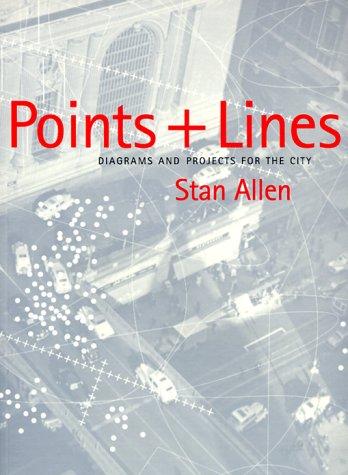
Points + Lines: Diagrams and Projects for the City is a 1999 book by the American architect Stan Allen, published by Princeton Architectural Press. Organized like a user’s manual, it pairs three essays (contextual tactics, infrastructural urbanism and field conditions) with built and unbuilt projects, including the Cardiff Bay Opera House and Museo del Prado competition entries. Its argument: the networks and systems that connect buildings, not the buildings themselves, are architecture’s real subject.
A field condition, in Allen’s own definition, is “any formal or spatial matrix capable of unifying diverse elements while respecting the identity of each.” Field configurations are “loosely bounded aggregates characterized by porosity and local interconnectivity”: a swarm, a crowd, a highway interchange. The unit of design is no longer the composed object but the rules that govern how parts aggregate.
What does field conditions mean in architecture?
In architecture, a field condition is a way of organizing a building or a city from the bottom up: many similar parts held together by local rules of spacing and connection, instead of one composed form imposed from above. Allen set out the idea in “From Object to Field,” published in Architectural Design in 1997, and reworked it as the “Field Conditions” essay in Points + Lines. His key historical example is the hypostyle Great Mosque of Córdoba, a field of columns enlarged several times without losing its order. In practice the idea means designing the rules and letting the overall form follow from them.
The book’s second key term, infrastructural urbanism, applies the same thinking at city scale. Roads, utilities, drainage and transit become architecture’s working material: the architect sets up conditions for future use rather than delivering a finished object.
What was architecture arguing about in 1999 — and why did Allen’s answer land wrong?
Drive out of any American city today and the argument becomes obvious. The Amazon fulfillment center sits three miles from the freeway interchange. The data center cluster occupies the former agricultural land that no one was watching. The detention basins and drainage corridors hold the suburban edge together in ways no building does. Stan Allen named all of this in 1999, and almost no one in architecture wanted to hear it.
The discipline in 1999 was not thinking about logistics. Gehry’s Guggenheim Bilbao had opened in 1997, and the conversation had turned decisively toward parametric formalism. What digital fabrication could produce, how far the building envelope could be pushed as sculptural object: those were the questions. Against this, Allen’s insistence on networks, connective tissue, and the organizational logic of flows was a minority position that read, to many readers, as a refusal of architecture’s most exciting possibilities.
Allen had arrived at the argument through a specific institutional context. He directed Columbia’s Advanced Architectural Design Program from 1990 to 2002, working in an intellectual climate shaped by Bernard Tschumi’s urban-field debates. The “Field Conditions” essay was first published in 1997, according to Princeton’s research database, and became the theoretical core of Points + Lines two years later. The book’s structure was deliberate: not a theoretical treatise but what Allen called a user’s manual. Speculative texts were interleaved with built and unbuilt projects including the Cardiff Bay Opera House competition in Wales, a Korean-American Museum of Art proposal in Los Angeles, and a Museo del Prado competition entry in Madrid.
Allen belongs to the generation of architect-theorists (alongside Bernard Tschumi, Rem Koolhaas, and others) who are part of a longer tradition of theorists who shaped how architecture understood itself in the postwar period. His credentials were not those of an ivory-tower academic: he had worked for Richard Meier in New York and Rafael Moneo in Madrid before founding his own practice in 1991, and he understood the gap between architectural argument and architectural production. What distinguished him was that he treated this gap as a design problem, not a professional inconvenience.
The Columbia debates shaped the argument’s frame. In a 2013 BOMB Magazine interview with Nader Tehrani, Allen acknowledged that the essay had become the primary way the discipline knew him. He was identified, in that conversation, as the architect who wrote “Field Conditions” above all else. The essay defined field conditions as “any formal or spatial matrix capable of unifying diverse elements while respecting the identity of each. Field configurations are loosely bounded aggregates characterized by porosity and local interconnectivity.” That definition is careful and technical; it is not a manifesto. But its implications were radical for a discipline organized around singular objects.
Why field conditions was premature in 1999 and necessary now
The argument Allen made was this: the building is not architecture’s primary unit. What architects should design are the conditions, the systems of connection, flow, movement, and adjacency, that make buildings matter or not. As Allen wrote in the essay, field conditions “moves from the one toward the many: from individuals to collectives, from objects to fields.” This inverts the training architects receive. The studio, the presentation, the rendering, the monograph: all of it focuses on the object. Allen was arguing that the object is a secondary artifact of the field that produced it.
In 1999, this read as theoretical abstraction. The logistics networks, data infrastructure, climate adaptation systems, and supply-chain architectures that would eventually prove Allen’s thesis hadn’t yet become visible at urban scale. Or rather, they were visible but not legible as architecture. What the suburban freeway interchange was doing to settlement patterns, what the distribution warehouse was doing to land use, what the drainage corridor was doing to ecological continuity: these were engineering problems, infrastructure problems, not architectural problems.
The urgency in 2026 is harder to miss. Amazon warehouses organize suburban space more thoroughly than any planned building program in American history. Data center clusters in Northern Virginia, in Central Washington State, in rural Ireland rewrite regional infrastructure in ways no building permit captures. Climate adaptation requires designing systems at scales where the building is irrelevant: levees, managed retreat corridors, regraded watersheds. Allen’s field conditions is the theoretical predecessor of exactly this shift. The argument he made about the relationship between industrial design systems and architectural systems runs parallel to the industrial design systems Allen’s theory was running alongside in the same decade.
Keller Easterling’s Extrastatecraft (Verso, 2014) is the most direct intellectual descendant of Allen’s position. Easterling traces how infrastructure (free trade zones, broadband networks, ISO standards) operates as a hidden form of political space. That is precisely the move Allen made in architectural terms. Easterling was at Yale; Allen was at Columbia and Princeton. These are parallel genealogies that confirm the thesis rather than a direct line of influence.
Allen’s intellectual path from field conditions moved through infrastructure, mat-building, ecology, and eventually landscape. He arrived at landscape through infrastructure, not through aesthetics. This matters because his engagement with landscape urbanism was always about organizational logic, not scenography. The collective organizational logic that the Bauhaus had introduced in its approach to the designed environment was the formal prehistory Allen was working from. Its resonance with the compositional thinking the Bauhaus had developed is not incidental. The module, the grid, the serial unit as constituent of a larger field: these were Bauhaus tools that Allen adapted to infrastructural thinking.
What Allen built while everyone was watching the signature buildings
Allen’s practice was never large in the way Meier’s or Koolhaas’s was. What he built while everyone watched the signature buildings of the late 1990s and 2000s was more consequential for the discipline’s understanding of itself.
Cardiff Bay Opera House Competition, Wales, 1994
The Cardiff Bay competition entry remains one of the cleaner demonstrations of field conditions as a design method rather than a theoretical position. Allen organized the opera house not as a singular massing but as a distributed field of connected elements, using landscape as an organizational logic rather than program. The building dispersed. The field held it together. The project was unbuilt, but it circulated widely in academic architectural culture as evidence that the field conditions argument could produce an architecture, not just a theory.
Fresh Kills Competition, Staten Island, 2001
Allen co-directed Field Operations with landscape architect James Corner and won first prize in the Fresh Kills competition. The project involves a 2,200-acre former landfill site on Staten Island redesigned as a living ecological and recreational infrastructure. The scale alone makes the argument concrete: this is not a building, not even a park in the conventional sense, but a layered system of ecological and recreational fields that will unfold over decades. Field Operations treated the former landfill not as a site to be designed but as a system to activate. The Fresh Kills project is one of the most significant American landscape urbanism projects of the period—what happens when Allen’s field conditions thesis meets a client, a budget, and 2,200 acres of contaminated ground.
Arroyo Parkway, Pasadena, 2002
Also with Field Operations, also first prize in an invited competition. An infrastructure corridor running through Pasadena was redesigned as a multi-use landscape field. The project is formally modest. It is conceptually precise. Movement, ecology, and program are organized not as separate systems but as a single organizational matrix.
Points + Lines (Princeton Architectural Press, 1999)
The book itself is a work. Princeton Architectural Press published 192 pages organized as a user’s manual for a particular way of seeing the city. Not a textbook, not a polemic, but a set of instruments. The “Field Conditions” essay anchors the theory; the projects apply it. ISBN 1568981554. The book remains in print and in architectural syllabi because it is useful in the way that genuine theoretical tools are useful: it changes what you can see. SFMOMA’s Open Space published the essay in 2012, confirming its reach beyond architecture schools.
Practice: Architecture, Technique and Representation (Routledge)
Allen’s companion volume, also collected and expanded over time. If Points + Lines is the argument about what architecture should be doing, Practice is the technical apparatus for how to do it. Drawing, representation, the instruments of architectural thinking comprise the book’s content. The two books together define the project.
How did field conditions shape landscape urbanism?
Directly. James Corner, Allen’s partner at Field Operations, carried the field-conditions vocabulary into landscape architecture, where it became one of the founding arguments of landscape urbanism. The movement’s central move, designing the performative surface rather than the object on it, is Allen’s thesis with hydrology and ecology swapped in for buildings. Fresh Kills was the proof of concept at 2,200 acres, and Corner’s later work on the High Line applied the same logic at the scale of a linear park.
The lineage runs backward as well as forward. Allen’s insistence that the grid, the network, and the void do the real organizational work is already present in Mies van der Rohe’s open plans, where the structure recedes so the field of movement can dominate. And it runs outside architecture entirely: the shift from composed object to distributed public system is the same shift that new genre public art made in the same decade, trading the monument on a plinth for work that exists as a network of social relations. Artists had already spent decades treating the grid as a subject in its own right, from Agnes Martin’s pencil grids to Sol LeWitt’s wall drawings, a history traced in the grid in contemporary art.
Shop the collection
These are the two books that define Allen’s argument and its application. There is no substitute for either.
- Points + Lines: Diagrams and Projects for the City by Stan Allen (Princeton Architectural Press, 1999): The primary text. It introduced field conditions to a generation of architects and remains the clearest statement of why infrastructure, not the building, is architecture’s actual subject.
- Practice: Architecture, Technique and Representation by Stan Allen (Routledge): Allen’s companion volume on drawing and representation. If Points + Lines is the theoretical argument, Practice is the method that makes it buildable. The two books together constitute the complete Allen position.
Further reading
These two books extend the field conditions argument into territory Allen theorized but didn’t fully map.
- Keller Easterling, Extrastatecraft: The Power of Infrastructure Space (Verso, 2014): Easterling is the intellectual descendant of Allen’s field conditions argument. She traces how infrastructure (free trade zones, broadband networks, ISO standards) operates as a hidden form of political space. That is the same move Allen made in architectural terms. Reading Easterling after Allen shows where the field conditions thesis went in the hands of a theorist willing to follow it across disciplinary lines.
- Kazys Varnelis, ed., The Infrastructural City: Networked Ecologies in Los Angeles (ACTAR, 2008): The closest book-length application of Allen’s theoretical frame to an actual city. Los Angeles is mapped as a system of networked infrastructure rather than a collection of buildings, with architects, artists, and scholars contributing photography, essays, and maps. This is the book Points + Lines implied but didn’t build.
Frequently asked questions
What is Stan Allen’s field conditions theory?
Field conditions, as Allen defined it in his 1997 essay and in Points + Lines (Princeton Architectural Press, 1999), is “any formal or spatial matrix capable of unifying diverse elements while respecting the identity of each.” The theory argues that architects should design not individual objects but the organizational systems, the flows, connections, and adjacencies, that give individual buildings their meaning and coherence. The building, in this frame, is secondary to the field that produces it.
What is Points + Lines by Stan Allen about?
Points + Lines is a 1999 text published by Princeton Architectural Press that presents Allen’s field conditions theory alongside a set of built and unbuilt projects applying it in practice. The book is organized as a user’s manual: theoretical essays interleaved with project documentation including the Cardiff Bay Opera House competition, a Korean-American Museum of Art proposal, and a Museo del Prado competition entry. Its argument is that urban infrastructure, the networks, flows, and systems that connect buildings, is architecture’s actual subject.
What does field conditions mean in architecture?
A field condition is a bottom-up way of organizing space: many similar parts held together by local rules of spacing and connection, instead of one composed form imposed from above. Stan Allen introduced the term in “From Object to Field” (Architectural Design, 1997) and developed it in Points + Lines (1999). The hypostyle Great Mosque of Córdoba, a field of columns, is his main historical example.
What is infrastructural urbanism?
Infrastructural urbanism is Stan Allen’s term, from an essay in Points + Lines, for an architecture that works through the systems a city runs on: roads, utilities, drainage, transit and the ground itself. Instead of designing finished objects, the architect designs infrastructure that sets up conditions for future use. The idea fed directly into landscape urbanism.
How does field conditions differ from conventional architectural theory?
Conventional architectural theory positions the building, the singular designed object, as architecture’s primary unit. Field conditions inverts this. Allen argues that the organizational system, the matrix of connections and flows, is what architects are actually designing when they work at urban scale; the building is a secondary artifact of the field. This shifts the designer’s attention from the object’s formal properties to the relational logic of the system it belongs to.
Why is Stan Allen’s infrastructure argument more relevant now than in 1999?
In 1999, logistics networks, data infrastructure, and climate adaptation systems weren’t yet legible as architecture at urban scale. By 2026, Amazon distribution centers organize suburban space more systematically than any planned building program, data center clusters rewrite regional infrastructure across entire counties, and climate adaptation requires designing systems (managed retreat corridors, regraded watersheds, levee networks) where the building is beside the point. Allen’s frame is now the obvious way to describe what is happening to the built environment.
Is Stan Allen still practicing architecture?
Allen transferred to emeritus status at Princeton University School of Architecture on July 1, 2025, according to Princeton’s directory of faculty. He had served as Dean of the Princeton School of Architecture from 2002 to 2012 and as acting dean again in 2014–2015, having joined Princeton as George Dutton ‘27 Professor of Architecture in 2002 after directing Columbia’s Advanced Architectural Design Program from 1990 to 2002.
What other architects or theorists built on Allen’s field conditions concept?
Keller Easterling’s Extrastatecraft (Verso, 2014) is the most direct extension of the field conditions argument into political and economic infrastructure. Free trade zones, wireless networks, and ISO standards function as operating systems of global space. In landscape architecture, James Corner’s Field Operations practice, which Allen co-directed, applied field conditions methodology at the scale of the Fresh Kills landfill project. Kazys Varnelis’s The Infrastructural City (ACTAR, 2008) mapped Allen’s theoretical frame onto Los Angeles as a case study.
See also: Building Skins: Schittich on Facade Design, Systems Art Explained

About Zoe Post
Zoe Post holds a BFA and a Master of Architecture from the School of the Art Institute of Chicago. She now works as a product marketing leader at an architectural product design firm, bringing hands-on industry perspective to everything she writes. At ADI she covers contemporary artists, textile and pattern design, and the design objects that sit at the boundary of art and function.