
When a designer working on AI hardware design chooses how to give AI a physical form, they are making a bet. Not just about what users want or what the market will accept, but about something more fundamental: what kind of thing AI is, and therefore what kind of object could honestly express it.
Three approaches have shaped the AI hardware field so far. The first announces the technology. The second hides it. The third dissolves the design problem entirely. Each has produced recognizable product categories. Each has also stalled, in different ways and for overlapping reasons.
Reading the forms backward reveals the bets being made. The bet is always, underneath, about what AI is.
The announcement (Google Glass)
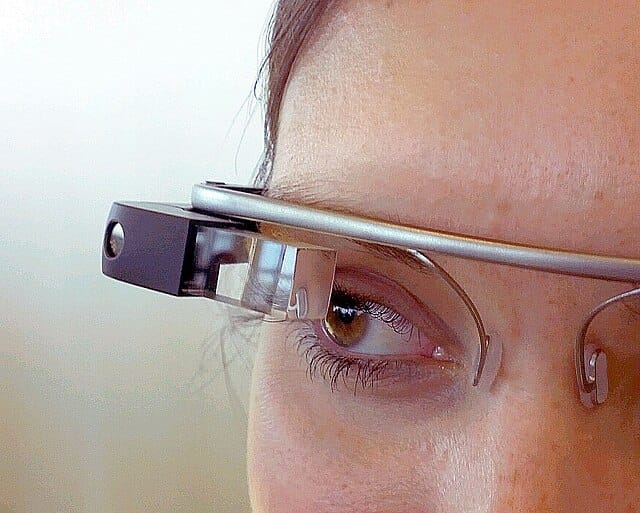
Google Glass, announced in 2012 and released to developers in 2013, was not primarily an AI product. It was a wearable computing and augmented reality device — notifications, navigation, photography. It has since been absorbed into the lineage of AI hardware because it established what perception-overlay form looks like. Its visual language borrowed from science fiction: a slim titanium frame, a prism display mounted in the upper visual field, the look of a heads-up display from a near-future film. It did not look like a product from the Braun-to-Apple tradition of resolved industrial form. It looked like a prop from a William Gibson novel, because that was the reference pool.
The aesthetic argued: this is what computing looks like when it reaches the face.
The implicit theory — carried through to today’s AI glasses — was intelligence as an overlay on human perception. Information augmenting vision, delivered directly into the user’s line of sight. If intelligence belongs in the visual field, the hardware should live on the face. That is still the operative premise of much of this category.
The product failed on several axes. The most visible failure was social, though the form itself helped produce that response. Wearing a camera on your face in public collapsed the distance between user and device in ways that other people found invasive. The “Glasshole” label that attached to early adopters was a social rejection of the theory. The theory said: AI belongs in your line of sight, integrated with perception. The social response said: not in our spaces.
Even if the model was coherent, the social contract it required did not materialize. Privacy norms, the visibility of the camera, the status signals of face-worn technology — these intervened before the form could become habitual. The form was internally consistent; the human relations it assumed were not yet in place. The mismatch is also a Norman problem: the device’s system image did not match the user’s mental model of what the technology could do. Whether Norman’s framework applies when the “thing” is an AI system is examined in The Design of Everyday Things Was Not Designed for This.
The camouflage (Meta Ray-Ban smart glasses)
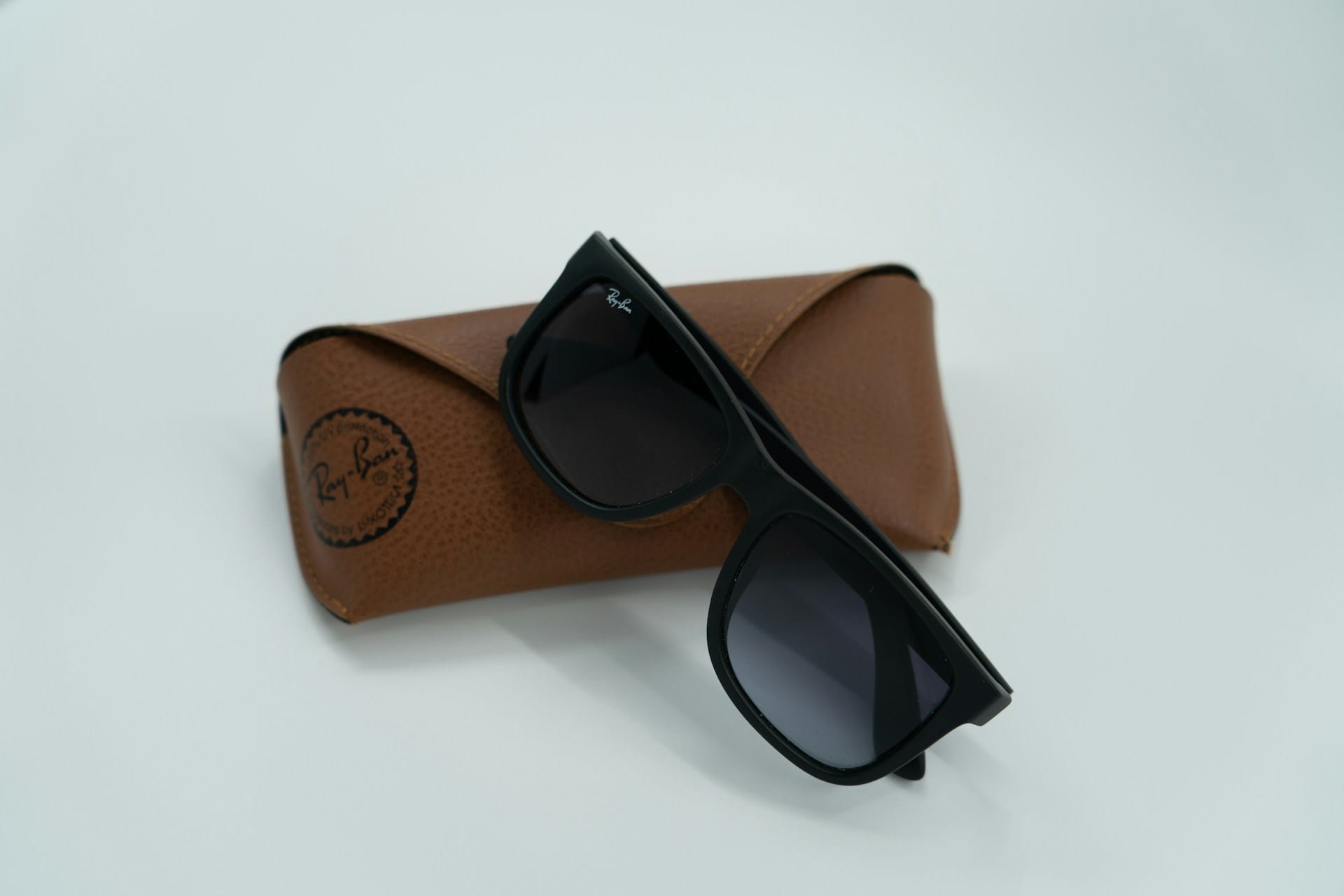
Meta’s Ray-Ban Stories glasses, first released in 2021 and substantially updated since, represent almost the opposite strategy. Where Glass announced the technology, the Ray-Bans hide it.
The Wayfarer is one of the most culturally embedded eyewear silhouettes in existence. Ray-Ban has produced it since the early 1950s. Its cultural saturation is deep enough that you do not notice someone wearing one the way you notice Google Glass. That invisibility is the design strategy. Cameras, microphones, and speakers are installed inside a form so familiar it disappears into daily life before anyone looks twice.
The underlying theory: AI is a service best delivered inside existing life rather than announced as an interruption. If intelligence should be ambient, the hardware should be ambient too. Don’t ask for attention. Don’t wear your technology visibly. Let the form do the social work of disappearing, and let AI appear only when called.
As a strategy, camouflage has proved more socially tolerable and commercially durable than overt announcement. But it raises its own category of question.

The Wayfarer silhouette was developed to make light refraction comfortable and eyes readable in social interaction. It is a form that solved a problem having nothing to do with AI hardware design, cameras, or audio. When AI is installed inside it, the form borrows cultural trust the silhouette earned under different conditions. The question is not whether concealment is dishonest in itself — products have hidden electronics inside familiar forms for decades. The sharper question is what kinds of hidden capability change the social meaning of the object. A camera changes what it means to face someone while wearing sunglasses. That is not the same kind of addition as a speaker or a pedometer.
This is a subtler version of the borrowed-authority problem examined in the second essay in this series. The Ray-Bans are not borrowing from a design tradition the way the R1 borrowed from Teenage Engineering. They are borrowing from culture — from the established social meaning of a familiar object — and installing a capability that alters those social meanings without updating the form to reflect the change.
There is also an underrated structural advantage to this strategy. The form does not announce capability, so it cannot fall short of announced capability. If the AI inside the Ray-Bans improves dramatically between product generations, the glasses look identical. The upgrade is invisible because the form never made the promise. In addition, the camouflage approach is partly resistant to the temporal mismatch argument developed in the first essay in this series: the slow time of physical product development running against the fast time of AI capability advancement. A form that makes no claims on the technology’s behalf cannot be made obsolete by the technology changing.

The dissolution (the chat interface)
The third strategy minimizes the design claim almost to zero.
The text input field, the submit button, the scrolling response: these are the minimum viable surface through which language can move. No materiality, no considered form, no claim about what the intelligence is or where it lives. The interface says only: the AI is reachable here. Type, and something will respond.
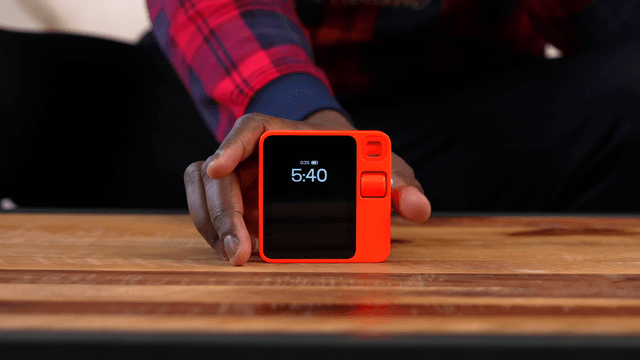
This form was not designed so much as defaulted into. Large language models process language, and the most direct interface for language is text. The chat paradigm spread because it matched the underlying technology without overstating it. Where the R1 and the Humane AI Pin proposed forms that exceeded what the technology could support, the text box proposed almost nothing. The technology could support almost nothing without difficulty.

By most measures, the chat interface has reached more users than all dedicated AI hardware combined — though the comparison is imperfect given how differently these products are distributed and priced. The point is not the scale claim. It is the pattern: the most widely used AI interface is the one that makes the fewest formal claims about what AI is.
This is also the interface that philosophy of mind presses on hardest, though from an uncomfortable direction. Merleau-Ponty’s argument, examined in the first essay in this series, held that intelligence is grounded in the body’s situated engagement with a physical world. The text box makes no claim about embodiment at all. It routes around the philosophical problem rather than addressing it. The intelligence is still nowhere in particular — in servers distributed across continents, trained on human language but not situated in anything resembling a human world. The form is honest about that absence. However, the absence remains.
Voice assistants represent a parallel version of this strategy: AI delivered through audio rather than text, still through an access point rather than a dedicated body. The smart speaker, the phone assistant, the car’s voice interface — these all share the same core logic. The AI lives somewhere else. You reach it through a hole in the present.
The dissolution strategy is an interim position rather than a stable one. Voice, spatial computing, ambient systems, and autonomous agents are beginning to compete with the text box in specific use cases. It solved the immediate problem of needing an interface for language models. It did not resolve the embodiment question. It chose not to.
What each bet reveals
A word of caution before reading these three strategies as clean theories. Products arrive through coalitions of constraints: manufacturing tolerances, brand deals, component economics, PR strategy, regulatory decisions. The form often reflects a negotiated position rather than a pure design argument. Reading backward from object to ontology is interpretation, not proof.
With that said, the three AI hardware design categories are still usefully distinct. Announcement puts the AI forward and asks for social acceptance of a new visible apparatus on the body. Camouflage hides the AI inside an existing form and asks only that nothing change visibly. Dissolution provides access to the AI and asks nothing of the body at all. These are genuinely different bets — about whether AI is a presence you wear, a service you carry invisibly, or a capability you reach through language.
The outcomes track those bets, imperfectly. The perception-overlay model produced social resistance the product could not negotiate. The ambient model is more durable but raises questions about what is being hidden inside trusted forms and why. The communication model has found the most users but provides no stable description of what AI is — it just gives access to something that keeps changing.
Why AI hardware design strategies keep stalling
The first essay in this series argued that the primary obstacle for AI hardware is temporal mismatch: physical product development running on eighteen-to-twenty-four month cycles, AI capability advancing weekly. That argument applies across all three strategies, though unevenly.
The announcement strategy is most exposed. Glass was designed around what AI could do in 2012. The gap between its claims and its delivery became visible quickly. A product built around the theory of AI-as-perception-overlay needs the AI to be good enough to justify overlaying it on human vision. In 2013, it was not. That question is now being retested by Meta’s updated glasses and other entrants — with more capable AI behind them.
The camouflage strategy is more resistant to the mismatch, for the reason described above. A form that does not announce capability cannot become obsolete through capability change. The Ray-Bans’ design will not need to change if the AI inside them becomes dramatically better. The form has structural distance from the technology. This is a real advantage, though it comes with the cost of never being able to honestly advertise what has improved.
The dissolution strategy is the most resistant of all. A form that makes no claims cannot fall short of them. As the AI improves, the text box simply returns better responses. The form is almost completely decoupled from the capability. This is why it has been the dominant interface: not because it is a good answer to the design problem, but because it avoids the design problem almost entirely.
What resolution would require
The three strategies share an underlying condition: each is a way of deferring the question the furniture phase always asks. Announce a theory, hide inside borrowed form, or make no claim at all — none of these positions requires having answered what AI is. They are all ways of operating before the answer is in.
The form that would resolve the furniture phase would need to do what resolved forms have always done: wait for the technology to stabilize into something that can be honestly described, then describe it honestly. Dieter Rams could make an honest radio because the radio was a finished thing. Teenage Engineering can make an honest synthesizer because synthesis, as a domain, is settled. The instrument does what an instrument does. The form can tell the truth about that.
AI is not yet settled in the relevant sense. Whether it is a tool that extends human capacity, a collaborator with its own agency, a service delivered at scale, or an environment that surrounds us — these are not academic distinctions. Each answer would produce a different object. In some cases, the answer produces no object at all. The form follows from the answer. The answer is still being argued by the people building the technology, not just by its critics.
The next form will probably not come from a better version of any of these three strategies. It will come from a settled working theory about what AI is in relation to the people using it — a theory stable enough for honest form to respond to.
What the three strategies have produced, in the meantime, is useful evidence. Wearing a camera on your face produces social resistance. Hiding AI in familiar forms can work if the intelligence does not overreach. Giving people a text box and a fast language model can scale far beyond dedicated AI hardware.
These are not failures. They are the iterations of a furniture phase still running, testing hypotheses the culture has not yet resolved.
Joe Post is a writer. He holds an MFA from CalArts and writes about design as cultural argument at artdesignideas.com.

About Joe Post
Joe Post holds an MFA in Art from California Institute of the Arts (CalArts) and has done additional graduate work at the School of the Art Institute of Chicago. He founded Art Design Ideas to write about design as cultural argument — the decisions, contradictions, and assumptions built into the objects we live with.