
Conceptual art rules govern who makes the work. The idea, often written instructions, is the work itself. Artists do not execute their concepts so much as design the conditions for execution. The result is art that can be made by anyone, owned by no one, and authored entirely by a mind working at a remove from its own hands.
What Sol LeWitt was actually proposing: conceptual art rules as a structural argument
The most important sentence in Sol LeWitt’s “Paragraphs on Conceptual Art,” published in Artforum Vol. 5, No. 10, Summer 1967, is not the famous one. It comes two sentences before: “When an artist uses a conceptual form of art, it means that all of the planning and decisions are made beforehand and the execution is a perfunctory affair.” Then: “The idea becomes a machine that makes the art.”
That is not a metaphor. It is a structural proposition about where authorship lives. LeWitt moves authorship out of the hand, the studio, the act of making, and into the design of the system. LeWitt’s claim is that the real work happens at the planning stage. Everything after that is manufacture. Taken seriously, that proposition became a movement of its own: systems art, where the rule set is not a method but the subject.
To understand why this needed to be said in 1967, you have to understand what it was said against. Clement Greenberg’s formalist criticism had dominated American art discourse since the late 1940s. Greenberg evaluated art on purely visual and formal terms: paint surface, color relationships, the specificity of the medium. For Greenberg, the meaning of a painting was in its visual properties, full stop. You looked at it; the looking was the meaning.
LeWitt’s manifesto refused those terms entirely. If the idea is the machine, then Greenberg’s visual analysis is analyzing the wrong thing. It’s reading the label on the factory building instead of reading the engineering drawings that the building was built from. In the same essay, LeWitt pressed the point further: “Ideas alone can be works of art…All ideas need not be made physical.”
This was not LeWitt working in isolation. Henry Flynt had coined the term “concept art” in 1961 and published his essay “Concept Art” in 1963, establishing that ideas could be the material of art before LeWitt gave the position its theoretical scaffold. But it was LeWitt’s 1967 manifesto, and his follow-up “Sentences on Conceptual Art” (published in 0–9 magazine and Art-Language in 1969), that gave the movement its working vocabulary. LeWitt (1928–2007) had trained as a minimalist in the early 1960s before making this turn. This matters, because minimalism had already pushed against expressionist painting’s mythology of the artist’s gesture. Conceptualism pushed further: remove not just the myth but the hand.
This argument also had a market dimension. The object (painted, sculpted, cast) can be bought and sold. The idea cannot be easily commodified. Conceptualism emerged partly as a refusal of the art market’s terms, a way of making something that resisted the logic of the commodity. Whether it succeeded at this is a different question, and worth holding open.
The Bauhaus’s own rule-governed design logic provides an interesting parallel frame: there too, system-building preceded individual execution, and the question of what counted as “the work” was deliberately complicated. But the Bauhaus was trying to unite art and manufacture. Conceptualism was trying to sever the relationship between art and the made object altogether.
How instructions became the artwork, and what that did to authorship
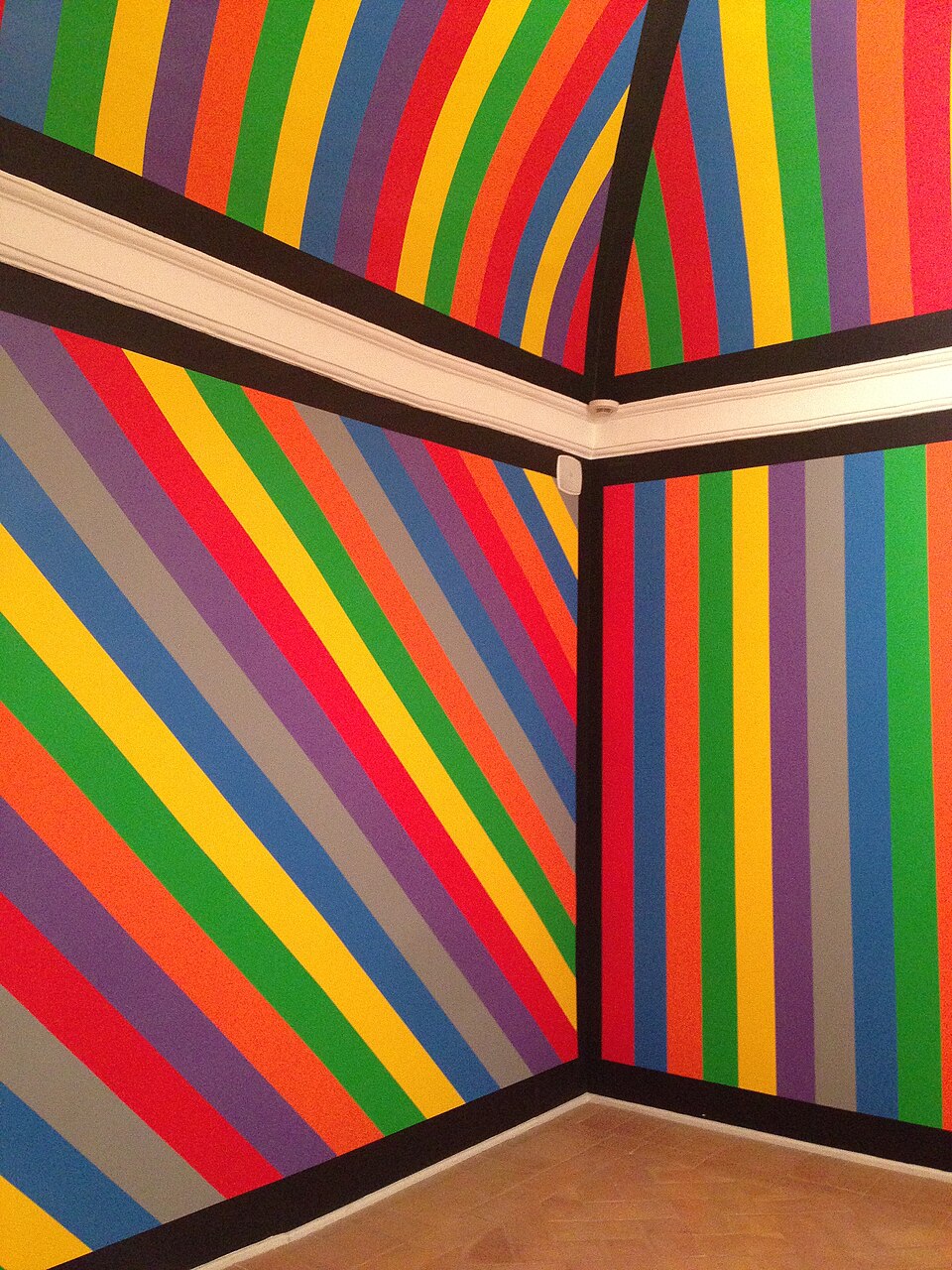
LeWitt’s Wall Drawings are the clearest demonstration of his own proposition. He sold a set of written instructions (the plan), not a finished object. Museum staff, strangers to LeWitt and to each other, executed the drawing on site, following the instruction card. The wall drawing exists as two distinct things: the instruction-set, which is the artwork, and the drawn surface, which is a temporary instantiation of it. When the show ends, the wall is painted over. The surface is destroyed. The instructions persist.
This produces a structural paradox that the art world has still not fully resolved. The work is simultaneously authorless (anyone can execute it) and highly authored (only LeWitt’s instructions authorize it). His intelligence is fully present in the design of the system. Only his body has been removed. A certificate of authenticity records authorship, edition size, paint codes, wall dimensions, and installation constraints, as documented in Sol LeWitt: Wall Drawings (Damiani, 2006). What the certificate certifies is not an object. It certifies a permission.
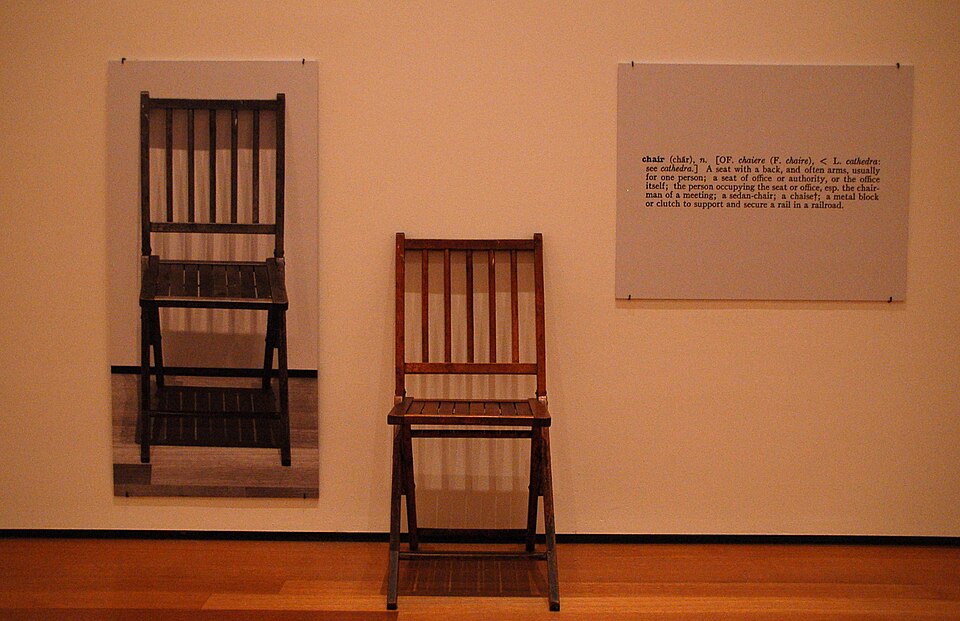
Joseph Kosuth arrived at the same problem from a different direction. One and Three Chairs (1965, MoMA, New York) places a folding wood chair next to a full-scale photograph of that chair and a photostat of the Merriam-Webster dictionary definition of “chair.” The piece does not claim to be about chairs. It asks which of these three things (object, image, definition) is actually the “chair.” By extension, it asks whether the concept of something is more fundamental than any material instance of it.
Kosuth theorized this in “Art after Philosophy,” Studio International, October–November 1969, arguing that conceptual art was not a style but an inquiry into what art is. The work at MoMA remains one of the most frequently reproduced images in modern art precisely because it makes its argument visually, without requiring the viewer to have read the theory.
Lawrence Weiner’s position was the most uncompromising of all three. His “Declaration of Intent” (1968), reprinted in Alexander Alberro and Blake Stimson (eds.), Conceptual Art: A Critical Anthology (MIT Press, 2000), stated three clauses: “1. The artist may construct the piece. 2. The piece may be fabricated. 3. The piece need not be built.” The third clause is the whole argument.
Then Weiner went further: “Once you know about a work of mine you own it.” This is a genuinely radical claim about intellectual property. The art market has never resolved it. Weiner’s position makes ownership impossible to enforce and impossible to assign. You cannot un-know something. Once the idea has entered a mind, the artist’s claim to exclusive possession of it collapses. That tension has not been resolved in the decades since, and the article is weaker if it pretends otherwise.
Rule-based thinking is not unique to fine art. Rams wrote ten principles for what good design is and is not: a different kind of instruction set, one that constrains industrial production rather than artistic execution, but operating from the same structural belief that the design of a system precedes and governs the quality of its outputs.
Five works that demonstrate the argument
These five works are not a survey of conceptual art. They are five different versions of the same argument, each pressing on a different joint.
Sol LeWitt, Wall Drawing #1 (1968)
Lines drawn using four directions (vertical, horizontal, diagonal left-to-right, diagonal right-to-left) and their combinations, in pencil, on a wall. The entire instruction set fits on a card. The drawing can be remade indefinitely from the same card, anywhere, by anyone authorized to do so. The physical surface is not the work. The card is the work. This is what it means for an idea to be the machine.
Joseph Kosuth, One and Three Chairs (1965)
Folding wood chair. Full-scale photograph of the same chair. Photostat of a dictionary definition of “chair.” Side by side in a gallery at MoMA. The piece poses one question (which of these three things is the chair?) and refuses to answer it. Kosuth was twenty years old when he made it. He had already understood that the question of what art is was more interesting than any particular thing art could make.
Yoko Ono, Grapefruit (instruction book, 1964)

A book of event scores: brief written instructions for works that may or may not ever be executed. “Draw an invisible image. Frame it. Hang it.” Ono’s scores, first published by Wunternaum Press, Tokyo, in a small edition, predate LeWitt’s manifesto and establish the instruction-as-artwork form from within Fluxus. Where LeWitt’s system is geometric and systematic, Ono’s is poetic and open. Both arrive at the same place: the instruction is the art; the execution is optional.
Lawrence Weiner, Declaration of Intent (1968)
Not a physical object. A typed statement of principle. Three clauses, a period. The work is the statement. No fabrication required. No fabrication expected. Weiner held this position for the rest of his life; it never softened. Among artists who worked in conceptualism, this remains the most uncompromising position, because it refuses to leave any room for the art market’s preferred resolution: buy the certificate, buy the documentation, buy the authorized print. Weiner’s position says: you already own it, because you know it now.
Hans Haacke, MoMA Poll (1970)
Installed at the Guggenheim Museum, New York, in 1970. Visitors answered a yes/no political question (whether they believed Nelson Rockefeller’s failure to condemn Nixon’s Indochina policy was reason enough to vote against him) by placing ballots in one of two transparent urns. The artwork was the accumulation of answers. The artist designed the system; the audience executed the work; the result was a public political statement that the museum had not anticipated and could not control. The Guggenheim’s institutional record of the period documents what happened next: museum director Thomas Messer canceled a separate Haacke exhibition the following year over concerns about institutional critique. The system had worked exactly as designed.
The work of an artist like Karen Kilimnik sits in an interesting relationship to this tradition. It is contemporary practice that draws on conceptualism’s structural inheritance while moving the emotional register somewhere entirely different.
Shop the Collection
Two books worth owning on this subject. Not a reading list; a minimum viable library.
- Sol LeWitt: Wall Drawings (Damiani, 2006): Documents a single wall drawing from instruction card through execution to final image: the clearest visual argument for what it means for an idea to be the machine that makes the art, and the book that established how LeWitt’s certificate system actually worked.
- Sol LeWitt: Wall Drawings 1968–1984 (Stedelijk Museum Amsterdam, 1984): The definitive early survey; shows how the instruction system scaled across sixteen years and hundreds of variations without the core logic changing; that consistency is itself the argument, made visible.
Further Reading
The critical literature on conceptual art is large and uneven. Two books anchor it; everything else builds on them.
- Lucy R. Lippard, Six Years: The Dematerialization of the Art Object from 1966 to 1972 (University of California Press, 1997 reprint): Lippard assembled this as the movement unfolded; it is closer to primary source than secondary survey. She was in correspondence with LeWitt, Weiner, and Kosuth; the documents she collected are the record. If you want to understand what conceptualism felt like from inside, this is the book. She and LeWitt later co-founded Printed Matter in 1976, the artist-book bookstore that still operates in New York.
- Alexander Alberro and Blake Stimson (eds.), Conceptual Art: A Critical Anthology (MIT Press, 2000): The primary texts (LeWitt’s manifestos, Kosuth’s “Art after Philosophy,” Weiner’s Declaration, Lippard’s essays) in one volume. Read this after the article if you want to encounter the arguments in the artists’ own words. The critical literature on conceptual art is well-mapped here for anyone who wants to go further.
Frequently Asked Questions
What is conceptual art in simple terms?
Conceptual art is art where the idea takes priority over the physical object. In many cases the idea (usually written as a set of instructions) is the artwork itself, and the object, if there is one, is just a temporary execution of that idea. Sol LeWitt put it plainly in 1967: “The idea becomes a machine that makes the art.” That machine can run without the artist present.
Why do conceptual artists use rules and instructions instead of making the work themselves?
Because removing the artist’s hand from execution forces a question: if someone else can make this work from instructions, what exactly did the artist contribute? The answer conceptualism gives is: the design of the system. The rules are not a constraint on expression; they are the expression. The artist’s intelligence lives in how the rules are written, what they permit, and what they leave open.
Who started conceptual art and when?
Henry Flynt coined the term ‘concept art’ in 1961 and published his essay ‘Concept Art’ in 1963. Sol LeWitt gave the movement its most influential theoretical statement with ‘Paragraphs on Conceptual Art,’ published in Artforum in Summer 1967. Marcel Duchamp’s readymades (1913 onward) are often cited as a precursor, but historians generally treat them as anticipation rather than origin; the movement as a named, theorized practice dates from the 1960s.
Can conceptual art be owned if anyone can make it?
This is the question the movement deliberately left unanswered, and the art market’s solution (certificates of authenticity, edition sizes, authorized reproductions) is a workaround rather than a resolution. Lawrence Weiner’s position was the most radical: ‘Once you know about a work of mine you own it.’ If he meant it, and he did, then ownership cannot be assigned or revoked. In practice, LeWitt’s Wall Drawings are owned via the instruction-set and the certificate that records authorization, not via the wall surface, which gets destroyed.
How is Sol LeWitt’s wall drawing different from a painting?
A painting is an unrepeatable object: a specific surface, that exact act of making, this one canvas. A LeWitt wall drawing is a system that can be instantiated anywhere, any number of times, from the same instruction card. The wall surface is destroyed when the exhibition closes. The instruction-set persists and authorizes every future execution. What you buy when you acquire a LeWitt wall drawing is permission to run the system, not possession of an object.
Is conceptual art still relevant today?
The structural move conceptualism made (locating authorship in the design of a system rather than in its execution) turns out to describe a large portion of how culture is produced now. Software, algorithms, generative AI: all of these separate the design of the generative system from the outputs it produces. LeWitt’s proposition that the idea is the machine that makes the art looks less like an art-world argument and more like a description of the present. That does not mean every artist working today is a conceptualist, but it does mean the question of where authorship lives is not going away.
See also: Conceptual Art After Minimalism, How to Read Conceptual Art, The Grid in Contemporary Art

About Joe Post
Joe Post holds an MFA in Art from California Institute of the Arts (CalArts) and has done additional graduate work at the School of the Art Institute of Chicago. He founded Art Design Ideas to write about design as cultural argument — the decisions, contradictions, and assumptions built into the objects we live with.