

The Design of Everyday Things AI is Don Norman’s 1988 framework for how humans interact with designed objects. He built it on five interlocking concepts: affordances, signifiers, constraints, mappings, and feedback. Norman’s vocabulary assumes consistent, predictable systems. AI violates every one of those assumptions. The book was right about its world. The question is whether that world still exists.
What Problem Was Norman Actually Solving in 1988?

Norman didn’t set out to write a design manifesto. He was frustrated, specifically by the experience of standing in front of ordinary objects and not knowing what to do with them. Doors that refused to signal whether you pulled or pushed. Stoves whose knobs bore no legible relationship to the burners they controlled. Light panels that required a map. His diagnosis was that the fault was design’s, not the user’s. That inversion (from blaming the person to blaming the object) is the entire argument of the book.
The frustration had academic form. Norman earned a BS in Electrical Engineering from MIT in 1957, then a PhD in Psychology from the University of Pennsylvania in 1962, studying under Duncan Luce. He did post-doctoral work at the Center for Cognitive Studies at Harvard. By the time he sat down to write what would become The Design of Everyday Things, he was operating at the intersection of cognitive science and engineering. The book is exactly that: a cognitive psychology argument wearing a design manual’s jacket.
Timing mattered. The IBM PC launched in 1981; the Macintosh arrived in 1984. Norman was writing into a moment when machines with interfaces had just landed in the homes of people who had never operated anything like them. He was arguing, in effect, that the coming era of human-computer interaction had a problem, and that problem was systemic, not individual. The user is never wrong. That phrase sounds liberal and obvious now. In 1988, it was a direct challenge to decades of industrial safety culture that attributed accident and error to human failure. Norman argued that 75 to 95 percent of accidents labeled “human error” were actually design failures. Not a metaphor; the operational thesis of the book.
The original title was The Psychology of Everyday Things (Basic Books, 1988). It was retitled The Design of Everyday Things for the 1990 paperback edition, because bookstores were shelving the original in the psychology section, where designers never found it. Even the title change is a lesson in Norman’s argument: the object’s relationship to the user matters at every level, including where the book sits on a shelf.
Norman joined Apple in 1993 as User Experience Architect — a title that, as far as the record shows, had not existed before. He co-founded the Nielsen Norman Group with Jakob Nielsen in 1998, and in 2013 published a revised and expanded edition of DOET that added a chapter on technology and complex systems, introducing for the first time a distinction that the original had conflated.
What the Eameses were actually arguing (that good design solves real human problems through disciplined formal decisions, not through aesthetics alone) is the mid-century lineage Norman’s work grew from. The cognitive science frame was new; the problem-solving orientation was inherited.
What Norman’s Framework Can Do, and the One Thing It Cannot
The Design of Everyday Things AI framework reaches its limit here. DOET is built from five interlocking concepts. None of them stands alone. Affordances are the perceived relationship between an object and a person: what the object suggests it allows. A chair affords sitting; a door handle affords grasping. Norman adapted this from James J. Gibson’s ecological psychology (Gibson’s original work dates to 1977), but with a defining modification: for Norman, affordances are perceptual, not physical. What matters is what the user believes the object permits, not what it technically can do.
Signifiers are the visible signals that communicate what affordances exist. A flat metal plate on a door is a signifier: it says push. Norman added this distinction in the 2013 revised edition after spending twenty years watching designers use “affordance” to mean what he had always meant by “signifier.” The plate doesn’t create the affordance; it points to it. Getting this wrong produces doors that require push-pull signs — the design failure that gave “Norman door” its name. The distinction is laid out on Norman’s own site with characteristic directness.
Conceptual models are the mental maps users build of how a system works. Norman’s argument is that good design plants a correct conceptual model; bad design plants a wrong one; and the worst design plants none at all. His formulation from DOET: “It is the conceptual model that provides true understanding. A good conceptual model allows us to predict the effects of our actions. Without a good model we operate by rote, blindly.” Feedback is the perceptible response to an action (the click, the beep, the screen change) that tells a person what happened. Mapping is the spatial or logical relationship between controls and effects. A steering wheel has natural mapping; a light panel with twelve identical switches does not.
These five form a unified theory of legibility. Together, they describe what it takes for a designed system to be readable to a human mind. And underneath all five runs a single assumption that holds the framework together: the system is consistent. It behaves the same way today as it did yesterday. The door that always pulled will continue to pull. The conceptual model a user builds this month will remain accurate next month. Feedback is interpretable because the system is deterministic — a known input produces a predictable range of outputs.
This is where AI breaks the framework. Not disproves it — breaks the conditions under which it operates.
A large language model has no stable mapping. The same prompt produces different outputs, not because the interface is poorly designed but because stochasticity is the mechanism. There is no control surface that corresponds to the system’s confidence levels, knowledge cutoffs, or capability limits. The text input box, identical across every major AI product, affords nothing specific about what the system can or cannot do. The conceptual model a user builds today can be silently invalidated by the next model update; the user receives no notification, and the interface looks identical before and after.
Feedback is the sharpest failure. In Norman’s framework, bad feedback (the microwave that doesn’t beep, the door that doesn’t click) is identifiable. The absence of information is information. With AI, the response always arrives, always in fluent, grammatically correct prose. Confident text and hallucinated text are identical in form at the interface level. There is no perceptible signal of error. Norman’s framework assumes that errors can be detected; with current AI systems, they often cannot be.
Norman himself has been candid about this. In a July 2024 UX Magazine podcast with Robb Wilson, he said: “It’s a huge cost, it’s powerful, and it has no intelligence… Don’t forget the A; it’s artificial. It doesn’t understand what it is doing. It’s a pattern matching device. It finds patterns and then recites them.” That is not a defense of DOET’s applicability to AI; it’s a description of why the framework’s premises no longer hold in this domain. Separately, in a 2023 McKinsey Author Talks interview, Norman was more measured: “using generative AI as a collaboration, and the result is something I could never have done by myself. A person plus this device is far better than either the device alone or the person alone.” Both statements are true. They just don’t resolve the design problem. Where AI sits in the design lineage is the question the framework cannot answer by itself.
Dieter Rams’ demand for legibility (the proposition that a good design’s function should be self-evident) rests on the same assumption Norman’s does: that the designed system is stable and that its logic is accessible to the user’s understanding. AI is neither.
Five Concepts That Defined a Generation of Design, and What AI Does to Each
Affordances. Norman adapted Gibson’s concept for the designed world in DOET’s original 1988 edition: the perceived relationship between object and actor, suggesting what actions are possible. A chair seat affords sitting for a body of the right proportions; a glass affords gripping at its middle. The designed affordance is a communication: it tells the user, through form, what to do. In AI systems, there are no perceived affordances. Every generative interface presents the same text input box regardless of the system’s actual capabilities. The box affords typing. That is all. Whether the system behind the box can write code, diagnose medical symptoms, or translate Urdu is invisible at the interface level.
Knowing how to read a designed object (what its form implies about its use) is a practice that design critics have developed over decades. Norman’s affordance theory gave that practice theoretical grounding. AI removes the surface to read.
Conceptual Models. The mental map a user builds of how a system works. Good design creates a correct one; bad design creates a false one. In Norman’s framework, even a false conceptual model is stable: the user is wrong about the system, but consistently wrong in the same way, and the wrongness can be corrected by redesign. In AI, no stable model can be built. Model weights update silently between versions. Capabilities shift. The user’s understanding of what the system can do is constantly being invalidated without notification. There is no redesign that can fix this — the instability is architectural.
Feedback. Perceptible information about the result of an action. The click, the beep, the screen change. In Norman’s world, bad feedback is identifiable: the microwave that doesn’t respond is clearly malfunctioning. With AI, the response always comes, and it always looks the same (complete, fluent, confident) whether the system retrieved a documented fact or constructed a plausible-sounding fiction. The identical form of correct and incorrect output means the user cannot read the feedback for reliability. Norman’s “Design for Error” principle assumes that errors are detectable at the interface level. With current AI systems, they are not.
Mapping. The spatial or logical relationship between controls and their effects. A steering wheel maps naturally to vehicle direction; the relationship is intuitive because the geometry corresponds. In AI, there is no meaningful mapping. No control surface corresponds to knowledge cutoffs, confidence thresholds, or the difference between retrieved memory and generated inference. The interface does not represent the system’s internal state at any level.
Design for Error. Norman’s principle that good systems anticipate user error and design for graceful recovery: make errors visible, make them reversible, design out the conditions that produce them. A nuclear plant that can be shut down by one misread instrument is badly designed. The principle assumes that errors produce distinguishable states. An AI that generates a factually incorrect answer and an AI that generates a correct one produce responses that are distinguishable by the user only if the user already knows the correct answer. If they did, they would not have asked.
Shop the Collection
There are two Norman books worth owning, not the whole catalog, just these two. The 2013 edition of DOET is the one to read; the 2023 book shows where he took the argument after forty years.

The Design of Everyday Things: Revised and Expanded Edition by Don Norman (Basic Books, 2013): The 2013 revision adds the signifier/affordance distinction that the original collapsed, and a chapter on complex systems that is directly relevant to the AI argument this post is making. The 1988 edition is historically interesting; the 2013 edition is the working text.
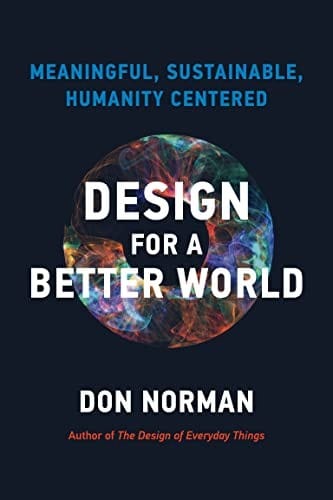
Design for a Better World: Meaningful, Sustainable, Humanity Centered by Donald A. Norman (MIT Press, 2023): Norman’s most recent book shifts from individual product usability to systemic, humanity-centered design, tracing the evolution of his thinking after five decades of practice, and the context in which he is now grappling with AI’s implications for the designed world.
Further Reading
DOET is the founding argument; the two books below show where it runs into its own limits.

Donald A. Norman, Emotional Design: Why We Love (or Hate) Everyday Things (Basic Books, 2004): DOET established the cognitive argument. Emotional Design is where Norman acknowledges that pure usability thinking isn’t enough: pleasure, aesthetics, and meaning do work that efficiency cannot. Reading them together reveals the tension this post is built on: Norman knew his framework had limits before AI made them visible.

Donald A. Norman, Living with Complexity (MIT Press, 2010): Norman’s argument that complexity is not the enemy — bad design is. This is the bridge between DOET and the AI question: AI is genuinely complex, not just poorly designed. Norman’s own distinctions begin to strain here in ways he doesn’t fully resolve.
Frequently Asked Questions
What is the main argument of The Design of Everyday Things?
DOET argues that when people fail to operate everyday objects (doors, stoves, switches, computers) the fault lies with the design, not the user. Norman inverts the conventional blame-the-user reflex and argues that 75 to 95 percent of incidents labeled “human error” are actually design failures. Good design creates correct conceptual models, provides clear feedback, makes affordances visible, and designs for error recovery. The user is never wrong; the designer is.
What are affordances in design and why do they matter?
Affordances, in Norman’s usage, are the perceived relationships between an object and a person that suggest possible actions. A door handle affords grasping; a flat plate affords pushing. Norman adapted the concept from James J. Gibson’s ecological psychology, but modified it: what matters is the user’s perception of what the object permits, not its physical properties. Affordances matter because they are how objects communicate their own use, and when they fail, the user is left to guess.
How does Don Norman define a conceptual model?
A conceptual model is the mental map a user builds of how a system works. Norman argues that good design creates correct conceptual models; bad design creates false or absent ones. His formulation from DOET: “It is the conceptual model that provides true understanding. A good conceptual model allows us to predict the effects of our actions. Without a good model we operate by rote, blindly.” The conceptual model is the foundation on which all correct use of a system depends.
Is The Design of Everyday Things still relevant for digital and AI design?
Norman’s framework remains the best available vocabulary for critiquing interfaces built on consistent, deterministic systems. For most software, it still applies: an app that fails Norman’s affordance and feedback tests is genuinely badly designed. For AI, the framework runs into a structural limit: Norman’s five categories all assume a stable system. AI systems update silently, produce stochastic outputs, and present errors in the same form as correct responses. The framework identifies real design problems in AI interfaces; it cannot solve the underlying architectural ones.
What is the difference between an affordance and a signifier?
An affordance is the actual relationship between object and actor: the possibility of an action. A signifier is the perceptible signal that communicates what affordances exist. A flat plate on a door is a signifier (it says push); the affordance is that the door can be pushed. Norman introduced the signifier/affordance distinction in the 2013 revised edition after two decades of designers conflating the two, producing a generation of ‘push’ signs on doors that should have communicated their use through form alone.
Why did Norman rename the book from The Psychology of Everyday Things?
The original 1988 edition was titled The Psychology of Everyday Things (Basic Books). Bookstores shelved it in the psychology section, where designers rarely browsed. For the 1990 paperback edition, the publisher retitled it The Design of Everyday Things to move it to the design section. The title change is itself a lesson in Norman’s framework: the object’s relationship to its context of use (including where it sits on a shelf) is a design decision, not an afterthought.

About Joe Post
Joe Post holds an MFA in Art from California Institute of the Arts (CalArts) and has done additional graduate work at the School of the Art Institute of Chicago. He founded Art Design Ideas to write about design as cultural argument — the decisions, contradictions, and assumptions built into the objects we live with.