A Visual Dictionary of Architecture is Francis D.K. Ching’s illustrated reference to architectural terms, first published by Van Nostrand Reinhold in 1995 and now in a second edition from Wiley (2011). It defines more than 5,000 terms through hand-drawn line illustrations, grouped into 68 concept chapters, from arch and column to stair and structure, instead of an alphabetical list. For architecture students it is the standard picture dictionary of the field, and the grouping itself teaches how building parts relate.
Why Architectural Knowledge Had to Be Drawn, Not Defined
The book you are holding when you open the Francis D.K. Ching Visual Dictionary of Architecture feels like a textbook. It is not. It is a teaching argument that found its form over two decades and then got bound.
Francis D.K. Ching was born in Honolulu in 1943, earned his Bachelor of Architecture from the University of Notre Dame in 1966, and spent several years as a licensed architect — including a stint as a VISTA architect at Cleveland Design Center — before walking into a classroom at Ohio University in 1972. He is among the designers and educators who built architecture’s visual language, and the path he took to that position matters.
What Ching found when he started teaching was a problem of translation. Architecture students were expected to learn through text and lecture, then demonstrate understanding through drawing. But drawings encode spatial relationships that words can barely approximate. A student who reads the word “clerestory” has acquired a label. A student who sees a section drawing showing where a clerestory sits relative to the wall it punctuates, the light it admits, and the structural members it interrupts — that student has begun to understand the thing.
So Ching started making notes. During the 1974–75 academic year, he compiled over 400 pages of hand-lettered, hand-drawn material for his Ohio University students. His own UW faculty page records that “his writing and illustrating grew from his experience while teaching.” Students were photocopying these notes outside class. The book existed before the publisher did. Van Nostrand Reinhold published Architectural Graphics in 1975 — the first crystallization of the method — and the logic that produced it ran twenty more years before it produced the Visual Dictionary.
By the time the Visual Dictionary appeared in 1995, Ching had moved through the University of Wisconsin-Milwaukee and arrived at the University of Washington around 1992, where he taught beginning design studio and a sequence of design drawing courses. The book was the accumulated answer to two decades of watching students misunderstand when they only read. That is a different kind of scholarship than writing at a desk.
Drawing Is Not a Picture of a Building — It Is How You Understand One
The organizing principle of the Francis D.K. Ching Visual Dictionary of Architecture is also its argument: the 68 conceptual clusters are not a convenience. They are a taxonomy. Ching decided what the categories are: structure, construction, history, hardware, environmental issues, spatial behavior. And that decision is theoretical, not neutral.
Compare this to a standard dictionary. In a standard dictionary, a term stands alone, linked only to other terms by the accident of alphabetical proximity. “Column” precedes “combination” precedes “comfort.” The relationship between those terms is zero. In Ching’s dictionary, “column” appears within the structural vocabulary that surrounds it — base, shaft, capital, entasis, intercolumniation — and the page layout performs the argument: architecture is relational. You do not understand a column by reading its definition. You understand it by seeing how it loads, how it’s proportioned relative to its neighbors, what terminates it at the floor and the ceiling.
One Goodreads reviewer described the Visual Dictionary as “the Gray’s Anatomy of architecture.” That comparison is precise. Henry Gray also organized anatomy around systemic relationships — the cardiovascular system, the nervous system, the musculoskeletal system — not alphabetical listing. The point is the same: a body and a building are understood through the logic of their parts in relation, not the parts in isolation.
The line-drawing method reinforces this. Ching’s illustrations are not architectural photography and they are not watercolor rendering. They are axonometric and isometric technical drawings — inherited from the tradition of architectural representation that runs from Palladio’s plates through Beaux-Arts instruction to the post-war American architecture school. The lines encode structure first, surface second. What you see is load path and volume and threshold, not texture and atmosphere. The choice of what to draw is an editorial act about what matters in a building.
This is why the book stays in print. The second edition appeared from Wiley in 2011, updated to include 21st-century construction technology. A Kindle edition followed in 2022. The Visual Dictionary has been translated into more than thirteen languages — Bahasa Indonesian and Malaysian, both Simplified and Traditional Chinese, French, German, Greek, Italian, Japanese, Korean, Norwegian, Portuguese, Russian, Spanish, Thai, and Turkish. That translation reach is data. Among books that have stayed in print because the argument holds, the Visual Dictionary is one of the clearest cases.
The book’s staying power is also not a story about hand drawing surviving CAD and BIM. Architecture schools run Revit on every workstation. Ching’s students at UW were working in a computational environment for two decades before he retired. The argument the Visual Dictionary makes is not that pencil beats mouse. It is that spatial reasoning — understanding a building as the organization of three-dimensional space through structural and experiential logic — is not delivered by software. BIM models what you have already decided to build. The Visual Dictionary is used before that decision — at the stage where spatial thinking is still open.
That distinction connects the Visual Dictionary to the canonical design texts that architecture schools have relied on since the postwar period — Ching’s book belongs on the same shelf as the Bauhaus theory manuals precisely because it is asking the same question: what does it mean to understand space?
The Bauhaus answer was that design understanding comes from making. Ching’s answer is that it comes from drawing — but drawing understood as a cognitive act, not a representational one. That distinction is what connects the Visual Dictionary to the structural logic of space-making that Bauhaus inherited and Ching’s method extends. Both books approach architectural knowledge as a problem of spatial logic, not nomenclature.
Ching’s method earned institutional recognition beyond student adoption. The American Institute of Architects gave him its 2007 Institute Honor Award for Collaborative Achievement. The Cooper Hewitt National Design Awards recognized him with a Special Jury Commendation that same year. Nottingham Trent University awarded him an honorary Doctor of Design. None of that happened because his books were popular. It happened because the field decided they were right.
The Books That Built the Argument
Ching’s body of work is small and consistent. Every book extends the same argument. That consistency is itself evidence that the argument is serious — he spent fifty years elaborating a single pedagogical position, not chasing the market. Four books define the core argument.
Architectural Graphics, 7th Edition (Wiley, 2024)
The originating work. The hand-lettered, hand-drawn notes that Ohio University students were photocopying in 1975 became this book. It is now in its seventh edition — which is the real review. A drafting manual published fifty years ago that architecture schools still assign is not nostalgia. It is a method that works. The seventh edition, released by Wiley in 2024, updates the drawing vocabulary for contemporary practice while preserving the hand-drawn line as the primary teaching tool. The objects that get the same treatment in design school — studied by drawing, not photographing — find their methodological justification in this book first.
Architecture: Form, Space, and Order, 5th Edition (Wiley, 2023)
The theoretical companion to the Dictionary. Where the Dictionary catalogs the terms, Form Space and Order builds the argument: architecture is the organization of three-dimensional space through form, and drawing is the tool by which this organization becomes legible to the designer. Amazon’s editorial description notes that “for more than forty years, the beautifully illustrated Architecture: Form, Space, and Order was the classic introduction to the basic vocabulary of architectural design.” Secondary sources call it “the architect’s Bible.” What it actually is: the book that explains why the Dictionary matters. They belong together.
A Visual Dictionary of Architecture, 2nd Edition (Wiley, 2011)
The culminating reference work. 336 pages, 5,000-plus terms, 68 thematic clusters. The second edition added “the latest concepts and technology of 21st century architecture, design and construction,” per Wiley’s own description. The original hardcover appeared from Van Nostrand Reinhold in 1995 at 319 pages; the Wiley paperback runs 17 pages longer and carries ISBN 9780470648858. The 4.30-star average across 1,747 Goodreads ratings, with 54 percent of those being five-star, is the demand signal you would expect from a book that architecture students buy because they find it genuinely useful — not because a professor told them to and they had no alternative.
Design Drawing, 3rd Edition (with Steve Juroszek; Wiley)
The most direct statement of the thesis. Drawing is thinking, not drafting. If the Visual Dictionary raised the question of why hand drawing still matters in a computational environment, this book answers it explicitly. Ching and Juroszek argue that the act of drawing a building — freehand, with attention to line weight and spatial cue — is a cognitive process distinct from modeling it. The third edition updates the argument for a generation that learned to draw on screens.
A Global History of Architecture (with Mark Jarzombek and Vikram Prakash; Wiley, 2006)
The proof of scope. Ching’s structural-spatial framework applied across world architectural history — not European architectural history, not Western canonical monuments, but buildings across cultures and centuries organized by the same framework the Dictionary uses. Jarzombek brings global architectural history expertise; Ching brings the visual method; Prakash brings the cross-cultural frame. The result demonstrates that the Visual Dictionary’s organizing logic is not a stylistic tradition or a regional convention. It is a claim about how humans make space.
Shop the Collection
The core collection consists of three books. Start with the one that is the subject of this essay. Add the companion theory text if you want the argument behind the vocabulary. Add the originating graphics manual if you want to understand where the method came from and why it still works.
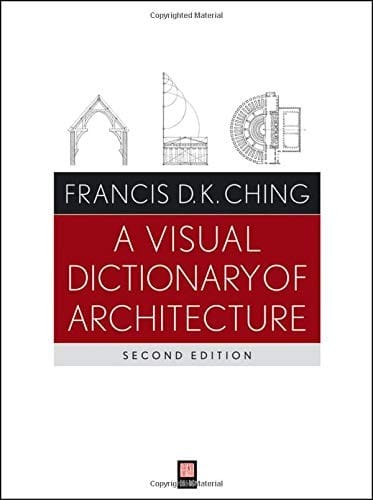
A Visual Dictionary of Architecture, 2nd Edition (Wiley, 2011): The definitive edition — adds 21st-century construction technology to the 1995 framework while keeping the hand-drawn visual method intact. This is the one to own.
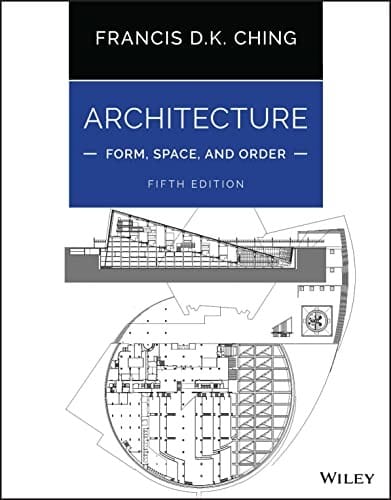
Architecture: Form, Space, and Order, 5th Edition (Wiley, 2023): The theoretical companion. The Dictionary catalogs the terms; this book builds the argument that spatial organization is what architecture is actually doing. They answer different questions, and both questions need answers.
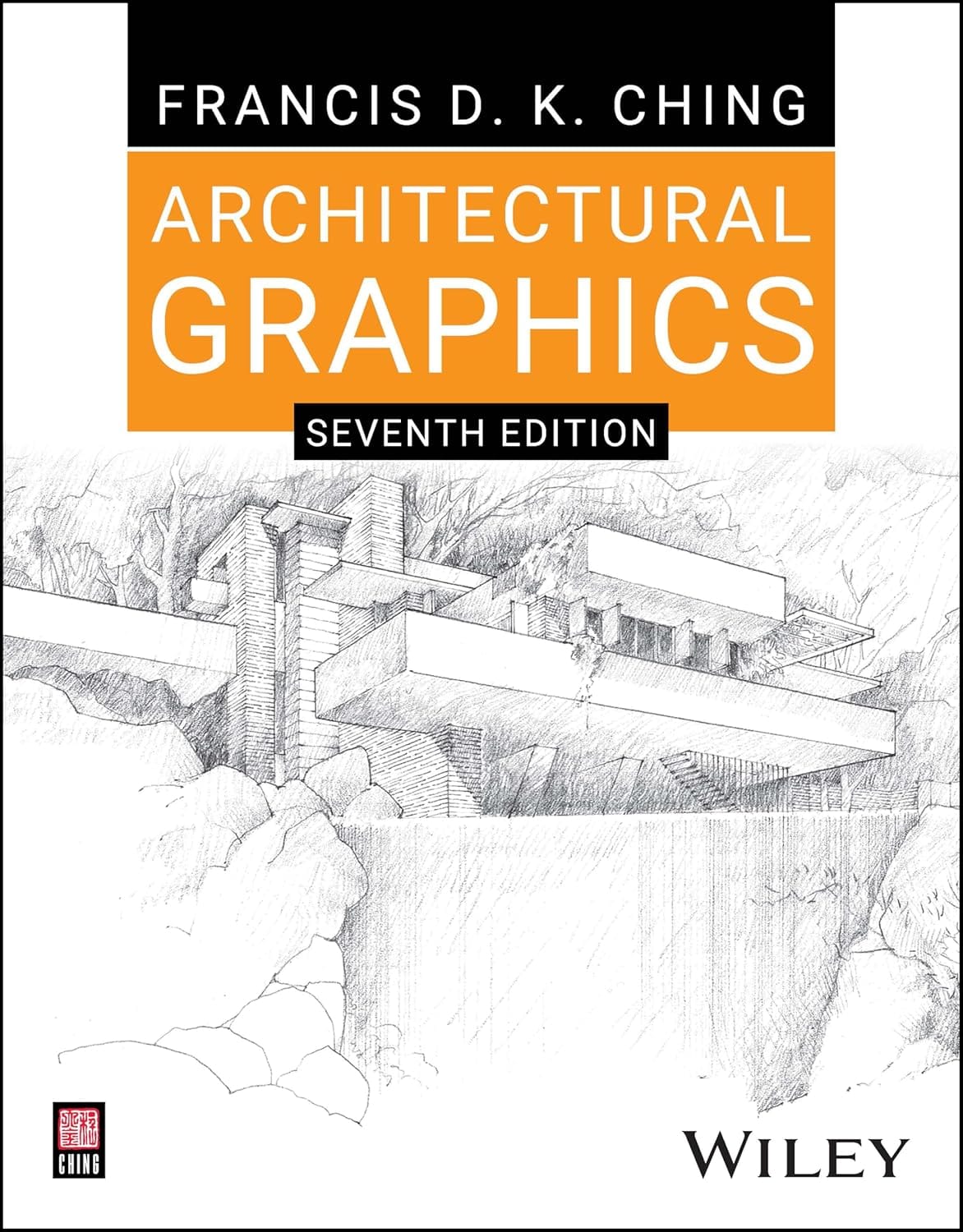
Architectural Graphics, 7th Edition (Wiley, 2024): The originating work, now fifty years old and still in a seventh edition. The fact that a graphics manual survives seven editions in an era of BIM software is evidence enough that Ching’s method has not been replaced — only supplemented.
Further Reading
These two books extend the argument in different directions. One is about the act of drawing itself; the other is about applying Ching’s spatial framework at global scale.
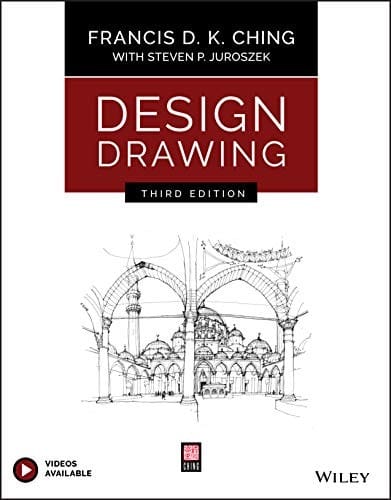
Francis D.K. Ching with Steve Juroszek, Design Drawing, 3rd Edition (Wiley): If the Visual Dictionary raised the question of why hand drawing still matters, this book is the direct answer — the argument that drawing is a cognitive act, not a representational one, spelled out at book length. Essential if the Visual Dictionary’s method convinced you but you want to understand the case for it.
Francis D.K. Ching with Mark Jarzombek and Vikram Prakash, A Global History of Architecture (Wiley, 2006): The strongest demonstration that the Visual Dictionary’s framework is not a Western stylistic tradition but a cross-cultural tool for understanding how humans build. Ching’s visual method applied to world architecture — the best expansion of the Dictionary’s argument into history.
Frequently Asked Questions
What is A Visual Dictionary of Architecture used for?
Architecture students use it for coursework and licensure exam preparation — it covers the full vocabulary a working architect needs across structure, construction, history, environmental systems, and spatial design. It also works as a desk reference for practitioners encountering unfamiliar terms. The thematic organization means it is more useful for building understanding than for quick lookups; most readers find themselves reading past the term they searched.
Is there a PDF version of A Visual Dictionary of Architecture?
Yes, through one authorized route: Wiley sells the second edition as an e-book, including a Kindle edition. The free PDFs that circulate on SlideShare, Scribd and file-sharing sites are unauthorized copies. For free legal access, many public and university libraries hold the book, and the Internet Archive lends a digitized copy of the 1995 first edition to registered borrowers.
What are the 7 visual design principles in architecture?
There is no single official list. The version most tied to Ching comes from his Architecture: Form, Space, and Order, whose ordering principles are axis, symmetry, hierarchy, datum, rhythm, repetition and transformation. Design courses often teach a different seven: balance, rhythm, emphasis, proportion, scale, contrast and unity. The Visual Dictionary defines these terms; Form, Space, and Order explains how to use them.
Is there a dictionary for architecture?
Yes, several. Ching’s A Visual Dictionary of Architecture is the best-known illustrated one, defining terms through drawings. For text definitions and history, the standard reference is James Stevens Curl’s A Dictionary of Architecture and Landscape Architecture from Oxford University Press. Students usually keep Ching for how things look and fit together, and a text dictionary for names, styles and dates.
How is A Visual Dictionary of Architecture organized?
Rather than alphabetical listing, the book groups over 5,000 terms around 68 thematic clusters — structural systems, spatial organization, building types, construction technology, design history, environmental considerations, and hardware. Terms sit alongside the related terms they belong with, and each entry includes hand-drawn illustrations that show spatial and structural relationships. The organization reflects Ching’s argument that architectural knowledge is relational, not atomized.
Is Francis D.K. Ching’s Visual Dictionary good for architecture students?
It is widely used in architecture schools and for NCARB licensure exam preparation. Goodreads data shows a 4.30-star average across 1,747 ratings, with 54 percent of those being five-star. The book is most useful for students who want to build spatial and structural understanding alongside vocabulary, rather than those looking for a fast glossary. Students who only need to look up a term quickly will find a standard architectural glossary faster; students who want to understand what they are looking up will find the Visual Dictionary more useful.
What is the difference between the first and second edition of A Visual Dictionary of Architecture?
The first edition was published by Van Nostrand Reinhold in 1995 as a hardcover, 319 pages, with ISBN 9780471284512. The second edition was published by Wiley in 2011 as a paperback, 336 pages, with ISBN 9780470648858. Wiley’s description states the second edition was updated to include ‘the latest concepts and technology of 21st century architecture, design and construction.’ For most purposes, the second edition is the one to own — it covers a broader range of contemporary building systems and materials while preserving the original visual method.
Why does Francis Ching use hand-drawn illustrations instead of photographs?
Photographs show surfaces. Ching’s drawings show structure. The axonometric and isometric line illustrations encode spatial and structural relationships — load paths, volumes, thresholds — that photographic images cannot convey cleanly. A photograph of a column shows you what a column looks like; a Ching drawing shows you how it sits on its base, how it transitions to the capital, how it relates to the bay it defines. The choice of hand drawing is not stylistic nostalgia — it is an argument about what kind of understanding the book is trying to produce.
What other books by Francis Ching should I read after the Visual Dictionary?
Architecture: Form, Space, and Order is the most direct companion — it builds the theoretical argument behind the Dictionary’s vocabulary. Architectural Graphics is the originating work, showing where the visual method came from and why it still holds. Design Drawing (with Steve Juroszek) makes the case for drawing as cognitive rather than representational — the most direct statement of why hand drawing matters in a computational era. A Global History of Architecture (with Mark Jarzombek and Vikram Prakash) demonstrates that Ching’s framework works across cultures and centuries, not only in the Western canonical tradition.

About Zoe Post
Zoe Post holds a BFA and a Master of Architecture from the School of the Art Institute of Chicago. She now works as a product marketing leader at an architectural product design firm, bringing hands-on industry perspective to everything she writes. At ADI she covers contemporary artists, textile and pattern design, and the design objects that sit at the boundary of art and function.