
Connie Hatch is an American photographer and CalArts faculty member whose practice spans photography, sound, installation, and narrative performance. Since the mid-1970s, she has treated documentary not as a record of fact but as a constructed argument about labor, gender, and who holds the authority to represent working life.
What CalArts was arguing when Connie Hatch arrived
John Baldessari’s Post Studio class at California Institute of the Arts in the early 1970s enrolled David Salle, Mike Kelley, Tony Oursler, James Welling, Barbara Bloom, and Troy Brauntuch. That list tells you what the institution was. It was not a place where you learned a medium. It was a place where medium-specificity itself was up for argument.
The Feminist Art Program, co-led by Miriam Schapiro and Judy Chicago, ran from 1971 to 1972 and opened Womanhouse in January 1972 as the first public feminist art installation in the United States. By the time Hatch arrived to join the faculty in 1983, the institution had spent more than a decade insisting that art’s relationship to politics, to the body, to representation, and to the gallery system were not separate questions. They were the same question.
Hatch came with an MFA in Fine Art from the San Francisco Art Institute (1979) and had been making photographic work since 1975. Work that was already asking what happens when a woman holds the camera in a tradition built on male voyeurism. CalArts gave her a peer network and a theoretical framework: politically engaged, formally experimental, and skeptical of any photography that claimed to simply record what was there. That skepticism placed her alongside Martha Rosler and Allan Sekula, who were working similar problems out of the UCSD Visual Arts program, and connected her practice to the post-Benjaminian critique of documentary that was moving through critical photography in the 1980s.
The CalArts formation Hatch joined is sometimes called the “new genre.” A term that arrived partly through later institutionalization, partly through necessity. It named a shared set of refusals rather than a unified aesthetic: refusal of the decisive-moment photograph, refusal of the humanist subject, refusal of making work whose primary destination was the art market. These refusals were not aesthetic preferences. They were political positions. The institution, for all its contradictions, created the context in which those positions were legible as such.
The contrast is worth stating directly. Where the postwar American art world’s faith in formal autonomy had produced a generation of artists committed to painting as self-sufficient, non-referential, and politically unaccountable, CalArts pushed back. The institution was an argument against that tradition. Hatch’s practice is one of its sharper conclusions.
The generation that emerged from CalArts in that period was not uniform. The generation of CalArts artists who absorbed its ambivalences moved in many directions. But Hatch’s work holds closer than most to the institutional critique framework. She stayed, and she teaches there still.
Documentary was never a record. It was always a claim
The central argument across all three of Hatch’s major project series is not formally complex. It is this: the documentary photograph does not record reality. It constructs one. It decides who is visible, under what conditions, and with whose authority. The photograph is not evidence. It is ideology.
This argument has a lineage. Abigail Solomon-Godeau, in “Reconstructing Documentary: Connie Hatch’s Representational Resistance” (Camera Obscura, Vol. 5, Issue 1-2, September 1985), positions Hatch in the framework Walter Benjamin and Bertolt Brecht developed. The argument that photographic transparency is a fiction, and that “something has to be constructed, something artificial” if documentary is to serve any genuinely political purpose. Solomon-Godeau’s essay is not supplementary criticism. It is the primary critical text on Hatch’s practice, and her reading of the Benjamin/Brecht framework is worth taking seriously on its own terms.
What Hatch adds to that framework — and Solomon-Godeau identifies this clearly — is feminist analysis. Benjamin and Brecht argued about class and capital. Hatch asks what changes when you introduce gender as a structural variable: the photograph’s meaning depends not only on institutional context but on the sexual identity of the viewer and, more fundamentally, on who holds the camera. Street photography as a tradition was built on a particular kind of male looking. Solomon-Godeau calls this “the non-neutrality, non-innocence of the look.” When a woman operates the camera in that tradition, the assumption of the neutral observer collapses. The voyeur becomes visible.
The formal choices Hatch makes follow directly from this argument. She refuses to produce sellable objects. She prefers slide-show presentations incorporating performance. A form that cannot be purchased, that exists only in its presentation, and that formally blocks the commodification that neutralizes even explicitly radical work once it enters the gallery system. This is not an aesthetic preference. It is the argument, made in material terms.
Solomon-Godeau notes that Hatch’s work “falls through the cracks,” occupying neither pure art photography nor postmodernist practice, fitting no clean political art category. That marginal positioning is exactly the point. The work refuses the institutional containers that would absorb it. It does precisely what Benjamin argued documentary needed to do and almost never managed: it constructs a form resistant to its own recuperation.
The question of representation extends to questions about whose experience gets depicted and by whom. Painting as street-level argument asked related questions from a different position. Who gets to claim authorship of experience, whose voice counts as art. Hatch’s work is inside the same argument, working through the camera rather than the canvas. And the problem of ideology in documentary photography connects directly to the problem of representation and mass culture. The question of whether images that circulate in mass media can be turned to critical use, or whether the apparatus itself forecloses that possibility.
Hatch’s answer, across three decades of practice, is that the apparatus can be turned. But only if you are honest about what the apparatus does. The camera is not a window. It is a claim. What the document actually claims is always a political question, and Hatch treats it as one.
Three projects, one argument. What work looks like in Hatch’s photographs
The De-Sublimation of Romance (1975–1981)
The series is gelatin silver prints, 11 by 14 inches. Hatch photographed men engaged in street voyeurism. Men watching women, men positioned as the subjects of a gaze they had assumed was theirs to exercise. The move is precise: she enters a photographic tradition organized around the male look (Walker Evans, Henri Cartier-Bresson, Robert Frank) and reorients it. The woman behind the camera photographs the man who thought he was looking.
According to documentation held at the University of Southern California’s Scalar platform and referenced in Solomon-Godeau’s analysis, Hatch explicitly wanted “her position as a woman recording this sexualized phenomenon to be noted by viewers.” The work does not expose voyeurism from a neutral position. It makes the viewer complicit in the exposure. You are watching someone watch. You are now inside the structure the photograph is about. The series is in the collection of the Binghamton University Art Museum and the J. Paul Getty Museum.
Form Follows Finance (ongoing from the early 1980s)
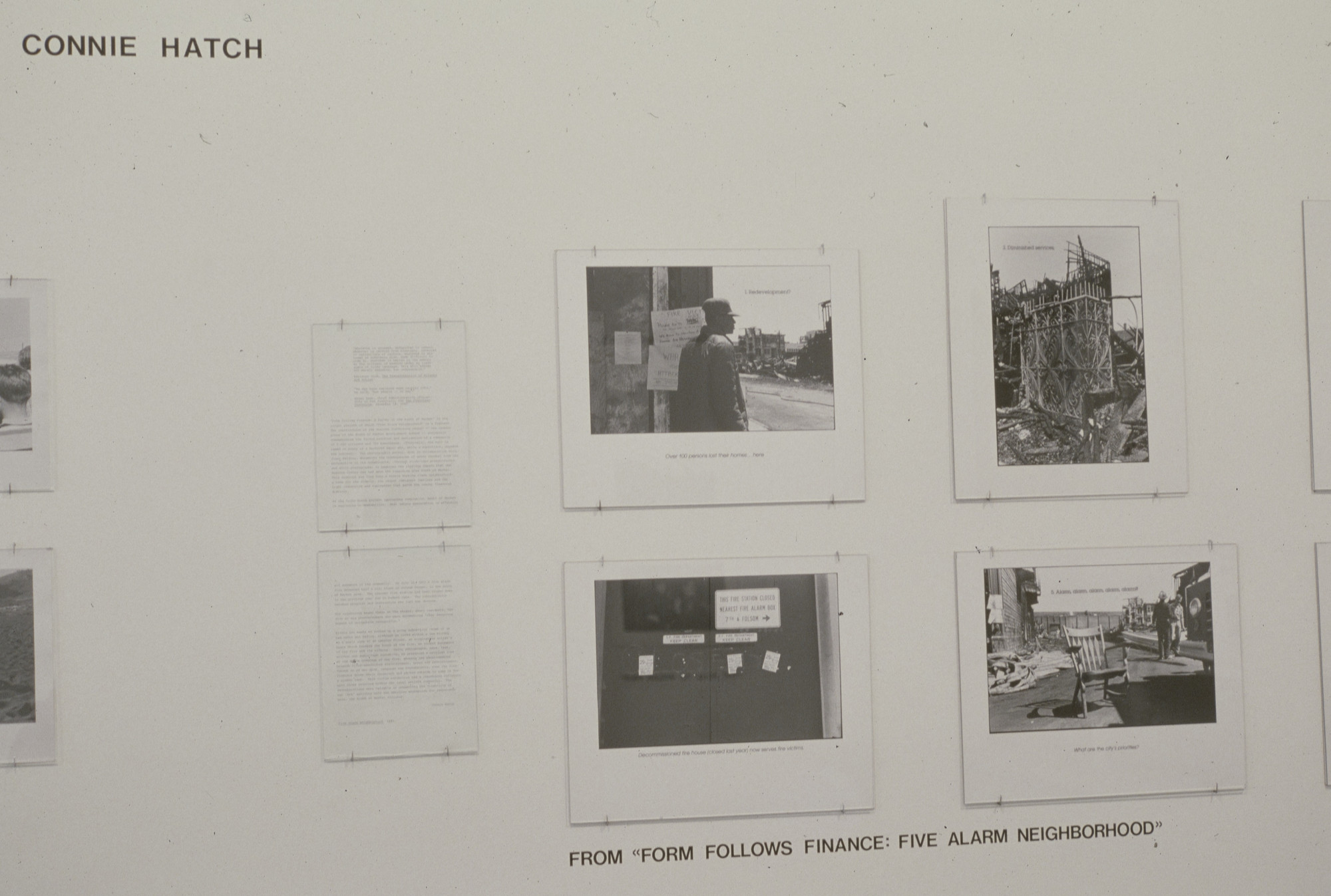
The title inverts Louis Sullivan’s functionalist motto. Sullivan said form follows function. Hatch says form follows finance — naming capital as the actual driver of urban transformation, the force that determines who lives where and under what conditions. The project documents San Francisco’s gentrification through community narratives, oral histories, and media language, expanding documentary beyond the single photograph into a form that can hold competing voices.
Solomon-Godeau’s analysis demonstrates that even this explicitly political work faced absorption into art gallery contexts; this is precisely the institutional problem Benjamin identified. The fact that the work is political does not protect it from the market. Solomon-Godeau’s reading makes clear that Form Follows Finance is partly about that impossibility.
Serving the Status Quo: From Stories We Tell Ourselves, Stories We Tell Each Other (1986)
The work is a three-part audio-slide projection, shown at the New Museum in New York from April 12 to June 12, 1986, in a group exhibition that included Jessica Diamond and Group Material. The New Museum Digital Archive documents the exhibition and its participants.
The three parts track three subjects. The Edwards family’s consumerist entrapment, Frankie Mann’s oscillating sexual identity, Marta Dane’s investment in conventional femininity as fantasy. Voices are displaced over what Solomon-Godeau describes as “the ruined sequence of their stories.” Image and audio held apart, the expected coherence of narrative deliberately broken. This is Brechtian alienation in a specific sense: the disjunction does not produce insight automatically. It produces discomfort. The formal frustration of narrative expectation is itself the argument about how ideological stories tell us who we are.
Some Women… Forced to Disappear; from: A Display of Visual Inequity (1989–91)
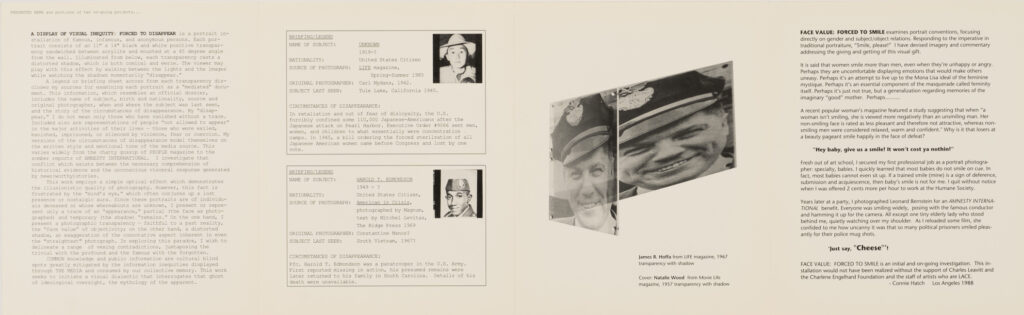
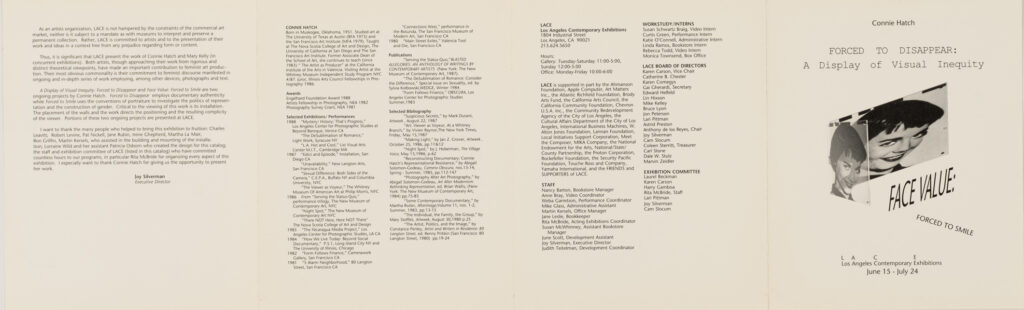
Twelve black-and-white transparencies in acrylite (14 by 11 inches each), twelve briefing sheets, two floor-mounted light boxes. The work juxtaposes portraits of famous, infamous, and anonymous women. The “visual inequity” of the title is literal: fame and obscurity placed side by side. The politics of who becomes visible is made explicit in the installation format. The work was shown at Randolph Street Gallery in Chicago for “Who Counts? Assessing the 1990 Census” (February 23 to March 31, 1990) and at LACE (Los Angeles Contemporary Exhibitions) in 1988, documented in the SAIC Digital Collections.
The 1998 exhibition at Roy Boyd Gallery in Los Angeles, reviewed by Amy Gerstler in Artforum (September 1998), included this work alongside Homes I Will Never See Again, 1898–1937? (two large-scale photographic portraits of Bessie Smith and Amelia Earhart suspended via steel cables), and History on Ice (Distortion). The 1898–1937? piece documents Smith’s death after being denied hospital admission due to racism. The date range in the title is ambiguous: the question mark at Earhart’s end marks her disappearance. Both women vanish from the historical record under different kinds of erasure. The work makes documentary a statement about what disappears when visibility is controlled by power.
Shop the collection
These three books are the critical literature for the political documentary lineage Hatch works inside. Reading any one of them changes how you look at a photograph. Reading all three is a course.
- Martha Rosler, Decoys and Disruptions: Selected Writings, 1975–2001 (MIT Press, 2006): The essential companion text for understanding the critical framework Hatch shares. Rosler’s essays on documentary, feminist art, and the politics of representation are the intellectual peer group, not the background reading.
- Allan Sekula, Photography Against the Grain: Essays and Photo Works, 1973–1983 (MACK, 2016): Sekula and Hatch are working the same problem from adjacent positions. His essays on the visualization of labor and capital are the closest thing to a manifesto for the political documentary lineage Hatch inhabits.
- Abigail Solomon-Godeau, Photography at the Dock: Essays on Photographic History, Institutions, and Practices (University of Minnesota Press, 1991): Contains “Reconstructing Documentary,” the definitive critical essay on Hatch’s practice. Not a secondary source but the primary critical text. The surrounding essays define the theoretical moment Hatch emerged from, and the book’s four-part structure maps the exact critical terrain she occupies.
Further reading
These two books are the ones worth owning in full, not just consulting.
- Abigail Solomon-Godeau, Photography at the Dock (University of Minnesota Press, 1991): The essay “Reconstructing Documentary: Connie Hatch’s Representational Resistance,” originally published in Camera Obscura, Vol. 5, Issue 1-2, 1985, and reprinted here, is the most sustained critical reading of Hatch’s practice. The book’s four-part structure (aesthetics, postmodernism, documentary, sexual difference) maps the exact critical terrain Hatch occupies.
- Martha Rosler, Decoys and Disruptions: Selected Writings, 1975–2001 (MIT Press, 2006): Rosler and Hatch are working the same political documentary problem. Reading Rosler’s writing on the Bowery, on video, on government patronage, and on gendered domestic space illuminates what the CalArts/UCSD critical photography formation was actually arguing, and why it mattered.
Frequently asked questions
Who is Connie Hatch and what is she known for?
Connie Hatch is an American artist born in 1951 in Muskogee, who holds an MFA from the San Francisco Art Institute (1979) and has taught at California Institute of the Arts since 1983. She is known for photographic, sound, and installation work that treats documentary as a political argument about labor, gender, and representation rather than a transparent record of fact. Her major series — The De-Sublimation of Romance, Form Follows Finance, and Serving the Status Quo — have been shown at the New Museum, the Whitney Museum, LACMA, and P.S. 1. Her work is held in the collections of the J. Paul Getty Museum and the Museum of Contemporary Art Los Angeles.
What is the CalArts new genre photography lineage?
“New genre” names a formation at California Institute of the Arts and related institutions (primarily UCSD) from the 1970s onward, characterized by shared refusals rather than a unified aesthetic: refusal of the decisive-moment photograph, refusal of the humanist subject, and refusal of making work whose primary destination was the art market. The formation included Hatch, Martha Rosler, Allan Sekula, and artists across media who were working with performance, installation, video, and text as extensions of, or arguments against, photography’s documentary tradition.
How does Hatch’s work treat documentary photography differently?
Where most documentary photography claims to record reality transparently, Hatch treats every photograph as a construction. A set of decisions about who is visible, under what conditions, and with whose authority. Drawing on the Benjamin/Brecht argument that photographic transparency is a fiction, and extending it with feminist analysis, Hatch asks what changes when a woman holds the camera in a tradition built on male voyeurism. Her formal choices — audio-slide presentations, no saleable objects, performance contexts — are designed to block the commodification that absorbs even explicitly political work once it enters the gallery system.
What is The De-Sublimation of Romance about?
The De-Sublimation of Romance (1975–1981) is a series of gelatin silver prints in which Hatch photographed men engaged in street voyeurism. Reframing the street photography tradition by entering it as a woman with a camera. The work exposes the assumption of the neutral observer embedded in that tradition: the viewer is made complicit in the exposure of voyeurism rather than allowed to occupy the voyeur’s position comfortably. The series is in the collections of the Binghamton University Art Museum and the J. Paul Getty Museum.
What is Serving the Status Quo and where was it shown?
Serving the Status Quo: From Stories We Tell Ourselves, Stories We Tell Each Other is a three-part audio-slide projection examining the lives of workers from various social classes. It was shown at the New Museum in New York from April 12 to June 12, 1986, in a group exhibition with Jessica Diamond and Group Material. The work uses Brechtian alienation effects. Displacing voices over disrupted narrative sequences to reveal the anxieties created by money, exploitation, and the social formation of sexual identity.
How does Connie Hatch’s practice relate to Martha Rosler and Allan Sekula?
Rosler, Sekula, and Hatch are working the same critical problem from adjacent positions: how documentary photography can serve genuinely political purposes without being absorbed by the art institution or neutralized by the gallery system. Rosler and Sekula developed much of their work through the UCSD Visual Arts program; Hatch’s practice came through the San Francisco Art Institute and CalArts. All three draw on the Benjamin/Brecht framework, all three refuse photographic transparency, and all three foreground the political construction of documentary form. Solomon-Godeau’s “Reconstructing Documentary” (Camera Obscura, 1985) positions Hatch within this lineage while identifying what her feminist analysis adds to it.
See also: The CalArts Mafia, Jessica Bronson

About Joe Post
Joe Post holds an MFA in Art from California Institute of the Arts (CalArts) and has done additional graduate work at the School of the Art Institute of Chicago. He founded Art Design Ideas to write about design as cultural argument — the decisions, contradictions, and assumptions built into the objects we live with.